


The $80,000 Mac-and-Cheese Heist Has a Software Problem Hiding Inside It
A former Chick-fil-A employee in Grapevine, Texas walked back into the restaurant after being fired, sat down at the register, and rang up roughly 800 phantom large mac-and-cheese tray orders. He refunded every one of them to his own credit cards. Total take: just over $80,000. Police reported the suspicious activity in November 2025, surveillance footage tied the transactions to the former employee, and Keyshun Jones was arrested on April 17, 2026 with help from the Texas Attorney General's Fugitive Task Force.
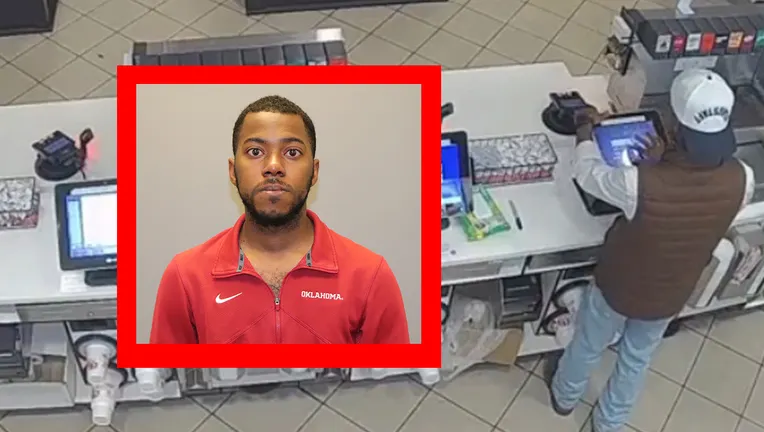
It reads like a weird-news headline. Underneath, it's a product brief for restaurant POS fraud detection at the small-operator scale.
The gap is smaller and better than enterprise loss prevention: a lightweight, POS-connected refund anomaly detection layer for the 3-to-20-unit restaurant franchisee. Not a dashboard they have to babysit. Not another "restaurant operating system." A weekly report that says: here are the five employees, transactions, registers, and refund patterns you should look at this week. The whole wedge fits in one sentence, and it's a good one.
Here's the opportunity:
The money: 300 franchise groups at $79 per location per month across seven stores each gets you near $2M ARR. Solo founder territory.
Inside:
• CSV-first MVP scope and pattern library
• $499-$1,500 Refund Leak Audit wedge
• Per-location pricing across three tiers
• GTM through bookkeepers and brand groups
The Quiet Bleed Inside the Register
Restaurant operators already obsess over food cost, labor cost, rent, delivery app fees, and chargebacks. They know margins are thin. What most of them lack is a clean way to see the small internal leaks happening inside the POS itself.
Refunds. Voids. Comps. Discounts. Manager overrides. Cash adjustments. Unlinked refunds. End-of-shift anomalies. Repeated card patterns. One employee who somehow issues refunds at four times the store average. Most of these actions are legitimate. A guest complains. A cashier rings the wrong item. A manager comps a meal because the kitchen ran 20 minutes late. The behavior lives inside the normal rhythm of restaurant operations, which is exactly why this category hides fraud so well.
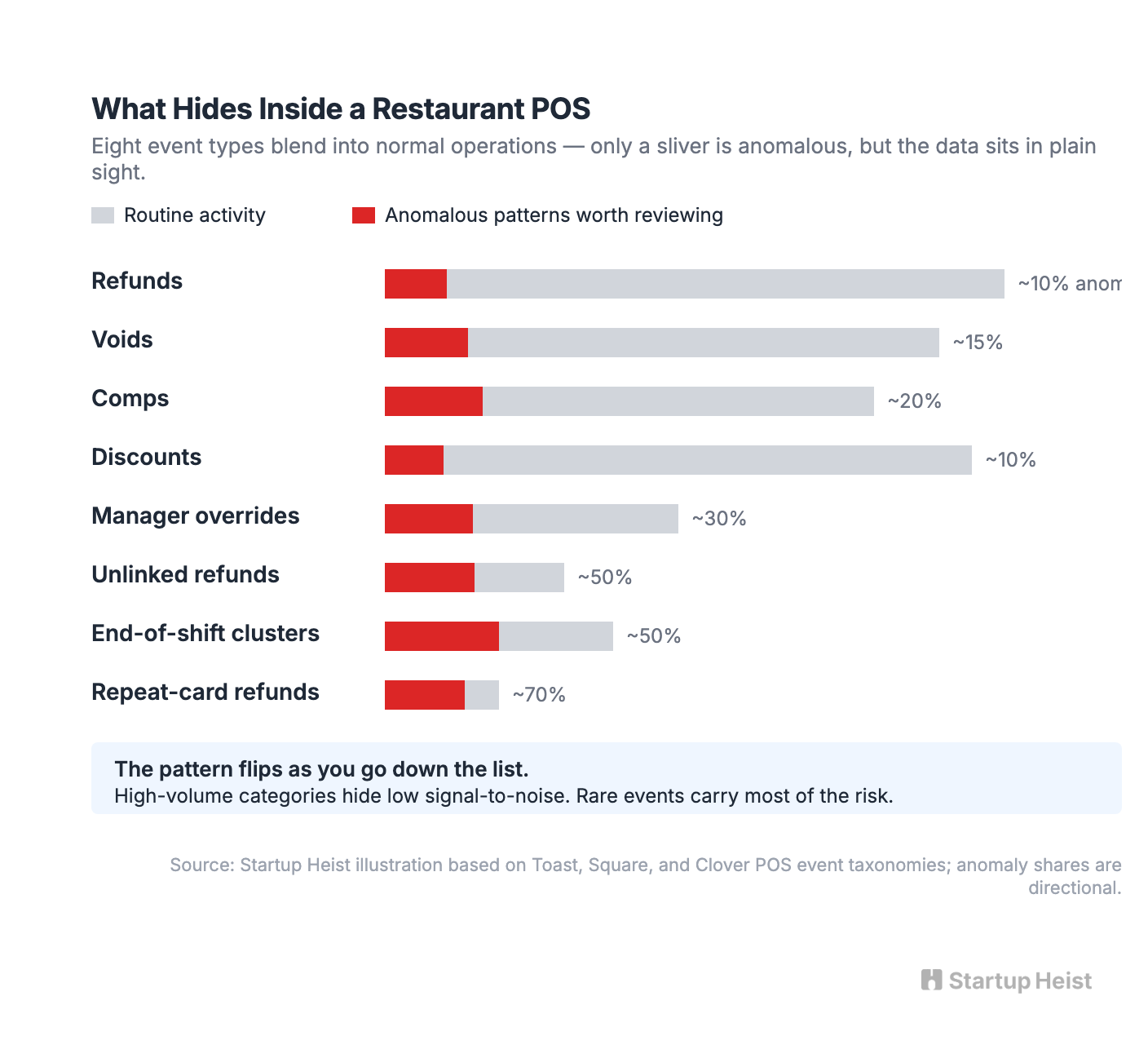
The POS records it. The owner technically has the data. Having the report isn't the same as knowing what to look for. Toast distinguishes between voids, refunds, and comps cleanly: a void removes an item, check, or same-day payment as if it never happened; a refund returns money after the payment is captured; a comp waives the charge for an item the guest received. Toast also exposes refund permissions and POS exception reporting for voided orders, including void summaries by server and by approver, plus all voided items. Clover offers similar role-based controls, including the ability to disable refunds for certain roles and gate refund access by employee permission.
Useful, but not enough. A seven-unit franchisee doesn't need another place to click. He needs an alarm bell with judgment.
Why the Existing Stack Doesn't Cover This
The enterprise restaurant loss prevention software category already exists. Agilence sells analytics and reporting for retail and restaurant chains. Solink fuses video with POS data for chains running dozens to hundreds of locations. NCR Voyix bundles Restaurant Guard into its Aloha POS for big operators. Mirus Reporter runs exception reporting for enterprise restaurant groups. The common pattern: heavy implementation, enterprise pricing, dedicated loss prevention staff on the buyer side, and a sales cycle measured in quarters.
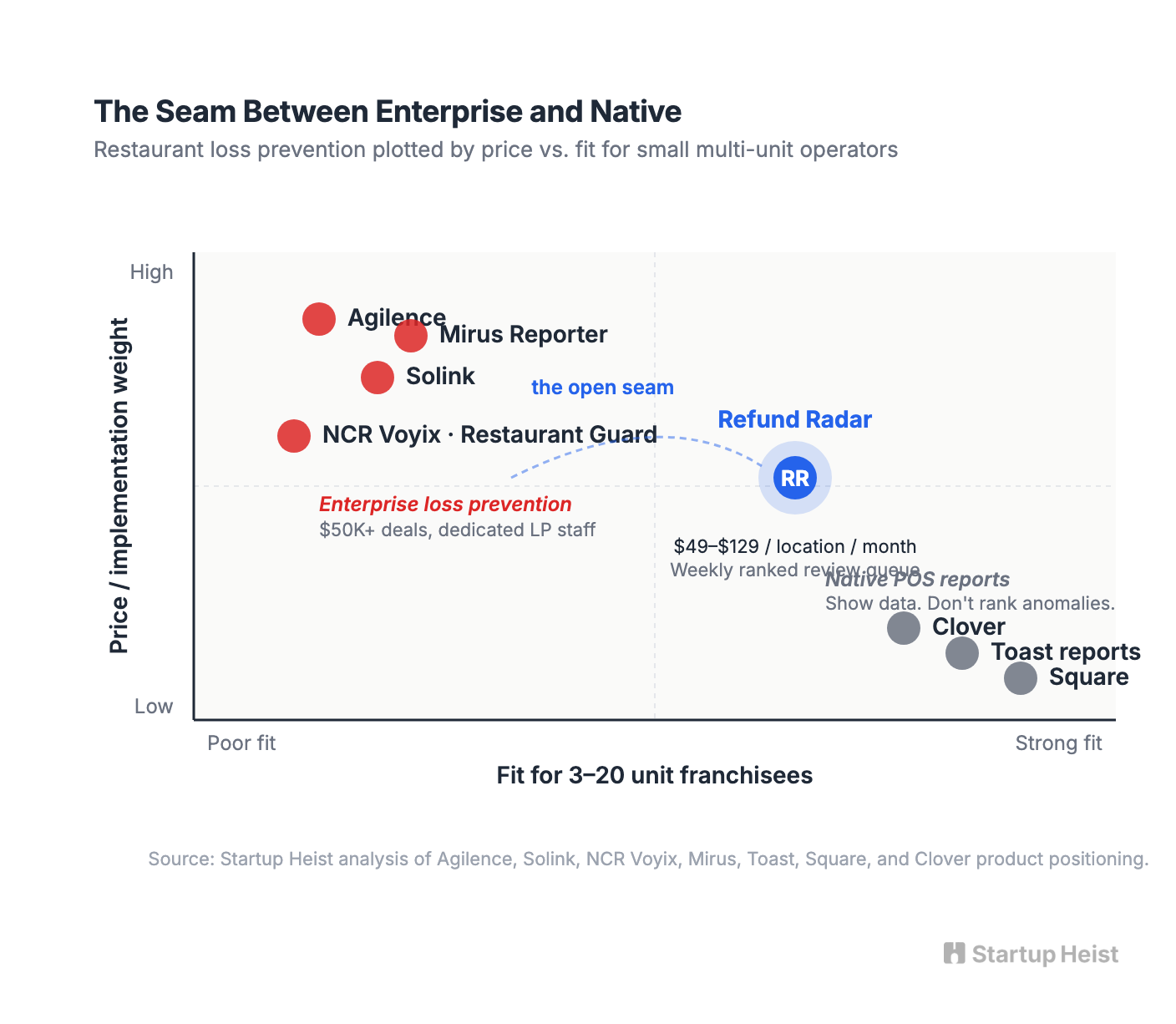
Meanwhile, Toast, Square, and Clover ship native void and refund reports for everyone else. They show the data. They don't rank what looks abnormal. A bookkeeper reviewing the monthly P&L will see a refund line item. She won't see that Employee #482 issued 71 percent of his refunds in the last 45 minutes of his shifts. The data exists in the database. The judgment doesn't exist anywhere.
A seam opens between them. Enterprise tools cost too much and require too much overhead. Native POS reports tell you what happened, never what's unusual. Sitting between them is a single sharp product: a weekly ranked review queue for the operator who is too big to watch every register and too small to staff a fraud team.
The Product: Refund Radar
Call it Refund Radar, CompWatch, RegisterLeak, or MarginTripwire. The positioning matters more than the name.
The product connects to a restaurant's POS or ingests scheduled POS exports. It monitors refunds, voids, comps, discounts, and adjacent transaction events. Then it builds a baseline for each location, employee, terminal, daypart, and transaction type. Every week, the owner receives a ranked report:
- Employees with unusually high refund, void, comp, or discount activity.
- Refunds clustered at suspicious times, especially shift-end and low-supervision windows.
- Repeated refunds to the same partial card fingerprint, without storing sensitive full card data.
- Locations with abnormal refund rates versus their own history and sibling locations.
- Unlinked refunds or manually adjusted refunds that deserve review.
- High-dollar comps by employee, manager, item type, or register.
- Refunds that happen after an employee was terminated, after a scheduled shift, or outside normal role permissions.
- Suspicious transaction chains: sale, void, refund, discount, reopened check, adjusted payment.
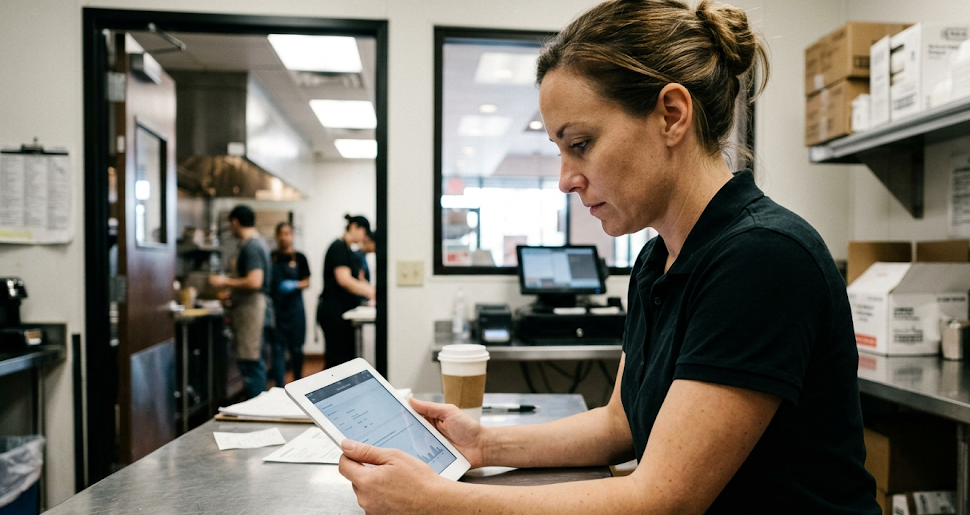
This is a review queue, not a fraud conviction engine. The framing matters legally and operationally. A small franchisee doesn't want to accuse innocent staff based on a black-box score. He absolutely wants to know where to look. The product's promise fits in one sentence: your POS already records the data, we rank the patterns worth checking.
The ideal buyer is the multi-unit franchisee with three to twenty locations of a quick-service, fast-casual, dessert, coffee, chicken, sandwich, pizza, or casual brand. Too large to manage every register personally. Too small to have enterprise loss prevention. He won't buy "AI." He'll buy "find the $800 monthly leak per store before it becomes an $80,000 problem."
There's precedent for the analytical shape. Elder Research has documented a restaurant refund-fraud project where models assigned fraud probabilities to refunds and ranked them daily for stakeholder review, using transactional and restaurant-level features like refund timing and recent refund frequency. The enterprise consulting version already works. The heist is turning it into low-touch micro-SaaS for restaurants run by small multi-unit operators.
Why Now
The plumbing is finally there. Square exposes a Refunds API that can return funds from Square Point of Sale and other Square payment products. Toast publishes detailed operational data, permission structures, refund workflows, and reports. Clover ships granular refund and void permissions and lets merchants restrict refund access by role. A third-party product can finally read what it needs without begging.
Franchise operators are under margin pressure and increasingly technology-friendly. FRANdata and the International Franchise Association reported in 2025 that franchisors were doubling down on technology investment, with franchise executives prioritizing operations, automation, labor efficiency, and revenue growth.
Fraud awareness is rising in parallel. Retailers are dealing with more sophisticated return and refund abuse, including AI-generated damage claims and fake documentation in e-commerce and physical retail. Restaurants sit inside the same broader movement toward exploiting refund workflows: delivery refund abuse, chargebacks, internal refund manipulation. Five years ago a small operator might have heard "AI fraud monitoring" and felt either priced out or paranoid. Today, "software that watches your transaction data and tells you what changed" feels normal. Expected, even. The window is open.
Market Sizing: Small Enough to Ignore, Big Enough to Matter
This isn't a venture-scale company on day one. Treating it that way would ruin it.
The right initial target is a boring, profitable micro-SaaS doing $20K to $100K MRR with low churn, simple onboarding, and strong owner-level ROI. The surrounding markets back the direction. The franchise management software market was estimated at $2.8 billion in 2024 and projected to reach $6.5 billion by 2033, with food and beverage as a major segment. Global POS software was estimated at $17.13 billion in 2025 and projected to reach $38.82 billion by 2033.
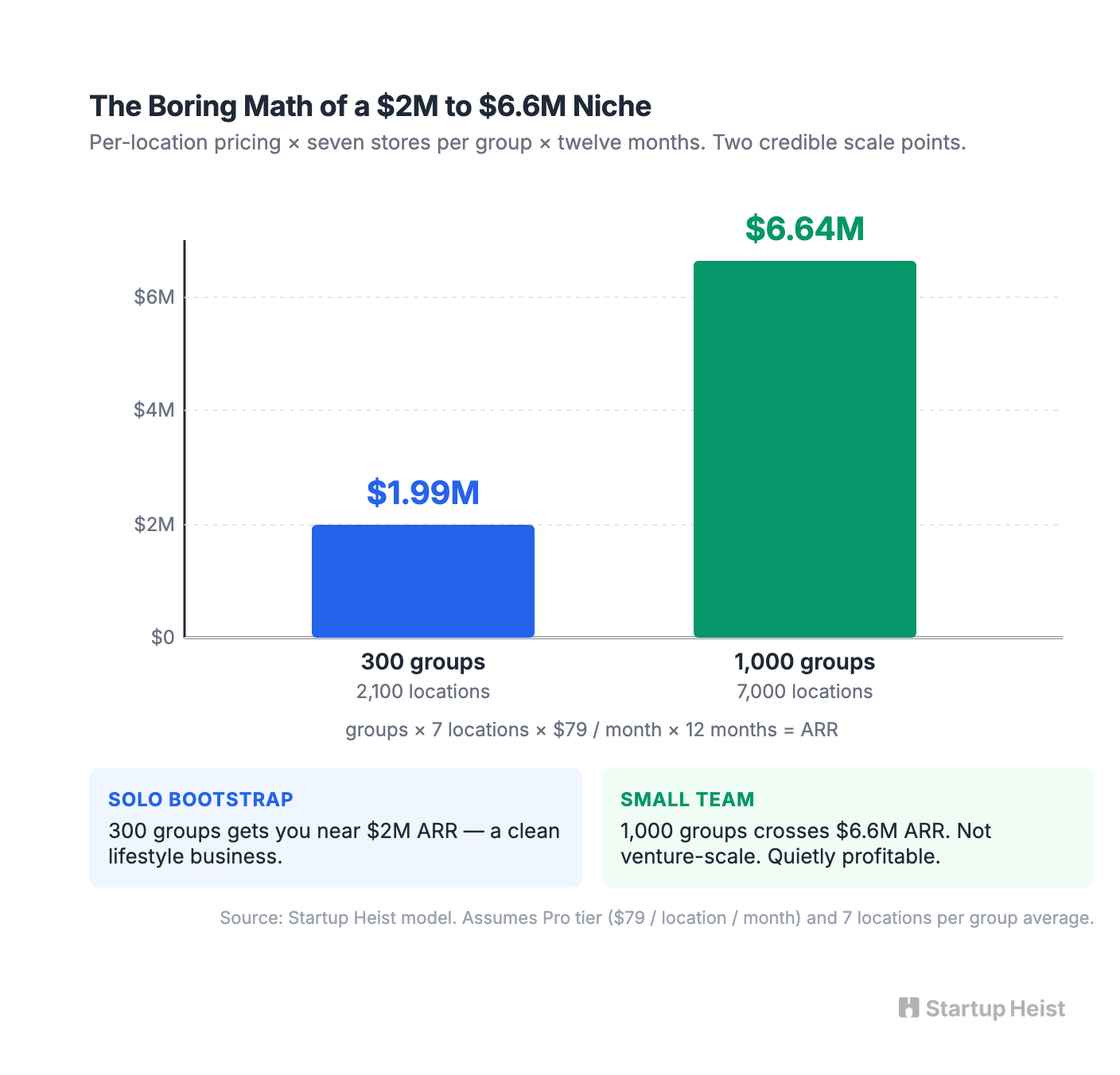
Practical math is more useful. Picture 1,000 restaurant groups with an average of 7 locations paying $79 per location per month. Seven thousand locations times $79 times 12 equals roughly $6.6 million ARR. Even at 300 groups, the math holds: 2,100 locations times $79 times 12 is just under $2 million ARR. A clean vertical SaaS business with expansion paths, not a unicorn pitch. The mistake would be trying to become the operating system for franchise risk too early. The win is to own one painful, measurable leak.
A founder who tries to be a platform on month one will lose. A founder who owns refunds, voids, and comps inside the seven-store franchisee market will print money quietly. The leak is the wedge. The platform comes later, or never, and either outcome is fine.
MVP Scope
The v1 should be almost embarrassingly narrow. Don't build a full restaurant BI platform. Don't integrate every POS. Don't build real-time fraud blocking. Don't touch payroll, inventory, food cost, camera systems, or HR workflows. Do the following:
Unlock the Vault.
Join founders who spot opportunities ahead of the crowd. Actionable insights. Zero fluff.
“Intelligent, bold, minus the pretense.”
“Like discovering the cheat codes of the startup world.”
“SH is off-Broadway for founders — weird, sharp, and ahead of the curve.”


