


The Game Shutdown Compliance Stack
The next compliance niche in gaming isn't loot boxes or child safety or app-store fees. It's the end of the game itself.
For the last decade, publishers quietly trained players to accept a strange bargain: buy the game, buy the DLC, buy the cosmetics, build the account, and accept that someday a server shutdown can make the thing disappear. That worked when shutdowns were rare, player bases were small, and "you licensed access, you didn't buy ownership" sounded like boring legal boilerplate.
In 2026 that bargain became political. On May 15, 2026, California's AB 1921 — the Protect Our Games Act — cleared the Assembly Appropriations Committee 11-2, the last committee gate before a full floor vote. The bill would force publishers of online-dependent paid games released on or after January 1, 2027 to give players at least 60 days' notice before shutting down services required for ordinary use. After support ends, the publisher must provide one of three remedies: a continued playable version, a patch enabling offline use, or a refund. The Entertainment Software Association, which represents Microsoft, Sony, Electronic Arts, Ubisoft, Capcom, and Epic, has opposed the bill, arguing the requirements would force studios to spend resources maintaining old systems instead of building new games.
That objection is the tell. The industry isn't saying the bill is irrelevant. It's saying the bill is expensive.
That cost is where the startup opportunity sits. Forget the grand game-preservation foundation. Forget arguing with gamers on Reddit. Forget promising every studio a magic offline mode. The immediate business is much more boring, and therefore much more buildable: a game shutdown compliance SaaS that automates shutdown notices, refund logic, entitlement snapshots, audit logs, public FAQs, and preservation-plan documentation for online-dependent games. Think of it as sunset operations software for games. The first product doesn't preserve the game. It preserves the studio from chaos.
Here's the opportunity.
The money: $15-30K MRR from per-title project fees plus $2.5-6K annual studio subscriptions. First customer: any indie with one online-dependent paid title.
Inside:
• Six-module MVP scope
• Three-tier pricing from $499 to $25K
• Cold email and free-audit lead magnet
• Four compounding moats around the workflow
Why Now
U.S. consumer spending on video games hit $60.7 billion in 2025, with $52.3 billion of that from content. Subscription spending grew 20% year-over-year, which matters because subscriptions, online accounts, DLC, battle passes, and live-service mechanics multiply the number of games with messy server dependencies. Globally, Newzoo's revised December 2025 estimates put the games market at $196.7 billion in 2025, projected to reach $227.2 billion by 2028.
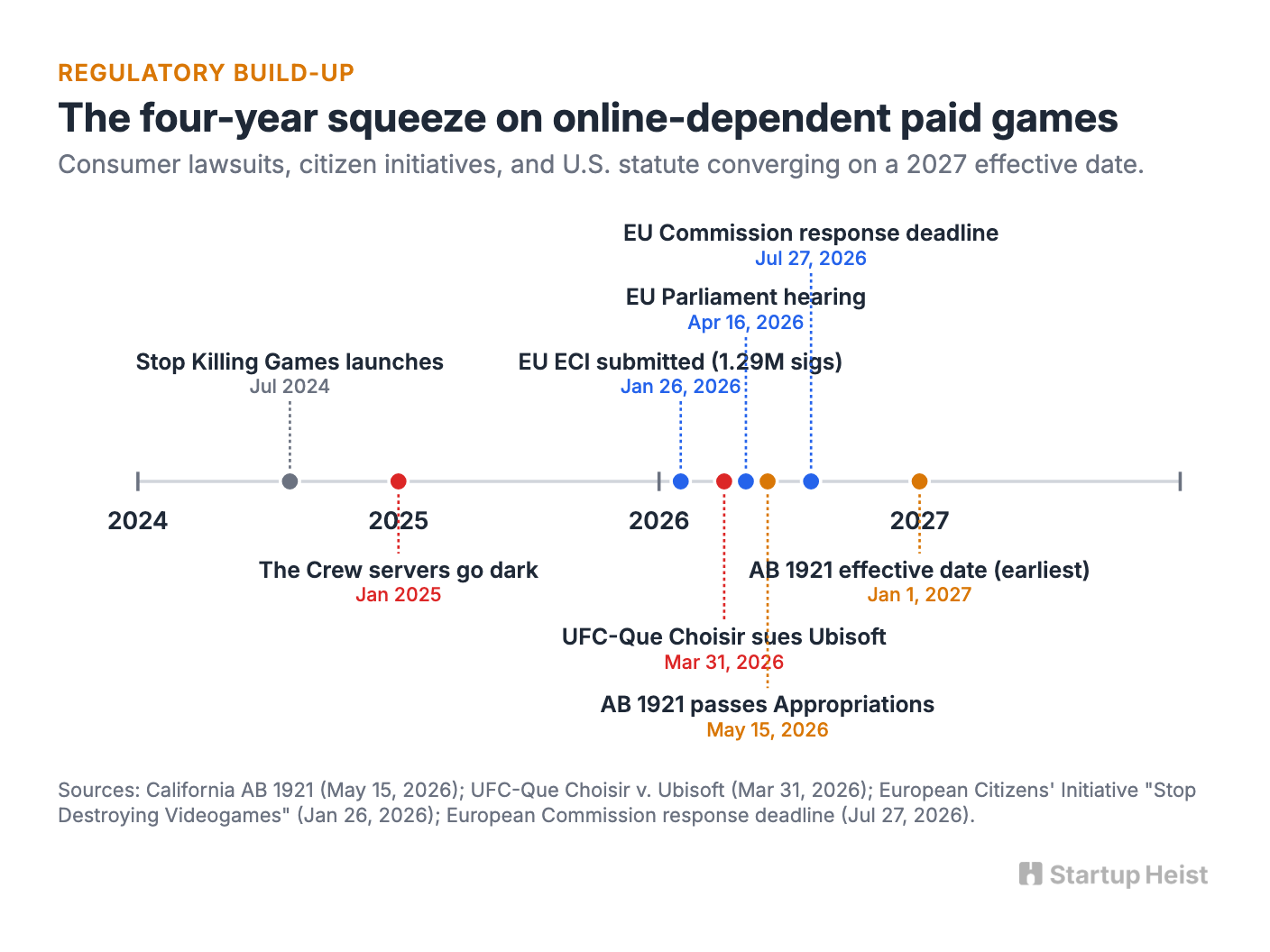
The real trigger is regulatory. On March 31, 2026, French consumer group UFC-Que Choisir filed suit against Ubisoft at the Créteil court over the shutdown of The Crew, a paid online racing game delisted in 2023 and made permanently unplayable when servers went dark in 2024. The complaint targets deceptive practices and abusive contract clauses around the "license to use" framing. The lawsuit is backed by Stop Killing Games, the consumer movement founded by Ross Scott in 2024. In Brussels, the Stop Destroying Videogames European Citizens' Initiative was submitted to the European Commission on January 26, 2026 with 1,294,188 verified signatures. The European Parliament held its public hearing on April 16. The Commission's official legal response deadline is July 27, 2026, with Commissioner McGrath signaling in a parliamentary exchange that a response could come as early as June 16. California's AB 1921 turns that European outrage into an American operational checklist.

The pressure on studios is two-sided. On the legal side, regulatory exposure. On the reputational side, GOG already markets long-term playability as a consumer attribute. A shutdown is no longer a support announcement. It's a refund event, a PR event, a regulator event, a platform event, and a community-management event at once. Most indie and mid-size studios aren't built for that.
The Live-Service Graveyard
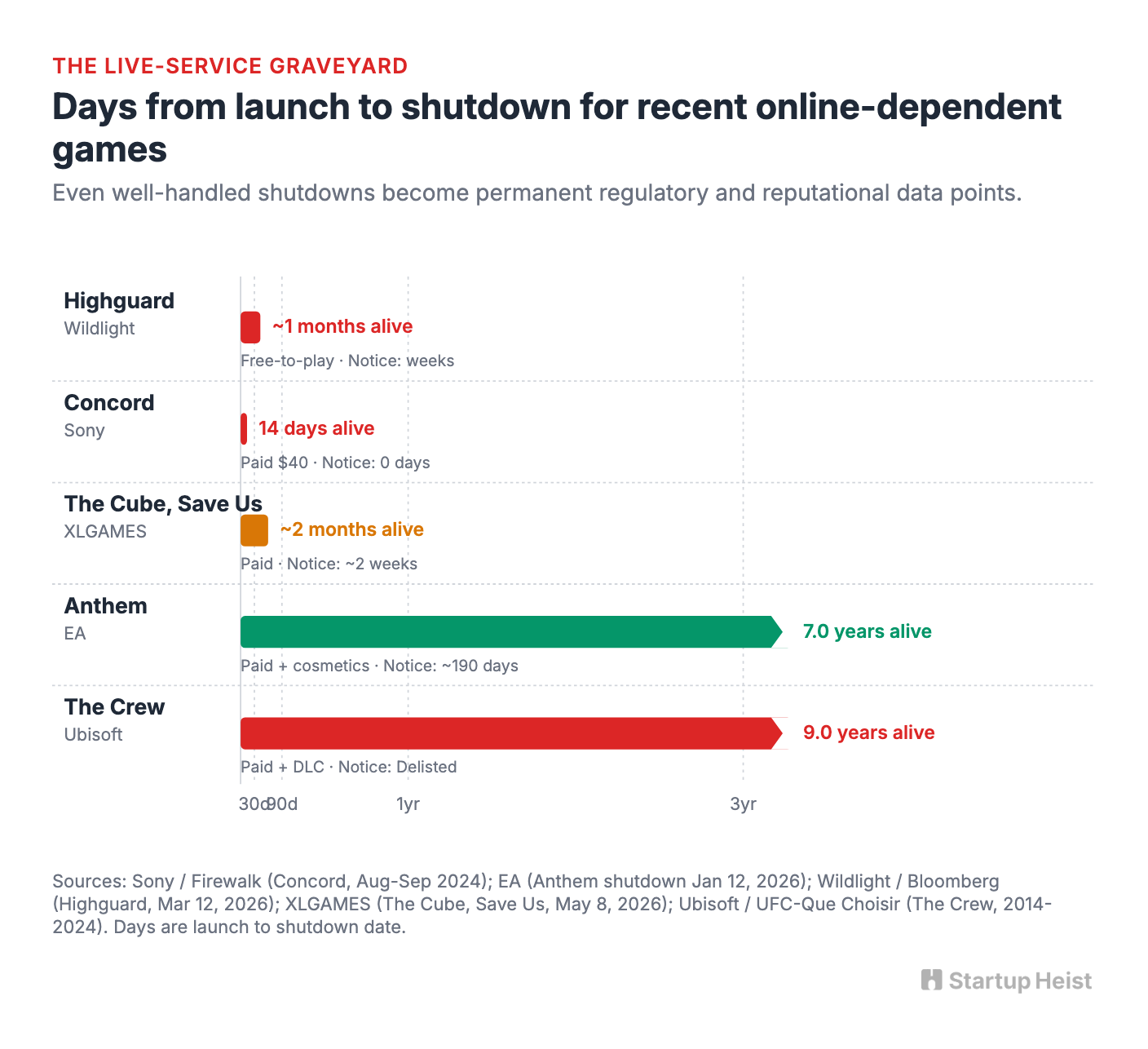
The pace of shutdowns made online game preservation unignorable in 2025 and 2026. Sony's Concord launched on August 23, 2024 and was taken offline 14 days later; developer Firewalk was shuttered. Sony refunded every buyer cleanly, which is the point — even a well-handled shutdown still becomes a permanent regulatory and reputational data point. EA shut down Anthem on January 12, 2026 after announcing the closure on July 3, 2025, giving players roughly six months of notice. EA also retired online services for Dirt Showdown, Dirt 3, Grid Autosport, and Grid 2 in November 2025. Wildlight Entertainment, founded by Apex Legends and Titanfall veterans, shipped the free-to-play shooter Highguard to nearly 100,000 peak concurrent users at launch in late January 2026; Bloomberg reported Tencent pulled funding shortly after, layoffs followed, and servers closed on March 12, less than six weeks from launch. XLGAMES announced The Cube, Save Us would shut down on May 8, 2026, weeks after a March launch, and issued automatic Steam refunds to all buyers.
Each shutdown produced the same messy substrate: rushed announcements, angry refund threads, support queues, confused press, and no auditable record of who decided what. The next wave will land in front of a regulator.
The Customer
The ideal customer isn't Electronic Arts or Ubisoft. Large publishers have legal departments, platform teams, policy staff, and enough internal bureaucracy to build their own version of this when the law forces them. They may buy later. They aren't the wedge.
The wedge is the studio or small publisher with one to five online-dependent titles and no dedicated legal-ops team. Independent studios with paid multiplayer games. Mid-size publishers managing a portfolio of aging titles. Live-service teams that never reached breakout scale. Premium games with online authentication, matchmaking, cloud saves, or DLC entitlements. Studios that inherited older codebases through acquisition. Small publishers preparing to sunset a game without triggering consumer backlash.
These companies sit in the worst middle. Large enough to have real exposure. Too small to have a mature compliance function. The current game studio compliance workflow looks like a producer maintaining a shutdown calendar in a spreadsheet, a lawyer reviewing announcement language, support teams improvising refund answers, engineering guessing which services are load-bearing, marketing posting an FAQ, and finance trying to reconstruct who bought what when. Nobody is fully sure whether the studio preserved enough evidence if a regulator, journalist, or consumer group asks what happened. Workflow gaps are where boring SaaS gets paid.
The Product
Call it SunsetOps.
Resist the temptation to build "game preservation middleware." Skip Unity plugins, Unreal plugins, private-server conversion, peer-to-peer networking, and offline binary generation on day one. Those are technically difficult, game-specific, and services-heavy. The ESA's objection to AB 1921 is partly credible because modern games depend on licensed content, anti-cheat, server-side logic, and infrastructure that can't be trivially frozen into an offline mode.
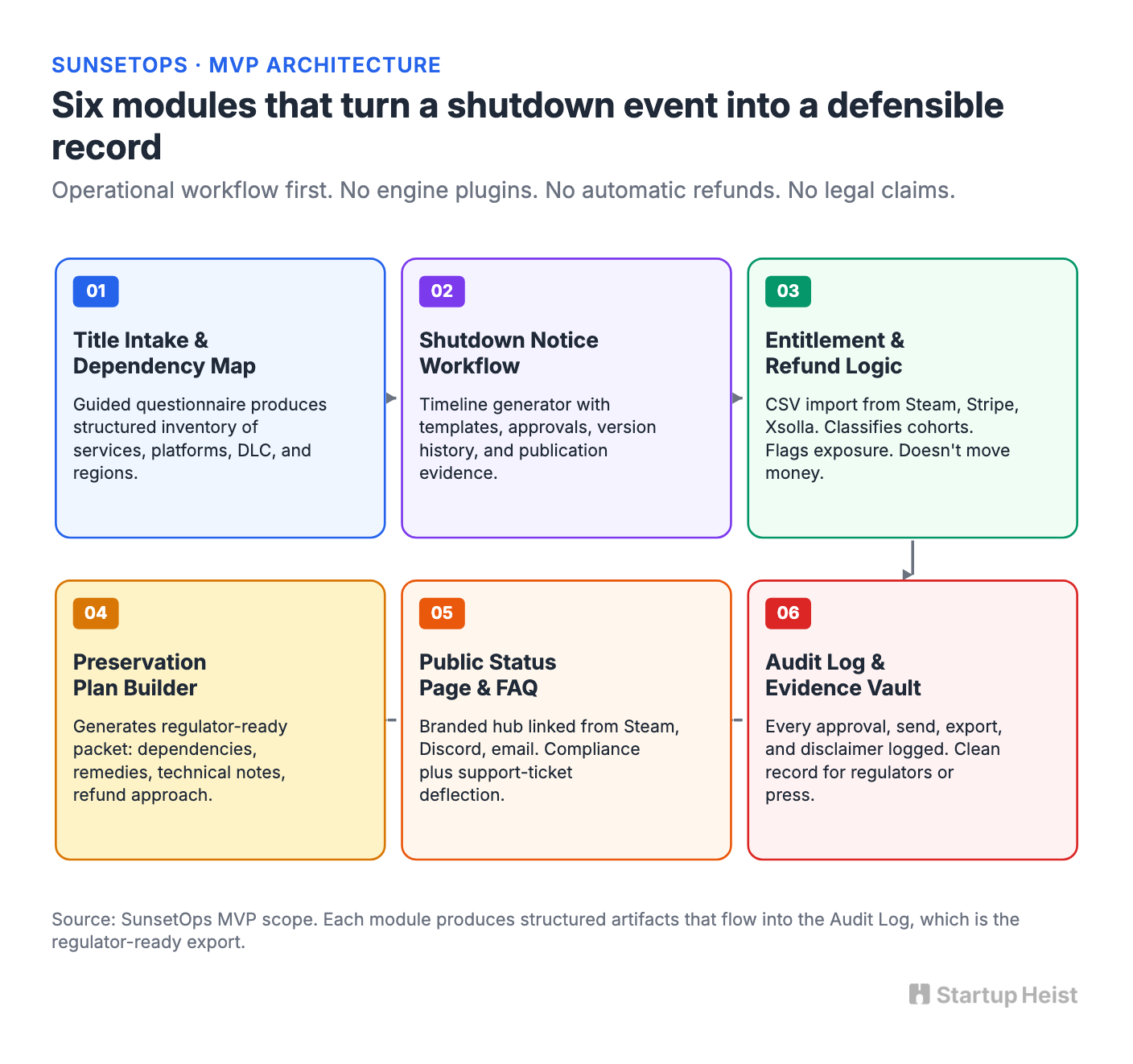
The first product owns the operational layer around shutdown. Six modules.
Unlock the Vault.
Join founders who spot opportunities ahead of the crowd. Actionable insights. Zero fluff.
“Intelligent, bold, minus the pretense.”
“Like discovering the cheat codes of the startup world.”
“SH is off-Broadway for founders — weird, sharp, and ahead of the curve.”


