


The Anti-App Accountability Layer for the #LockIn Era
There are two kinds of productivity products. The first helps you plan: calendars, task managers, project boards, second brains, AI planners. The second helps you actually do the thing. That second category is smaller, uglier, more behavioral, and often a better business.
The "lock in" wave is the strongest demand signal that category has had in years. The Great Lock-In is framed on TikTok as a three-month intensive running September through December, where Gen Z trades soft life for visible commitment to fitness, study, savings, and shipping. Fortune called it a rejection of millennial hustle aesthetics. Marie Claire and Betches flagged its toxic-productivity edge. Google search interest for the term has grown more than 1,300%, and #GreatLockIn has crossed roughly 12,800 posts. The signal is simple: millions of people are publicly entering a season where they stop messing around, and they want other people to see whether they follow through.

That's a clean opening for a lightweight SMS accountability layer aimed at the TikTok lock in trend, without asking anyone to adopt another bloated productivity app. The trap is overbuilding. The obvious version is an SMS bot that demands photo proof and auto-charges on failure. It sounds sharp. It's where the operational mess begins. MMS costs more than SMS. Verification creates disputes. Automatic penalties create Stripe risk. U.S. business texting now runs through A2P 10DLC: brand registration, campaign vetting, monthly campaign fees, and carrier passthrough that varies by carrier and message type. A founder who treats those as afterthoughts discovers them through unit-economics pain.
Here's the opportunity in one frame:
The money: 50 Builder Club groups at $49 each = $2,450 MRR. 20 Cohort plans at $149 average = $2,980 MRR. Both stacked clear $5K MRR within months at modest pilot scale.
Inside:
• Full MVP scope for SMS lock-in groups
• Five-tier pricing from $9 to $299
• GTM playbook for community operators
• Five compounding moats and expansion path
The narrower play is better. Start with SMS-based goal check-ins, streaks, and group enforcement. Skip the AI photo policing and automatic financial punishment. Add proof and stakes only after retention proves people want the loop. This is a micro-SaaS Quick Steal with a real expansion path, not a venture-scale social network on day one. The wedge is habit accountability rails for small groups.
The Customer Isn't Buying Productivity. They're Buying External Pressure.
Most people don't fail because they lack a task manager. They fail because there's no consequence.
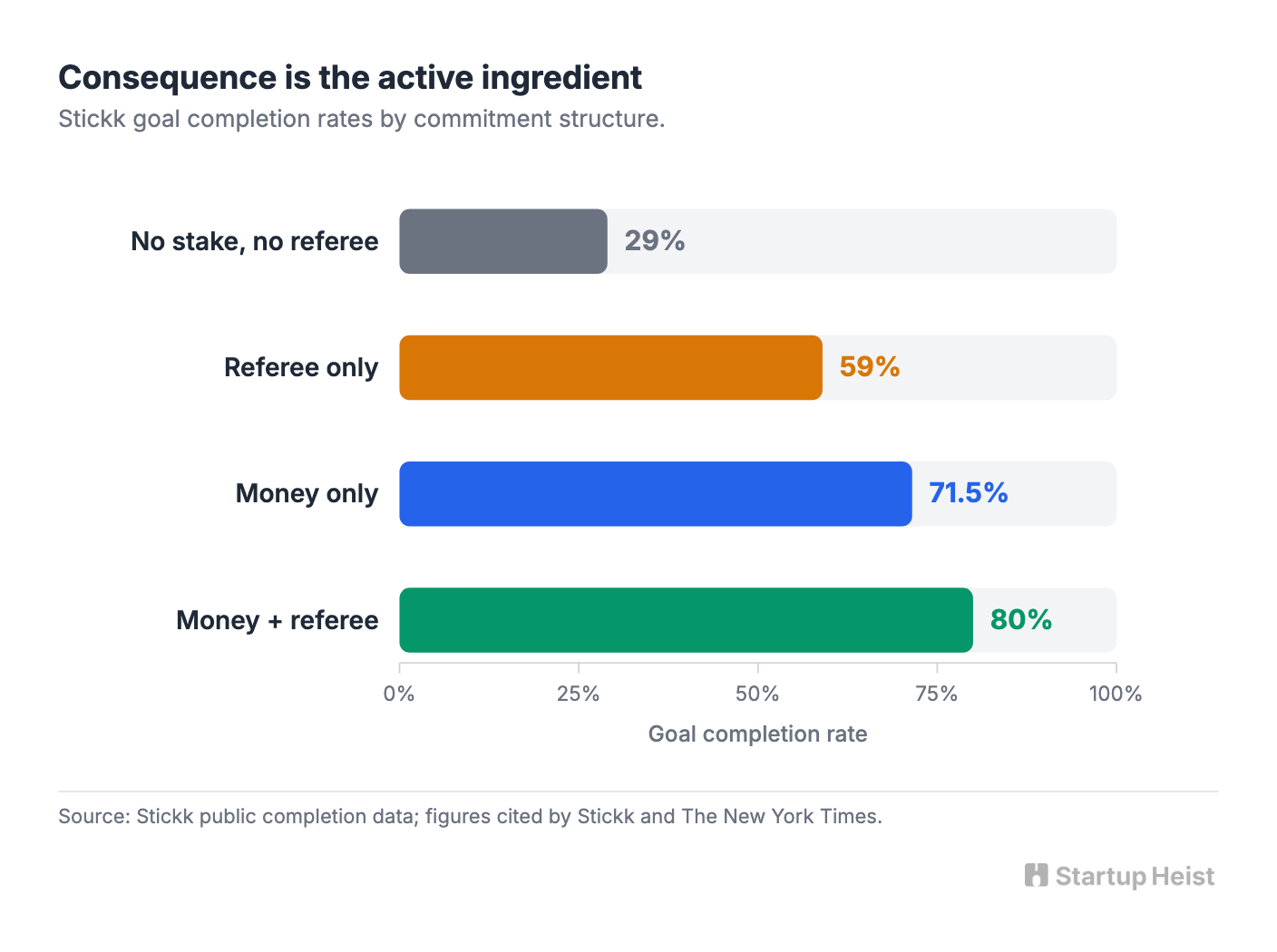
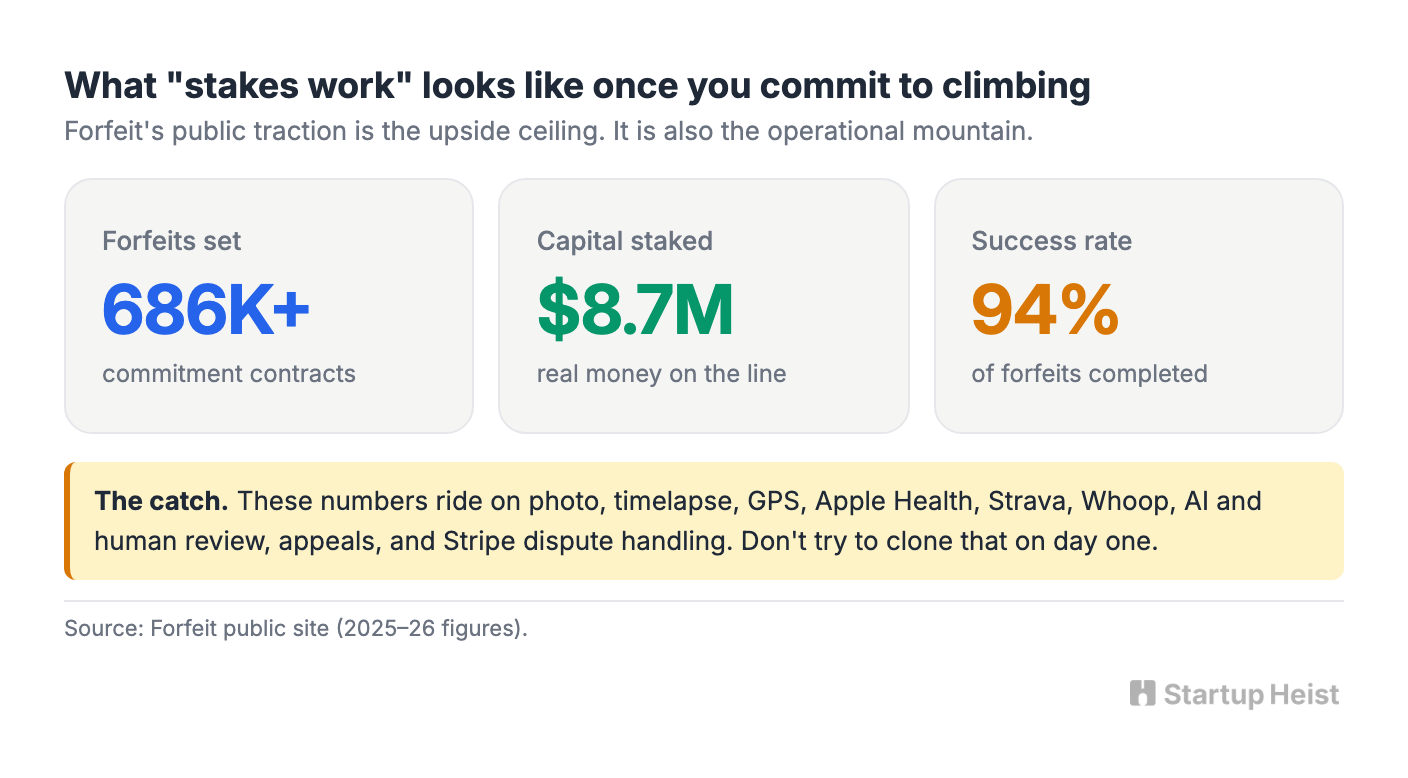
That's why accountability apps work even when the software looks primitive. Focusmate matches users with a stranger for a scheduled video coworking block, with three free sessions a week and unlimited sessions on Plus at $8 a month billed yearly or $12 monthly. Forfeit takes the opposite tack: users stake real money on a habit and lose it if they fail, with verification through photo, timelapse, Apple Health, Strava, Whoop, GPS, web tracking, friend checks, or AI and human review. Its public site now claims more than 686,000 forfeits set and $8.7 million staked, with a 94% success rate. Beeminder forces an escalating pledge ladder, where each derailment raises the next stake. Stickk, the Yale-founded commitment-contracts platform, has been arguing for years that users with money on the line plus a Referee are roughly two to three times more likely to succeed than those with no stake. Their own NYT-cited data shows completion lifting from around 30% with neither, to 70-80% with both. Different mechanisms, same lesson: when the consequence is real, the software doesn't need to be elegant.
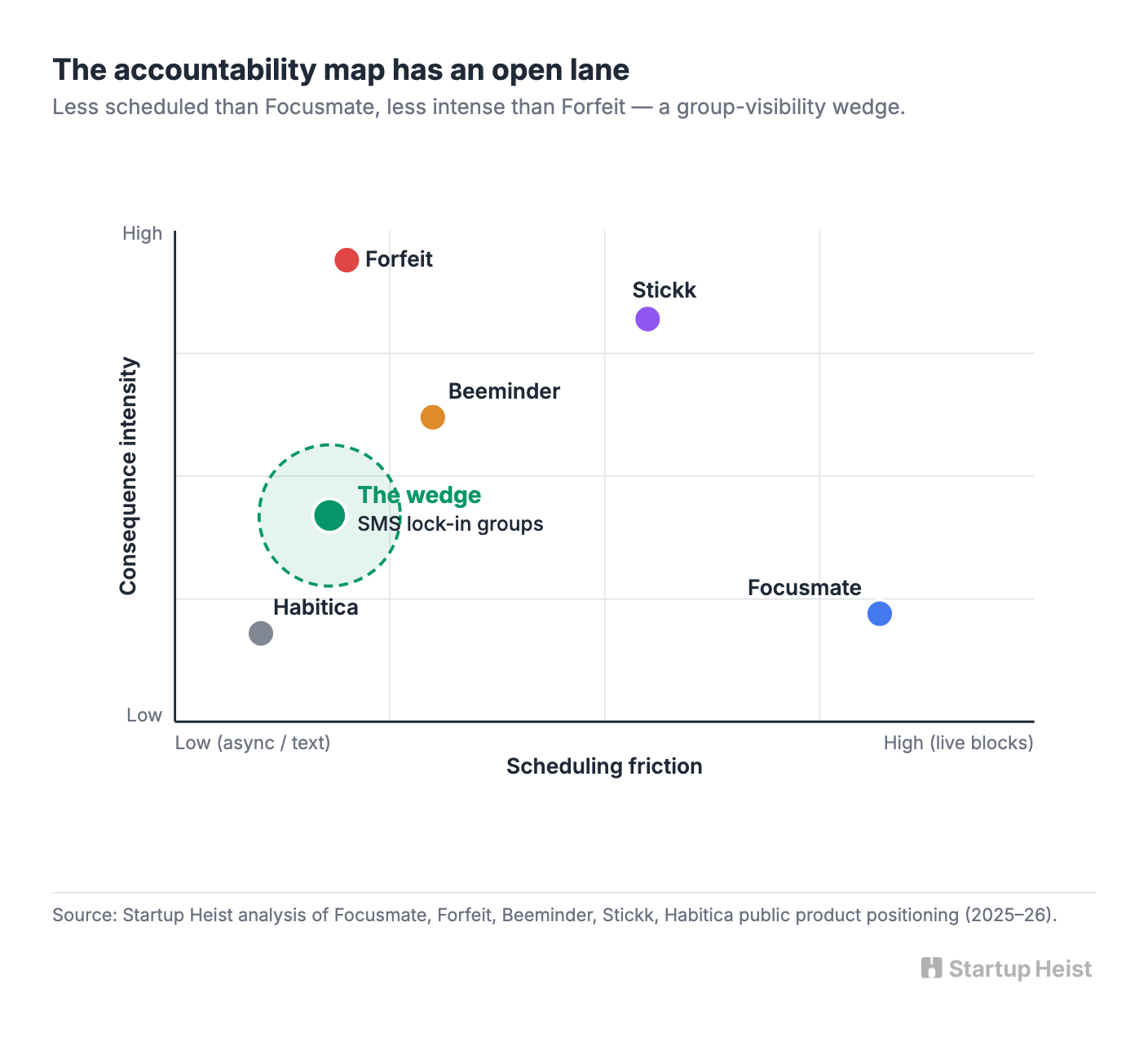
The open space sits between these poles. Less scheduled than Focusmate. Less intense than Forfeit. A solo founder building a Forfeit alternative, Focusmate alternative, or Beeminder alternative shouldn't try to out-engineer them. They should sit in the gap. More social than a private habit tracker. Lighter than a productivity OS. Built for the person who says, "Text me every morning. Make me say what I'm doing. Tell my group if I disappear." That's the product.
The Wedge: Lock-In Groups, Not Solo Habit Tracking
A solo habit tracker has a retention problem. A group accountability product has social gravity.
The user shouldn't think, "I'm installing an app." They should think, "I'm joining a lock-in challenge." Apps ask for attention. Groups create obligation. The product starts with one promise: create a private lock-in group, everyone texts their goal in the morning, everyone checks out at night, miss your check-in and the group sees it.
That's enough for an MVP. No dashboard. No AI coach. No habit library. No social feed. No avatar system. No productivity operating system. Just six moves: morning commitment, midday nudge, evening check-out, group summary, missed-check escalation, weekly scoreboard. The product isn't replacing Notion or Apple Reminders. It sits above them as a social enforcement layer. The existing productivity stack helps people organize intention. This monetizes the gap between intention and follow-through.
SMS Is the Right Interface, and a Dangerous Religion
SMS is attractive because it feels anti-app. No install. No new interface. No feed. No dopamine casino. The user gets a message and replies. That fits the lock-in psychology. If the whole aesthetic is "I'm reducing noise and getting serious," asking the user to download a feature-heavy app is tone-deaf.
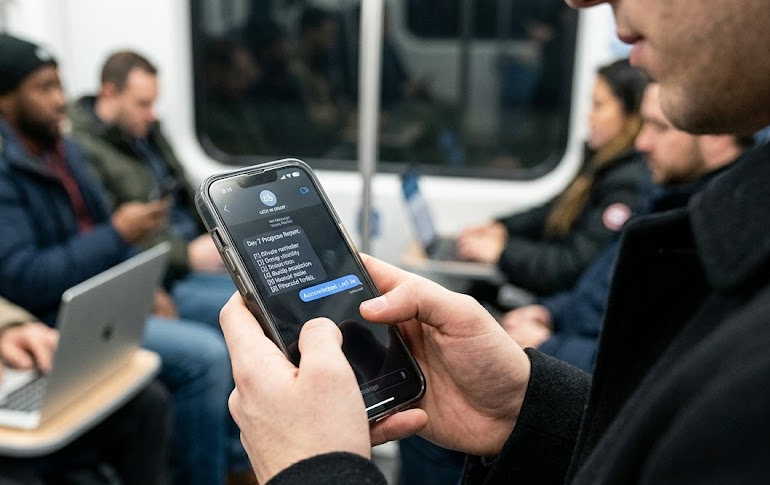
SMS is still a wedge, not a religion. The user experience is simple. The operator economics are not. Twilio lists U.S. long-code SMS at $0.0083 per segment in each direction, with carrier passthrough on top. AT&T adds roughly $0.0035 a segment. MMS on long codes runs $0.0220 outbound and $0.0165 inbound before carrier fees. A2P 10DLC registration adds a one-time $4.50 for Sole Proprietor or Low Volume Standard brands, $46 for a Standard brand with secondary vetting, $15 campaign vetting, and $1.50 to $10 per campaign per month. A basic loop quickly stacks to 10 to 20 message events per user per day across group members. At $5 a month, careless message design eats the business.
Design around message scarcity. This product isn't a chatty bot. It's a disciplined one. One morning prompt. One optional reminder. One evening check-out. One group digest. Aggressive batching. No media by default. No fake AI personality. Over time, the same behavior loop can move into WhatsApp, Telegram, Discord, Slack, email, or push by user segment. The first product wins by being almost boring.
The Real Product Is Social Consequence
Stop thinking in features. The atomic unit is a consequence. A good accountability app lets users pick the level:

Unlock the Vault.
Join founders who spot opportunities ahead of the crowd. Actionable insights. Zero fluff.
“Intelligent, bold, minus the pretense.”
“Like discovering the cheat codes of the startup world.”
“SH is off-Broadway for founders — weird, sharp, and ahead of the curve.”


