


Flip the Headhunter
For decades, recruiting ran on one rule: the company paid.
A business needed an engineer or a product leader. A recruiter found the person. If that person accepted, the recruiter collected a contingency fee of 20% to 30% of their first-year salary. On a $180,000 role, that is $36,000 to $54,000 for a single introduction.
The candidate never saw a bill. The candidate was the inventory.
That rule is breaking. Job seekers have started hiring their own agents to run the search from their side. These reverse recruiters build target lists, contact hiring managers, submit applications, manage the follow-up, prep the interviews, and sometimes negotiate the offer. The candidate becomes the client.
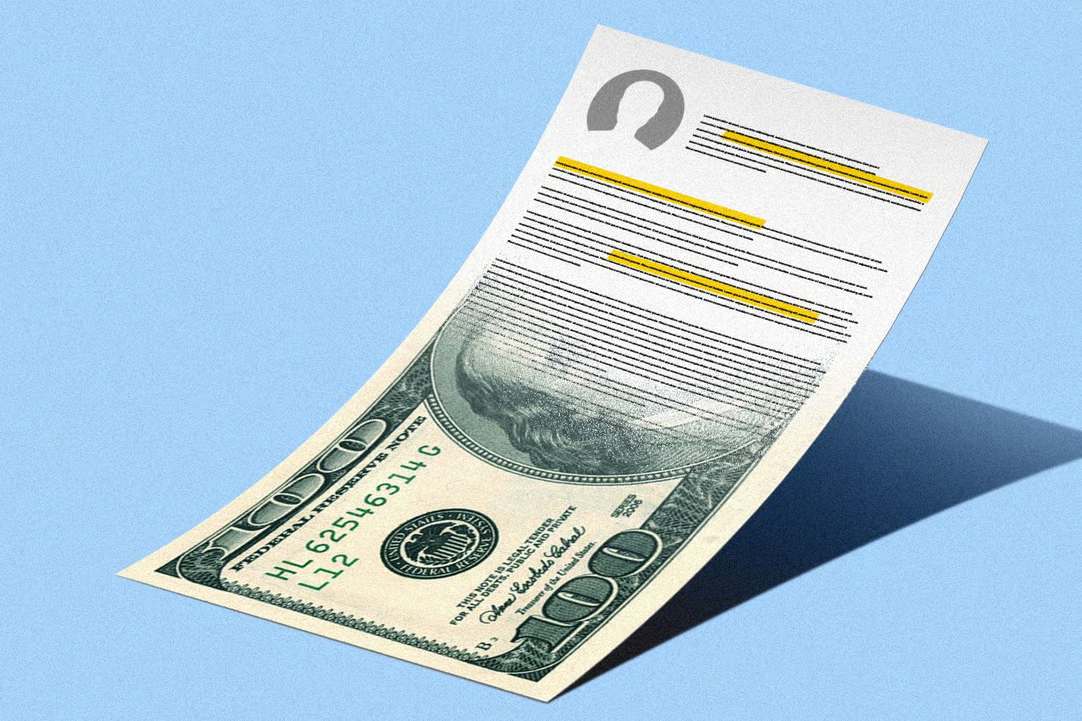
The category already has paying customers, venture money, and national press. It also has a flaw sitting in plain sight, and that flaw is your opening.
Here is the play:
The money: Twelve clients on ten-week campaigns at a $4,500 flat fee and a 50% placement rate is roughly $140,000 a year, solo. The incumbents already charge $1,500 a month plus 10%.
Inside:
• The 10-week campaign, priced and scoped
• Flat success-fee tiers that beat 10% + retainer
• Outreach templates that get forwarded
• The underwriting moat competitors cannot copy
The Signal Collapse
The headline numbers mislead.
June 2026 was not a jobs apocalypse. Unemployment sat at 4.2%, its lowest in almost a year. Employers reported roughly 7.6 million open positions, the most since 2024.
The pain is real and it is concentrated in long-term unemployment. About 1.9 million people have been out of work for 27 weeks or more, up 286,000 over the year, and they now make up 27.3% of everyone unemployed. The average unemployment spell runs 25.5 weeks. Payrolls added 57,000 jobs in June, down from 129,000 in May and well under the 114,000 economists expected.
So the jobs exist. Experienced white-collar professionals still cannot reach them. The channel between the two has stopped carrying information.
Economists have measured why. Studying a large online labor platform, they tracked what happened when an AI cover letter tool arrived. Individually, the tool worked. It sharpened the match between letters and job posts, and it lifted callback rates, with the biggest gains going to the weakest writers. Collectively, it destroyed the thing it improved. Once everyone could produce a well-aligned letter, the correlation between a letter's alignment and an actual callback fell by 51%.
The signal did not get worse. It stopped being a signal.
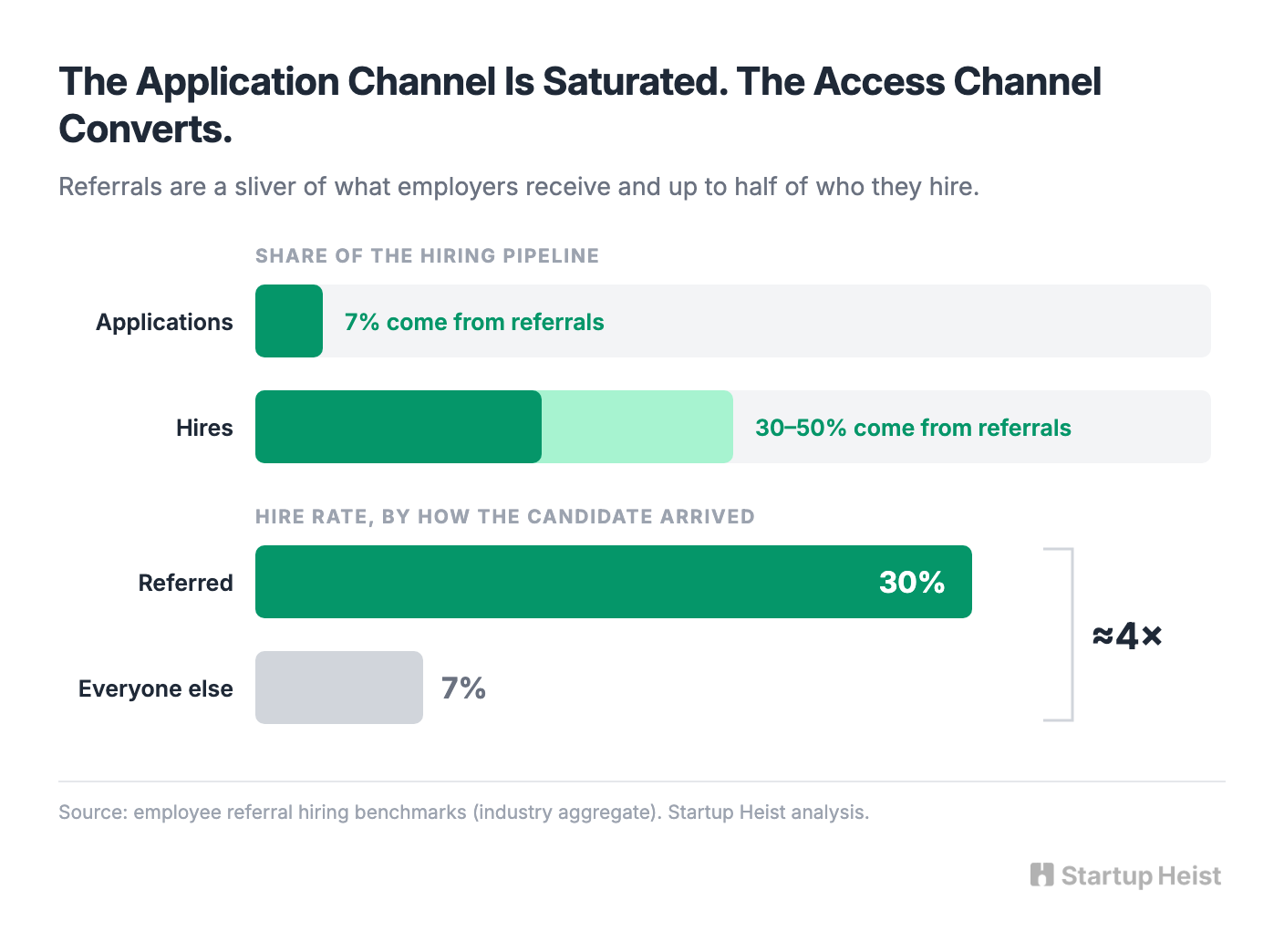
Employers noticed and moved their attention to things that are expensive to fake, starting with prior work history. The employee referral numbers tell the same story. Referrals account for roughly 7% of applications and somewhere between 30% and 50% of hires. A referred candidate gets hired at around 30% versus 7% through other channels, and gets there weeks faster.
The application channel is saturated and devalued. The access channel is scarce and converts at four times the rate.
So a reverse recruiter earns the fee by manufacturing access. Generating applications is worth nothing on its own. Your client already has a chatbot that does that for free.
The Category's Own Numbers Give It Away
Reverse recruiting is no longer an oddity. It has pricing pages.
Find My Profession bills itself as the original in the category and charges $2,000 to $4,500 for a first month, with renewals from $1,500 to $4,000, and attaches a six-month job offer guarantee to its upper tiers. Reverse Recruiting Agency runs $1,500 a month plus 10% of your first-year salary, refunds month one, and promises a minimum of nine interviews in three months. My Personal Recruiter sits between $900 and $2,500 a month. Executive packages reach $10,000 to $15,000 for people earning $200,000 to $400,000. On the venture side, Refer raised a $2.5 million pre-seed, works with roughly 2,000 companies, keeps the service free until you are hired, and then takes 20% of your first month's pay.
Willingness to pay is settled. People will hand thousands of dollars to a stranger to get out of the queue.
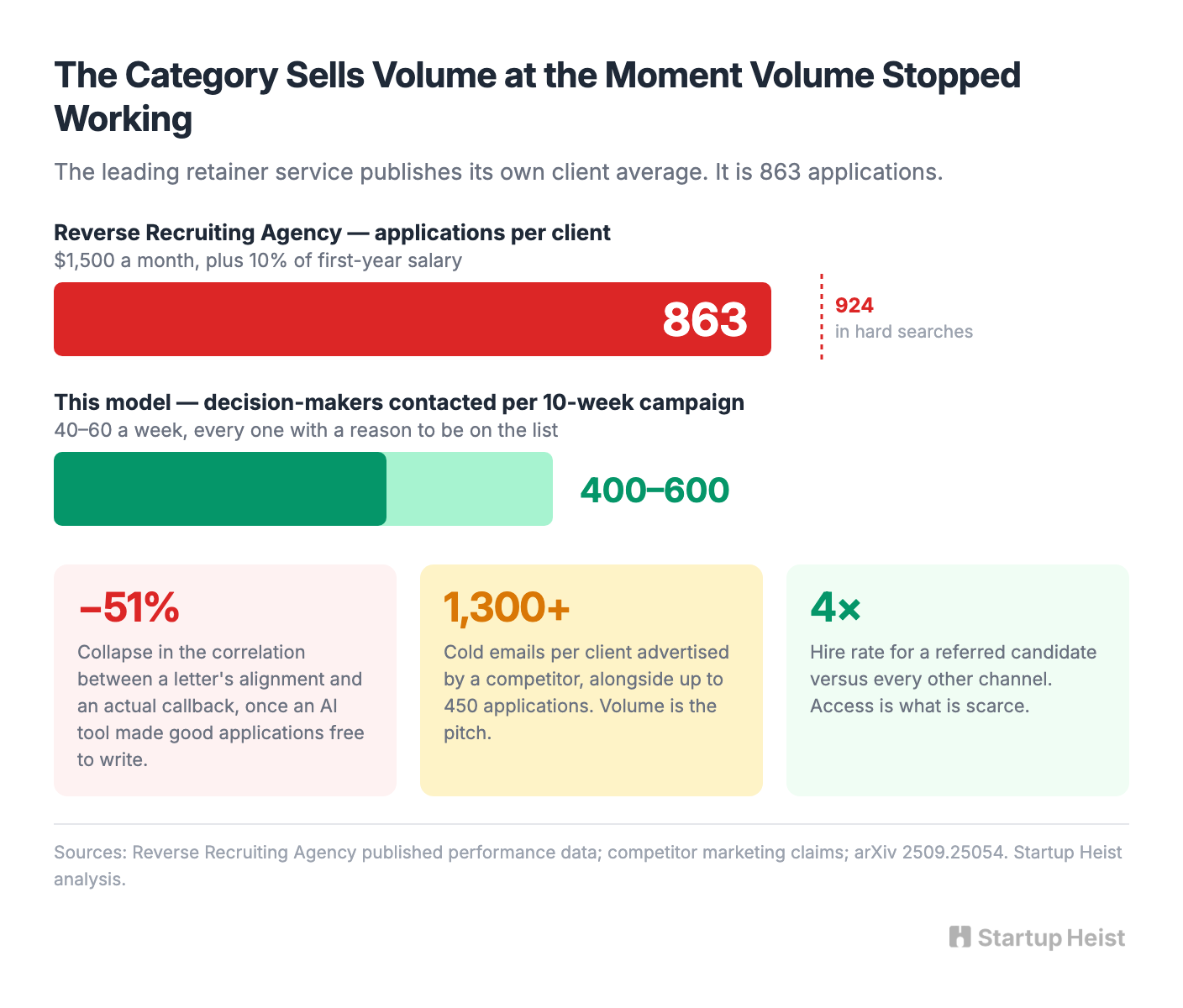
Now read the fine print on the leading retainer service. Its own published performance data says clients average 863 applications before landing an offer, and as many as 924 in hard searches.
Eight hundred and sixty-three.
The premium service, the one charging $1,500 a month plus 10% of your salary to rescue you from a broken application channel, is selling you a bigger pile of applications into the same broken channel. The disease sold as the cure, with a retainer attached, at the exact moment the research says each of those applications carries roughly half the signal it used to.
That firm is not even the extreme case. A competitor advertises up to 450 applications and more than 1,300 cold emails per client, and puts those numbers in the marketing on purpose, because volume is the only thing the category knows how to sell.
The weakness is the offer. Monthly retainers before results. Volume as the deliverable. Percentage-of-salary fees stacked on top of the retainer. Broad positioning across every industry at once.
The gap that leaves is wide enough to drive a business through.
One niche, one defined campaign, no retainer, and a single capped fee that comes due only when the client wins.
Pick One Hiring Market and Own It
"Reverse recruiting for tech workers" is still too broad to execute. Go narrower than feels comfortable:
Staff and principal product managers, eight-plus years of experience, targeting growth-stage B2B software companies at $180,000 and above.
Start with underwriting. A real product manager can tell you what they launched, what moved, and how they got engineering and sales to go along with it. All of it is checkable in one conversation, which matters enormously when you only get paid if they land.
Their value is contextual, which is exactly what the résumé channel destroys. A PM who reads as generic on paper is the ideal hire for the one company currently drowning in the pricing or enterprise-migration problem she already solved. That kind of fit is invisible to an applicant tracking system and obvious to a human who knows the market.
Product hiring runs on narrative. A short note explaining why this person's last two years map to your current roadmap problem beats a polished application, because the note is the thing an AI cannot manufacture on the recipient's behalf.
The money supports the fee. A $4,500 charge is 2.5% of a $180,000 base. Your client compares that to 10% plus a retainer everywhere else and stops shopping.
For the first six months, tighten it further. B2B SaaS only. Formerly at Series B through public companies. Depth in enterprise workflows, data products, fintech infrastructure, developer tools, or vertical SaaS. US remote or major hubs. No visa sponsorship during the pilot.
The ambition here is narrow on purpose: know one hiring market better than the people living in it.
What Your Client Is Actually Buying
Unlock the Vault.
Join founders who spot opportunities ahead of the crowd. Actionable insights. Zero fluff.
“Intelligent, bold, minus the pretense.”
“Like discovering the cheat codes of the startup world.”
“SH is off-Broadway for founders — weird, sharp, and ahead of the curve.”


