


Steal the Sponsorship Layer Before Tiny Apps Become a Creator Category
A new creator category is forming around prolific app-makers. They have the attention. Nobody has built the layer that sells it to brands yet.
For most of the creator economy's life, the unit of production has been content. You publish a video. Record a podcast. Send a newsletter. Post a thread.
AI-assisted coding, or vibe coding, introduced a different unit: the tiny interactive application.
It might be a personality test, a cultural parody, a strange calculator, a one-purpose social toy, or a website that turns a meme into something people can actually play with. It takes three days to build, holds attention for a week, and never develops recurring users. Judged as software, it's a failure. Judged as media, it worked exactly as intended.
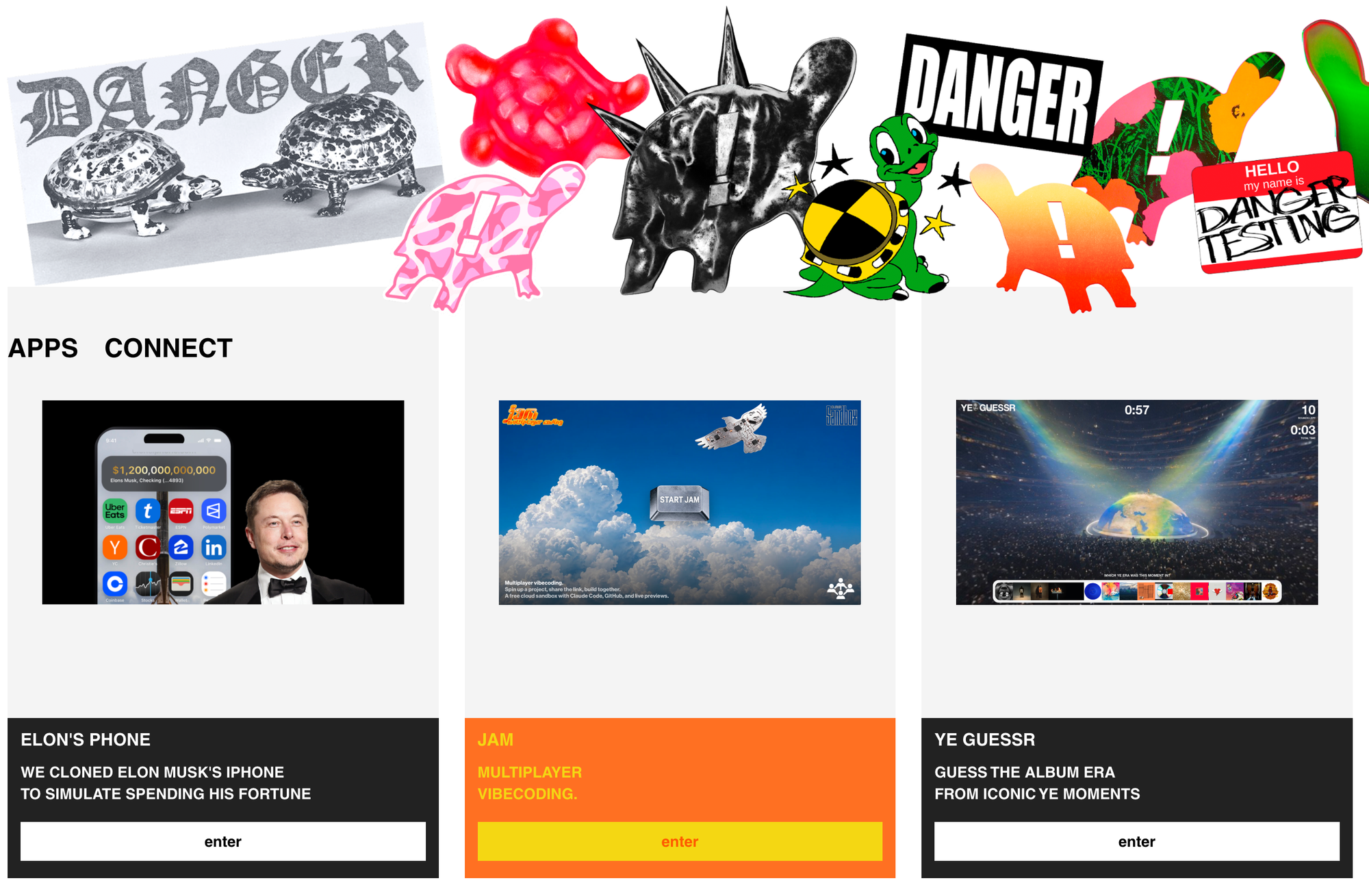
Danger Testing is the clearest example running. The studio ships apps on a weekly cadence and has put out more than 50 in a year, with more than 40 still live, under a banner across the top of its site that reads "DROPPING APPS LIKE SONGS → TUNE IN NEXT WEEK." The catalog is exactly as strange as that promises: vandalizefriend.com, which lets you digitally deface Friend's New York subway ads; mybrainrot, which turns your camera roll into a personalized slop feed; Ye Guessr; Fish for Compliments; Walkie Promptie; a Labubu app. The founders, who go by Marc and Los, describe the operation as something closer to Warhol's Factory than a software company.
Retention was never the goal. A strange, participatory moment worth sharing was.
They have a word for the people who work this way: appstars. Creators who treat applications the way musicians treat songs. The framing came out of sports. As Los put it, the same way an athlete gets signed, maybe someone who makes apps full-time gets signed too.
The behavior is early. The monetization gap is already obvious.
A prolific app creator can generate millions of impressions across launches, posts, and screenshots. But each individual app is too temporary, too weird, and too small to sell like conventional ad inventory. The creator has attention and no ad-sales department.
That's the heist.
The money: Four $15,000 seasons a month is $60,000 in billings and about $18,000 in monthly gross profit. Creator ad spend hit a projected $37 billion in 2025.
Inside:
• Season pricing: $7,500 founding to $30,000
• The 55-70% creator revenue split, worked out
• Seven-part MVP scope, plus what not to build
• 90-day roster, sales, and outreach playbook
Don't build another vibe-coding tool. Don't build an ad network. Build the sponsorship operations layer for experimental app portfolios. Represent a small number of prolific creators, package their launches into curated seasons, sell those seasons to brands, and handle integrations, reporting, contracts, and payments.
Software comes later.
The shift: from software products to media programming
Traditional app economics are built on permanence. Spend months building, acquire users, retain them, monetize through subscriptions or transactions. The product compounds as the user base grows.
Tiny-app creators invert that. Their portfolio is the product.
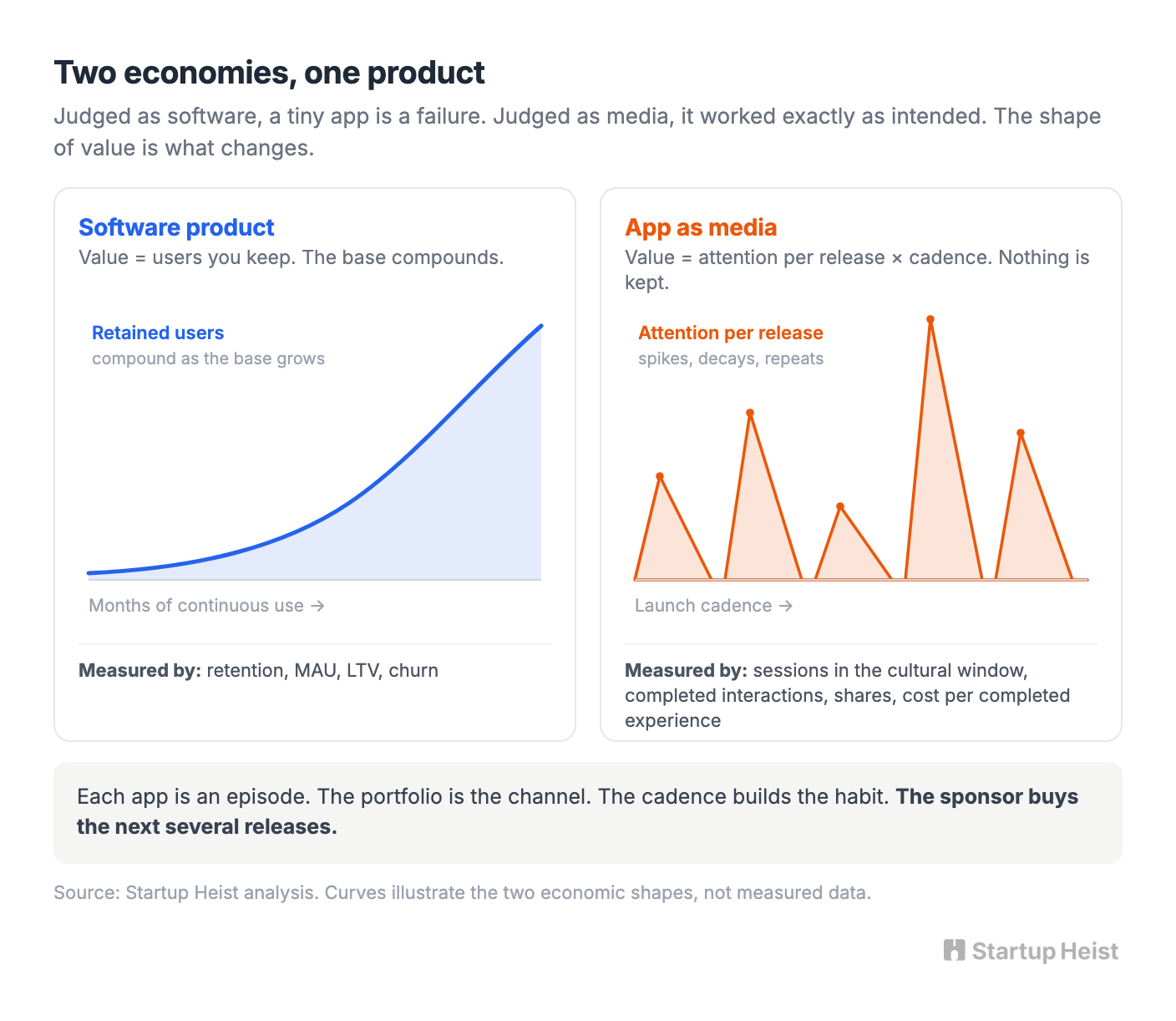
One app dies when a cultural moment passes. Another gets used once. A third goes big because screenshots of it circulate on TikTok. Individually, the economics look terrible. Read as a recurring media operation, they look like a YouTube channel:
- Each app is an episode.
- The portfolio is the channel.
- The launch cadence builds the audience habit.
- The sponsor buys the creator's next several releases.
That changes what you measure. One-week retention is the wrong instrument. For an app-as-media product, the numbers that matter are unique sessions during the cultural window, completed interactions, results generated, shares initiated, referral traffic, sponsor-feature engagement, and cost per completed experience. The app doesn't need to keep the user. It needs to deliver a memorable interaction.
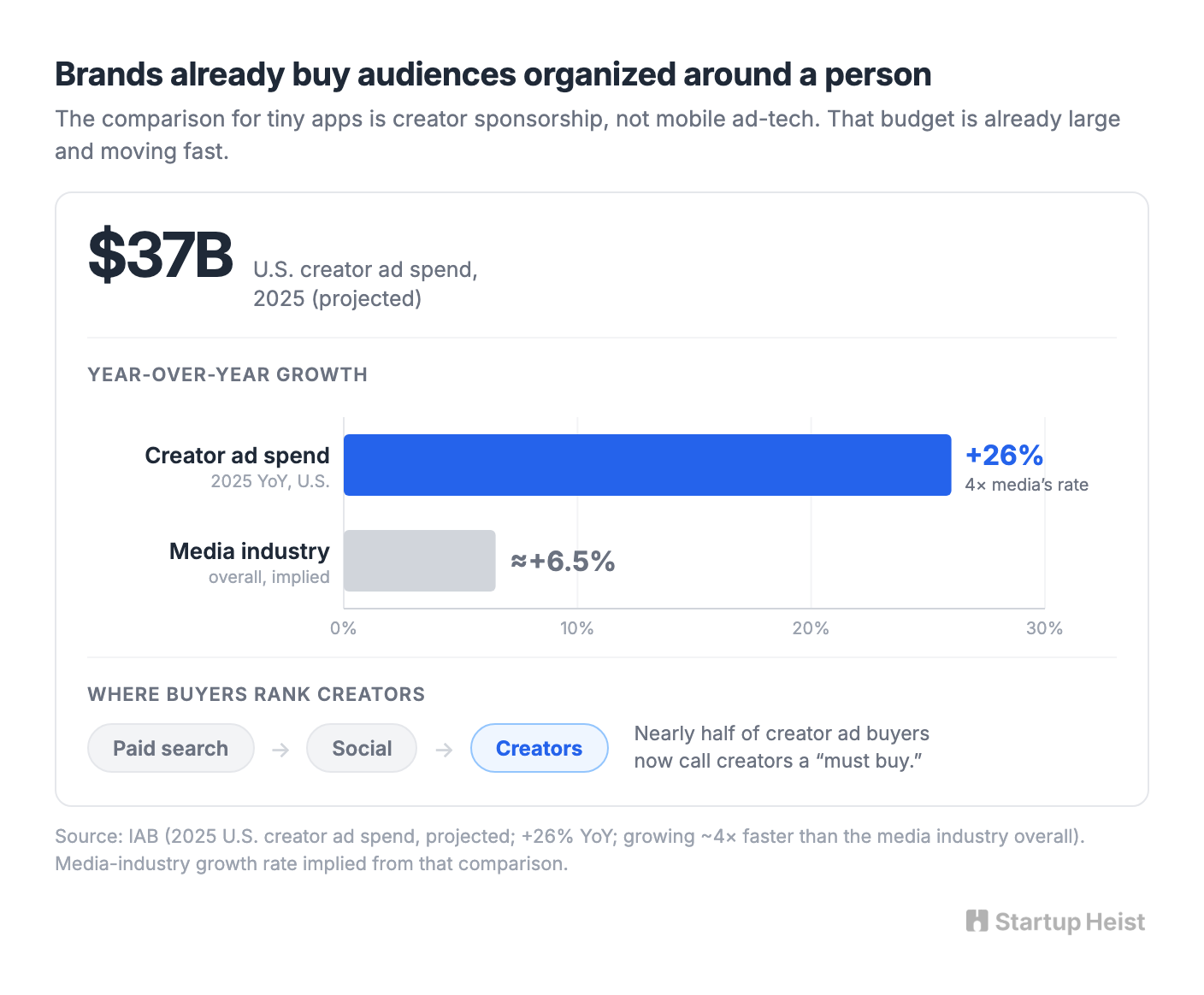
The right comparison is creator sponsorships and influencer marketing, not mobile ad-tech. U.S. creator ad spend hit a projected $37 billion in 2025, up 26% year over year and growing roughly four times faster than the media industry overall, according to the IAB. Nearly half of creator ad buyers now call creators a "must buy," ranking them just behind paid search and social. Brands already know how to buy audiences organized around a person instead of a media company.
Nobody has translated that buying behavior into interactive software yet.
Why the obvious product is the wrong product
The obvious response is an ad network for tiny apps. That's premature, and the reason is structural.
An ad network needs standardized inventory, predictable demand, and enough volume to automate matching. Tiny apps have none of the three. A quiz result page is not a game mechanic, and a parody pulling 300,000 visitors in two days behaves nothing like a utility doing 10,000 a month. Calling all of it "impressions" hides more than it reveals.
Supply is thin, too. One studio shipping dozens of apps proves the format works. It doesn't prove thousands of independent appstars are standing by to install an SDK and wait for advertisers. Build the marketplace now and you get an empty database: creators join and get no campaigns, advertisers browse incoherent inventory, pricing has no benchmarks. You'd spend your time manufacturing liquidity instead of learning how these sponsorships should actually work.
Start with a software-enabled sales operation instead. Pick five to ten prolific creators, learn what they're shipping, package it into coherent inventory, and sell it by hand.
The mature creator platforms already walked this path, and recently enough that you can still see the footprints. On June 15, 2026, Substack launched a native sponsorship program built around creator-controlled brand partnerships. The inaugural roster was not experimental money: Uber, T-Mobile, Balenciaga, Whatnot, Granola, Polymarket, and Yahoo Scout, collectively putting millions into creators on the platform. Substack hired Dan Robbins, formerly of Roku and PayPal, to run it. Matchmaking is still done by hand, and its Creator Kits give publishers with at least 100 paid subscribers a standard way to package audience, formats, and past partnerships for brands.
Beehiiv built the operational version for newsletters: sponsorship storefronts, an inventory calendar, proposal management, advertiser payments held in escrow until placements run, and placement insertion inside the editor.
Both companies sell the same thing, and neither started with an auction. Tiny-app creators need the equivalent, except the inventory has to be invented before anyone can automate it.
The product: sell seasons, not placements
The packaging innovation is the app season.
Instead of asking an advertiser to sponsor one unknown application, sell participation in a creator's next five releases over six to ten weeks. A season includes five app launches, category exclusivity, one deeply integrated sponsored mechanic, sponsor presence across the other four, social-launch inclusion, a branded portfolio page, campaign analytics, a post-season performance report, and rights to reuse selected campaign footage.
The buyer stops betting everything on one tiny app and starts buying a portfolio of creative experiments.
That matters because individual app performance is wildly volatile. One project does 5,000 sessions. The next unexpectedly does 500,000. Bundling absorbs the variance for the buyer and gives the creator room to be weird.
It also fixes the sales story. "Sponsor five interactive cultural releases reaching AI-curious, design-conscious early adopters" is a media package. "Put your logo in this weird calculator we're launching Thursday" is a favor.
Organize the season around a creator, a theme, or an audience. A creator season is five releases from one recognized app creator, for buyers who believe in that creator's taste and distribution. A category season pulls apps from multiple creators around one theme like dating, music, or internet culture, for brands that want audience fit without single-creator risk. A cultural season is a flexible calendar built to react to moments in entertainment, tech, or fashion, for brands that value speed over predictability.
Your first job is making the inventory understandable. Volume comes later.
What brands are actually purchasing
Selling this as cheap impressions would be a mistake. Tiny apps cannot beat Meta or Google on targeting, scale, or optimization, and shouldn't try.
The product is participation in novelty. Brands buy the chance to be part of something people voluntarily explore and share.
Your early buyers are companies that already benefit from being seen experimenting: AI products, developer tools, design software, productivity apps, consumer tech, creative hardware, music and entertainment products, youth-oriented commerce brands, and new products hunting for an identity rather than immediate scale.
Danger Testing's Walkie Promptie shows you where the format currently sits. The app turns voice prompts into police-dispatch narration, and at the bottom of the page there's a "Try Superwhisper" link with the logo attached. That's it. A voice product, a voice app, and a footer placement doing the work by hand. It's the crudest version of the unit this playbook proposes, running live, with no infrastructure underneath it.
The instinct is already there. The plumbing isn't.
The better version of that placement makes the sponsor part of the premise: the sponsor should improve the experience, not interrupt it.
A password manager sponsors a game about terrible passwords. A design tool sponsors an app that remixes a cultural image. A travel app sponsors a strange city-ranking simulator. A voice product powers the interaction itself instead of sitting under it. The strongest sponsorship unit may not look like an ad at all. It looks like a feature that couldn't have existed without the sponsor.
It still has to be disclosed. The FTC requires material connections between endorsers and advertisers to be communicated clearly and conspicuously, and a clever integration is exactly the kind of thing that buries a commercial relationship if you let it. Disclosure doesn't require creative separation. A sponsored mechanic can be native, useful, and transparent at once.
The initial offer
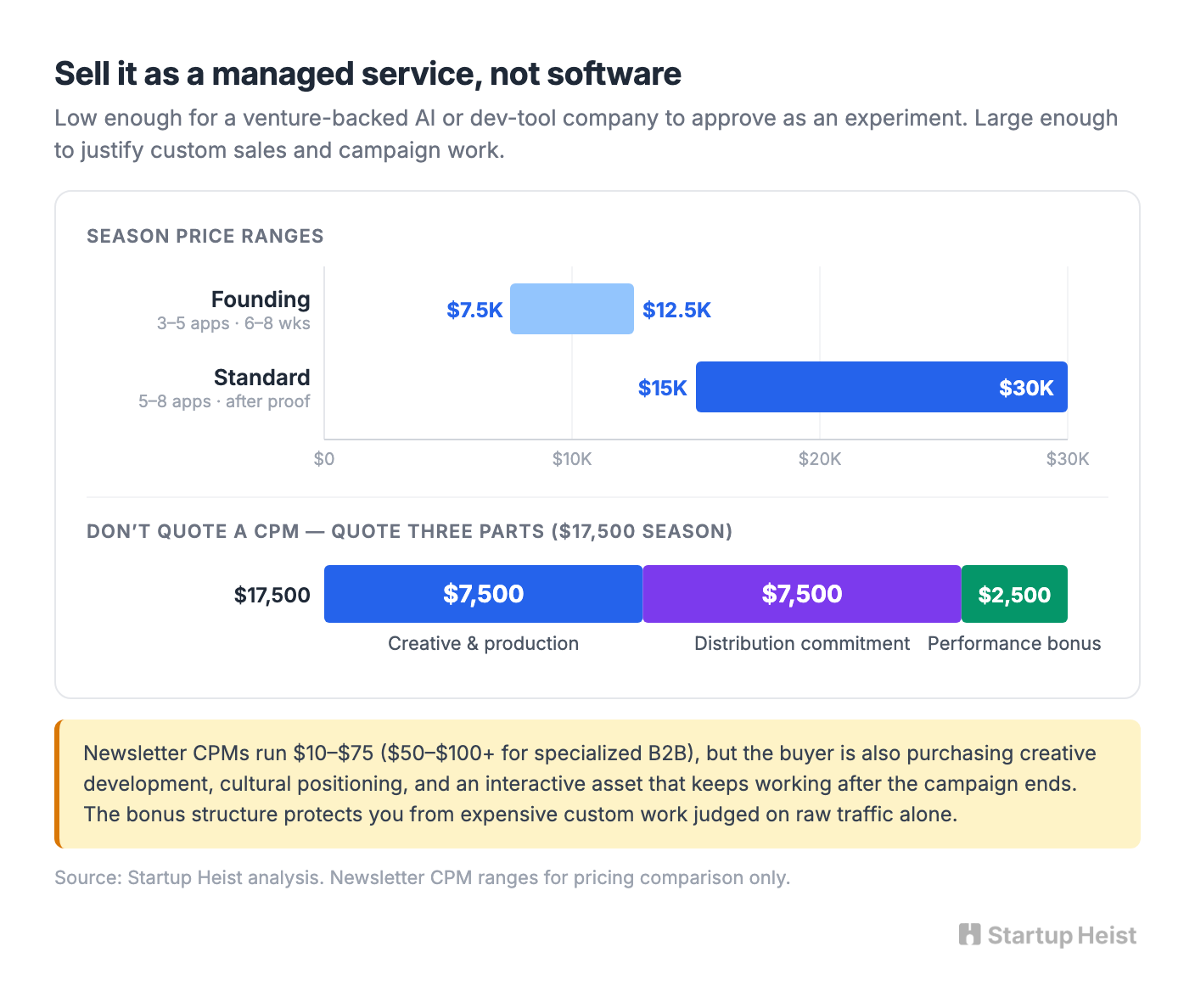
Sell the first version as a managed service, not software.
Unlock the Vault.
Join founders who spot opportunities ahead of the crowd. Actionable insights. Zero fluff.
“Intelligent, bold, minus the pretense.”
“Like discovering the cheat codes of the startup world.”
“SH is off-Broadway for founders — weird, sharp, and ahead of the curve.”


