


Steal the Forecast: Build the Climate Merchandising Layer for Beauty Retailers
A beauty retailer's merchandising calendar starts with the month. Summer campaign. Back-to-school campaign. Holiday campaign. Winter skincare campaign.
The customer doesn't experience the calendar that way.
She experiences a 97-degree subway platform, a humid commute, an oily scalp before lunch, sunscreen that feels too heavy on her face, a bedroom that never cooled down overnight. In that moment the weather has already created the problem, explained the product, and qualified the buyer. The store, meanwhile, is still showing her the same homepage it showed her in April.
The opportunity is to close that gap, and it doesn't take a new skincare brand or a proprietary weather model to do it.
Here's the shape of it:
The money: Fifteen retailers on a $349 plan is $5,235 in MRR plus $22,500 in setup fees. Korea's largest beauty chain already merchandises this way.
Inside:
• Nine-property climate taxonomy for beauty SKUs
• Five weather-state merchandising recipes
• Seven-component MVP, four to eight weeks
• Pricing ladder from $500 audit to $699/month
Start with K-beauty merchants carrying cooling skincare, lightweight sunscreens, scalp products, body wipes, and soothing gels. These are products whose usefulness swings with temperature and humidity.
You install the logic that connects weather to the merchant's existing catalog. Heat index crosses a threshold, the store changes what it promotes. Humidity rises, a different collection surfaces. High-UV forecast approaches, the email system fires a relevant campaign. Inventory runs low, the promotion shuts itself off.
The software here is straightforward. The value is knowing what to trigger, which products to include, how to explain them, and how to prove the intervention made money.
On day one this is a focused productized service rather than a venture-scale platform. It can reach $5,000 to $15,000 in monthly recurring revenue with a small client base, then earn the right to become software.
Korea Already Built the Category
The signal worth watching is Korea's dominant beauty retailer treating extreme heat as an operating variable.
Since April 2026, CJ Olive Young has been curating products under a campaign it calls Survival Beauty, organized into four themes: UV care, blemish care, oil and sweat care, and cooling care. Those are weather states with a merchandising plan attached. An Olive Young official put it plainly: survival beauty that responds to sudden heat and climate change is taking root as a new summer beauty trend.
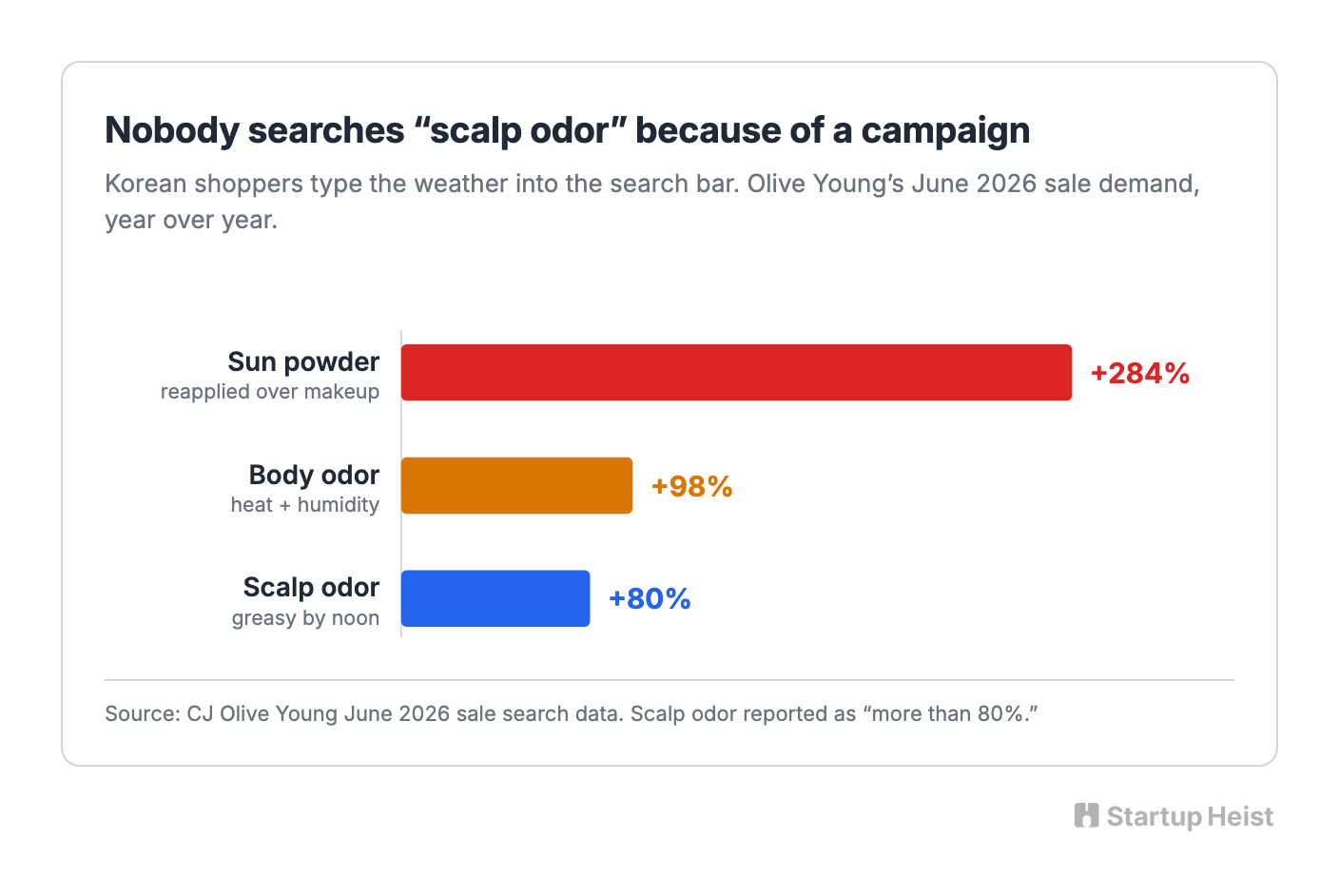
The demand shows up in what shoppers type into the search bar. During Olive Young's June sale, searches for sun powder rose 284% year over year, driven by a habit Korean shoppers call sun layering: sunscreen in the morning, then a stick, spray, or powder reapplied over makeup through the day. Body odor searches rose 98%. Scalp odor searches rose more than 80%. Nobody searches "scalp odor" because a campaign told them to. They search it because it's 95 degrees and their hair smells.
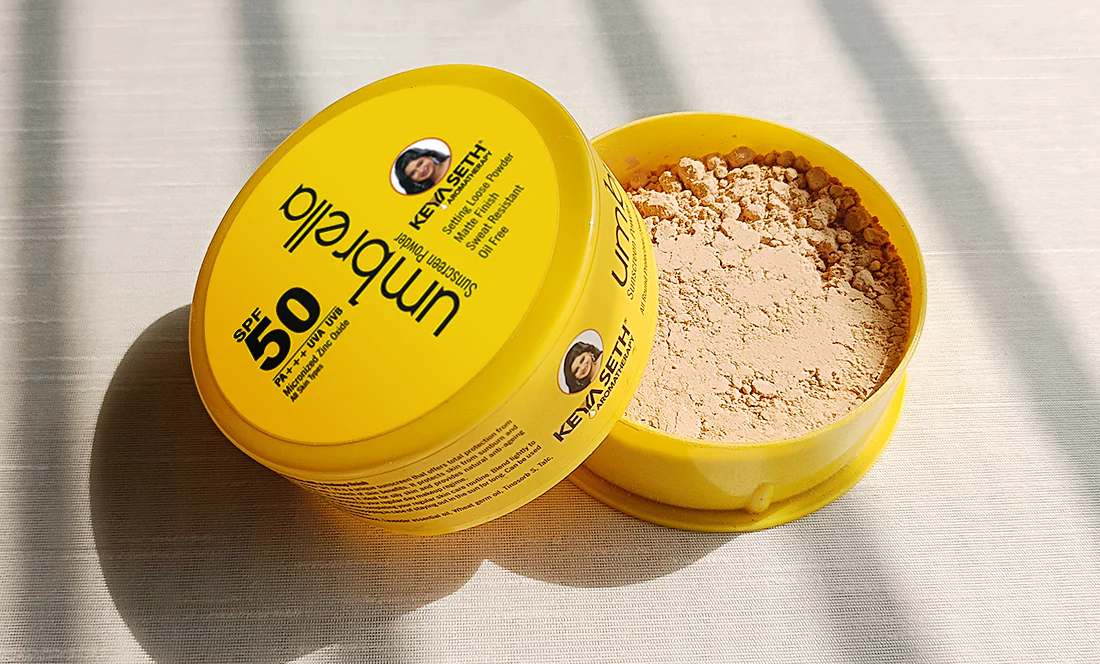
The product category has expanded well past peppermint face mist. Korean cooling beauty now runs to scalp sprays, body wipes, neck gels, hydrogel patches, sheet masks, soothing pads, and sunscreens built to stay comfortable through prolonged heat. Kolmar Korea developed the first scalp sunscreen in the country to clear the Ministry of Food and Drug Safety. LG Household & Health Care sells a cream it says drops skin temperature by 6.05°C. ISOI sells a cooling gel at 5.6°C. OBgE moved 1.2 million units of a single oil-control sun stick. Products engineered to a thermometer reading are a category naming its own trigger.
It's also why this merchandises differently than most beauty. Branding is how you explain a novelty product; context is how you explain a functional one. A shopper may have no idea what a cooling scalp tonic is or why she'd want one. She understands "your scalp feels greasy by noon because the heat index is 101."
The weather writes the copy. Most stores aren't reading it.
The Supply Is Already There
You don't need to manufacture anything. Korean beauty brands have built the catalog for you.
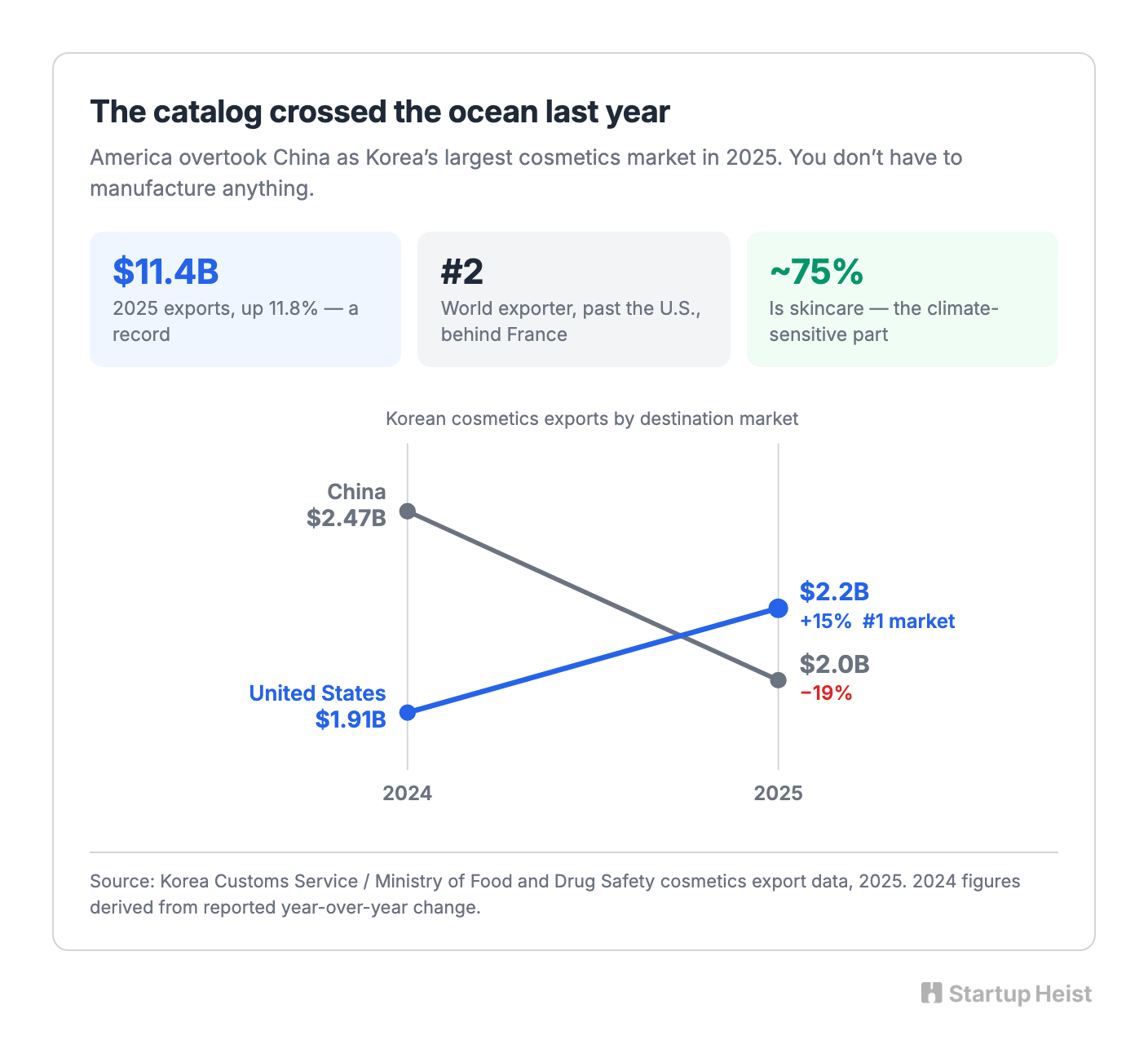
South Korean cosmetics exports hit a record $11.4 billion in 2025, up 11.8%, pushing Korea past the United States into the world's number two exporter slot behind France. The U.S. became Korea's largest single market, importing $2.2 billion, up 15%, while China fell 19%. Skincare, the climate-sensitive part, accounted for nearly 75% of it. The wave is already crossing into U.S. retail: LG Household & Health Care put its Belif Aqua Bomb Frozen Cream into Ulta Beauty stores in February 2026.
The retail channel is deep enough to support a specialist. Store Leads counted 312,461 live Shopify stores in Beauty & Fitness in July 2026: 193,881 selling face and body care, 50,363 selling haircare, and roughly 118,696 based in the United States. About 18.6% run Klaviyo, or some 58,000 stores.
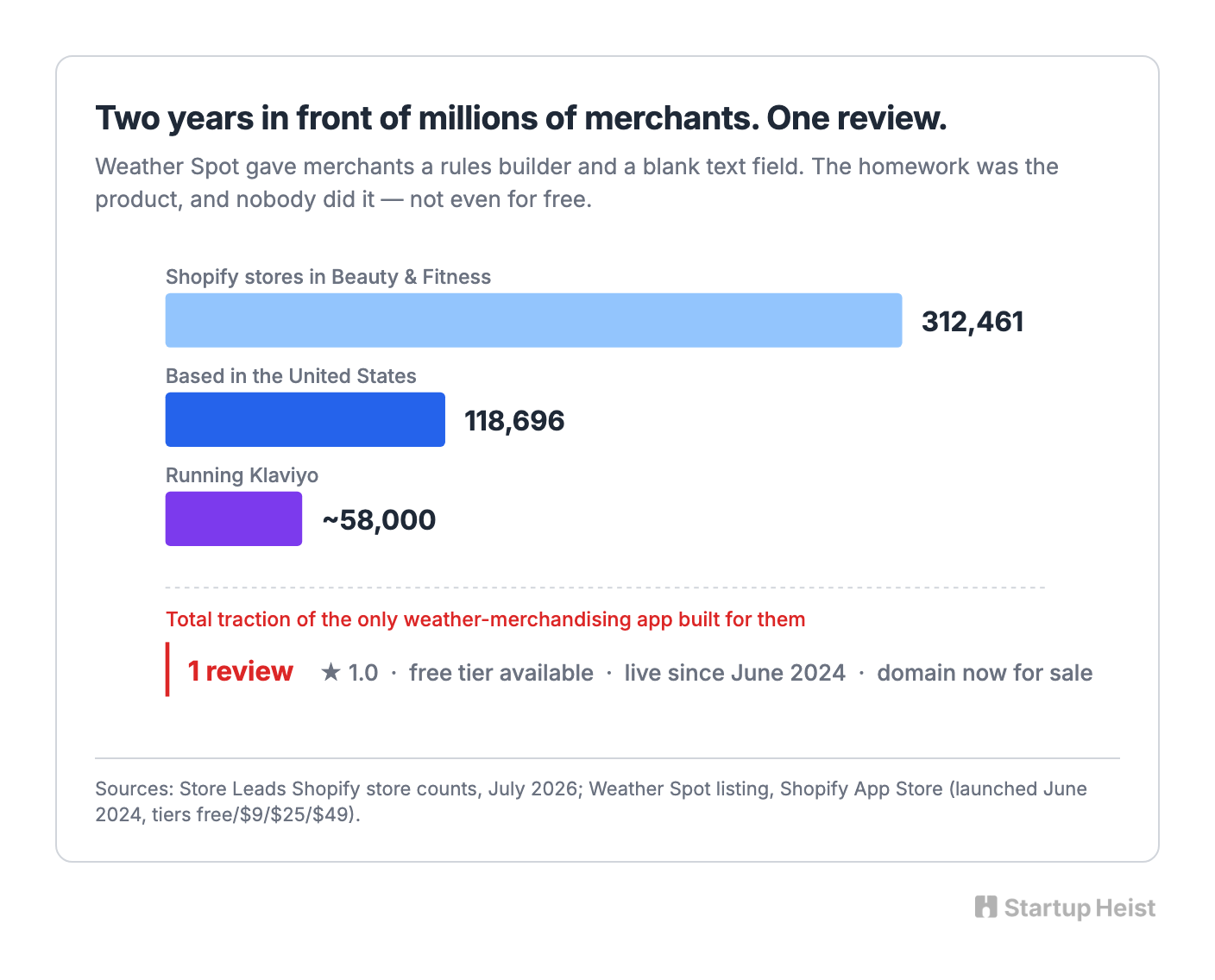
That number is far broader than your real market, which is the point. You need fifteen customers from the U.S., UK, Canada, or Australia, so the filter matters more than the pool:
- At least 30 climate-relevant products across SPF, scalp, body, or soothing skincare
- Klaviyo installed
- At least $40,000 to $50,000 in monthly online revenue
- Enough traffic to measure one campaign against another
A five-product skincare brand is a bad fit, because there's nothing to merchandise. The service earns its fee when a retailer carries 150 products and has to decide, every week, which ones to feature, bundle, email, and advertise.
The Category's One Competitor Is a Domain-For-Sale Page
The obvious move is to build a Shopify app. Look at what happened to the last person who did.
Weather Spot launched on the Shopify App Store in June 2024 offering weather-driven promotions and product recommendations, priced at a free tier and then $9, $25, and $49 a month. It has exactly one review, rated one star. The review reads: the application appears to be dead and goes to a domain for sale landing page. Its only real peer, Meteonomiqs, pipes wetter.com data into product recommendations across eight countries for $9.99 a month.
That cuts both ways. The bear case is that weather merchandising is a solved, worthless commodity. The bull case, which is the right one, is that a functioning generic weather app sat in front of millions of merchants for two years and generated almost no demand at any price, including free. What merchants rejected was the homework. An app hands you a rules builder and a blank text field and asks you to figure out which of your 140 products belong in a humidity promotion. That question is the actual work, and nobody was going to do it for $9 a month. The app sat unused until the founder let the domain lapse.
The infrastructure underneath is cheap and public. OpenWeather's One Call API 3.0 includes 1,000 calls a day free, with UV index and forecasts in the payload. Shopify's theme app extensions let you drop dynamic blocks into a merchant's storefront through the theme editor without touching Liquid. Klaviyo already handles catalog sync, segments, flows, A/B tests, and attribution.
None of it is scarce, and all of it sits inert without someone who knows what to say when it's 98 degrees in Houston.
Which is why you don't sell "change your website based on the weather." That pitch gets compared to a dead $9 app. Sell this:
We identify every climate-sensitive product in your catalog, organize it into a usable taxonomy, install five proven merchandising states, build the storefront modules and Klaviyo flows, write the campaign copy, block low-stock products from being promoted, and report whether each weather event produced incremental gross profit.
That's a merchandising system, and it gets priced like one.
What the Merchant Is Actually Buying
Unlock the Vault.
Join founders who spot opportunities ahead of the crowd. Actionable insights. Zero fluff.
“Intelligent, bold, minus the pretense.”
“Like discovering the cheat codes of the startup world.”
“SH is off-Broadway for founders — weird, sharp, and ahead of the curve.”


