


The $49 Mac Utility Hiding Inside Every Developer's Repo Folder
Developers don't only switch between tasks. They switch between mental rooms.
One window is the customer dashboard. Another is the billing service. Another is the half-broken side project from January. Another is the Claude Code branch that rewrote a service at 1:12 a.m. and never explained why. Five repos, five contexts, one dark theme. Same editor chrome, same tab strip, same folder names truncated just enough to be useless. The sameness is what creates the opening.
There's room on macOS for a sharp, fast, local-first utility that gives every Git repo a persistent visual identity. Not a workspace operating system, not another AI IDE, not a project manager. A small tool that says: when I'm inside this repo, the terminal and editor should feel like this repo. Color, badge, prompt, recall. Call it ProjectHue. The product is narrow on purpose. The pain is obvious. The buyer is reachable. The wedge is small enough to ship before any large tooling company notices, and just deep enough to be hard to dislodge once a developer's workflow accumulates inside it.
Here's the wedge in one line:
The money: 2,000 paying users at $49/year is $98K ARR for one founder. 5,000 gets you to $245K ARR with near-zero infra cost.
Inside:
• Five-piece MVP, ships in one quarter
• Free / $49 yr / $79 lifetime / $8 team
• Launch on HN, r/vscode, VS Code Marketplace
• Five compounding moats for a solo build
This isn't a venture-scale category. It's a clean indie software business with a real path to $250K ARR and a longer path to becoming the repo-context layer the whole modern developer stack quietly needs.
The Tax No One Bills You For
A modern builder might have several repos open, multiple terminal panes, one or two AI coding agents running in worktrees, a local dev server, a staging branch with a half-finished migration, a production incident tab, and a Slack thread asking whether the bug is fixed. AI was supposed to remove friction. In practice, it multiplies parallelism. Developers can now start more tasks, branch more experiments, and leave more half-finished sessions alive at the same time.
The cost is uglier than most managers think. Research from the University of California, Irvine pegs full refocus after a single interruption at 23 minutes and 15 seconds. Industry estimates put the annual context-switching tax in the tens of thousands of dollars per developer in lost productivity. The American Psychological Association attributes up to 40% of a worker's productive time to multitasking overhead. For developers, each switch costs 15 to 30 minutes because programming requires holding complex mental models of architecture, state, and logic.
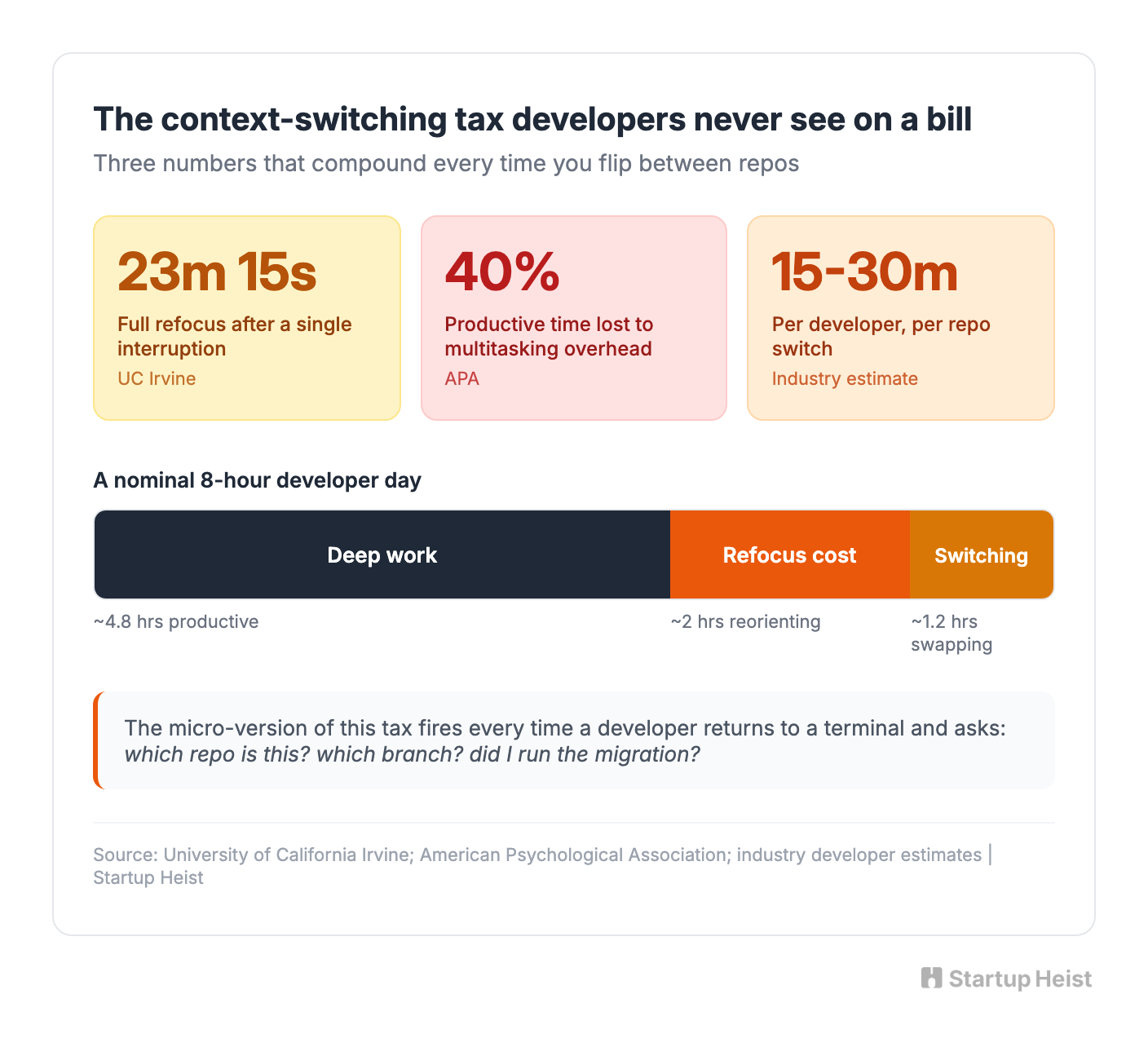
Most of that tax is invisible. The micro-version of it happens every time you return to a terminal and ask: which repo is this? Which branch? Did I already run the migration? Humans recognize context fastest through visual cues, and developers already lean on this informally. Different wallpapers for different jobs. Different terminal profiles for prod versus dev. Stickers on the laptop lid. None of it is automatic at the repo level. That's where most of the friction actually lives, and where almost no one has built.
Why The Market Is Ready
Three forces converged into a launch window that didn't exist eighteen months ago.
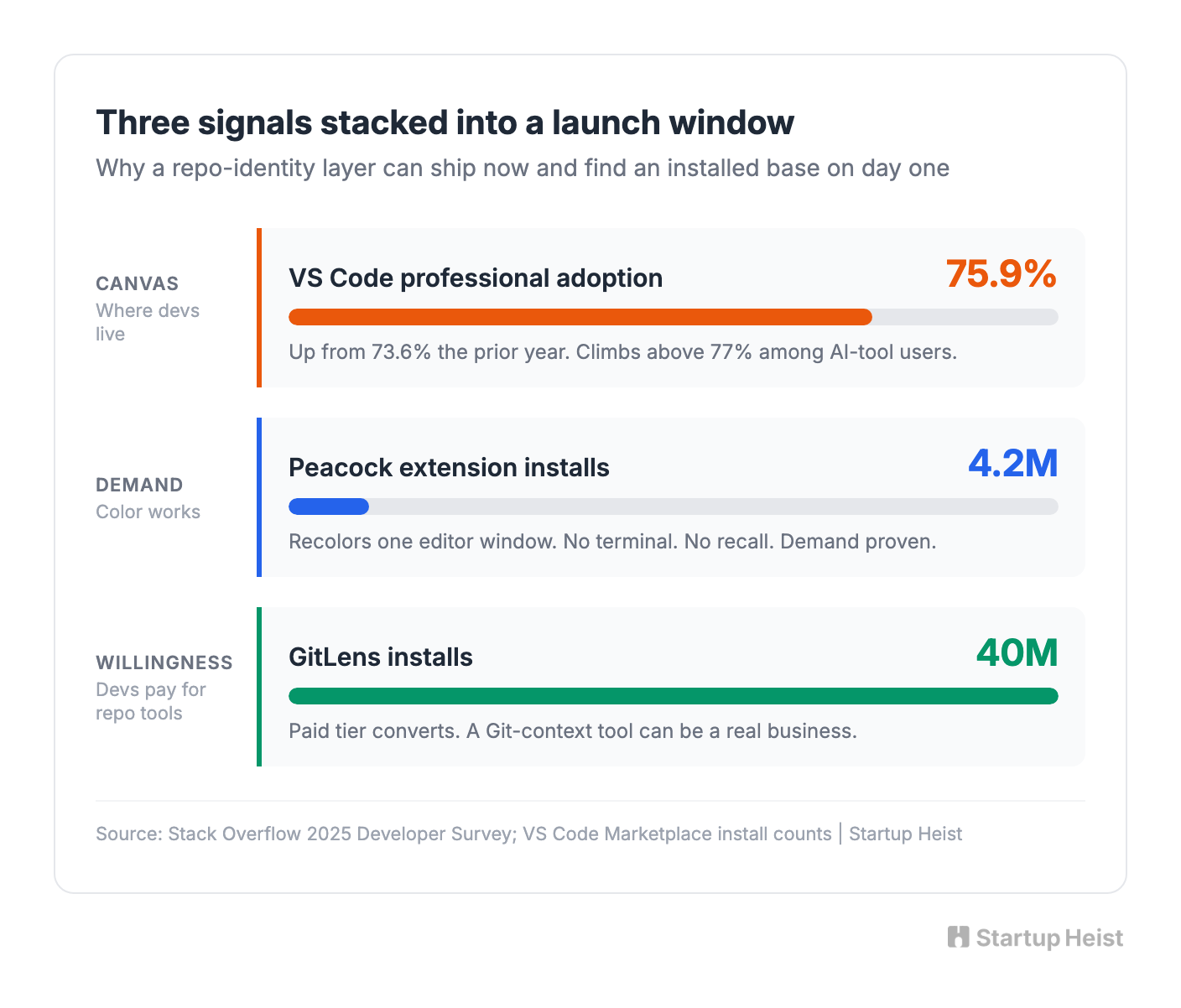
The first is canvas. Stack Overflow's 2025 Developer Survey put Visual Studio Code at 75.9% usage among professional developers, up from 73.6% the previous year and still extending its lead. Among developers using AI tools, that figure climbs above 77%. A repo-identity layer can sit on top of the canvas where developers already live instead of pretending to be a new workspace.
The second is direct demand validation. The VS Code extension Peacock, which subtly changes the workspace color so users can distinguish multiple VS Code windows, has cleared 4.2 million installs. GitLens, the dominant Git-context extension, has surpassed 40 million installs. Developers will install free tools that color their workspace, and they'll pay for tools that improve their Git workflow. A Peacock alternative that crosses into the terminal sits between those two proven demand curves.
The third, and most interesting, is the AI-agent wave. Git worktrees became load-bearing for AI coding in early 2026. Claude Code ships native worktree isolation. OpenAI's Codex uses worktrees for background tasks. Cursor, Windsurf, Crystal, Conductor, Vibe Kanban, and Claude Squad are all built around running parallel agents in parallel branches. A developer running three Claude Code worktree sessions is now juggling three terminal windows that point at the same repo but represent three different futures of that repo. The identity problem is no longer just which project. It's which version of this project, owned by which agent, in which working state. In that world, color stops being decoration and starts being wayfinding.
The Wedge: Project Identity + Workspace Recall
The first product should be brutally narrow.
A macOS menu-bar utility that detects the active Git repo and applies a persistent visual identity across VS Code and iTerm2, plus a lightweight recall layer of the last thing you were doing in that repo.
The flow is short:

Unlock the Vault.
Join founders who spot opportunities ahead of the crowd. Actionable insights. Zero fluff.
“Intelligent, bold, minus the pretense.”
“Like discovering the cheat codes of the startup world.”
“SH is off-Broadway for founders — weird, sharp, and ahead of the curve.”


