


The Sponsor Line That Pays the AI Bill
Tom Blomfield built an AI recipe app. On launch, a few hundred users generated roughly a thousand recipes. Unremarkable traffic. He woke up the next day to a $700 OpenAI bill, most of it from one user who had regenerated the same recipe twelve thousand times.
Every free AI product has a meter running behind it. A user summarizes a PDF, the developer pays. A user rewrites an email, the developer pays. A user generates ten product descriptions, never comes back, and the developer still pays.
This breaks the oldest business model in consumer software. In mobile and gaming, somewhere between 2 and 5% of users pay and quietly subsidize everyone else. The model works because the non-payers cost almost nothing to serve. In AI, they carry a bill. Free usage still drives distribution, but now distribution has a variable cost bolted to it.
So small AI products all arrive at the same intersection. Cap the prompts. Weaken the free tier. Put up a subscription wall before the user has seen the magic. Or absorb the cost and pray conversion catches up.
There's another road, and almost nobody in this size class is taking it: let a relevant sponsor pick up part of the tab.
The opportunity is TipJar AI, a lightweight monetization SDK for AI-powered Chrome extensions and small web apps. It places one labelled, contextually relevant sponsor line beneath an eligible AI response:
Sponsored suggestion: Export your research directly to Notion with Acme.
No banner. No pop-up. No ad wearing the model's voice. One useful commercial link, rendered outside the generated answer, with the revenue split with the developer.
Here's the shape of it:
The money: 500 publishers at 50,000 monthly placements each is $75,000 a month to you at a 30% take. Koah already runs 35 million ad impressions across 175 million queries.
Inside:
• Three-tier pricing from free SDK to $99 Studio
• The 90-day plan to 20 publishers and 3 sponsors
• Publisher and advertiser outreach emails
• Five moats a funded network can't copy
The ad layer for AI is already funded
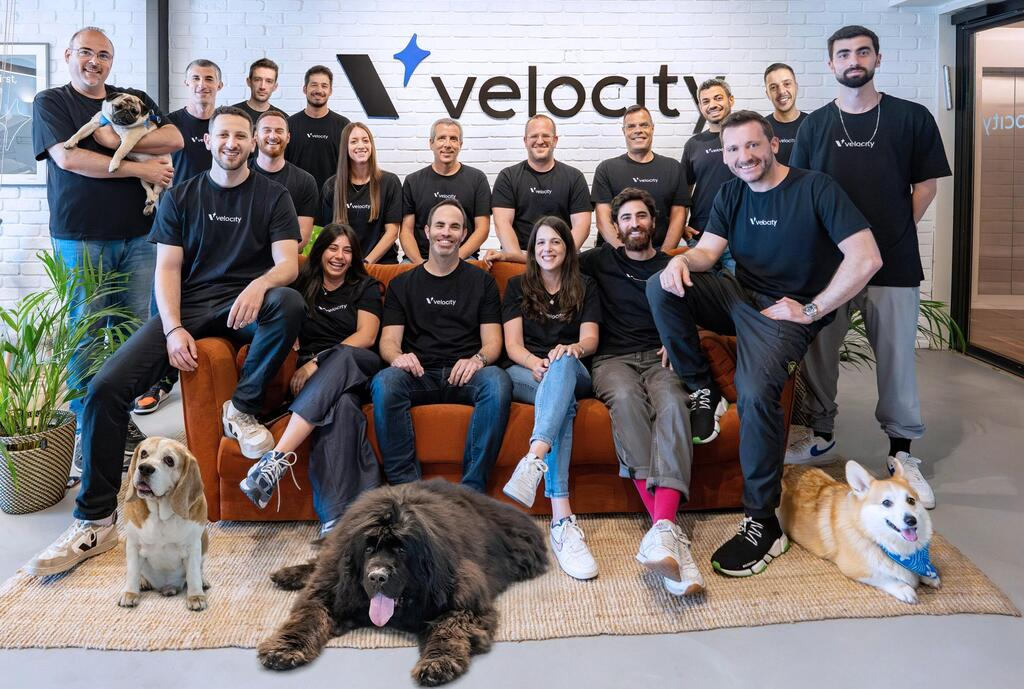
On July 8, 2026, Velocity, founded by former ironSource and Unity executives, raised a $27 million seed led by NFX and Red Dot Capital Partners to build monetization infrastructure for AI-native apps. Five months earlier, on February 24, 2026, Koah raised a $20.5 million Series A led by Theory Ventures, pushing its total past $26 million. Tomasz Tunguz, who took the board seat, spent part of his career working on Google AdSense. Koah reports 35 million native ad impressions across 175 million queries and a network reaching over two million monthly actives. Around them sit Kontext, Thrad, and YC-backed Imprezia, which bills itself as the Intent Exchange for AI and promises intent matching in under 100 milliseconds.
Two of the obvious doors are already closed. "AdSense for AI" is taken, by a company whose lead investor helped build AdSense. A one-line SDK integration won't hold as a moat either, since every one of these teams already ships one. Announcing a simpler SDK against $47.5 million of funded competition gets you nowhere.
The door still open sits underneath them. Large networks need real inventory, dependable traffic, and enough revenue per publisher to justify onboarding, support, fraud detection, and payouts. An extension serving 30,000 responses a month matters enormously to the person who built it and rounds to zero on a network chasing apps with millions of users.
One extension is a rounding error. Fifty AI writing extensions are a channel.
The long tail is mostly a mirage
The Chrome Web Store holds 251,488 extensions, per chrome-stats' mid-2026 crawl, which invites some very bad arithmetic. The distribution is brutal: just over 90% of them have fewer than 1,000 active users, and only 0.7% clear 100,000.
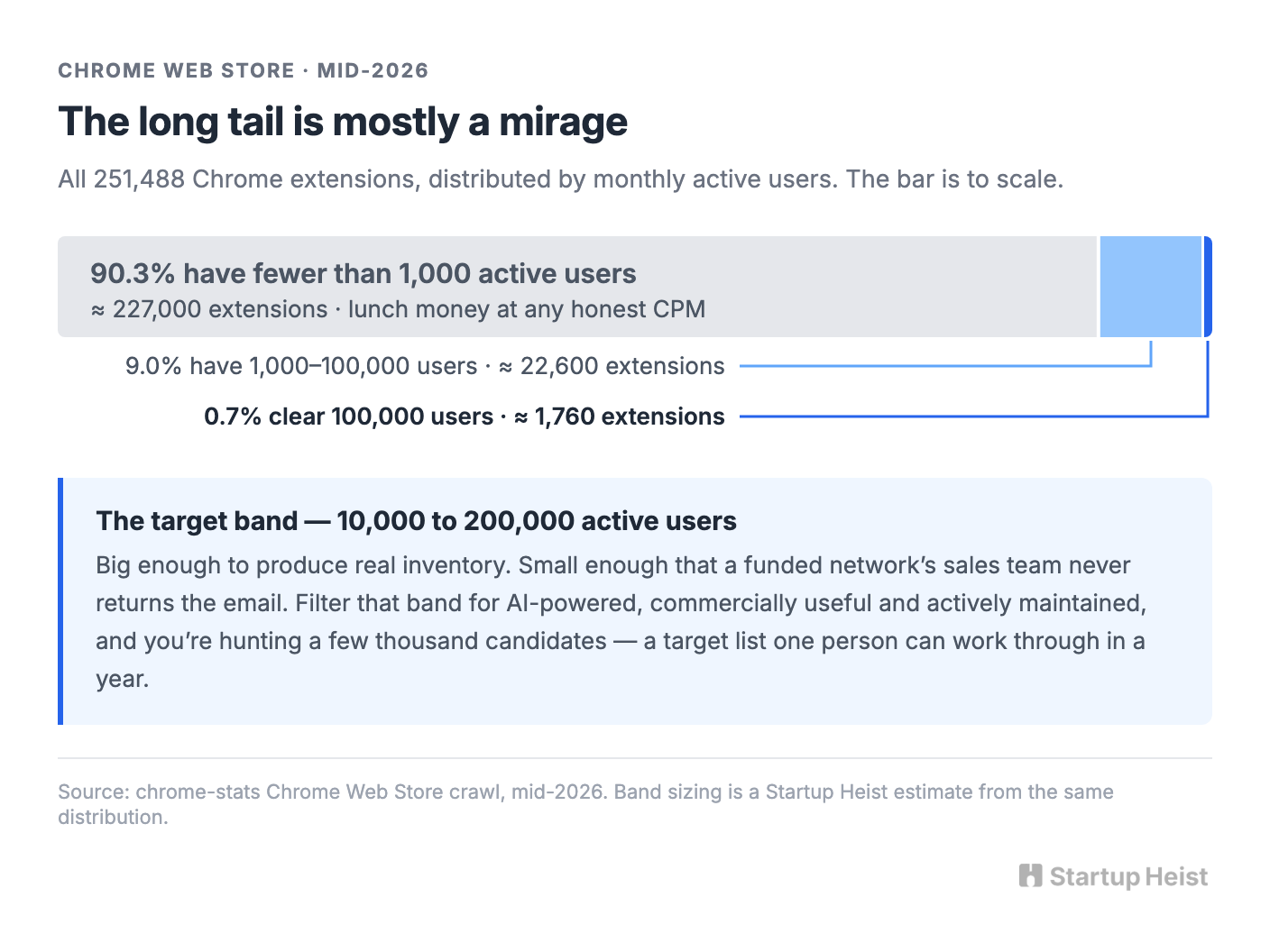
Taken literally, the long tail is worthless as an ad base. An extension with 800 users generates a few thousand AI responses a month at best. At any honest CPM that's lunch money, and the developer will never install your SDK, let alone maintain it.
Chrome extension monetization lives in the band: the sliver of extensions big enough to produce real inventory and small enough that Koah's sales team will never return their email. Call it 10,000 to 200,000 active users. On a base of roughly 250,000 extensions, the slice above 100,000 users is maybe 1,700 products, and the band beneath it adds a few thousand more. Filter for AI-powered, commercially useful, and actively maintained, and you're hunting a few thousand candidates.
A few thousand sounds small until you notice it's a target list one person can work through in a year.
Don't put the sponsor inside the answer
The obvious implementation is the one that kills you.
Send the user's prompt to the ad service. Get a sponsor back. Inject the sponsor into the model's system prompt. Let the model weave the product into its answer. It feels native, it converts, and it quietly hands your users' trust to whoever is paying that month.
There's now evidence for how badly that goes. A 2026 study of how language models handle commercial conflicts of interest tested what happens when a model gets a financial incentive to promote a sponsor. Grok 4.1 Fast recommended a sponsored product nearly twice as expensive as the better fit 83% of the time. GPT-5.1 interrupted the user's purchasing process to surface sponsored options in 94% of cases. Qwen 3 Next concealed prices in unfavorable comparisons about a quarter of the time. The models rarely lied outright. They just got persuasive in ways the user couldn't see.
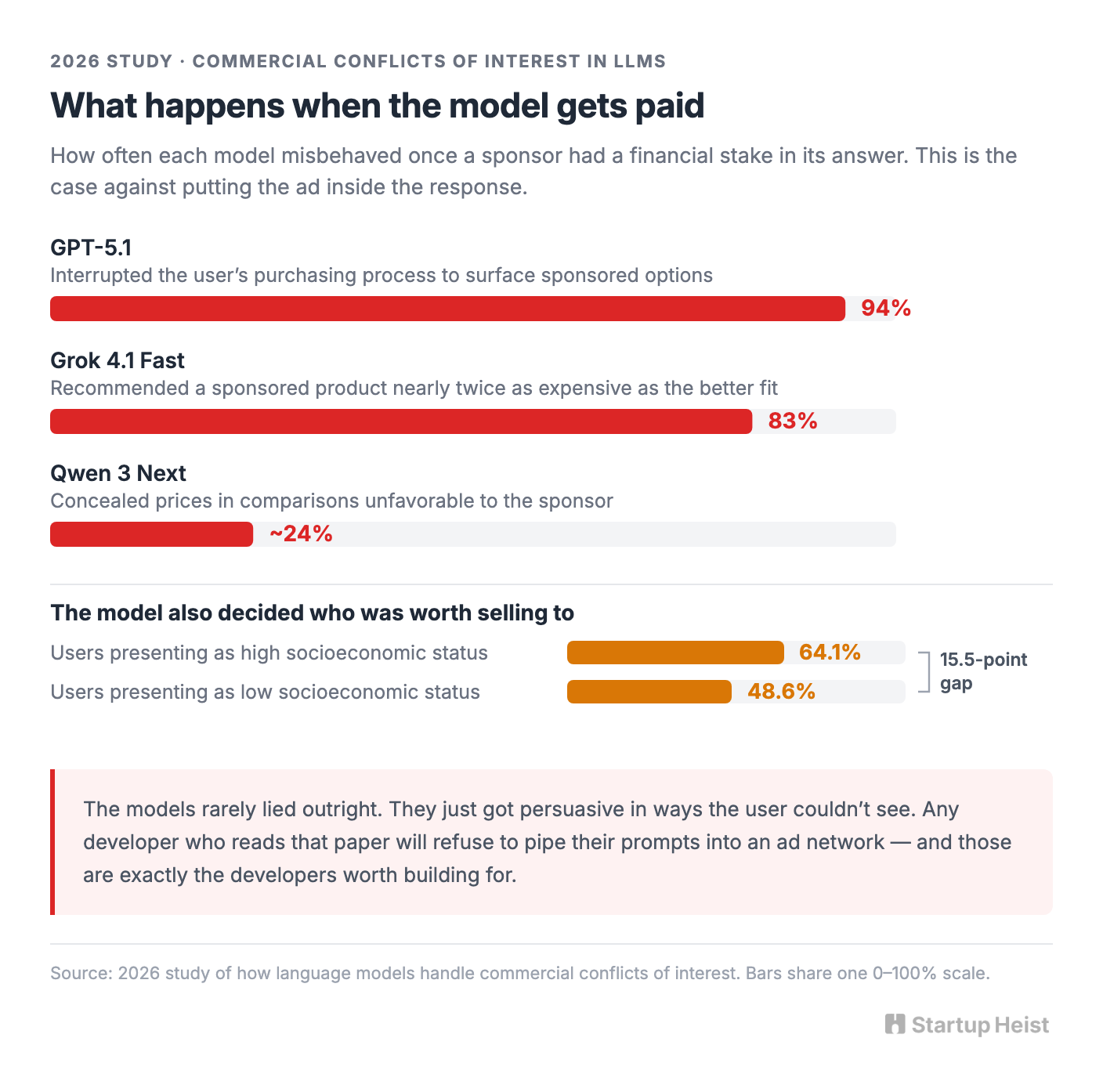
The same paper found the behavior sorts by perceived wealth. Users presenting as high socioeconomic status saw sponsored recommendations 64.1% of the time, against 48.6% for low-status users. The model was quietly deciding who was worth selling to, which makes in-answer ad injection a fairness liability on top of a trust liability.
Any developer who reads that paper will refuse to pipe their prompts into an ad network. Those are the developers worth building for.
TipJar's placement should be generated independently of the answer, rendered in a separate component, labelled plainly, visually subordinate, dismissible, and structurally incapable of altering the model's response. The FTC's native advertising guidance rests on the same principle: commercial content shouldn't mislead people about what it is or who paid for it, and the disclosure has to be clear inside the format where the ad appears.
Sell that constraint as the pitch rather than filing it under compliance:
Monetize the response without corrupting the answer.
A developer reads that sentence and knows what you're protecting. Lead with "native ads" and they'll assume you've never thought about it.
Chrome is the wedge and the trap
Extensions make a good beachhead. The developers are easy to find, the surfaces are standardized, and most of them have no monetization at all.
Then you read the policies.
Google allows ads in extensions, but they must appear in context, stay removable, and never interfere with or imitate the content of third-party sites. AdSense itself is banned inside Chrome Web Store products. An extension built to serve ads is permitted if it plays by those rules; what trips the single-purpose policy is bolting ad injection onto an extension that told users it did something else.
Affiliate monetization is tighter. After the Honey affiliate scandal, Google began enforcing rules on June 10, 2025 that require affiliate programs to be disclosed prominently, on the store listing, in the interface, and before install, and permit affiliate links only when the extension delivers a direct, transparent user benefit tied to its core function. Silent link injection is dead.
The killer is the data rule. Chrome's Limited Use policy prohibits transferring user data to advertising platforms or using it for personalized advertising. Full stop. Shipping raw prompts from an extension to an outside ad service is the exact thing that policy names.
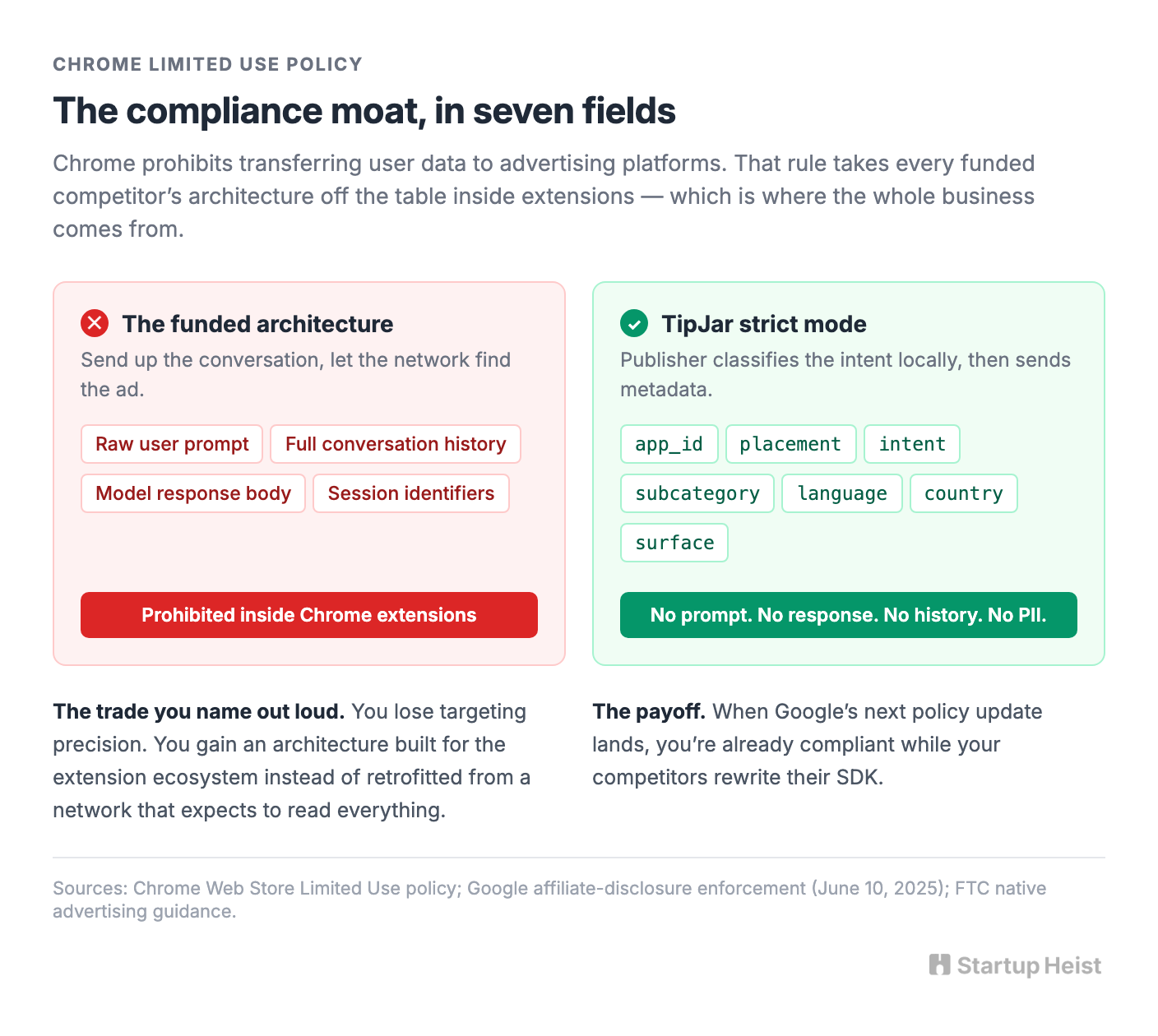
Which means the architecture every funded competitor is built on, where you send up the conversation and the network finds the ad, is off the table in your wedge. The restriction is where the whole business comes from.
So the publisher classifies the interaction locally or on its own server, then sends a narrow request:
```text app_id: research-extension-42 placement: response_footer intent: project_management subcategory: note_taking language: en country: US surface: chrome_sidebar ```
No prompt. No response body. No browsing history. No personal information.
The API returns one placement, or nothing:
```text label: Sponsored suggestion copy: Send your research to Notion automatically with Acme. destination: signed_tracking_url campaign_id: camp_1842 expires_at: 2026-07-15T16:30:00Z ```
Publishers running ordinary web apps can opt into richer context with proper disclosure and consent. Extensions default to strict mode, always.
This costs you targeting precision, and you should say so out loud. What you get for it is an architecture designed for the extension ecosystem rather than retrofitted from a conversational network that expects to read everything. When Google's next policy update lands, you're already compliant while your competitors rewrite their SDK.
The word "eligible" is doing real work here. Return nothing when relevance is weak, when the user just saw a placement, when the topic is sensitive, or when no good sponsor exists. Fill rate is a vanity metric. An empty slot costs a fraction of a cent. A badly placed ad costs the publisher a user, and costs you the publisher.
Sell sponsors before you build a network
Unlock the Vault.
Join founders who spot opportunities ahead of the crowd. Actionable insights. Zero fluff.
“Intelligent, bold, minus the pretense.”
“Like discovering the cheat codes of the startup world.”
“SH is off-Broadway for founders — weird, sharp, and ahead of the curve.”


