


Stop Selling AI to Contractors. Sell Them the Receipt.
A fixed-price shadow audit turns skeptical HVAC and plumbing owners into recurring AI customers. The move is to show them the jobs they already lost before you ask them to trust a robot with the phone.
Most AI receptionist companies pitch contractors backward. They lead with the technology. Here is the synthetic voice. Here is how it books an appointment. Here is 24/7 coverage. Imagine what it could do for your shop.
The contractor hears something else entirely: you want a robot to answer my most valuable phone calls.
That's a big ask in a business where one fumbled call costs an emergency repair, a maintenance contract, or a $12,000 system replacement.
The better business is a fixed-price Shadow Audit. You analyze a contractor's existing call recordings and job data, find the after-hours opportunities that got missed or mishandled, and show in plain English what a tightly controlled automation workflow would have done instead.
Nothing goes live. No customer speaks to AI. No schedule gets touched.
The contractor buys evidence first. Then you sell the automation. Here's the shape of it:
The money: Fifty managed shops at $1,500 a month is $75K MRR. ServiceTitan says Bonney Plumbing cut missed calls 60% running the destination product.
Inside:
• The 14-day Shadow Audit scope and $1,500 price
• Three managed tiers up to $3,000/month
• Probability-weighted ROI math owners believe
• Cold email plus the agency partnership channel
The gap between belief and adoption
Contractors have stopped dismissing AI. They're waiting for someone to make it concrete.
ServiceTitan's 2026 State of AI in the Trades surveyed 1,032 commercial and residential contractors across HVAC, plumbing, electrical, roofing, garage door, pest control, and commercial landscaping. Sixty-six percent expect AI to bring moderate or major transformation within one to three years. Only 12% have embedded it into operations. Another 34% are still poking at it. Among the contractors already running AI, 62% report measurable efficiency gains, many saving three or more hours a week.
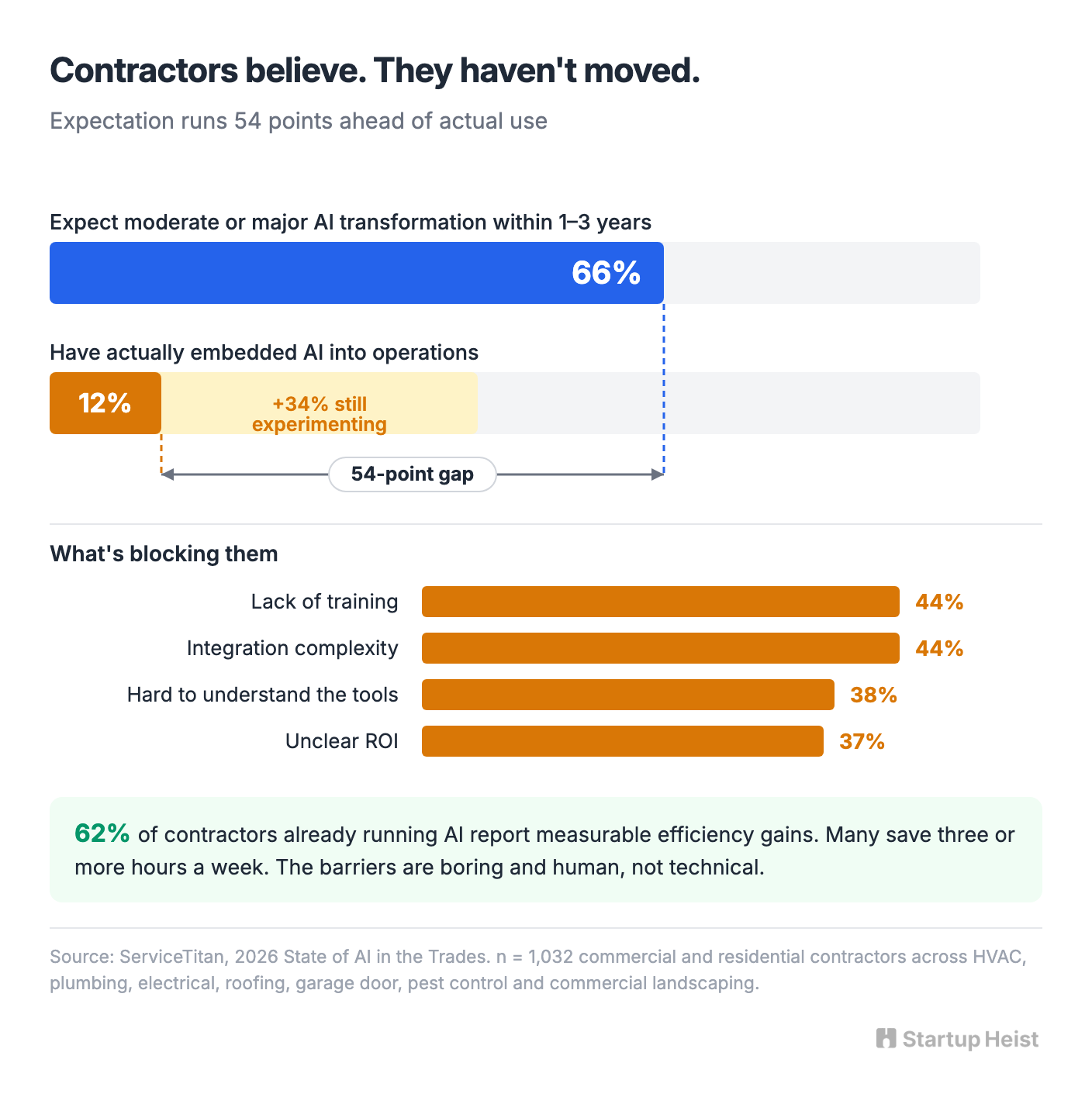
Appetite runs far ahead of adoption. The barriers that keep everyone else out are boring and human: lack of training (44%), integration complexity (44%), difficulty understanding the tools (38%), and unclear ROI (37%). Contractors have heard the pitch. What they lack is proof that applies to their business, their customers, their techs, and their dispatch rules.
So don't ask a contractor to believe an AI agent could recover revenue. Show him the exact calls where revenue already walked out the door.
Why after-hours calls are the right wedge
"AI for contractors" is too broad to sell. After-hours revenue recovery is specific, measurable, and already bleeding.
A homeowner whose furnace dies on a freezing night doesn't fill out a form and wait until morning. Neither does the one standing in two inches of basement water. They call until somebody answers.
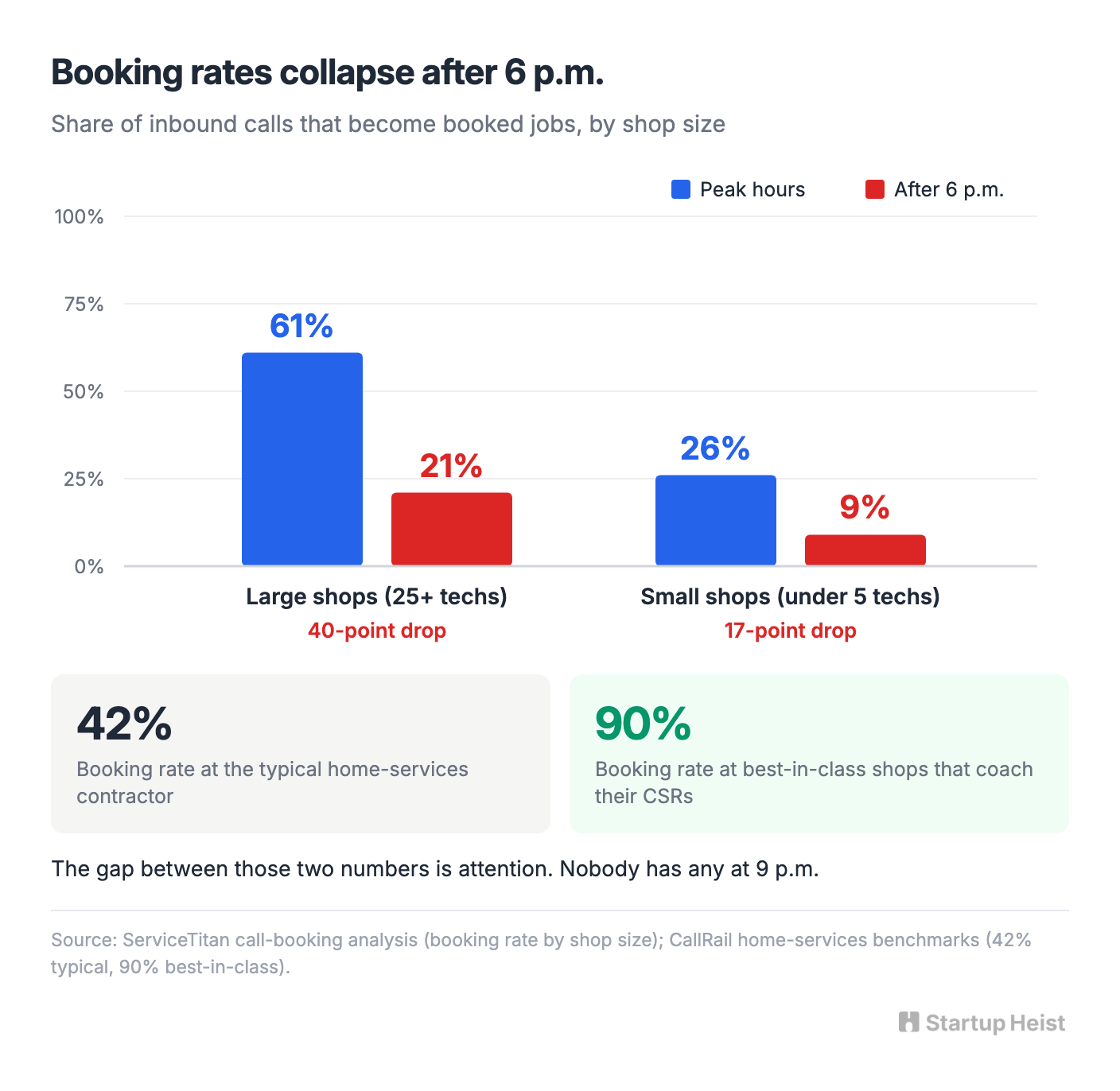
ServiceTitan's call-booking analysis found booking performance collapses as the day goes on: large shops with 25 or more techs peak at a 61% booking rate and fall to 21% after 6 p.m., while shops with fewer than five techs go from 26% to 9%. Plumbing holds steadier through the year for a reason one ServiceTitan adviser put bluntly: when you need a plumber, you need them now. CallRail's home-services data puts the typical contractor at 42% of inbound calls booked, against 90% for best-in-class shops that actively coach their CSRs. The gap between those two numbers is attention, and nobody has any at 9 p.m.
After-hours leakage is unusually well suited to a diagnostic. The time boundary is clean. The recordings usually exist. Caller intent can be classified. Job outcomes can be matched back to call records. The proposed workflow can be fenced to approved situations. And the economics can be estimated from the contractor's own history instead of a vendor's slide deck.
A contractor won't buy "AI transformation." He understands "you paid for this phone to ring and nobody converted the call."
The market is validated, and it's filling up
The destination product already exists, which is good news and a clock.
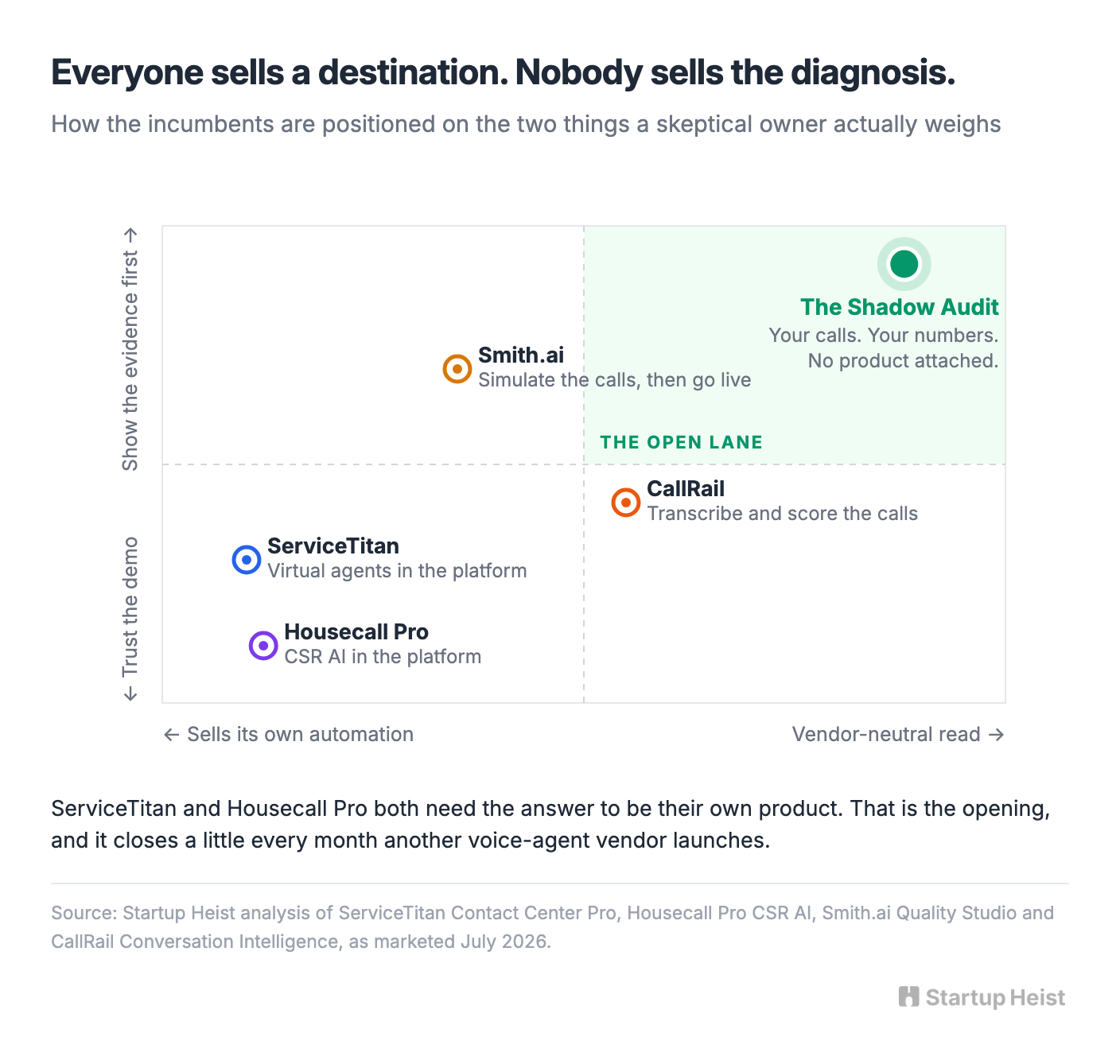
ServiceTitan's Contact Center Pro ships AI virtual agents for overflow and after-hours calls, plus call summaries and second-chance lead identification; ServiceTitan says Bonney Plumbing cut missed calls 60% and lifted bookings 11% after implementing it, without adding staff. Housecall Pro markets CSR AI as a 24/7 rep that answers, books, syncs to the schedule, and follows custom scripts, priced by quote rather than a public number. Smith.ai has moved closest to a proof-first motion: train and test the receptionist against simulated calls in its Quality Studio, review the transcripts, then go live free, with self-service plans starting at $95 a month. Test before you trust is becoming table stakes.
The sharper signal came from the trade press. In May 2026, Contractor Magazine ran a how-to on auditing one week of calls at your plumbing shop: gather every inbound attempt, score each as booked, qualified-but-lost, unqualified, or never answered, then compute answer rate, answered-to-booked ratio, and after-hours share. The promise was six figures of already-paid-for revenue sitting in the call log. When a trade magazine publishes the DIY version of your product, the demand is proven and the labor is the bottleneck. Almost nobody runs the audit. Doing it means listening to hundreds of recordings during the season the phone won't stop ringing.
So the durable opening is an independent, outcome-linked audit of what actually happened inside the business. ServiceTitan and Housecall Pro both need the answer to be their own product. You can say what neither of them can: here is the leakage, here is the safe workflow, here are the economics, and you can implement it with us, with your existing platform, or with somebody else. That neutrality gets more valuable every month another voice-agent vendor launches.
Who should buy this
Don't target every contractor. A two-truck shop taking 40 calls a month won't pay $1,500 for analysis when a full AI reception product costs a few hundred.
Your first customer is a residential HVAC or plumbing company with 8 to 40 field techs, $2M to $20M in annual revenue, at least 200 inbound calls a month, existing call recordings, a usable job-management system, real nights and weekends demand, and no reliable 24/7 booking process. Someone there already knows calls are being lost and can't put a number on it. That person signs the check.
Below that range the audit costs more than the problem. Far above it, security reviews and stakeholder count turn a two-week engagement into a two-quarter one. For your first ten customers, stay in the middle and build the thing they can actually buy.
The product: a 14-day Shadow Audit
Unlock the Vault.
Join founders who spot opportunities ahead of the crowd. Actionable insights. Zero fluff.
“Intelligent, bold, minus the pretense.”
“Like discovering the cheat codes of the startup world.”
“SH is off-Broadway for founders — weird, sharp, and ahead of the curve.”


