


California's Allergen Law Just Handed You a Prospect List
Build the coverage database, sell the remediation, then own the menu-change workflow
On July 1, 2026, a California law took effect that quietly conscripted a few thousand restaurant brands into a data problem they have never had to solve.
Senate Bill 68, the Allergen Disclosure for Dining Experiences Act, requires covered restaurants to disclose nine major allergens for every standard menu item: milk, eggs, fish, crustacean shellfish, tree nuts, peanuts, wheat, soybeans, and sesame. The disclosure can sit directly on the menu, or live in a digital format like a QR code, so long as the restaurant also offers a written alternative: an allergen grid, a chart, a booklet, a separate menu. Operators can use the common names of the allergens or standardized pictograms. California is the first state in the country to require any of it.
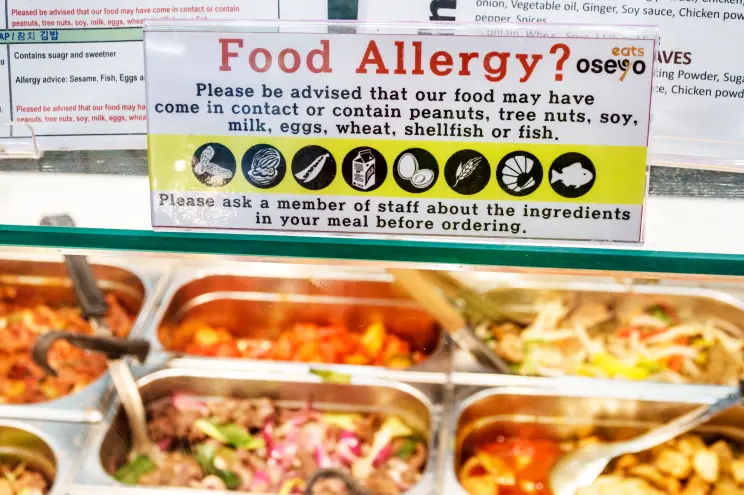
It reads like a California rule for California restaurants. The business lives in the gap between how the law reads and how the law works.
Here's what sits in that gap:
The money: Ten brands on $1,000 a month of monitoring is $120,000 ARR. Fifty is $600,000. Setups run $3,000 to $7,500 each on top.
Inside:
• The coverage test most chains read wrong
• Fixed-price setup: $750 to $7,500 scope
• Menu-drift monitoring that earns renewals
• The evidence graph that makes brand 40 cheap
The coverage trap
SB 68 doesn't define its own scope. It borrows one. The law reaches food facilities already subject to the federal menu-labeling framework: chains doing business under the same name, selling substantially the same menu items, at 20 or more locations. California adds a single condition. At least one of those locations has to be in California, and the 20-location threshold counts every location the chain operates anywhere, not just the California ones. The California Restaurant Association reads it that way, and Fisher Phillips gives chains the same practical warning: 20-plus locations anywhere, one foot in California, you're covered. The only carve-outs are compact mobile food operations and nonpermanent facilities.
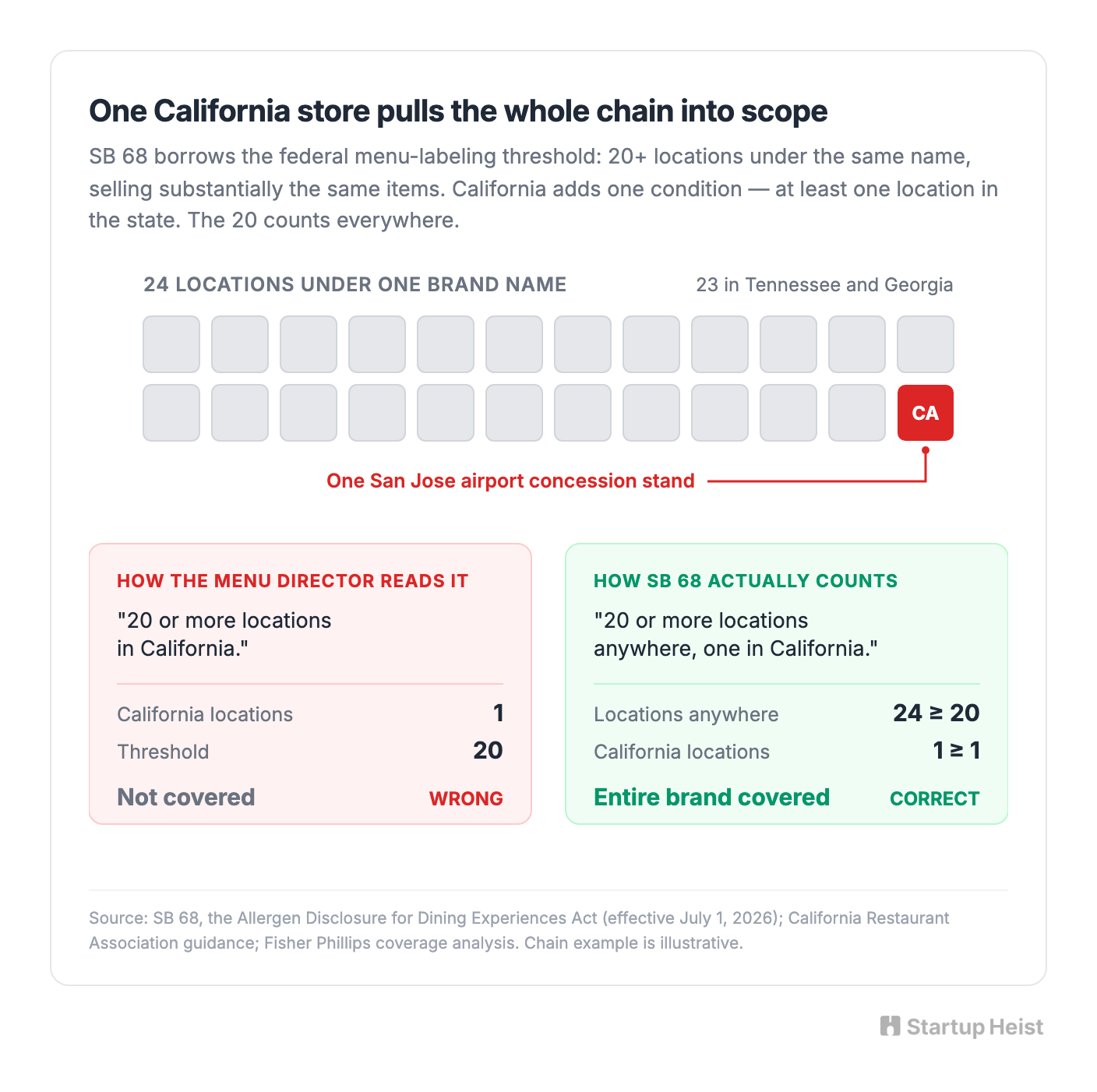
Picture the company this catches. A 24-unit barbecue chain headquartered outside Nashville, with 23 stores across Tennessee and Georgia and one concession stand inside a San Jose airport terminal that a franchisee opened three years ago. The company isn't a CRA member. Its outside counsel handles employment matters, not California food code. Its menu director has heard of SB 68 and concluded, reasonably, that a law about California restaurants applies to chains with 20 California restaurants. The single airport unit pulls the entire brand's menu into scope.
The bill was introduced in January 2025 and signed on October 13, 2025, which gave the industry roughly twenty months of warning. Every national brand with a general counsel used them. The chain with one California outpost and no California lawyer did not, because nobody was assigned to notice.
The market is smaller than "all restaurants," and better than it looks
Restaurant and foodservice sales will reach a projected $1.55 trillion in 2026, and the 500 largest chains booked $451.5 billion in 2025. Both numbers will lead you straight into bad market sizing. You're selling to a narrow slice of that population.
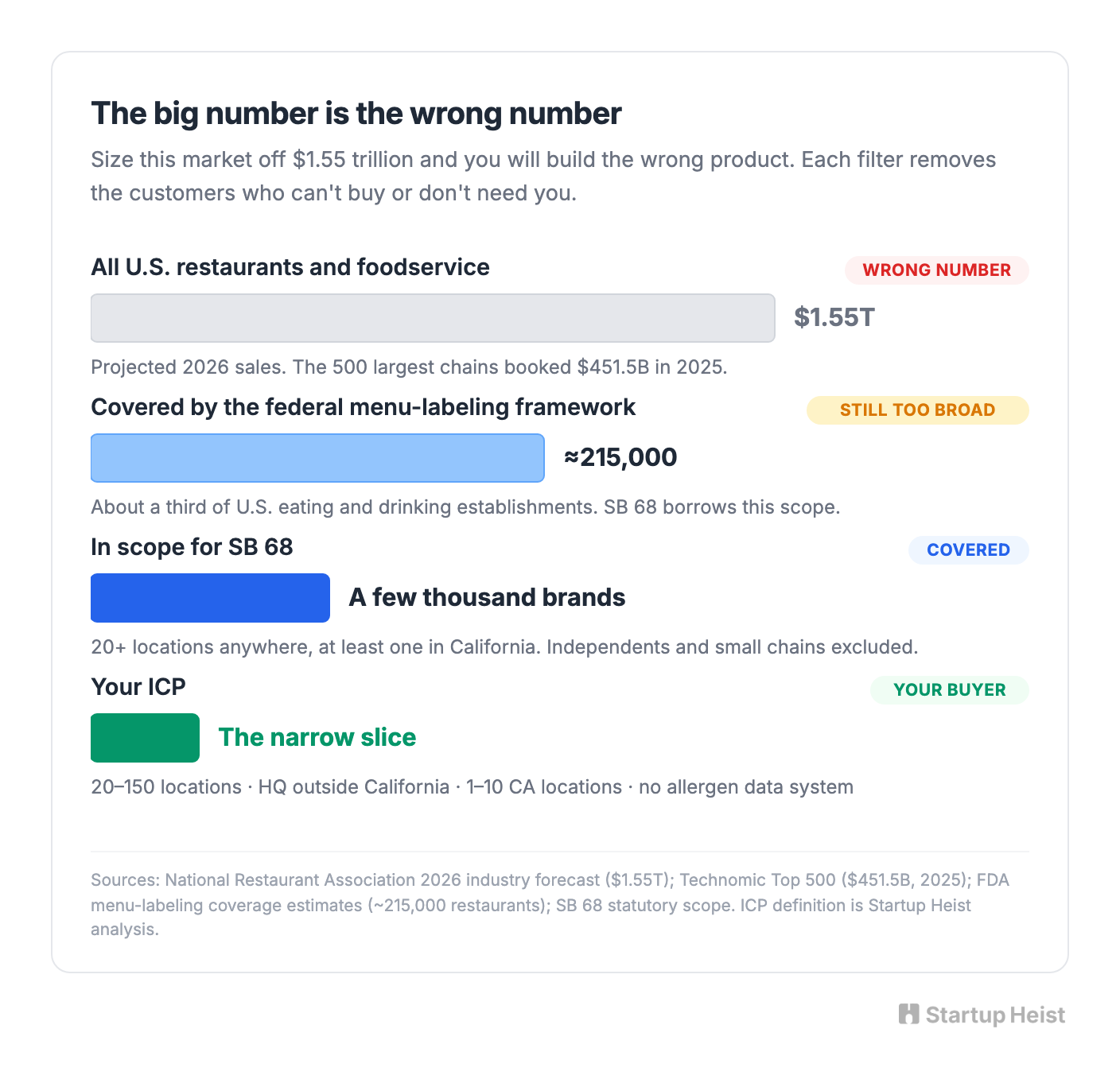
The federal FDA menu-labeling framework that SB 68 borrows already covers roughly 215,000 U.S. restaurants, about a third of the country's eating and drinking establishments. SB 68 takes that population and filters it to brands touching California. It excludes independents and small chains entirely. At the top, the national brands already employ food-safety teams, nutrition consultants, enterprise allergen software vendors, and outside counsel. They aren't your customer either.
What's left is specific:
A 20- to 150-location brand headquartered outside California, with one to ten California locations, no mature allergen-data system, and enough operational complexity to make spreadsheet compliance painful.
These brands are large enough to have a real food allergen compliance problem and small enough to lack a regulatory technology stack. They run a corporate website menu, a mobile ordering site, printed menus, drive-thru boards, kiosks, third-party listings on DoorDash and Uber Eats, franchise-specific variations, and limited-time offers that turn over every quarter. CRA guidance says the disclosure requirement reaches all of it: printed menus, menu boards, drive-thru boards, kiosks, websites, mobile apps, online ordering platforms.
Every one of those surfaces is a place for the allergen data to drift out of sync. The regulation creates the sale, and the operational mess creates the renewal.
The real risk isn't the health inspector
Most coverage of this law has the risk backwards. The statute lets enforcement agencies verify disclosures visually. An inspector can read a printed menu, pull up the digital version, ask to see the written alternative. But the statute doesn't create a new penalty scheme. It rides on the existing California Retail Food Code. Build your pitch around imminent fines and you're building on sand.
The actual exposure is civil. SB 68 requires disclosure of allergens the facility "knows or reasonably should know" are ingredients in each menu item. Fisher Phillips flags what that phrase does: it gives operators some cover for things outside their control, and it hands plaintiffs' attorneys a factual question for a jury. The firm expects lawyers to test the edges of that standard, and notes that liability climbs the moment a guest has told your staff about an allergy.
The operative question is what the restaurant should have known. The answer lives in supplier specification sheets, recipe files, and change logs — documents most 40-unit chains keep in a shared drive, in whatever format the distributor last emailed over. A brand that publishes a beautiful allergen grid and can't show where the data came from has manufactured a liability and called it a defense. The whole business sits in that distinction.
Build the coverage checker first
The first product answers one question: does SB 68 apply to us?
Unlock the Vault.
Join founders who spot opportunities ahead of the crowd. Actionable insights. Zero fluff.
“Intelligent, bold, minus the pretense.”
“Like discovering the cheat codes of the startup world.”
“SH is off-Broadway for founders — weird, sharp, and ahead of the curve.”


