


The $5K Factory Walkthrough That Makes Robots Less Scary
The Opportunity
Every factory automation sale has two buyers.
The first is management. They care about throughput, labor availability, yield, safety, cost per unit, and staying competitive against plants already further along on industrial robots and warehouse automation.
The second is the floor. Operators care about whether the new machine makes their job harder, exposes them to blame, slows down the line, threatens their role, or turns a familiar workflow into a confusing mess.
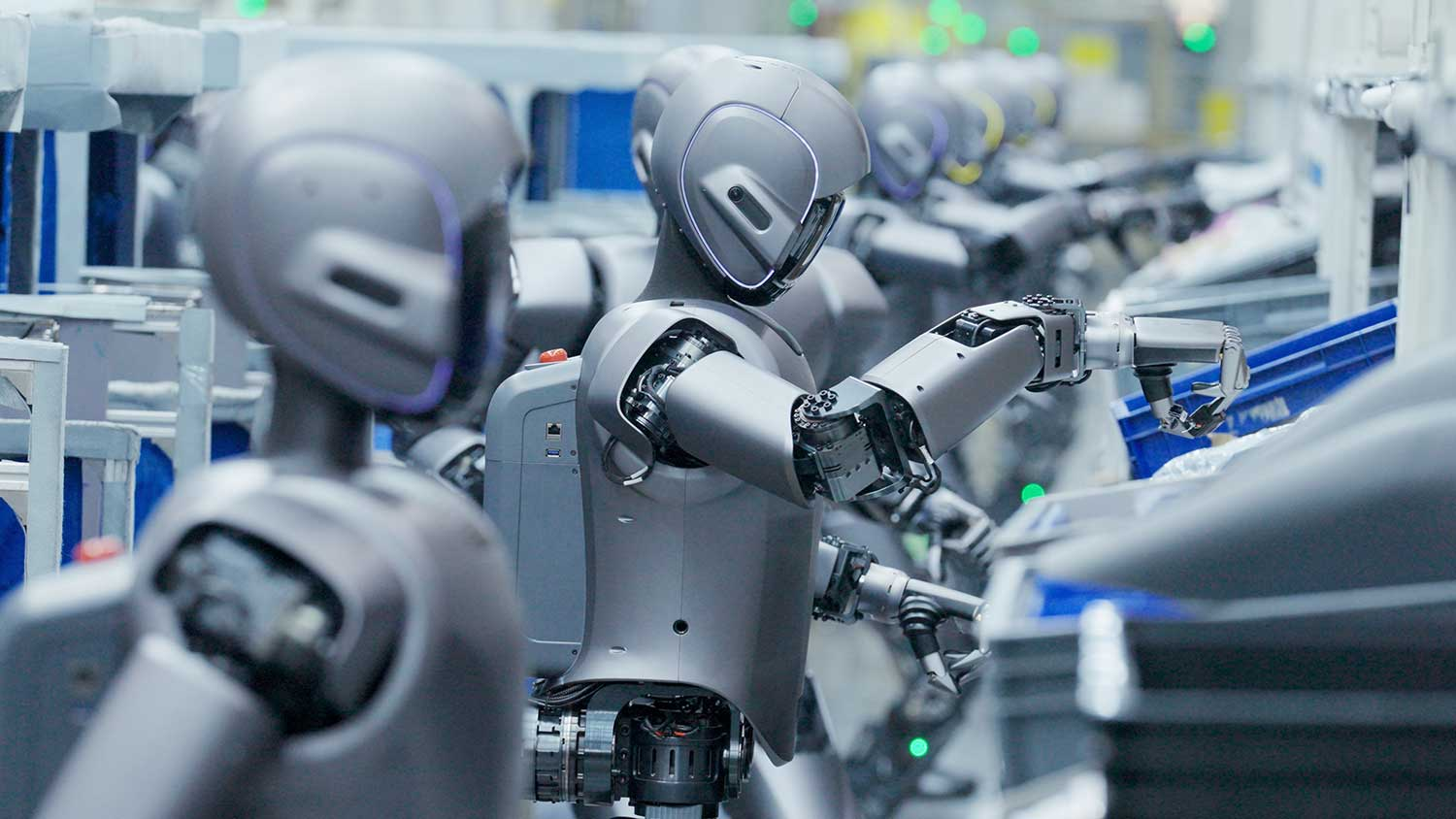
Most industrial vendors sell hard to the first buyer and hope the second buyer gets trained later. The gap between those two sales is the opening.
Here's the opportunity.
The money: Solo founder builds 8 modules per month at $5K = $40K MRR. Scale to 20 vendor retainers at $3K/mo = $60K MRR before project fees.
Inside:
• 4-tier pricing from $3K starter to vendor retainer
• 5-step MVP workflow built on templates
• Channel-led GTM through industrial integrators
• 4 moats including template library + adoption data
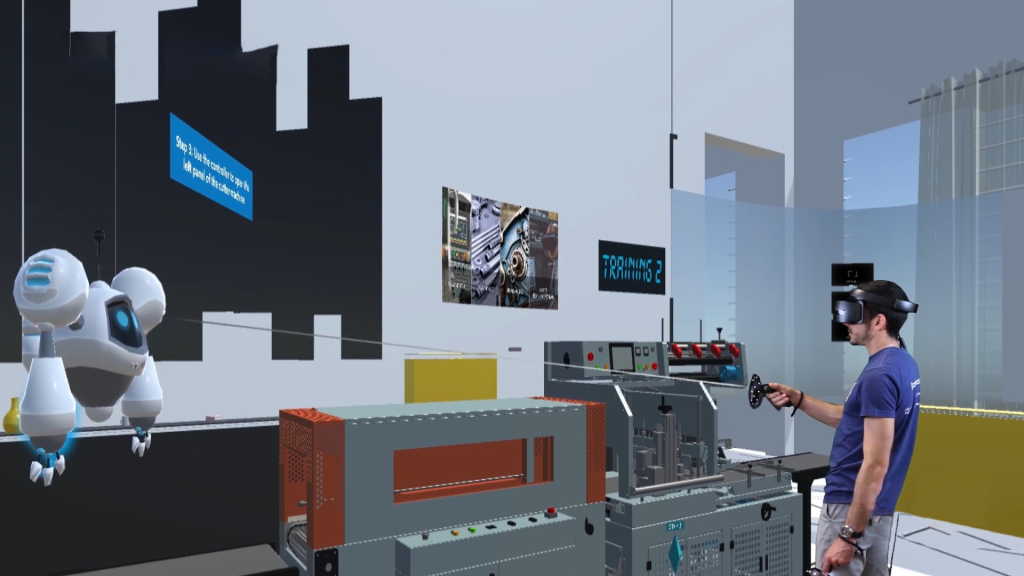
The play is a productized micro-agency that builds ultra-short 3D walkthroughs for factory technology rollouts. A five-minute visual preview of the new layout, machine cell, robot workflow, safety zone, handoff process, or operator station. It runs in VR if the customer wants. The same underlying scene also works on a tablet, laptop, wall display, or projector.
Price is $3,000 to $10,000 per walkthrough, sold as a deployment add-on through robotics vendors, AI inspection vendors, systems integrators, warehouse automation companies, and industrial software platforms.
The pitch fits on one line. Your robot may be good. Your rollout may still fail because people don't understand what's about to change. Add a cheap visual walkthrough before installation and you reduce fear, confusion, and late-stage objections.
This isn't a metaverse company. Don't say metaverse. Call it industrial sales insurance.
Why This Exists Now
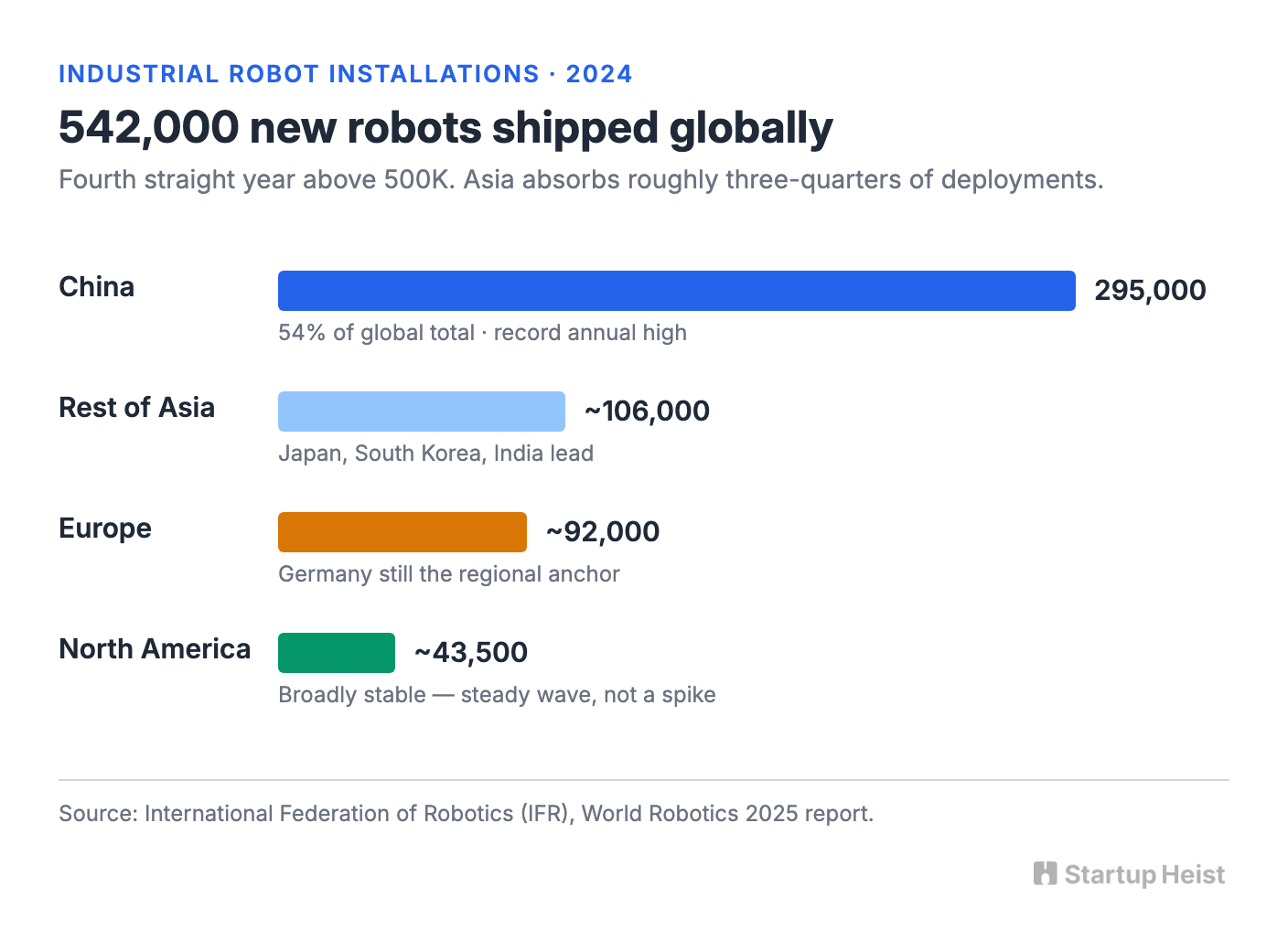
Factories are buying more automation than ever. The International Federation of Robotics reported 542,000 new industrial robot installations globally in 2024, the fourth straight year above 500,000 units and more than double the level of a decade earlier. Asia absorbed roughly three-quarters of new deployments. China alone installed 295,000 units, the highest annual total on record for any country. North American installations sit closer to 43,500 units and have been broadly stable, so the U.S. story isn't a volume explosion. It's a steady, ongoing wave of robot deployment that still keeps generating the same adoption problem on every floor.
Every new robot arm, vision system, mobile robot, AI inspection station, cobot cell, or warehouse automation layer creates a human adoption problem. Technology gets sold as efficiency. On the floor it's experienced as disruption.
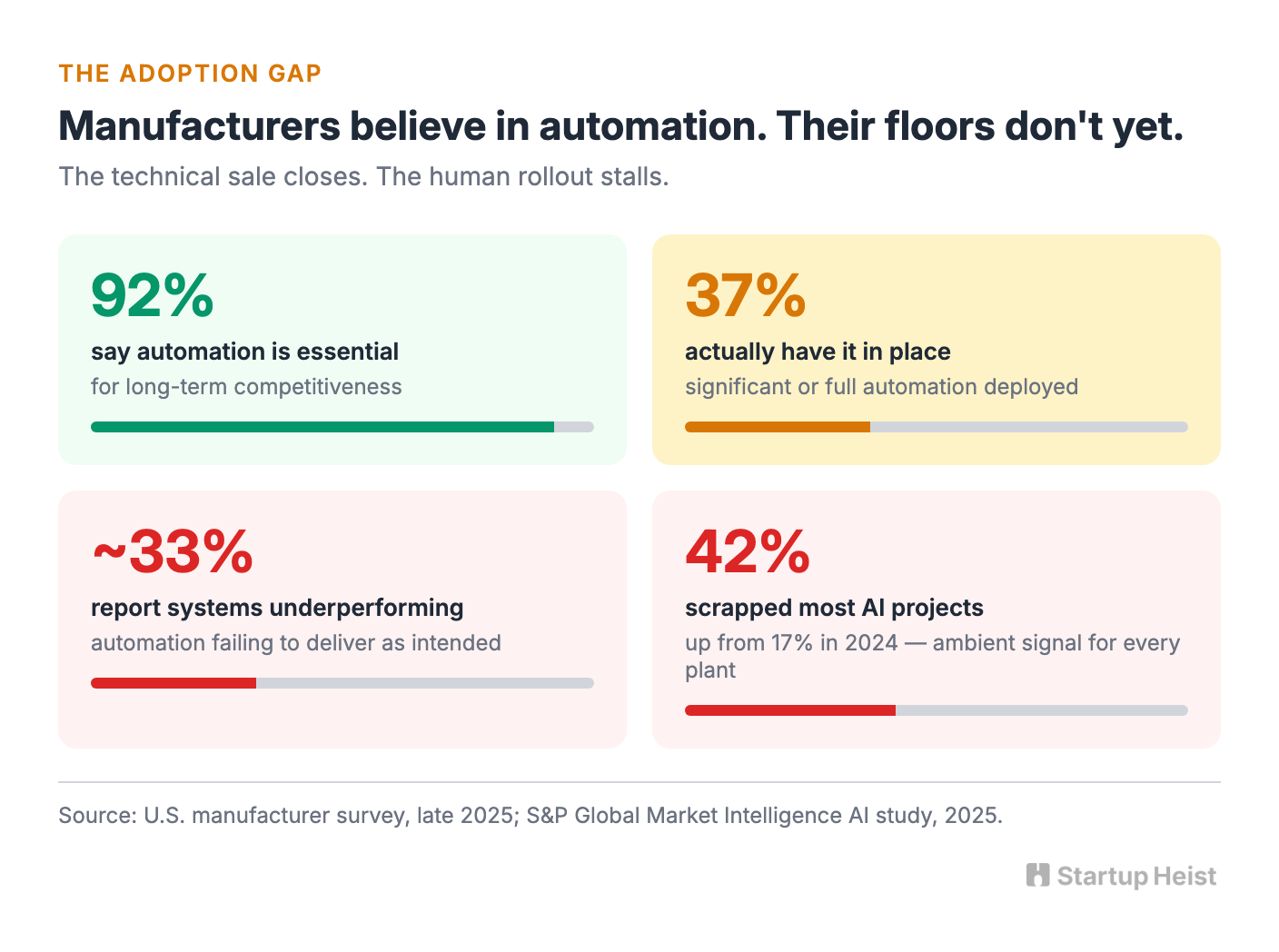
That disruption isn't landing softly. A late 2025 survey of U.S. manufacturers found 92% consider automation essential for long-term competitiveness, yet only 37% report significant or full automation in place. Roughly one-third of manufacturers report that automation systems are failing to perform as intended. Zoom out to enterprise AI projects broadly and the picture is worse: S&P Global tracked the share of companies scrapping most of their AI initiatives jumping from 17% in 2024 to 42% in 2025. Not all of that is factory floor automation, but it's the ambient signal every plant manager is reading.
The reasons rarely come down to bad hardware. They come down to bad rollout. Mercer's 2026 Global Talent Trends survey of 12,000 workers found 40% fear losing their jobs to AI, which slows union approvals and retraining. Reprogramming robots for a new product variant can take six months while humans adapt in hours. Vendors with deep machine expertise often lack experience integrating that machine into the actual rhythm of a real plant.
So when an operator sees a robot being installed, the question isn't just "how do I use this." It's "what happens to me." Pre-deployment visualization sits earlier in the cycle than training. Training assumes the decision is already accepted. Visualization helps workers see what's coming before it lands on the floor.
The immersive training market itself is large and growing. Grand View Research pegged it at about $16.4 billion in 2024, projected to reach $69.6 billion by 2030. Roughly 57% of that is hardware. The pure content and services slice, where this product would live, is smaller but real. Most VR training vendors aren't fighting for it. They chase bigger enterprise programs: safety modules, onboarding systems, simulation platforms, analytics dashboards, headset fleets, LMS integrations.
A gap sits below them. A factory doesn't always need a $75,000 VR pilot or a six-month immersive learning program. Some rollouts need a five-minute, good-enough visual walkthrough that lets operators understand the change, ask questions, and stop imagining the worst.
That's the heist.
The Pain: Vendors Lose Deals After They Win
Industrial vendors are used to selling ROI. They show the plant manager a payback model, the CFO labor savings, engineering a spec sheet, operations a throughput improvement. Then implementation starts.
The line has to be reconfigured. Operators change handoffs. A safety cage appears where there used to be open movement. A robot arm changes the rhythm of the shift. A machine vision system creates new rejects. A warehouse robot rewrites picking routes. Maintenance gets nervous about who owns downtime. Supervisors worry that the new system will make them look incompetent for three months.
The vendor technically delivers. The customer still feels pain. Delayed installation, low utilization, extra change orders, angry operators, supervisors quietly reverting to old workflows, training overruns, political pushback, future expansion deals frozen.
This is the hidden tax on industrial automation. The vendor's real problem isn't whether the machine works. It's whether the plant adopts it smoothly enough that the vendor gets the next purchase order. So the first customer of this business isn't the factory. It's the automation vendor who wants their deployment to feel safer.
The Product
The product is a Factory Change Walkthrough.
It's a short, guided 3D walkthrough of a coming operational change. Designed for comprehension, not cinematic realism. A typical module includes a simplified digital layout of the work area, the new machine or cell, a before-and-after view, operator movement paths, safety zones, material flow, key handoffs, common "what changes for me" moments, optional voiceover or captions, and a five-question feedback survey. Delivery is browser, tablet, and projector by default. Headset is optional.
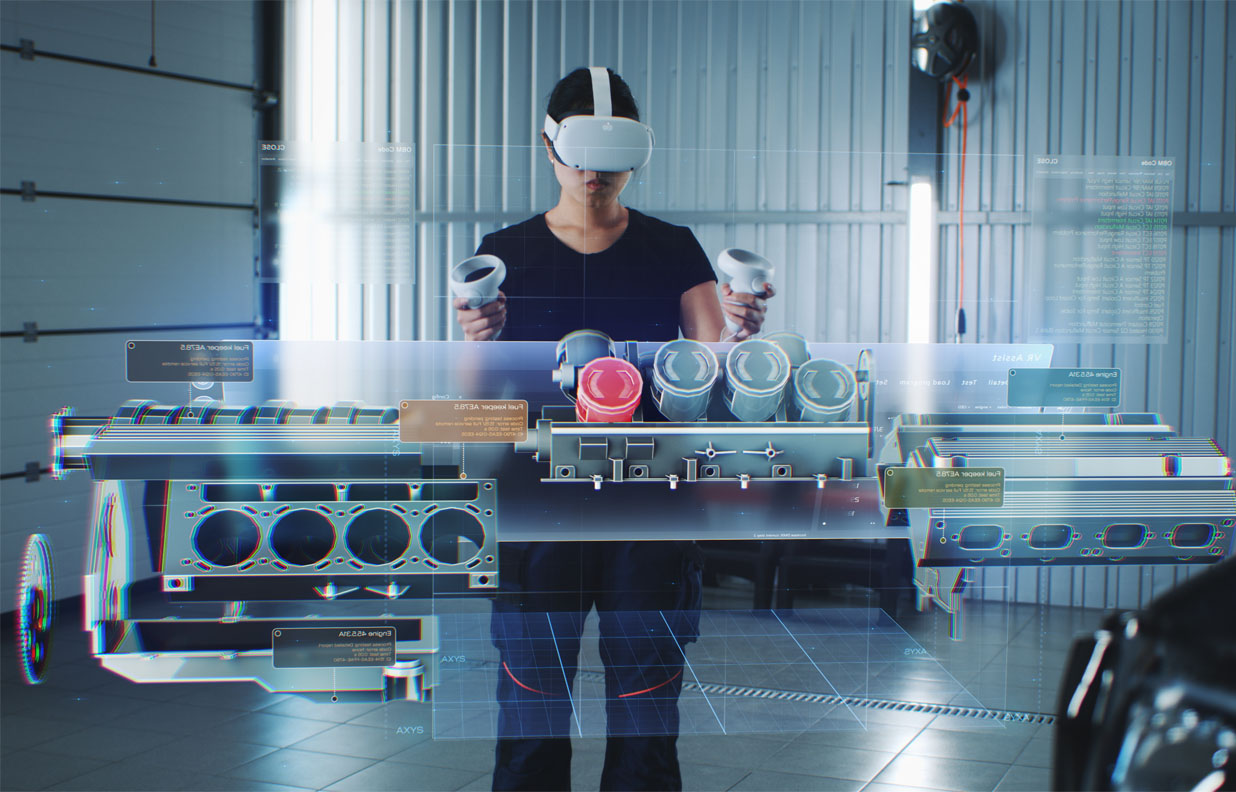
The output should feel closer to an industrial briefing than a video game. Building a beautiful digital twin would be a mistake. That isn't the buyer's immediate need. A perfect twin is expensive, slow, and overkill. The buyer needs clarity.
A good walkthrough answers five questions. What is changing. Where will it go. How will my workday look different. Where are the safety risks. What can I object to or clarify before installation. Five minutes is a feature. Factory workers don't need a 45-minute headset experience. They need a concrete preview before rumor fills the gap.
Why the Price Window Works
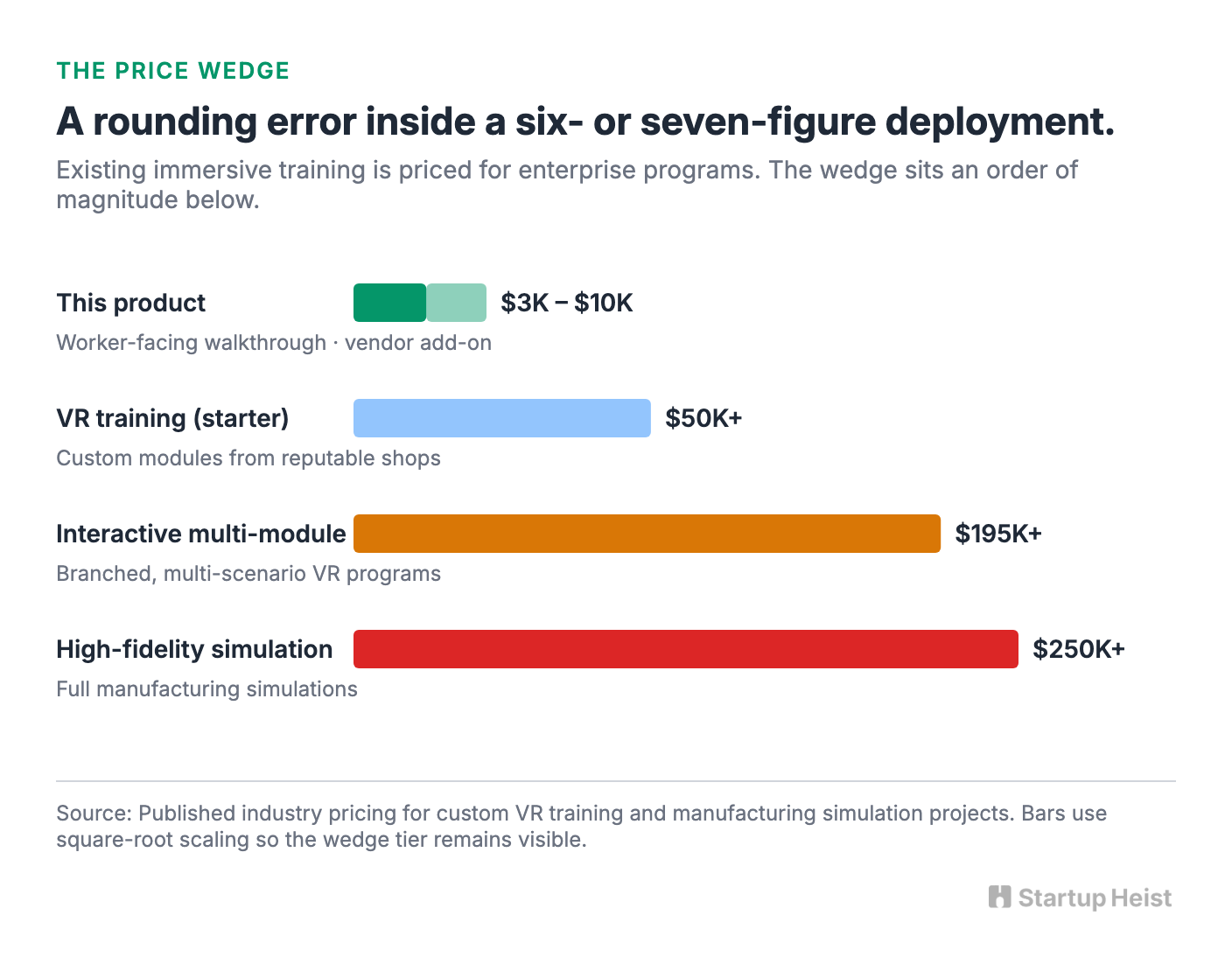
The target price is $3,000 to $10,000 per walkthrough.
That sounds small in consumer software terms. In industrial deployment terms it's a rounding error. A robot cell, automation project, warehouse system, or AI inspection rollout can easily be a six- or seven-figure capital project. A $5,000 visualization add-on rides inside that deployment budget as risk reduction.
The business model insight is this. Don't make the factory create a new purchasing category. Make the vendor include it as an optional line item. "Change visualization module: $5,000." Small enough to avoid procurement drama, large enough to produce real margin.
It also undercuts the existing market. Custom VR training projects routinely start at $50,000 per module from reputable shops. Interactive, branched, multi-module programs begin around $195,000. High-fidelity manufacturing simulations climb past $250,000. The incumbent market is optimized for large immersive training programs. This startup is optimized for quick deployment confidence.
The deliverable is intentionally constrained. No full facility model. No high-fidelity machinery unless CAD assets already exist. No custom physics simulation. No LMS integration in version one. No expensive headset fleet management. No multi-hour curriculum. No pretending to be a compliance certification product.
The product is a visual bridge between the sales deck and the installation. That's the whole point.
The Wedge Offer
The first offer should be narrow.
"We turn your deployment plan into a five-minute worker-facing visual walkthrough in 10 business days."
No VR transformation. No immersive industrial metaverse. No digital twin platform. A vendor should understand how to resell it in 30 seconds.
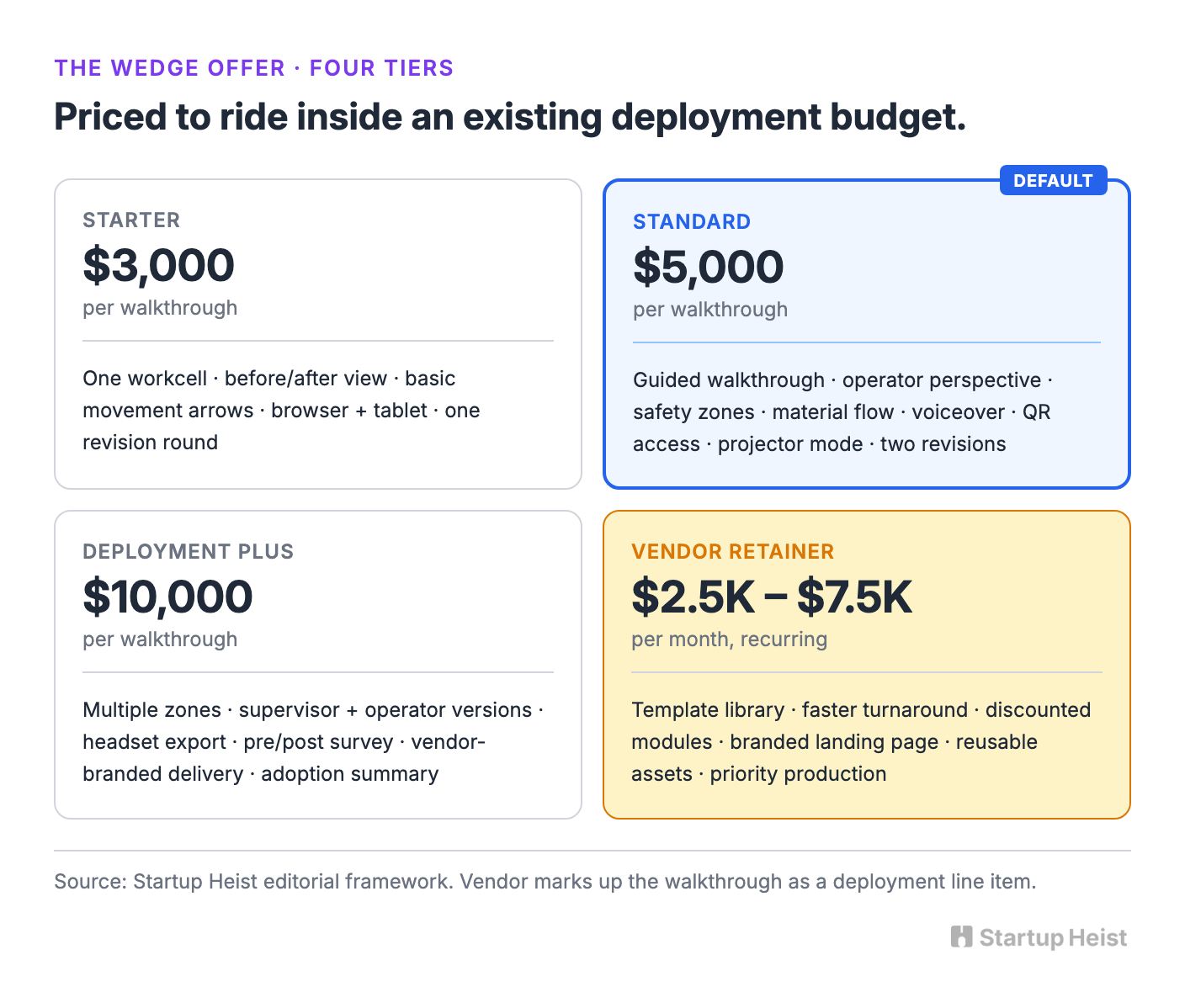
Package it in four tiers.
Unlock the Vault.
Join founders who spot opportunities ahead of the crowd. Actionable insights. Zero fluff.
“Intelligent, bold, minus the pretense.”
“Like discovering the cheat codes of the startup world.”
“SH is off-Broadway for founders — weird, sharp, and ahead of the curve.”


