


The Student Receipts Business: A Black Box for Academic Writing in the AI Era
The next academic-integrity company won't look like a proctoring company. It'll look like a receipt folder.
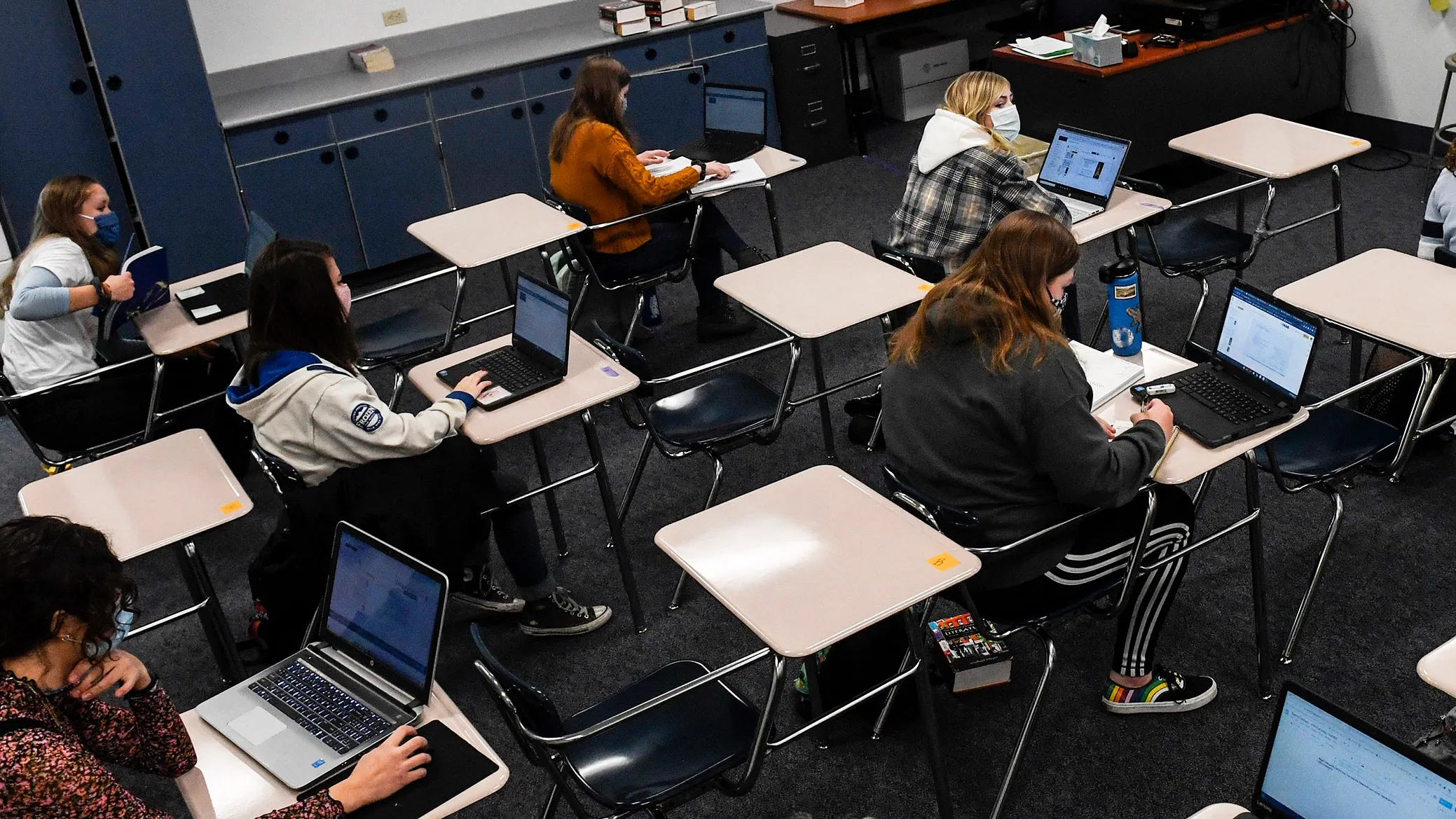
Schools are entering the AI era from the enforcement side. On May 11, 2026, Princeton's faculty voted to require proctoring for every in-person exam starting July 1, 2026. The vote was 133 years in the making and nearly unanimous, with one opposing vote. The stated catalyst isn't old-fashioned cheating. It's that AI has made proof of authorship hard to verify after the fact. Once a student submits an essay, a teacher may no longer know whether the work was written, pasted, polished, translated, brainstormed, or quietly assembled by a model.
Students and parents are entering the same era from the defense side. On May 5, 2026, a Palo Alto family filed a federal civil-rights lawsuit in the Northern District of California after their tenth-grade son was accused of using AI on an English essay. The reported evidence packet ran 1,162 pages: drafts, timestamps, handwritten notes, Google Docs revision history. The school had typed up the student's handwritten rewrite, run it through Turnitin without parental consent, and rejected a family settlement offer. The complaint alleges gender disparity in enforcement (male students flagged 4–5x more often), national-origin discrimination against Asian students, and an "abnormal obsession" with Turnitin scores.
The Palo Alto case isn't an outlier. It's the prototype. Here's the opportunity:
The money: 5,000 families at $99/year is roughly $500K ARR before services. Add 500 expert packets at $199 and another $100K lands.
Inside:
• Full MVP scope for Google Docs first
• Four-phase buyer sequence, parents to schools
• Pricing ladder from free to $399 expert review
• Six real landmines and how to design around them
The opportunity isn't beating Turnitin. It isn't helping students evade detectors. It isn't spying on your kid's laptop. It's a student-controlled proof-of-authorship product: a quiet recorder that captures how an essay actually came into existence, then exports a clean, teacher-readable packet when someone asks. The market is academic-process insurance.
The Old System Ran on Trust. The New One Runs on Logs.
For a century, schools could pretend authorship was mostly visible. A teacher recognized a student's voice. Suspicious passages could often be found. The system was imperfect, but the basic assumption was legible: writing left fingerprints.
AI breaks that assumption in a single workflow. A student can use ChatGPT to brainstorm a thesis, Gemini inside Google Docs to rephrase a paragraph, Grammarly to polish, a translation tool to bridge languages, and a citation helper to clean up sources. Some of that may be allowed. Some forbidden. Some ambiguous. The final essay alone cannot explain the workflow.
This is why Princeton broke its own honor code, and why the U.S. higher-ed proctoring market (estimated by ListedTech at around $60 million across more than 400 contracts) keeps growing. Institutions no longer believe student work can be evaluated without procedural evidence. But proctoring solves the school's problem. It doesn't solve the student's. A proctored exam says, "We watched you." A proof-of-authorship product says, "Here is how this work came into existence." The first protects institutions. The second protects honest students in a world where the default suspicion level is climbing.
Detectors Built the Accuser-Side Market. False Positives Are Building the Defense-Side.
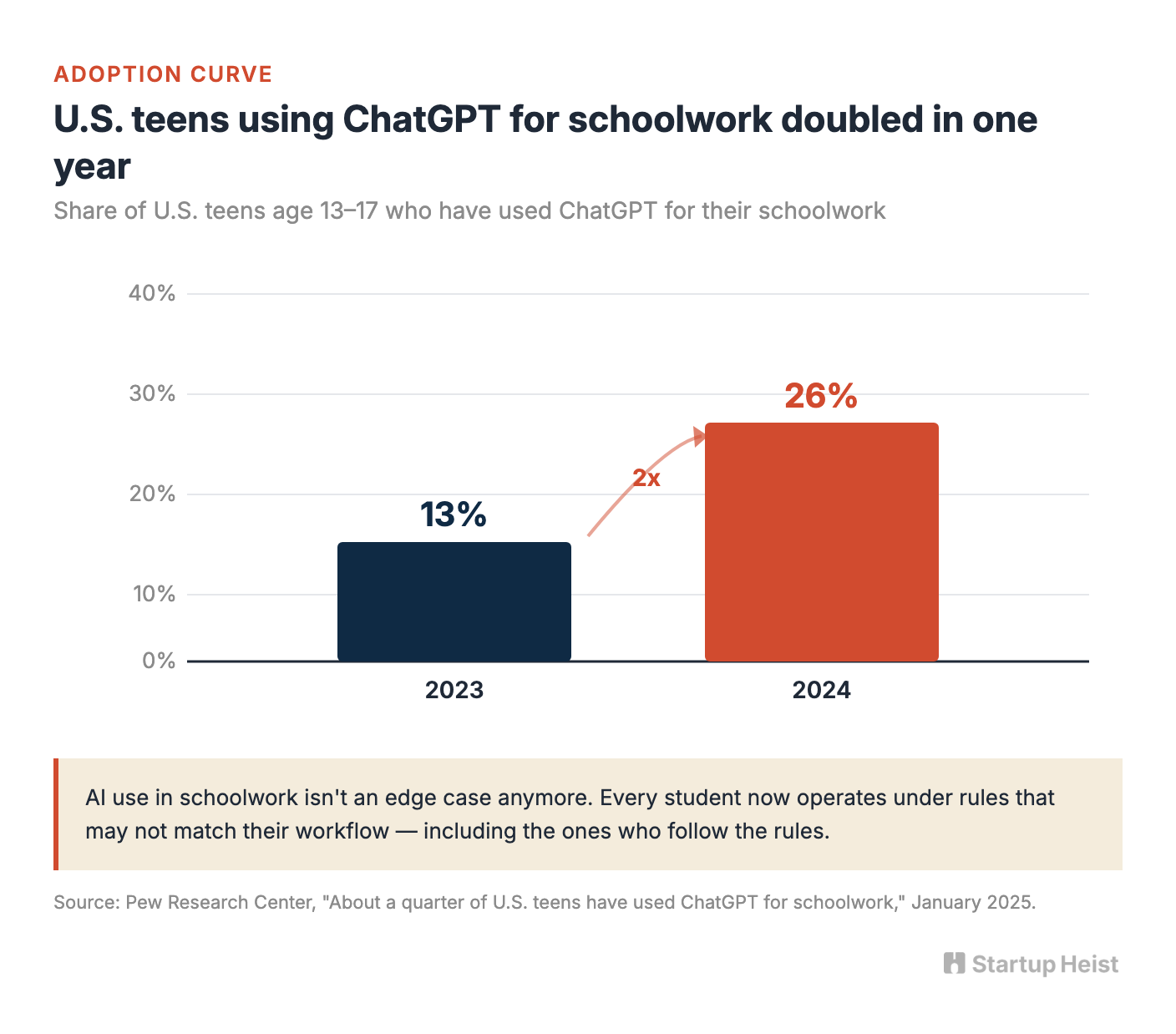
Turnitin moved fast because schools needed anything that looked like a response to ChatGPT. By May 2023 the company said 38.5 million submissions had passed through its AI detector, with 9.6% flagged as more than 20% AI-written. That's real distribution. It's also a structural backlash waiting to happen.
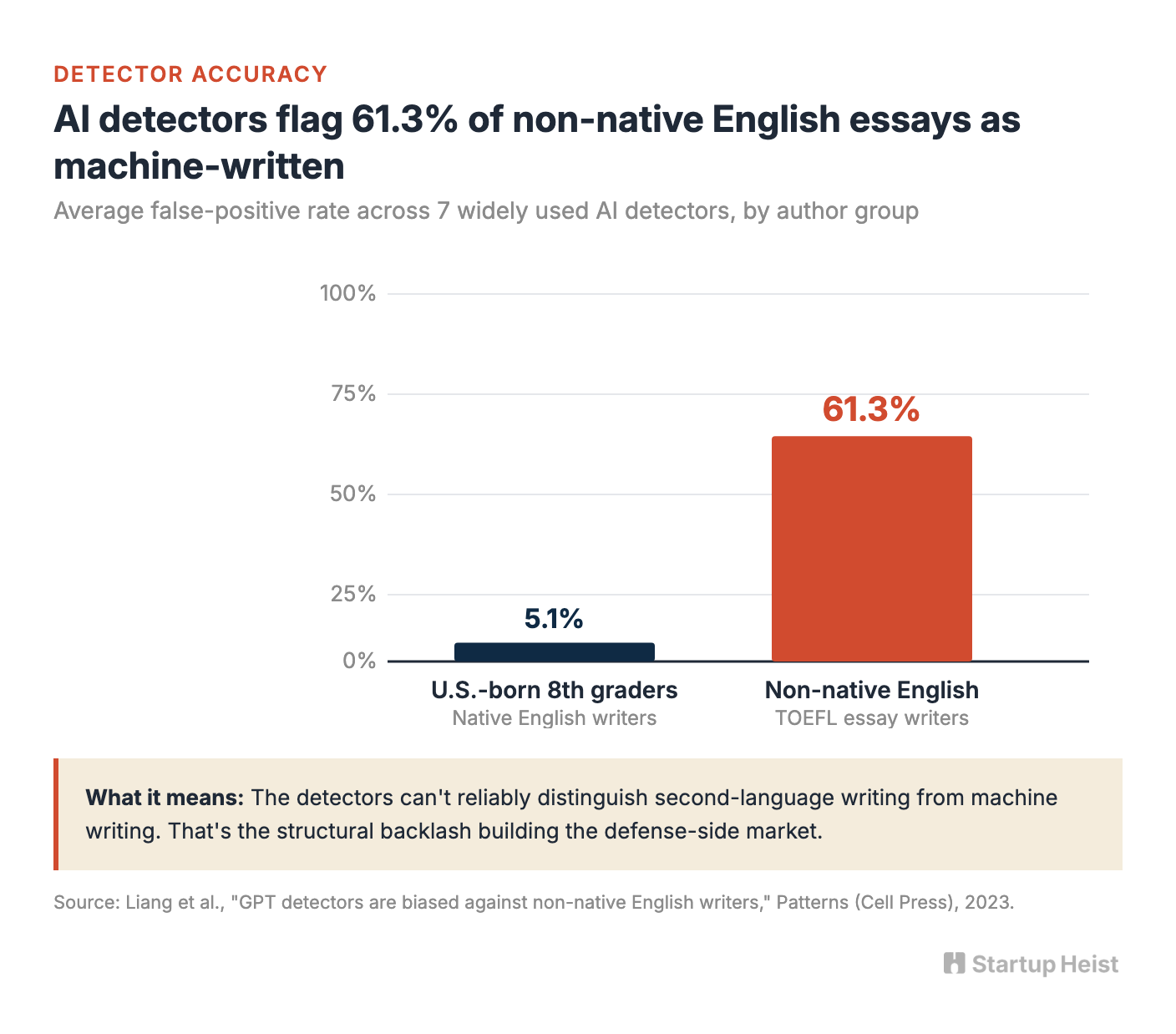
A Stanford-led study found that seven widely used AI detectors misclassified non-native English writing as AI-generated at an average false-positive rate of 61.3%. The detectors couldn't distinguish writing in a second language from writing produced by a machine. Vanderbilt disabled Turnitin's AI detector in August 2023. Waterloo went further in September 2025 and killed the feature entirely. MIT's teaching guidance is blunt: "AI detectors don't work." The recommended alternative isn't more detection. It's clearer policy, transparency, and assessment design.
Schools don't fully trust pure detection. Students don't trust accusations based on it. Teachers still need a way to evaluate whether AI was used appropriately. Parents need a way to defend a child who followed the rules but can't prove it cleanly. The missing layer isn't another detector. It's provenance, and the productized translation of provenance into something a teacher will actually read.
Capture Is Already Commoditized. The Wedge Is the Packet.
Three categories of player already exist in the authorship space, and they reveal where the open ground actually is.
Grammarly announced Authorship in August 2024 and rolled out the Google Docs beta that fall, then expanded into Microsoft Word and Canvas LMS. Students and instructors have generated nearly five million Authorship reports, averaging roughly 75,000 per week during the academic year. A second category sells raw capture: WritingTrace, GPTZero Writing Replay, Originality.ai's writing-replay extension, and Draftback all record keystrokes, paste events, and draft evolution in Google Docs. A third category, academic-integrity lawyers, has begun to advertise paid services for AI misconduct cases.
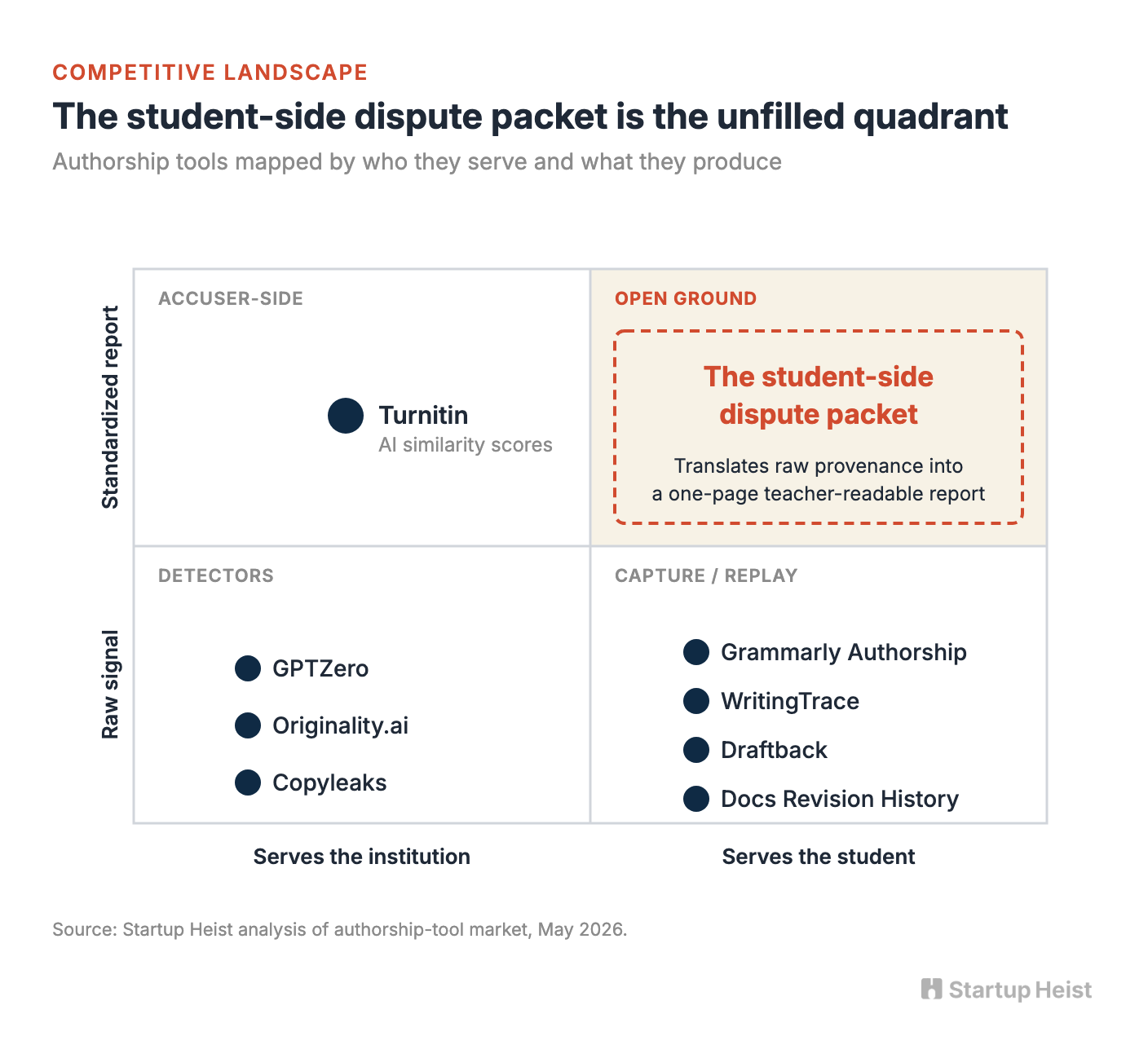
Those three categories triangulate the gap. Capture is commoditized. Detection is broken. Legal defense is expensive and reactive. The unfilled position is the standardized, student-controlled dispute packet: the format a teacher recognizes, a tutor recommends, a parent understands, and an academic-integrity committee accepts as a starting point. The product isn't the recording. It's the receipt. Replay tools dump raw data. A dispute packet translates that data into a one-page narrative that a teacher will read on a Wednesday afternoon between classes.
The Palo Alto family had to assemble 1,162 pages after the accusation landed. The opportunity is to productize the packet before the accusation lands, and compress it down to something a teacher will actually open.
The Product: A Black Box Recorder With a Translation Layer
Call it something like ProofDraft, DraftTrail, Authorship Locker, or Essay Receipts. The promise:
"Write normally. If anyone questions your work, export your authorship record in one click."
The MVP should focus on Google Docs first. That's where the workflow already lives in K-12 and most of college. Microsoft Word and Canvas come later.
Core feature set:
Unlock the Vault.
Join founders who spot opportunities ahead of the crowd. Actionable insights. Zero fluff.
“Intelligent, bold, minus the pretense.”
“Like discovering the cheat codes of the startup world.”
“SH is off-Broadway for founders — weird, sharp, and ahead of the curve.”


