


Europe Made One Sentence Mandatory. The Money Is in Proving You Said It.
On August 2, 2026, Article 50 of the EU AI Act started applying.
The rule is small enough to fit on a napkin. If you provide an AI system that interacts directly with people, meaning a support chatbot, a voice agent, an in-app assistant, you have to tell the person they're talking to AI. Unless that fact is already obvious.
The European Commission is specific about execution. People must be informed from the start of the first interaction, in a clear and distinguishable manner, and in line with accessibility requirements. Page 47 of the terms of service doesn't count. The Commission also says the obviousness exemption should be read restrictively, since it strips transparency from someone who would otherwise get it.

The number everyone quotes is €15 million or 3% of worldwide annual turnover.
Forget it. It's the wrong number for the company you'd be selling to, and leading with it makes you sound like a scam.
The fear pitch dies on two facts. The Act's own penalty structure treats small companies differently: for SMEs and startups, the fine is calculated as the lower of the fixed amount and the percentage, and the Commission has said proportionality applies to smaller businesses. A five-person SaaS with a support bot isn't looking at €15 million. The second fact matters more. The enforcement machinery barely exists yet.
That absence is where the actual opportunity hides, and almost everyone building here has it backwards.
The short version:
The money: 500 Pro seats at $199 a year is $99,500 in ARR. Add the Team and Agency tiers and you land around $224,000 solo.
Inside:
• Four-layer build, free widget to evidence log
• Eight-week ship plan with a free scanner
• Annual pricing: $199 / $499 / $1,490
• Agency channel math and the kill criteria
The requirement is a sentence. The work is a backlog item.
Article 50 is unusual because it lands inside the product surface rather than a policy binder. Most regulation asks a company to write a document; this one asks an engineer to change an interface.
Which turns into a small, annoying stack of tasks:
Add the disclosure, put it where the user actually sees it, and make sure it fires before the first message rather than after. Make it accessible. Translate it. Then confirm it's still there in six months, on mobile, in German, after the redesign.
This is the exact profile that produces micro-SaaS. The regulation is complicated, the implementation is trivial, and the customer has no interest in learning the distance between those two things.
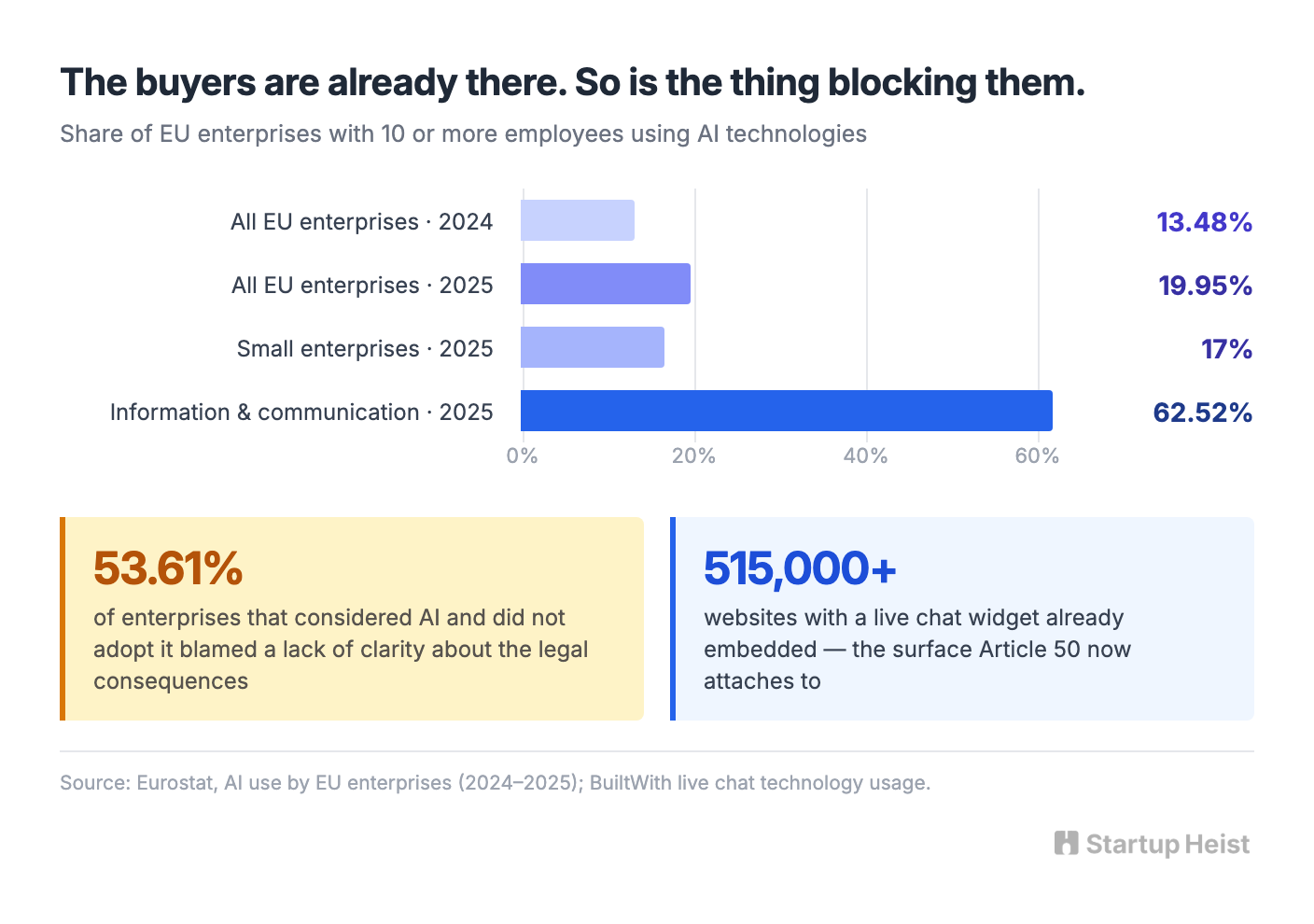
The installed base is real and growing fast. Eurostat put AI use among EU enterprises with 10 or more employees at 19.95% in 2025, up from 13.48% in 2024. Among small enterprises it hit 17%. In information and communication, the sector closest to the software companies you'd be selling to, it was 62.52%. BuiltWith counts more than 515,000 websites with live chat embedded.
The hesitation figure is the interesting one. Among enterprises that considered AI and didn't adopt it, 53.61% cited a lack of clarity about the legal consequences. Legal uncertainty is blocking purchases, and the buyers said so themselves.
The widget is already free
Two weeks after the rules took effect, the basic feature had already collapsed to zero.
Qadar AI ships a drop-in JavaScript widget that renders Article 50 disclosure labels in all 24 official EU languages, runs inside a Shadow DOM so nothing leaks either direction, makes no network calls, and costs nothing at any volume. On WordPress, Legibright gives away a GPL-licensed plugin that scans your live site, detects Intercom, Tidio, Crisp, Drift, Zendesk, LiveChat, Tawk.to, Voiceflow and thirty-odd other chat platforms, and drops in a multilingual "you are talking to an AI" notice. StudioMeyer's Transparency Toolkit does the same thing entirely in local PHP. Klarvo and EU AI Act Ready both hand out a free readiness score to get you into a funnel.
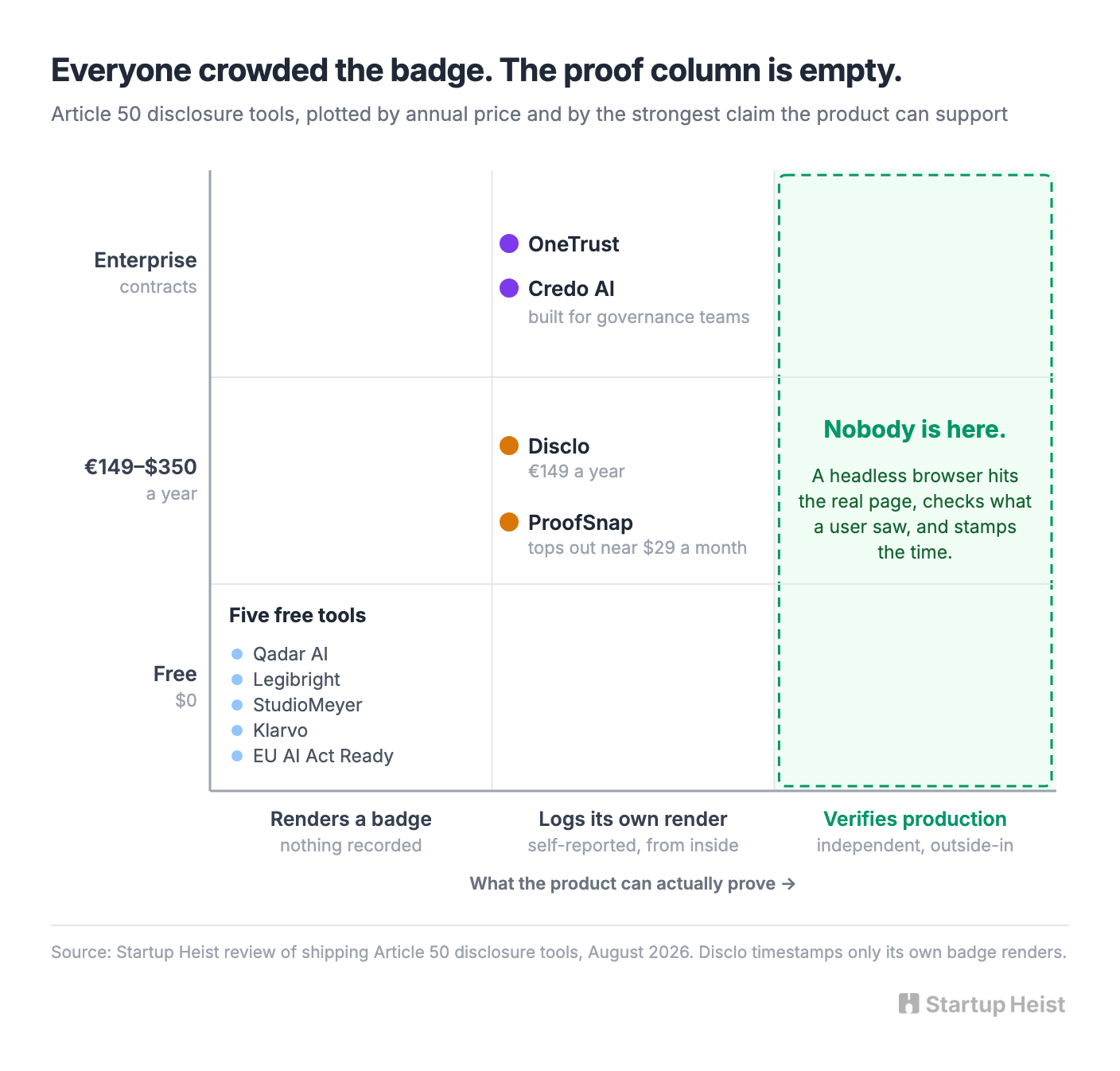
None of these are weak products. Legibright's chatbot fingerprinting across thirty-plus platforms is the single hardest piece of engineering in the category, and it is free and open source with fewer than ten active installations. The commodity layer arrived before the market did.
"We put an AI badge on your chatbot" isn't a company. An npm package does that, a chatbot vendor will eventually ship it natively, and a developer hard-codes it in ten minutes and never thinks about it again.
The regulation creates the wedge. Nothing about it creates a moat.
Your customer is not the regulator
Everyone selling €15 million horror stories has missed the same thing.
Member states were supposed to designate their national competent authorities by August 2, 2025. Only eight of twenty-seven did. That gap surfaced during the Digital Omnibus debates in the European Parliament, and it is a large part of why the EU pushed high-risk AI obligations out to December 2, 2027 for standalone systems and August 2, 2028 for AI embedded in regulated products.
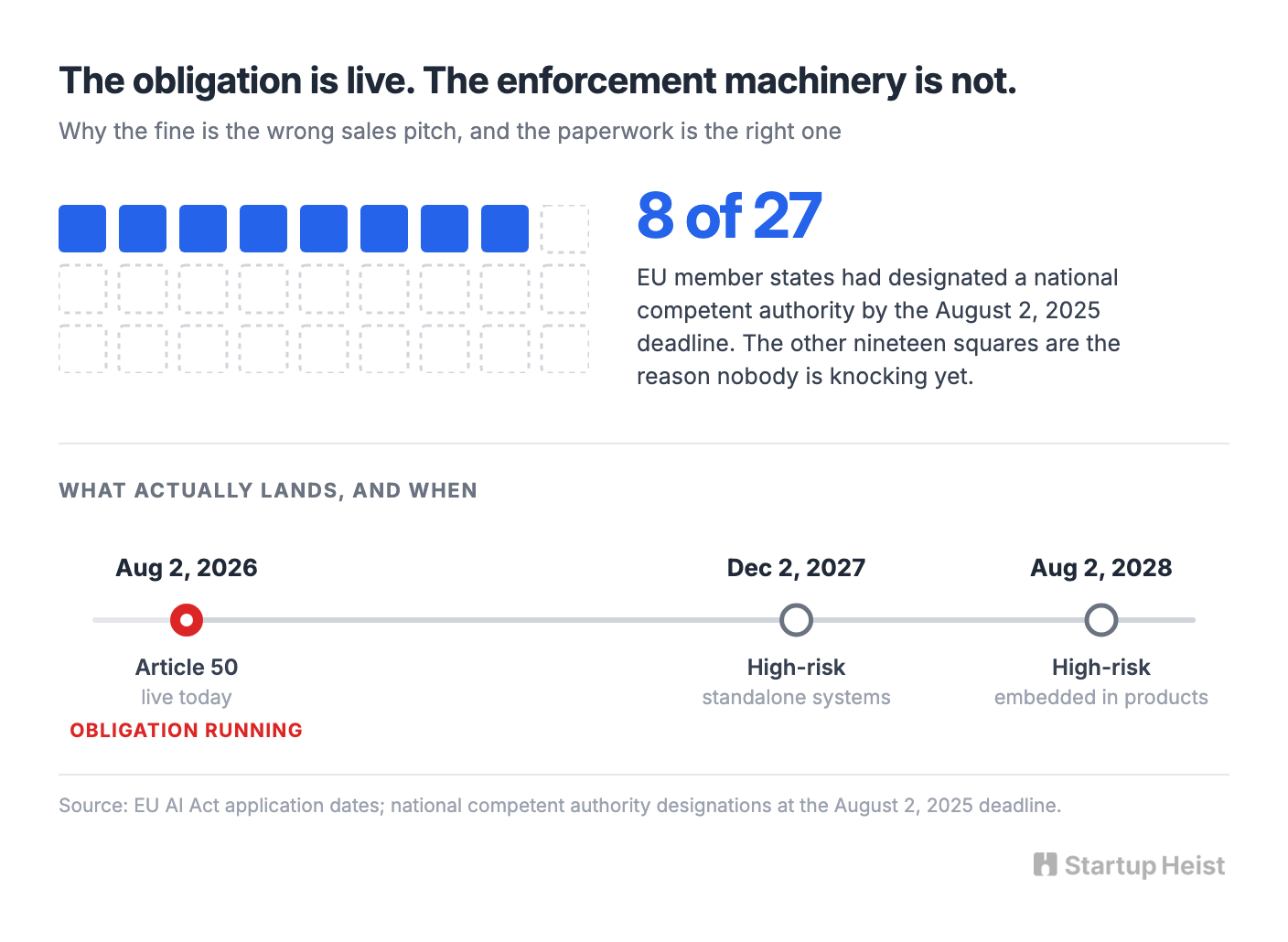
The honest picture on August 16, 2026 is a live obligation sitting behind a thin and uneven enforcement apparatus.
If your business model is "a regulator will punish you," you're selling against a clock that hasn't started.
Something else did move. On June 10, 2026, the Commission published a voluntary Code of Practice on Transparency of AI-generated Content. By the end of July, roughly 190 organizations had signed it, including OpenAI, Anthropic, Google, Microsoft, Meta, Mistral and Synthesia, alongside Getty Images, Lenovo, Lufthansa and Bulgari. About half the signatories were small, recent companies. Signing buys a degree of presumption of conformity, which is a formal way of saying it buys you documented evidence of good faith.
They signed a document whose main benefit is being able to prove something later. That's the buying trigger, and it looks like paperwork rather than punishment.
An enterprise procurement team sends a vendor questionnaire asking what AI disclosures you provide to European users, and "we added it, I think" doesn't close the deal. Your own lawyer asks which version of the disclosure was live in October, and somebody has to go look. The chat widget gets redesigned in November, the notice quietly disappears, and nobody finds out until a customer does.
Every company shipping an AI feature into Europe is about to acquire a small, recurring documentation problem. Almost none of them have a system for it.
The widget is free. The receipt is not.
The four layers you actually build
The product is a proof system with a free component attached. Build it in this order; the order is also the argument.
Unlock the Vault.
Join founders who spot opportunities ahead of the crowd. Actionable insights. Zero fluff.
“Intelligent, bold, minus the pretense.”
“Like discovering the cheat codes of the startup world.”
“SH is off-Broadway for founders — weird, sharp, and ahead of the curve.”


