


The 6 A.M. SOP Heist
Small trade crews run on knowledge that lives in one person's head. Build the layer that gets it out, gets it approved, gets it into Spanish, and sticks it to the machine.
At 6:07 a.m., the owner's phone rings.
"How do I reset the controller at the Smith property?"
6:19: "Which valve do I close before I disconnect the pump?"
6:42: "Where does the Bobcat key go when we're done?"
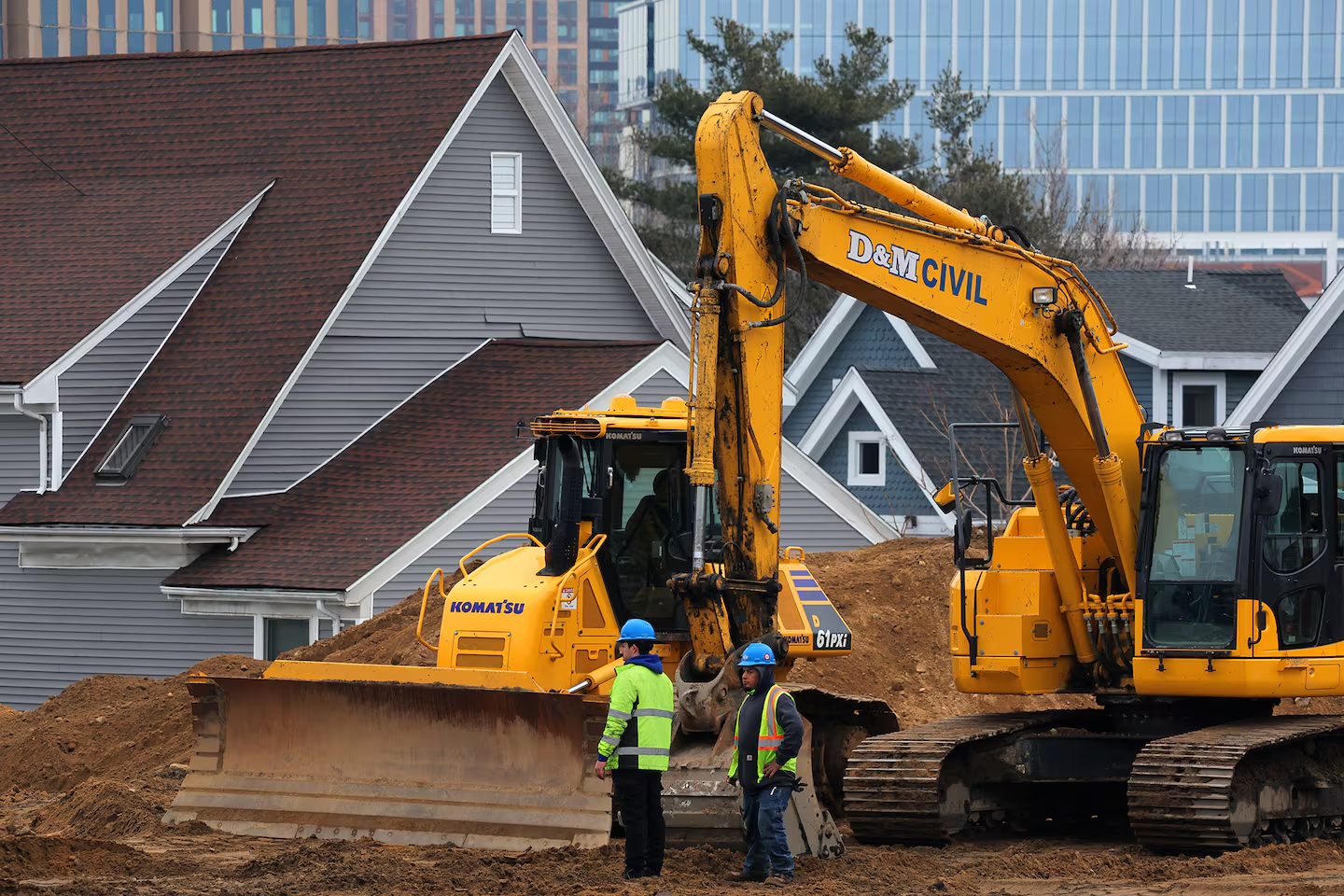
The company is a fourteen-person landscaping outfit with six trucks, three trailers, two skid steers, a stump grinder, and irrigation equipment spread across forty properties. It has procedures. Some live in the owner's head, some are buried in a text thread from March, and a few are printed in a binder nobody carries. Someone started a Google Drive folder and gave up at document four.
None of it helps a 24-year-old standing next to a machine who needs an answer in twenty seconds.
Those twenty seconds are the whole business.
Here's the opportunity:
The money: 500 customers at $99 a month is $49,500 MRR, about $594,000 a year. Trainual charges $249 for the office-team version.
Inside:
• Full MVP scope, plus what to refuse to build
• Per-company pricing that beats seat math
• The cold call that gets a yes in one line
• Five moats that compound after month six
The build is a voice-first, English/Spanish procedure system for 5-to-30-person trade businesses. The owner talks into his phone for three minutes. Software transcribes it, structures it into a checklist, translates it, routes it through approval, and publishes a permanent mobile page the crew reaches by scanning a sticker on the equipment itself.
Anyone can call this a chatbot for contractors. The accurate description is a machine that converts tribal knowledge into approved operating infrastructure and then bolts that infrastructure to the physical world.
The market sits between the binder and the platform
Field service management software is a real category with real budgets. Estimates for 2026 global field-service-management spending cluster between $5.9 billion and $6.7 billion, depending on whose definition you take. Contractors already pay for scheduling, dispatch, quoting, invoicing, fleet tracking, and timekeeping.
Documentation is the line item nobody funds.
The 2022 Economic Census counted 803,120 U.S. construction establishments, making construction the fourth-largest sector in the country by establishment count. Landscaping services alone accounts for roughly 118,000 establishments employing about 803,000 people. The overwhelming majority are small, owner-operated, and equipment-heavy — exactly the profile where operational knowledge is sophisticated and knowledge infrastructure is nonexistent.
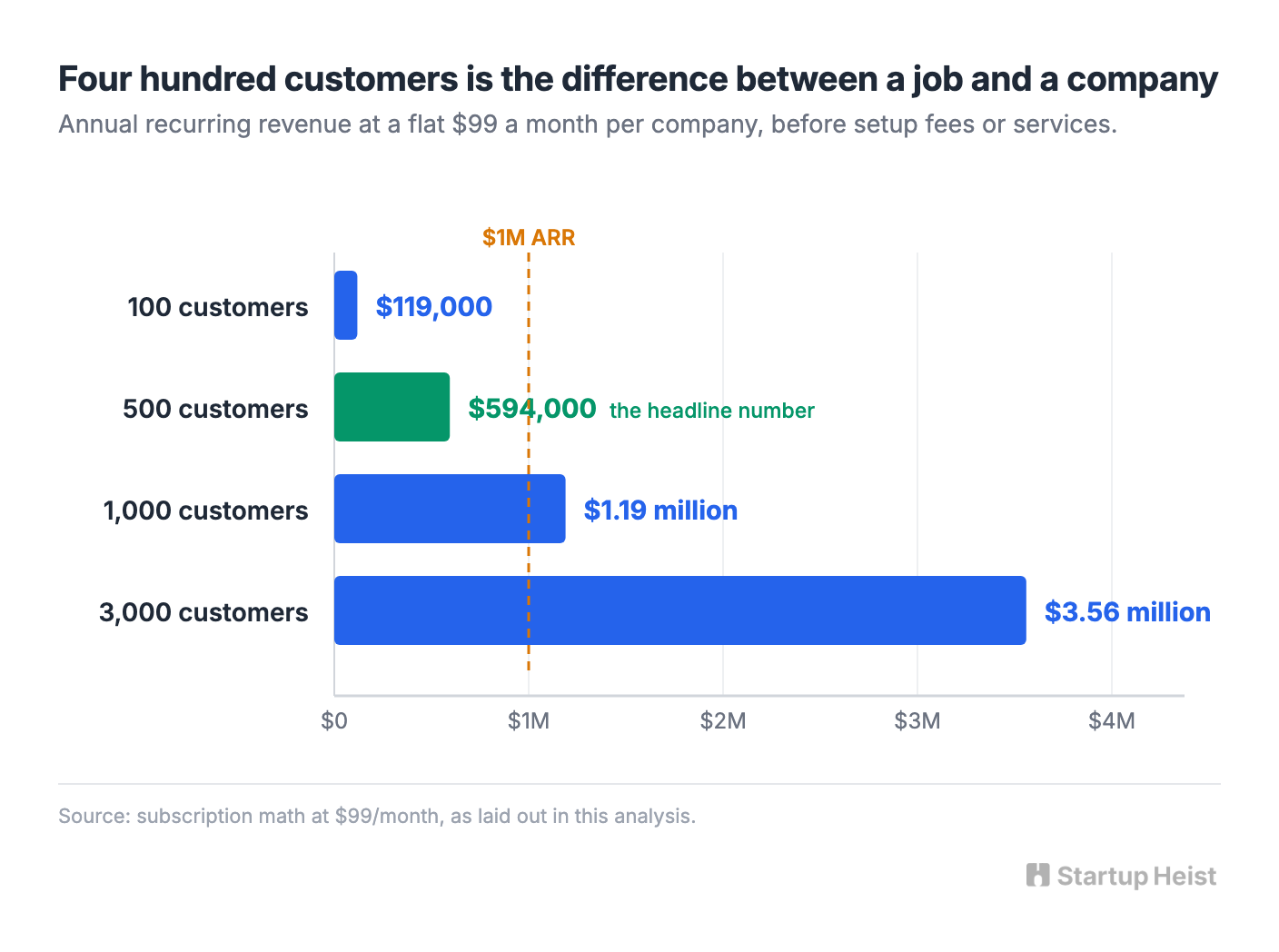
You don't need a meaningful slice of that. At $99 a month, 100 customers is $119,000 in annual recurring revenue. Five hundred is $594,000. A thousand is $1.19 million. Three thousand is $3.56 million.
This is a plausible $1M-to-$5M ARR vertical SaaS business if you solve one ugly workflow unusually well, and a larger one only if procedures become the doorway into training, inspections, and equipment records. Start narrow enough to actually win.
The incumbents are not who you think
The obvious objection is that contractors already own software. Correct, and more than they use. ServiceTitan exited fiscal 2026 with roughly 10,800 active customers and $961 million in revenue, growing 24% year over year, with more than 2,000 customers billing over $100,000 annually and driving more than 60% of billings. Its attention follows that money, and the fourteen-person landscaper is nowhere near it. Jobber runs $49 a month for a single user at Core. Connecteam is the sharpest comparison: free under ten users, roughly $49 a month for the first thirty on its Advanced tier, though pricing is per hub, so operations plus communications plus HR means three subscriptions. All three can build a checklist, so walking in with "we're a simpler checklist app for contractors" loses on day one.
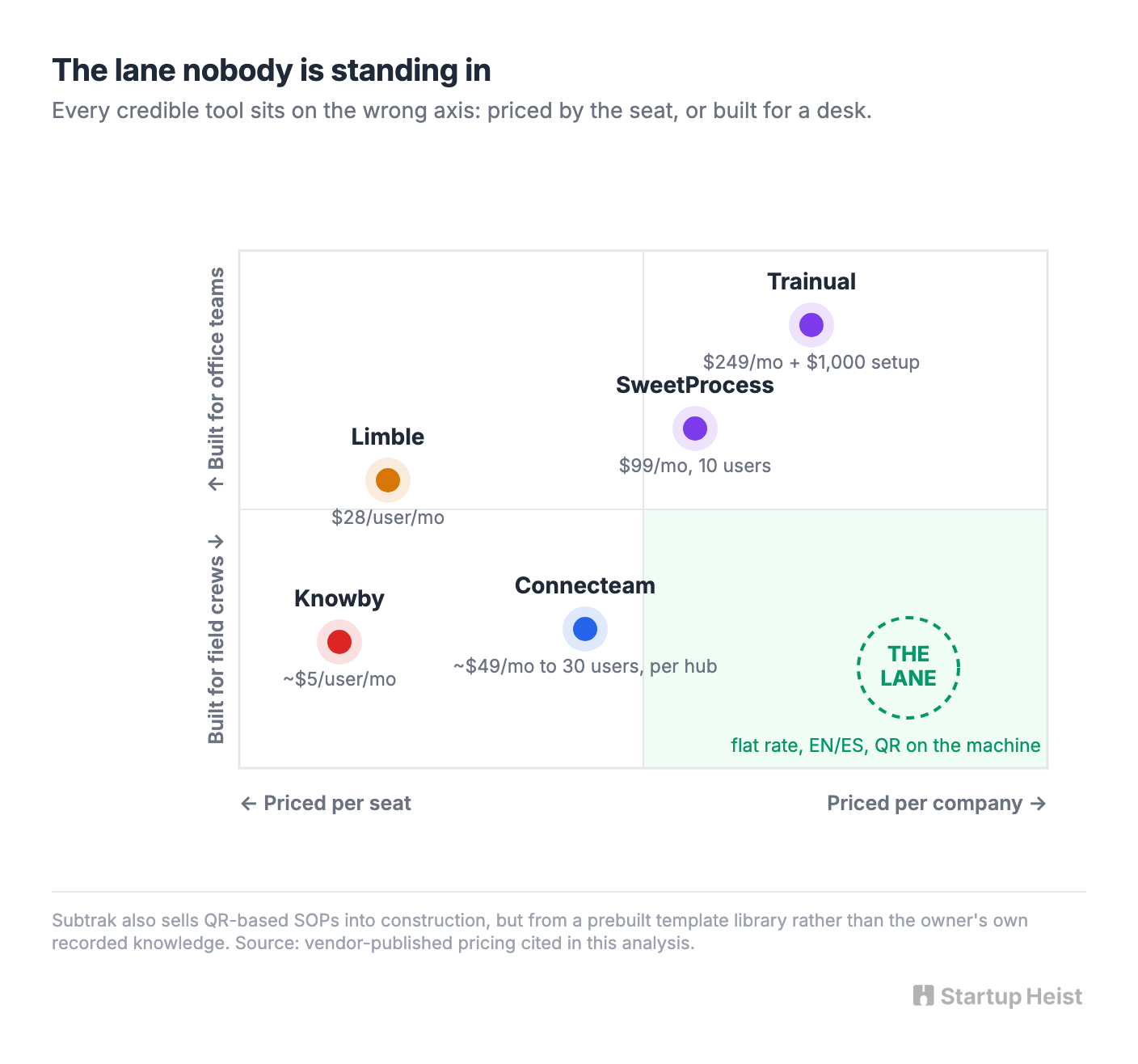
The competitive set that actually matters is the one contractors never look at. Trainual charges around $249 a month plus a $1,000 implementation fee and gates its real pricing behind a demo call. SweetProcess runs $99 a month for ten users. Both are good products built for office teams, neither speaks Spanish natively, and neither survives contact with a muddy job site. Limble, a maintenance platform, already puts QR codes on equipment and lets anyone scan without a login at $28 per user per month, aimed at facilities managers rather than crews.
Then the part worth knowing before you write a line of code. Knowby already ships this exact mechanism: record a voice or video walkthrough, get AI-generated step-by-step work instructions, stick a QR code on the machine, scan it with no app and no login, in any of 140-plus languages, for roughly $5 per user per month. Subtrak sells QR-based SOPs with automatic translation into the construction trades, though from a template library of prebuilt processes rather than an owner's own recorded knowledge.
Read that as confirmation. The mechanic works, somebody is already getting paid for it, and that's the cheapest validation you will ever receive. What's unclaimed is the positioning. Knowby is horizontal, priced per seat, and aimed at the factory floor, where 140 languages is a marketing bullet rather than an operating decision. The open lane is per-company pricing that doesn't tax an owner for hiring, English and Spanish executed properly instead of generically across 140, small outdoor trade crews instead of the plant, and a trade-vertical corpus no horizontal tool will accumulate. Nobody has pointed the mechanism at this exact reader: an author who will never open a laptop, a Spanish-speaking crew member holding a phone with dirty hands, and an interface that's a sticker on a skid steer.
The bilingual wedge is not a localization feature
Treat language as the product thesis, not a settings toggle.
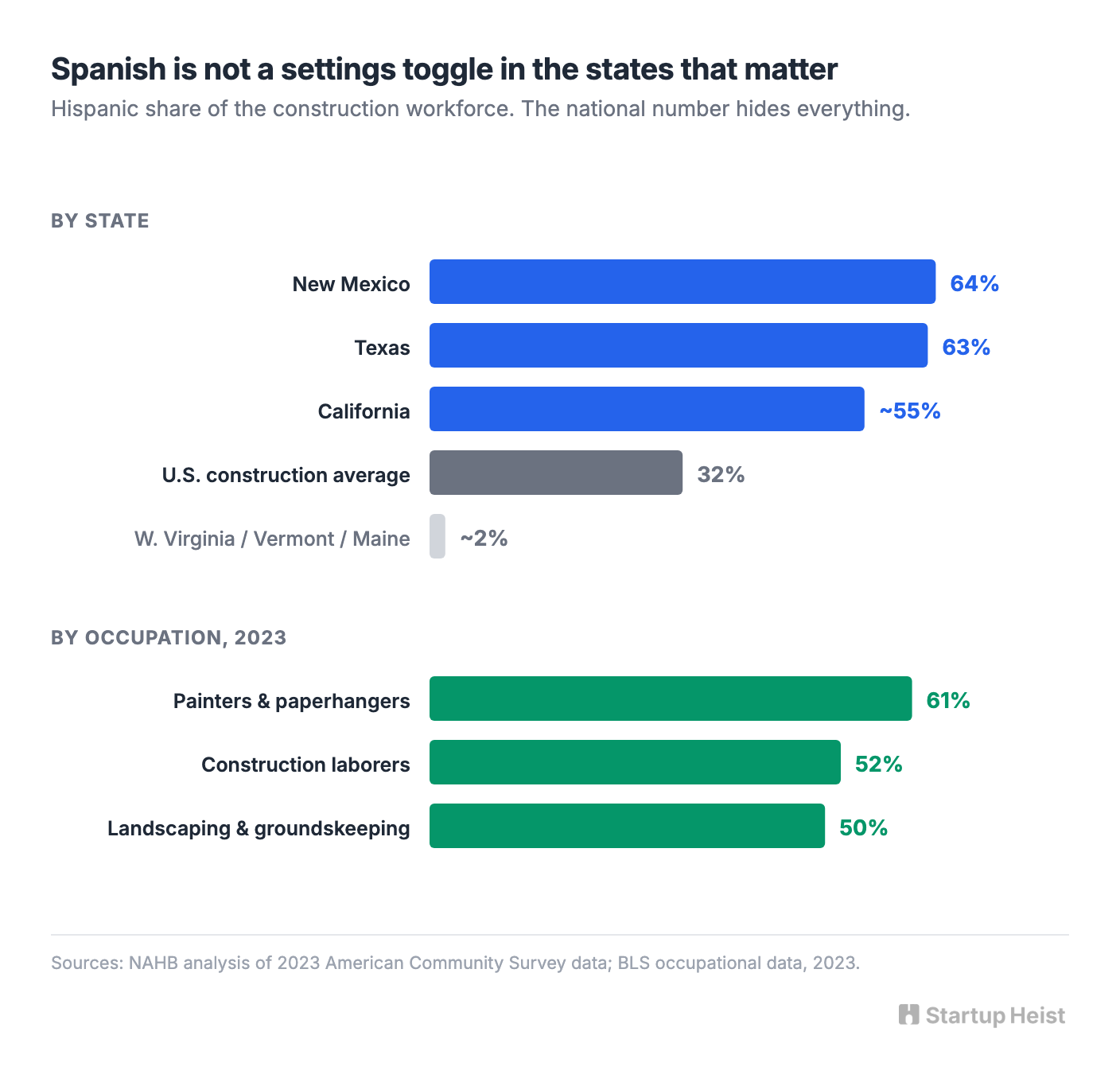
NAHB analysis of 2023 American Community Survey data puts Hispanic workers at 32% of the U.S. construction labor force, nearly 3.8 million people, up from 2.5 million and 23.6% in 2010. The concentration is the part that matters. Hispanic workers make up 64% of New Mexico's construction workforce, 63% of Texas's, and roughly 55% of California's, with Nevada also above half, while states like West Virginia, Vermont, and Maine sit near 2%. BLS occupational data tightens it further. In 2023, Hispanic or Latino workers made up 61% of painters and paperhangers, 52% of construction laborers, and 50% of landscaping and groundskeeping workers.
Then there's the regulatory floor. OSHA's April 28, 2010 Training Standards Policy Statement is explicit that required training must be delivered in a language and vocabulary the worker actually understands, and that handing someone material they cannot read doesn't satisfy the obligation.
Bilingual operating instructions are economically load-bearing at that point, and there's a trap sitting inside them. If your system mistranslates "do not open," reverses a lockout sequence, or invents a step for a machine it has never seen, that isn't a typo in a marketing email. Somebody gets hurt.
So the workflow has exactly one shape: AI drafts, humans approve, workers retrieve only approved material. Treat that constraint as the feature it is. It's the reason a contractor hands you the canonical version of how his company works.
The product: talk once, answer forever
The owner taps New Procedure and says:
Unlock the Vault.
Join founders who spot opportunities ahead of the crowd. Actionable insights. Zero fluff.
“Intelligent, bold, minus the pretense.”
“Like discovering the cheat codes of the startup world.”
“SH is off-Broadway for founders — weird, sharp, and ahead of the curve.”


