


The $850 Billion Returns Pile Has a Tiny Software Bottleneck
Walk into a regional liquidation warehouse and you find one of the stranger information problems in commerce. A cordless drill sits next to an air fryer. Beside that is a Wi-Fi router with no box, a lamp missing its shade, and a mystery appliance whose only clue is a faded model-number sticker on the back.
Someone has to turn all of that into money, and before any of it sells, a worker has to answer a long list of questions. What is it? Which exact model? What came in the box, and what's missing now? Does it work? What does a comparable used one actually sell for? Should it go on eBay, into the next local auction, into a bundle, into a parts bin, or straight to recycling?
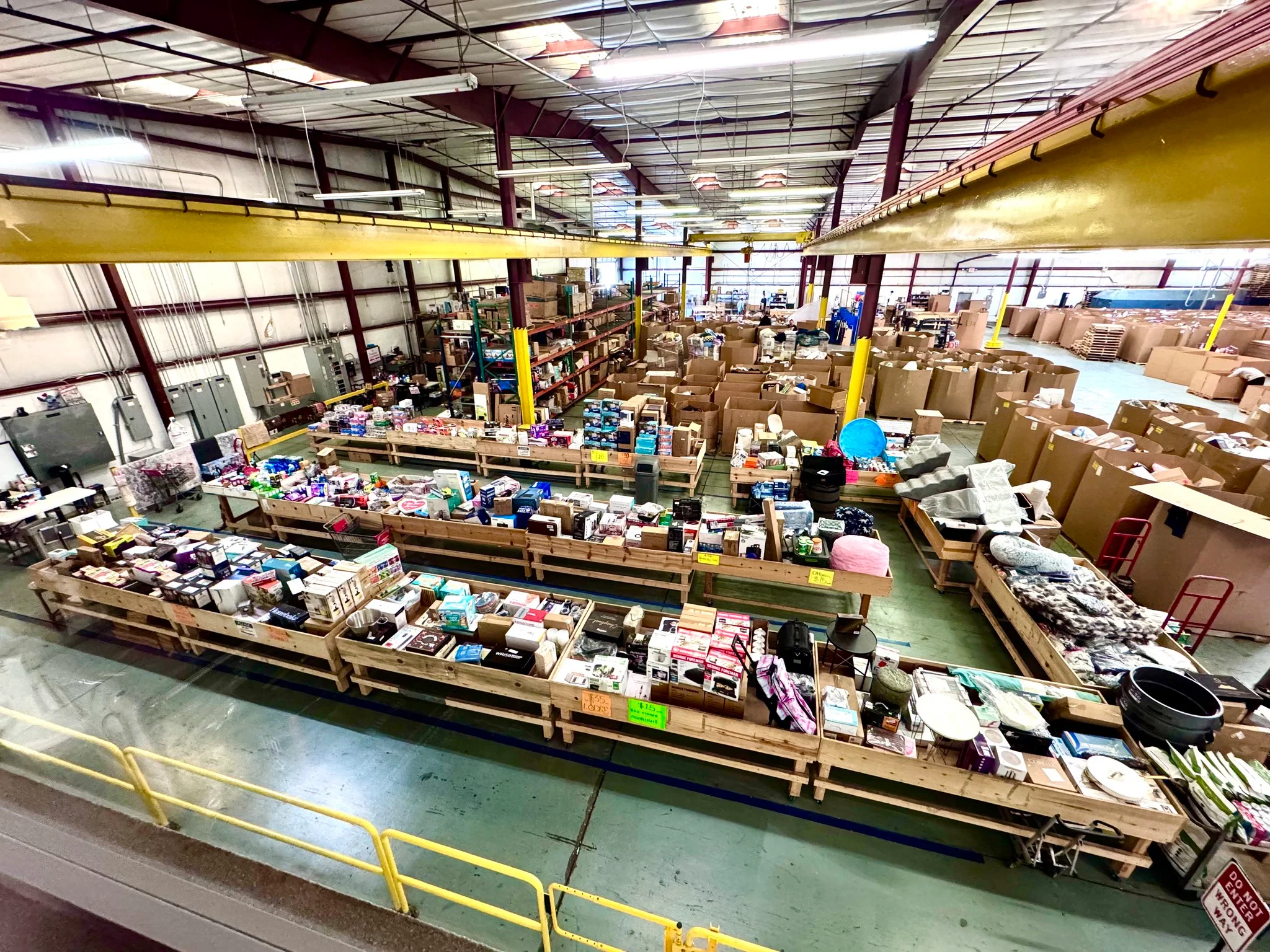
For a national retailer, that job is called reverse logistics and it has an enterprise software budget. For a regional liquidation warehouse buying returns pallets, it's a person with a phone, Google Lens, eBay, a spreadsheet, a label printer, and twenty browser tabs.
The opportunity is a human-in-the-loop intake workstation for those regional warehouses. Photos and barcode scans go in. A verified identity, a structured condition record, an internal label, a disposition recommendation, a listing draft, and a margin-aware price range come out. Call it PalletBrain for now. The name doesn't matter, and the obvious pitch (an image-recognition company) misses the point. What you're building is a decision system that turns messy physical inventory into decision-ready inventory, and that distinction carries the whole business.
Here's the short version before the details.
The money: Fifty warehouses at $250 a month blended is $12,500 MRR, with $500 to $1,000 pilot fees as upfront cash. BuyWander raised $21 million in September 2026 on this bottleneck.
Inside:
• Eight-piece MVP scope, intake to outcome capture
• Three tiers: pilot fee to recovery intelligence
• The 60-minute stopwatch pitch and cold email
• Five moat layers, ending in pallet economics
The signal: a fast-growing operator just described the bottleneck out loud
The National Retail Federation and Happy Returns projected that U.S. consumers would return $849.9 billion of merchandise in 2025, a 15.8% return rate, with online sales returning at 19.3%. Those goods have to be received, identified, inspected, graded, routed, relisted, liquidated, donated, or destroyed, and the farther an item travels from its original store, the worse its data gets. A clean store return still carries its SKU. A pallet that has passed through a liquidator carries a Milwaukee drill, an open-box Keurig, two routers, and a leaf blower whose charger vanished three owners ago.
Catalog data stops being enough at that point, and BuyWander is the company living there. On September 15, 2026, the Seattle-area company announced a $21 million Series A led by Madrona Venture Group and Inspired Capital, bringing total funding to $28 million. BuyWander runs $1-start, seven-day auctions on returned and overstock goods from retailers like Amazon, Target, Walmart, and Home Depot, with local pickup. Behind the raise: 400% year-over-year growth, nearly 500,000 unique items sold per month across eight fulfillment locations, 325 employees, and merchandise clearing at an average 75% below retail.
Pay attention to how the company describes getting there. Coverage of the raise credits AI for breaking the bottleneck that manual data entry and poor photography historically put on resale platforms: the system identifies returned products, pulls retail valuations, and generates listings with a single click across hundreds of thousands of items a month. CEO Jordan Allen put it plainly: "There's been a ceiling on this business historically because of the technology required." A company processing half a million unique objects monthly was forced to build an intake machine, and it just told the market that the machine is what made the volume possible.
Don't copy BuyWander. Steal the internal capability a scaling operator had to build for itself, and sell a version of it to every warehouse too small to build its own.
Don't build "AI for resellers." That layer already costs a dime.
The naive version of this idea is take a photo, AI writes the eBay listing. That's already commodity software, and the price is collapsing toward zero.
eBay's own Inventory Mapping API accepts photos and product identifiers and returns an AI-generated category, normalized item aspects, and a description for sellers to review before publishing. List Perfectly starts at $29 a month with AI listings and barcode scans; its $69 tier adds Google Lens pricing research and eBay pricing lookup, and the $99-plus tier adds QR inventory labels. Vendoo starts at $14.99. Auction Flex 360, the incumbent for HiBid auctioneers, runs $95 to $295 a month and already has a Scan Lot feature that turns a UPC scan into a catalog entry, marketed specifically for returned-goods auctions. Underneath all of them sits a fresh crop of AI cataloging tools: Gavelist writes titles, descriptions, condition notes, and value estimates from a handful of photos for $0.15 a lot, roughly $0.08 to $0.10 a lot on monthly plans, and exports straight to HiBid; AuctionWriter does 1,000 lots a month for $99.
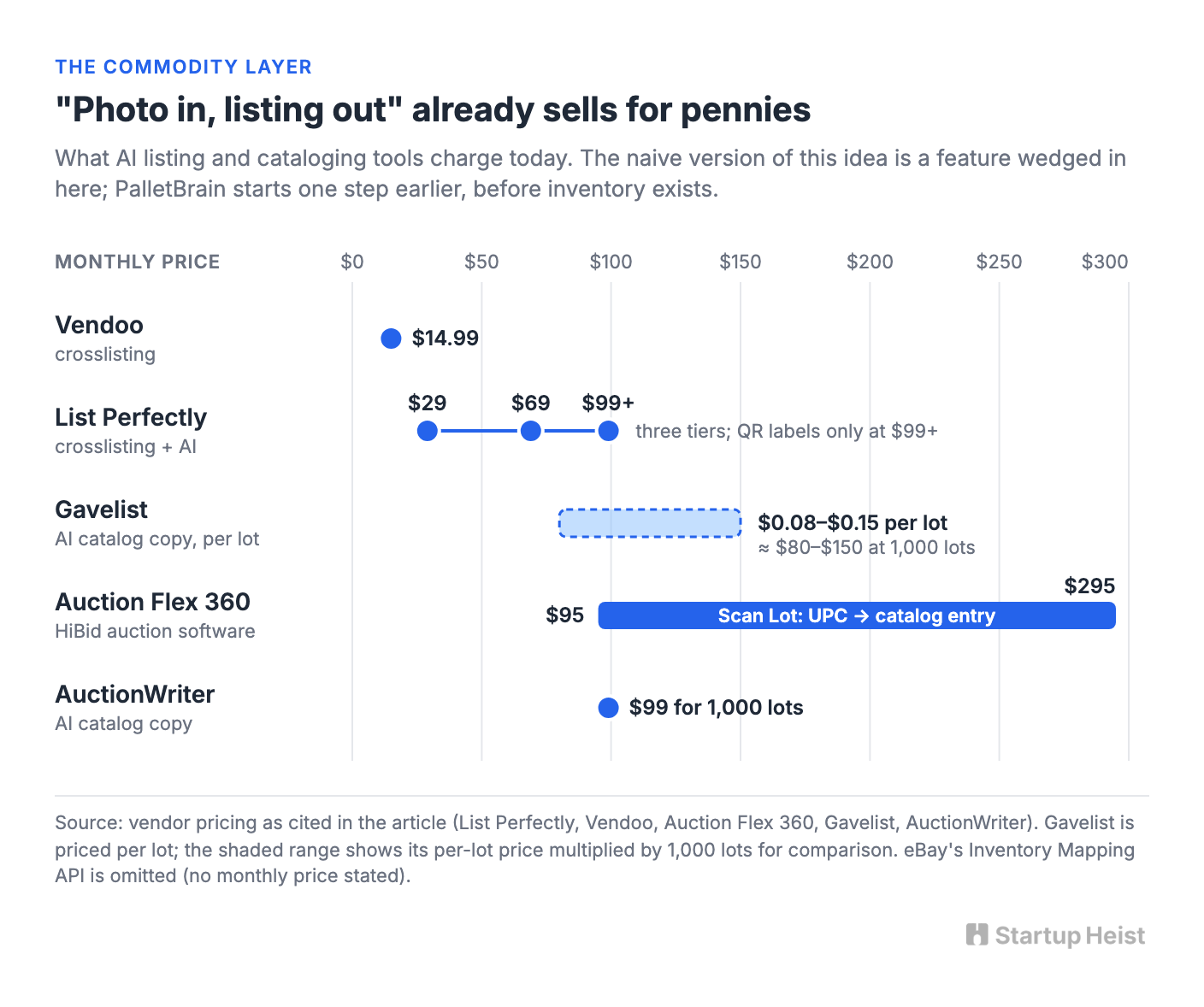
So if your startup is photo in, listing out, what you have is a feature wedged between eBay, Google, ChatGPT, and half a dozen crosslisting apps that already sell it for pennies. The real opening starts one step earlier. Listing software assumes you already have inventory. PalletBrain begins when you have an object, and nobody in the building yet knows what it's worth doing with it.
The customer is uglier than you want, and the market is smaller than the headline
Don't start with Amazon, Target, or a national reverse-logistics provider. Their procurement cycles will outlast a two-person startup's runway, and Optoro already sells them a disposition engine that routes returns to the highest-recovery channel, with American Eagle on the customer list.
The sweet spot is a regional liquidator, bin store, or HiBid auction house that processes roughly 500 to 5,000 individually identifiable hard-goods items a month, buys mixed returns, overstock, estate, or liquidation pallets, employs people whose job includes researching unidentified merchandise, sells across eBay, HiBid, local auctions, or Facebook Marketplace, and has enough throughput that saving two or three minutes an item shows up in payroll. HiBid alone was moving on the order of 670,000 lots a week in 2023 across thousands of auction companies, and a meaningful slice of those lots is exactly this kind of merchandise.
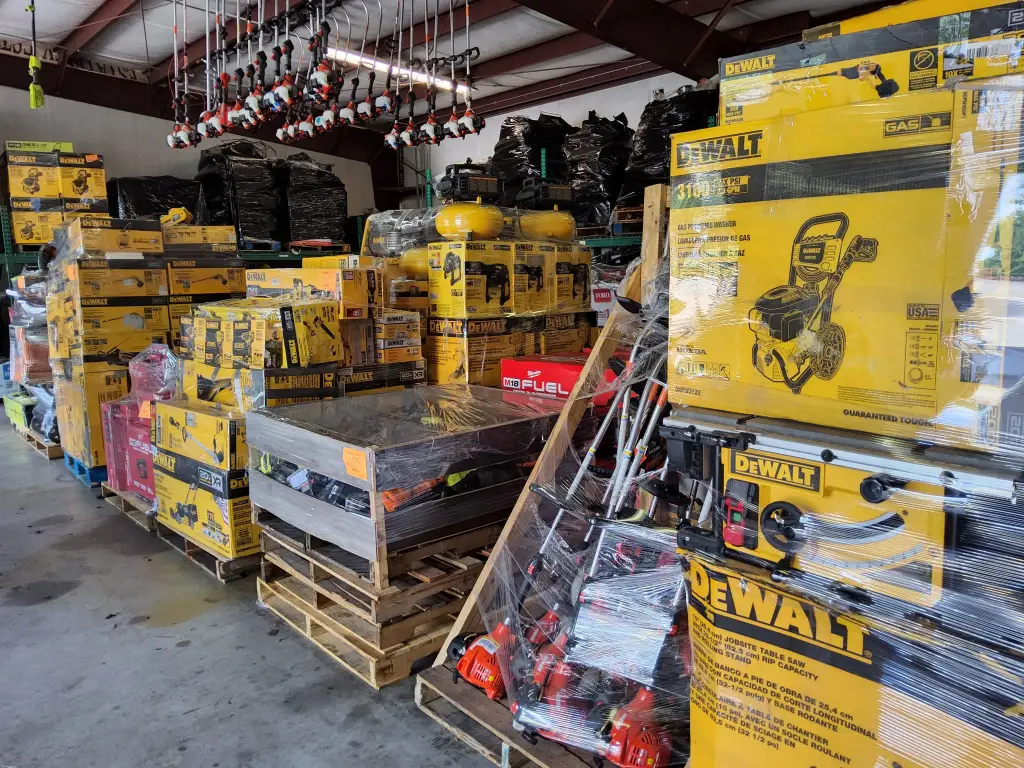
Start with boring categories: power tools, small appliances, consumer electronics, networking gear, branded home goods. Skip apparel, collectibles, furniture, generic imports, and anything where a wrong identification becomes a safety problem. You want objects where a model number, barcode, label, and accessory count can usually get a human to a defensible identity.
The tailwind is real; 2026 reverse-logistics industry reports name AI-driven disposition decisioning as a growth driver. But $850 billion of returns is not an $850 billion software opportunity. Most returned merchandise never enters your workflow, and some operators will run on spreadsheets forever. Treat the first version as a high-value vertical micro-SaaS with expansion rights. Fifty locations at $250 a month blended is $12,500 MRR. Two hundred fifty at $400 is roughly $1.2 million ARR. A thousand at $500 is $6 million. Read those as revenue geometry rather than a TAM forecast; the bet is that revenue per location expands as the product climbs from intake automation into margin analytics.
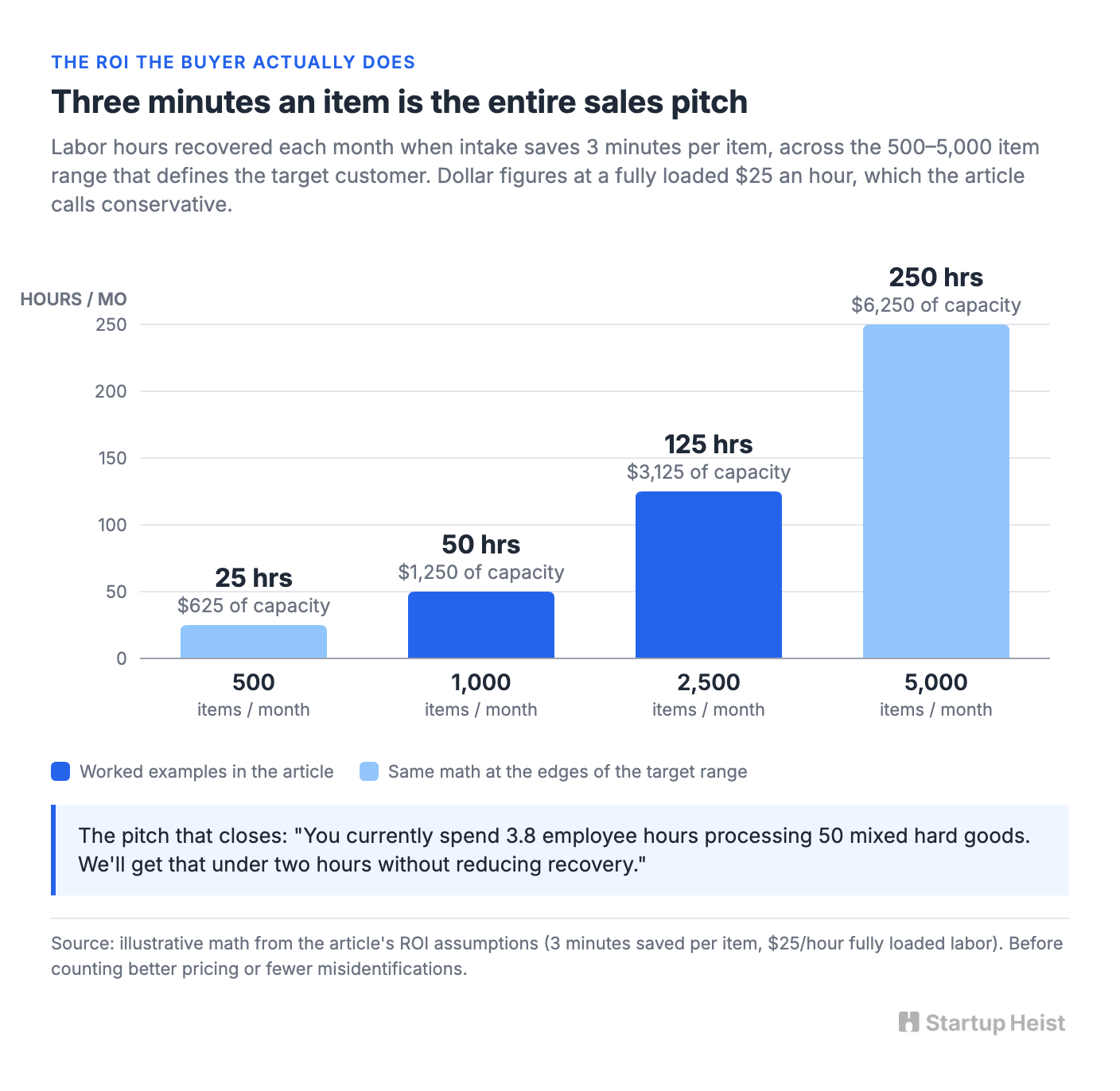
The ROI math the buyer will actually do is simpler. A warehouse processing 1,000 relevant items a month, saving three minutes each, recovers 50 labor hours, which at a fully loaded $25 an hour is $1,250 a month of capacity before you count better pricing or fewer misidentifications, and $25 is still conservative against what warehouse labor actually costs in 2026. At 2,500 items the same saving is 125 hours. So you never sell this with an AI pitch. You sell a sentence like: "You currently spend 3.8 employee hours processing 50 mixed hard goods. We'll get that under two hours without reducing recovery." A warehouse owner understands it instantly, and everything below is about making it true.
What the workstation actually does
A worker pulls a returned DeWalt drill from a pallet. Today the workflow is: photograph it, search the model number, open three tabs, figure out which battery it takes and whether one is included, search eBay sold listings, guess at condition, type a title and description, assign a lot number, print something, put the drill somewhere, and hope someone can find it later. PalletBrain compresses that into four moves.
Capture. Scan the UPC if one exists. The app asks for two to four photos: full object, model plate, accessories, visible damage. The interface behaves like a warehouse tool rather than a chatbot. Big buttons, gloves-friendly, minimal typing, next item.
Unlock the Vault.
Join founders who spot opportunities ahead of the crowd. Actionable insights. Zero fluff.
“Intelligent, bold, minus the pretense.”
“Like discovering the cheat codes of the startup world.”
“SH is off-Broadway for founders — weird, sharp, and ahead of the curve.”


