


Amazon Owns Tomorrow. Own This Afternoon.
The opportunity: build the urgent-commerce layer that turns independent Philadelphia pet stores into reliable, searchable, same-day inventory.
China spent the past few years teaching a few hundred million people a new shopping reflex: think of something, buy it, hold it within the hour. The reflex started with dinner. On September 3, 2026, Reuters reported it had spread to electronics, cosmetics, medicine and flowers, with the Ministry of Commerce projecting the instant-retail market at 1.2 trillion yuan (about $178 billion) by year-end and 12.6% annual growth through 2030. Alibaba and JD.com are now opening dark stores and "lightning warehouses" in dense neighborhoods to hit sub-60-minute dispatch. The subsidies that got people hooked have given way to physical infrastructure built to keep them.

The lazy read is that America needs another quick-commerce app. It doesn't. DoorDash, Uber and Instacart already built the driver networks. Uber Direct will pick up an order from any merchant and deliver it under the merchant's own brand, dispatched from a dashboard or an API, in under two hours, priced per delivery at around $7.
The interesting problem is everything that happens before the courier arrives.
A Philadelphia pet owner realizes at 6:15 p.m. that the aquarium heater has died. Or the dog is out of its one tolerated food. Or the cat carrier snapped the night before a vet appointment. There's a decent chance the exact product is sitting on a shelf within three miles, and almost no chance the customer can find out. Google probably can't surface it, the store's website probably doesn't show stock, and nobody can reserve it, confirm it or deliver it tonight. So the customer opens Amazon, checks three store sites, tries Instacart, calls twice, and drives to PetSmart.
That fragmentation is where the heist lives. Here's the brief:
The money: Forty stores at $149 a month is $5,960 in MRR before per-order fees; 100 locations clears $14,900. Locally's 62,000 listed stores prove merchants will publish inventory.
Inside:
• Pricing: $49 pilot to $149 standard, per order
• The eight-piece MVP a solo founder can build
• The merchant email that signs five stores
• Five metrics that decide the 60-day test
In practice that means verified local inventory, problem-oriented search pages, checkout or reservation, store pick confirmation, and 60-to-120-minute white-label delivery on courier rails someone else already paid for. It's a much smaller promise than "DoorDash for pet stores" or every SKU in the city within the hour: five good pet stores, reliably searchable for this afternoon.
Why Pet Retail, Why Philadelphia
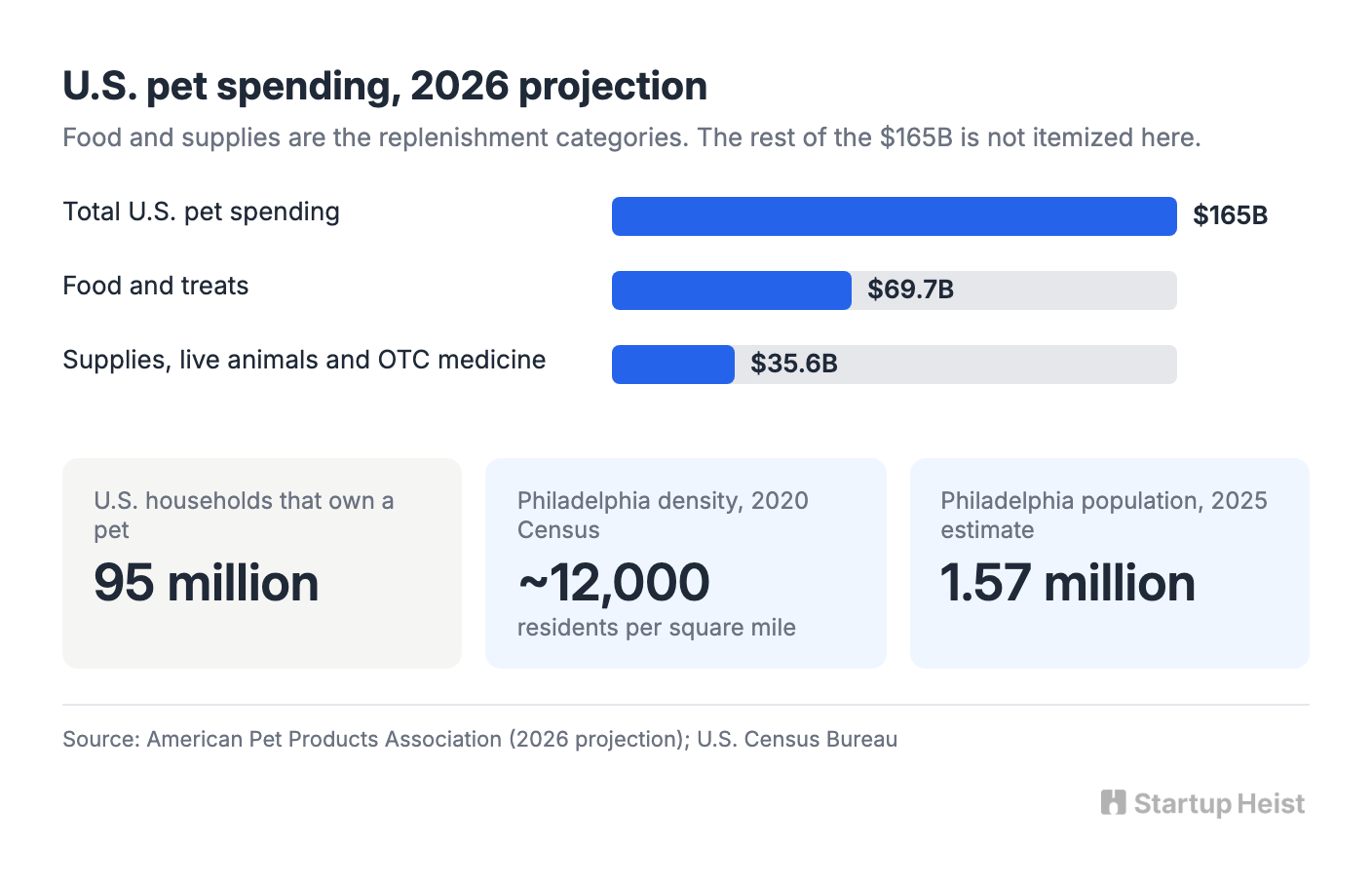
The American Pet Products Association projects $165 billion in U.S. pet spending for 2026, including $69.7 billion on food and treats and $35.6 billion on supplies, live animals and OTC medicine. Ninety-five million households own a pet. That's the TAM slide, and it's the least interesting part.
What matters is the behavior inside the category. Pet supplies combine replenishment (food, litter and filter media run out on a schedule), urgency ("sometime this week" turns into "tonight" without warning), and specificity (one brand, one formula, one size, one replacement part, because the animal refuses substitutes). Independent pet stores carry real expertise and will suggest a workable alternative. A 25-pound bag of the dog's usual food generates almost no returns. And an urgent first order has an obvious path to a recurring relationship, because the same bag runs out again in three weeks.
Philadelphia supplies the density. The 2020 Census counted roughly 12,000 residents per square mile, and the city's 2025 population estimate is 1.57 million. The whole city is beside the point; what matters is a handful of neighborhoods where a courier can run a two-mile trip profitably at 6 p.m.
The Catch: Someone Already Built the Pipes
Pitch "connect local inventory to same-day couriers" in 2024 and the infrastructure itself was a company. Today it's a feature. PetSmart promotes thousands of same-day delivery products. DoorDash's pets vertical carries over 400,000 items from PetSmart, Petco, Pet Supplies Plus and Independent Pet Partners. Instacart lists pet supplies in Philadelphia with delivery in as little as an hour. Since December 2025, Shopify Plus merchants have been able to switch on Uber Direct inside checkout for one-hour, same-day and scheduled delivery. Amazon runs a same-day pet storefront in some metros, stocked from its own warehouses rather than any local shelf. Chewy, the largest pure-play pet e-tailer, is the notable absence: it ships in one to three days via FedEx and offers no same-day delivery anywhere.
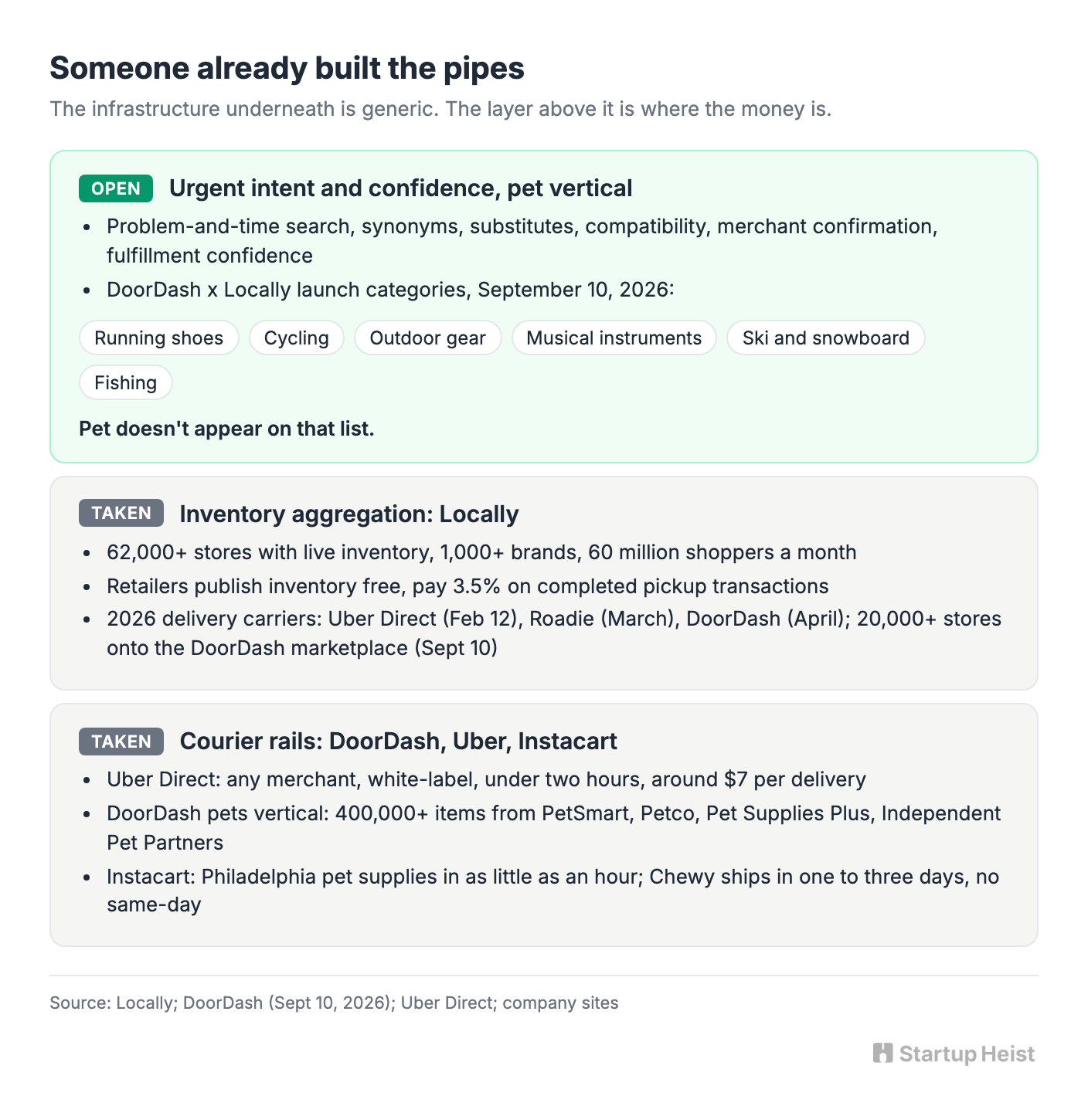
Then there is Locally, the competitor that matters. Locally describes itself as the infrastructure layer that makes real-time store inventory discoverable across brand sites, search, marketplaces and AI agents. It claims more than 62,000 stores with live inventory, over 1,000 brands and 60 million shoppers a month. Retailers publish inventory for free and pay 3.5% on completed pickup transactions. On February 12, 2026, Locally launched a nationwide same-day delivery program on Uber Direct, then added Roadie as a carrier in March and DoorDash in April. On September 10, 2026, DoorDash went further and announced a partnership that puts more than 20,000 of Locally's independent specialty stores on the DoorDash marketplace itself.
Generic local-inventory aggregation is therefore off the table. Someone far larger is already doing it and giving most of it away.
Read the DoorDash announcement closely, though. The launch categories are running shoes, cycling, outdoor gear, musical instruments, ski and snowboard, and fishing. Locally grew up as a tool for brands with authorized-dealer networks, which is why its coverage is deepest where brands pay to route demand to dealers. Pet doesn't appear on that list. The infrastructure underneath is generic, but the pet vertical is still open, and the layer above the infrastructure is where the money is.
The Product Is Urgent Intent, Not Delivery
Take three searches: "Open Farm dog food delivered tonight Philadelphia," "aquarium filter cartridge available near me today," "large dog crate delivered Philadelphia tonight."
Every big platform organizes shopping around stores and products. The startup should organize it around problems and time. A normal pet-store site walks the customer through Aquariums, then Filtration, then Replacement Media, then Brand, then Product. Urgent commerce starts from "my filter stopped working, what can I get within two hours that fits." Serving that requires synonyms, product relationships, compatibility, substitutes, merchant confirmation and fulfillment confidence on top of raw inventory.
The merchant's POS calls the item `ACME AQ FLTR CART 3PK SM`. The customer types `replacement filter for 10 gallon fish tank today`. The translation between those two strings is the product.
Build the Confidence Layer
Google has already learned how hard this is. Its Merchant Center local inventory feeds, the ones that power local inventory ads, require store-level availability and price, distinguish in-stock from limited availability and out-of-stock, and recommend updates at least daily. When a merchant's site can't display accurate store-level stock, Google's inventory verification program sends someone into the store for roughly two hours to check the shelves by hand. Anyone can print "IN STOCK" next to a product. Deserving to is the whole business.
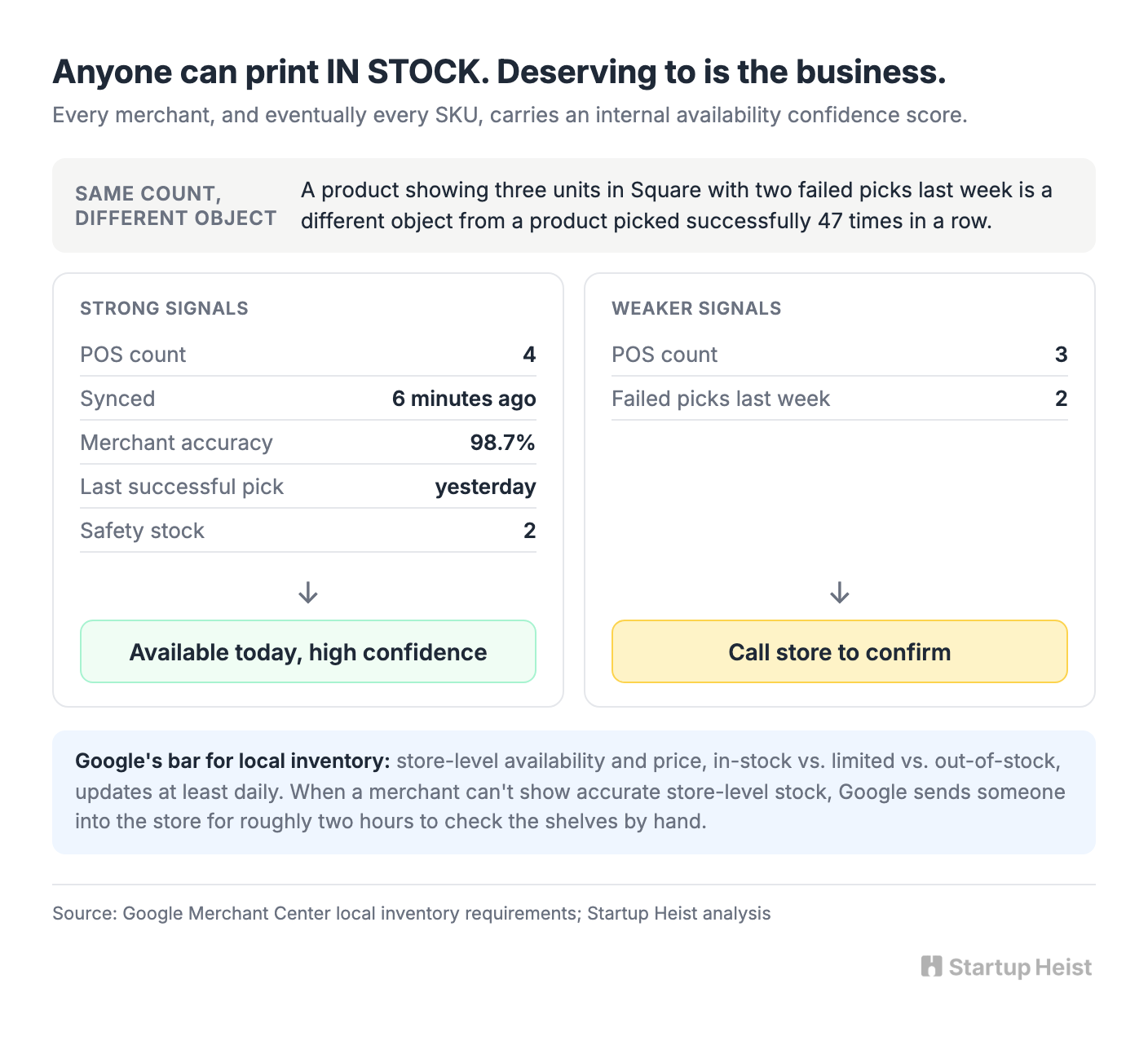
So every merchant, and eventually every SKU, carries an internal availability confidence score. A product showing three units in Square with two failed picks last week is a different object from a product picked successfully 47 times in a row. POS count 4, synced six minutes ago, merchant accuracy 98.7%, last successful pick yesterday, safety stock 2: that resolves to "Available today, high confidence." Weaker signals resolve to "Call store to confirm." Incumbents ingest counts, and this system does too, but it also accumulates observed shelf truth on top of them. After a year that record is data nobody else holds.
What follows is the operating plan: what to promise, what to charge, and how to prove it works in 60 days.
Don't Promise One Hour
Unlock the Vault.
Join founders who spot opportunities ahead of the crowd. Actionable insights. Zero fluff.
“Intelligent, bold, minus the pretense.”
“Like discovering the cheat codes of the startup world.”
“SH is off-Broadway for founders — weird, sharp, and ahead of the curve.”


