


The 31.5-Hour Store
A seven-store retailer usually has a schedule and calls it a labor model. The two sound similar, and the gap between them is the whole opportunity.
A schedule answers one question: who's working Thursday? A labor model answers a different one: how much work exists on Thursday, and how many labor hours did the store earn as a result? Enterprise retail calls that second number earned hours and has been engineering it for two decades. The long tail of multi-unit retail still runs on the first question.
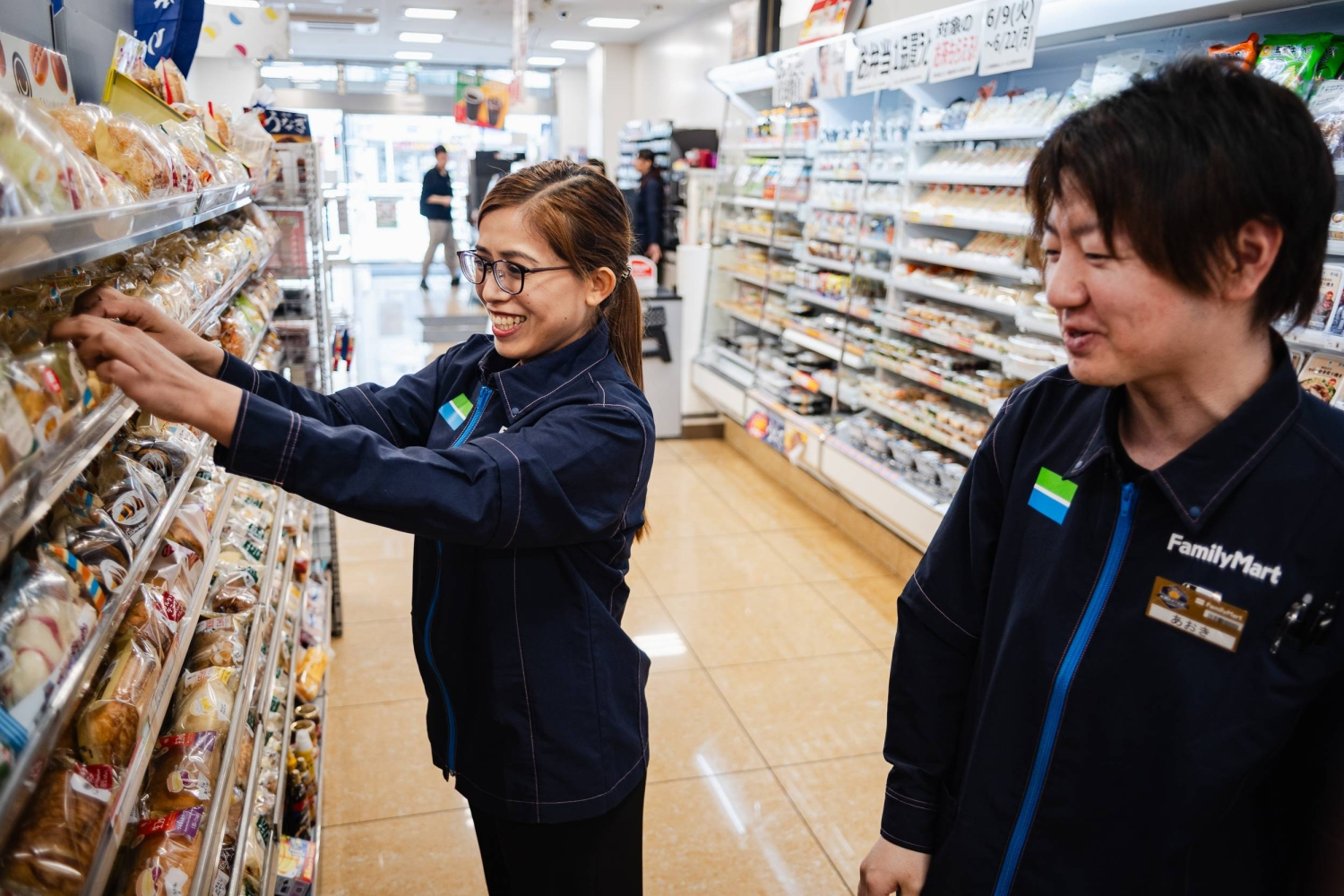
On September 3, 2026, FamilyMart announced a new operating system for roughly 16,500 stores across Japan, a rollout aimed at a staffing problem: about 30% of its franchise stores report staff shortages. The headline was a new generation of hybrid registers that flip between assisted and self-checkout, expected to cut register-related work by about 20% a day. The more interesting piece sat further down the release. FamilyMart is introducing a labor indicator it calls the Task Building Model, or TBM, which takes predicted customer counts and calculates the recommended labor hours each store needs for the day. Those hours flow into the Famima Work System, which recommends staffing by time slot and builds the schedule. The target is a roughly 20% reduction in total daily labor hours per store by fiscal 2030 against fiscal 2025.
FamilyMart can build that internally. Walmart can buy it from an enterprise workforce management vendor. A 500-store chain can hire industrial engineers to write task standards. The owner of seven specialty grocers, nine pet stores or five small-format markets has a labor model closer to "Maria normally works Thursday."
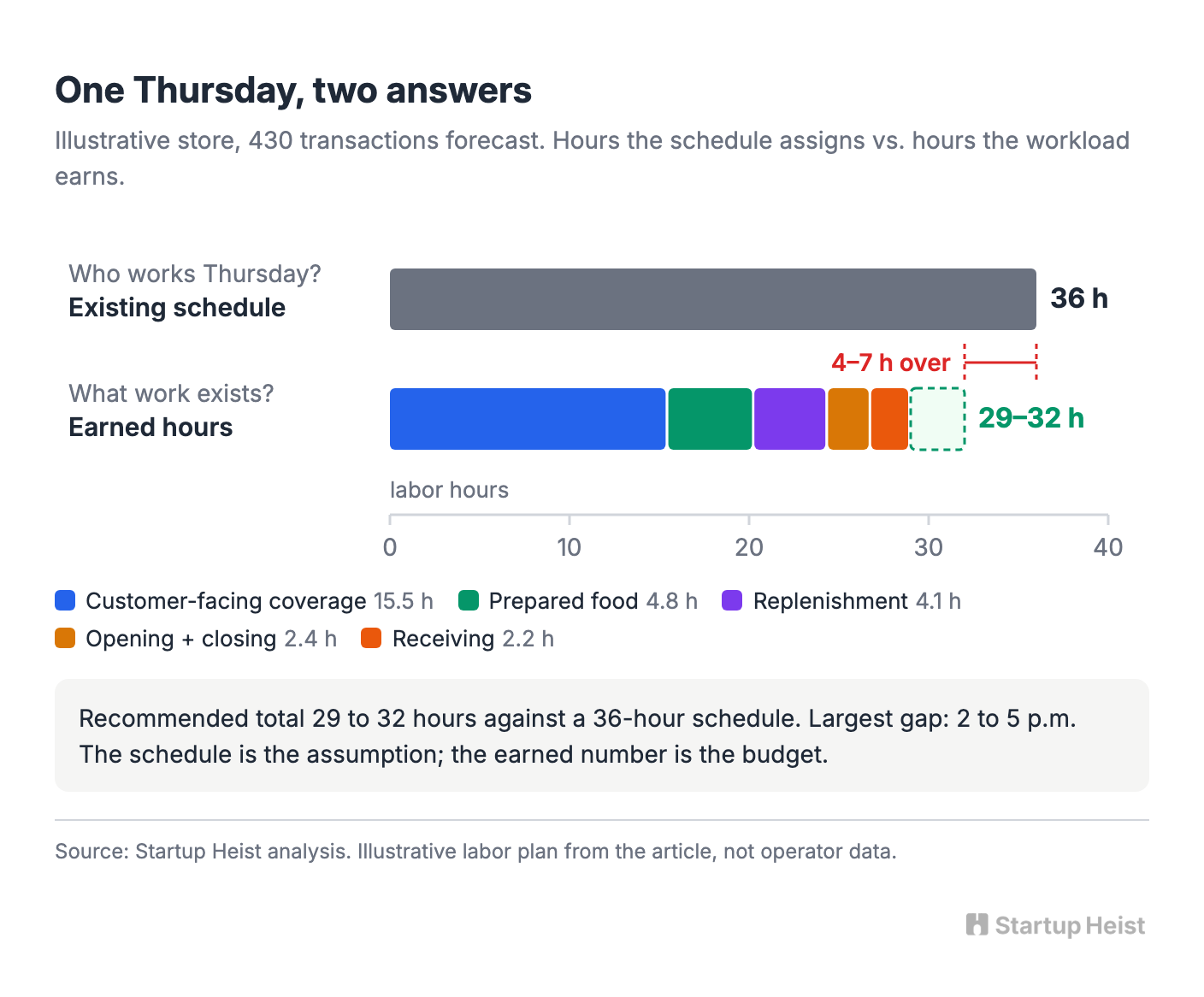
The alternative fits on one printout. Thursday demand: 430 transactions. Opening and closing: 2.4 hours. Receiving: 2.2 hours. Replenishment: 4.1 hours. Food preparation: 4.8 hours. Customer-facing coverage: 15.5 hours. Recommended total: 29 to 32 labor hours. Existing schedule: 36 hours. Largest gap: 2 to 5 p.m.
That printout is the product. Call it TaskBudget: a Square- and Lightspeed-first retail labor planning layer for multi-location operators that calculates how many labor hours each store should get before a manager builds the schedule. It doesn't replace Homebase, When I Work, Deputy or the spreadsheet somebody has maintained since 2019. It sits one decision upstream of all of them.
Nobody needs a new forecasting category. The heist is taking standards-based labor planning, an operating discipline enterprise retail already runs on, and shrinking it into something a 5-to-15-location operator can install, understand and afford.
Here's the opportunity, condensed:
The money: Thirteen eight-location accounts at $49 a location is about $5,100 MRR; 100 accounts at a blended $45 is roughly $432K ARR. Deloitte pegs labor standards at 0.5% to 2.5% savings.
Inside:
• Four-part MVP and a twelve-week build plan
• Square-first integration order, Toast last
• Paid baseline offer and $49/location pricing
• Backtest cold email and three kill conditions
The problem is budgeting the work, and nobody budgets it
Small retailers schedule backward. A manager looks at last week's shifts, remembers who's available, considers whether Friday tends to run hot, copies the template, moves a few names around and publishes. The schedule becomes the assumption, and the business finds out afterward whether labor was expensive.
TaskBudget reverses the sequence: calculate the work first, allocate the hours second, then let the manager decide which people fill them. That sounds like semantics until you look at the money. Deloitte's retail labor research describes labor as the largest controllable operating expense for most retailers, notes that standards-based scheduling and auto-generated schedules are common among large chains, and associates those capabilities with 0.5% to 2.5% labor-cost optimization. That's an enterprise benchmark rather than a promise to a seven-store pet chain, but it shows that labor standards move real money.
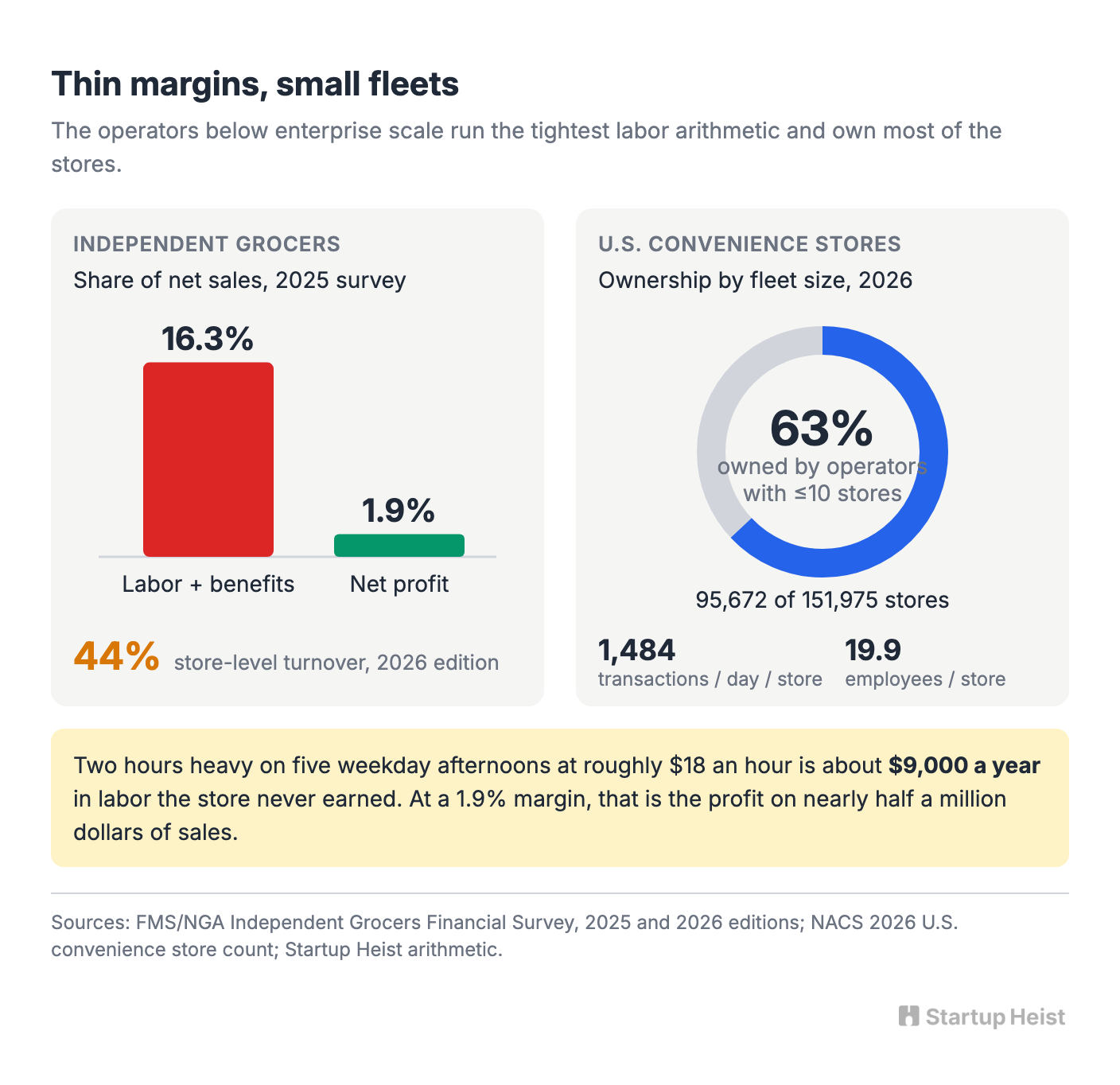
The pressure below enterprise is worse. The 2025 FMS/NGA financial study of independent grocers put labor and benefits at 16.3% of net sales, a record for the series, against a 1.9% net profit; the 2026 edition reported store-level turnover averaging 44%. At those ratios the arithmetic is unforgiving: a store that runs two hours heavy on five weekday afternoons at roughly $18 an hour spends about $9,000 a year on labor it never earned, and at a 1.9% margin that's the profit on nearly half a million dollars of sales. The Bureau of Labor Statistics counted 16.1 million retail jobs in 2025, and while retail productivity rose 2.9% that year, food and beverage stores posted a 1.7% decline because hours grew faster than output. NACS counts 151,975 U.S. convenience stores in 2026, 95,672 of them owned by operators with ten or fewer stores, each averaging 1,484 transactions a day and 19.9 employees. Specialty food and pet retail add tens of thousands more storefronts on the same POS systems. Forget the TAM slide. You need a few thousand multi-location operators with meaningful payroll, repetitive work and enough similarity between stores to make labor standards reusable. Those operators exist, they run Square or Lightspeed POS, and none of their software tells them what a Tuesday should cost.
Competitors already forecast labor, which is where the lazy version dies
Homebase forecasts sales from history and seasonality, tracks projected labor cost as managers build the schedule, sets labor targets and markets an AI scheduling assistant, all at $24 to $96 per location per month on annual billing, with a separate Task Manager add-on. When I Work bundles forecasting, auto-scheduling and coverage calculations against sales and labor budgets at $2.50 per user, or $5 per user for multi-location accounts. Deputy goes furthest: demand forecasting from POS data, hour and wage budgets, real-time variance, Square and Lightspeed integrations, and custom labor models built on the business's own rules. TimeForge sells labor forecasting plus scheduling to multi-unit operators running 3 to 300 locations, with a footprint in grocery, convenience and food and beverage, and like the others it folds the forecast straight into schedule-building. At the enterprise end, Zebra's Workcloud and Reflexis products tie task management, labor forecasting and scheduling together for chains like Shoe Sensation, which used them across nearly 200 stores to automate labor budgeting and reported a 15% lift in store conversion.
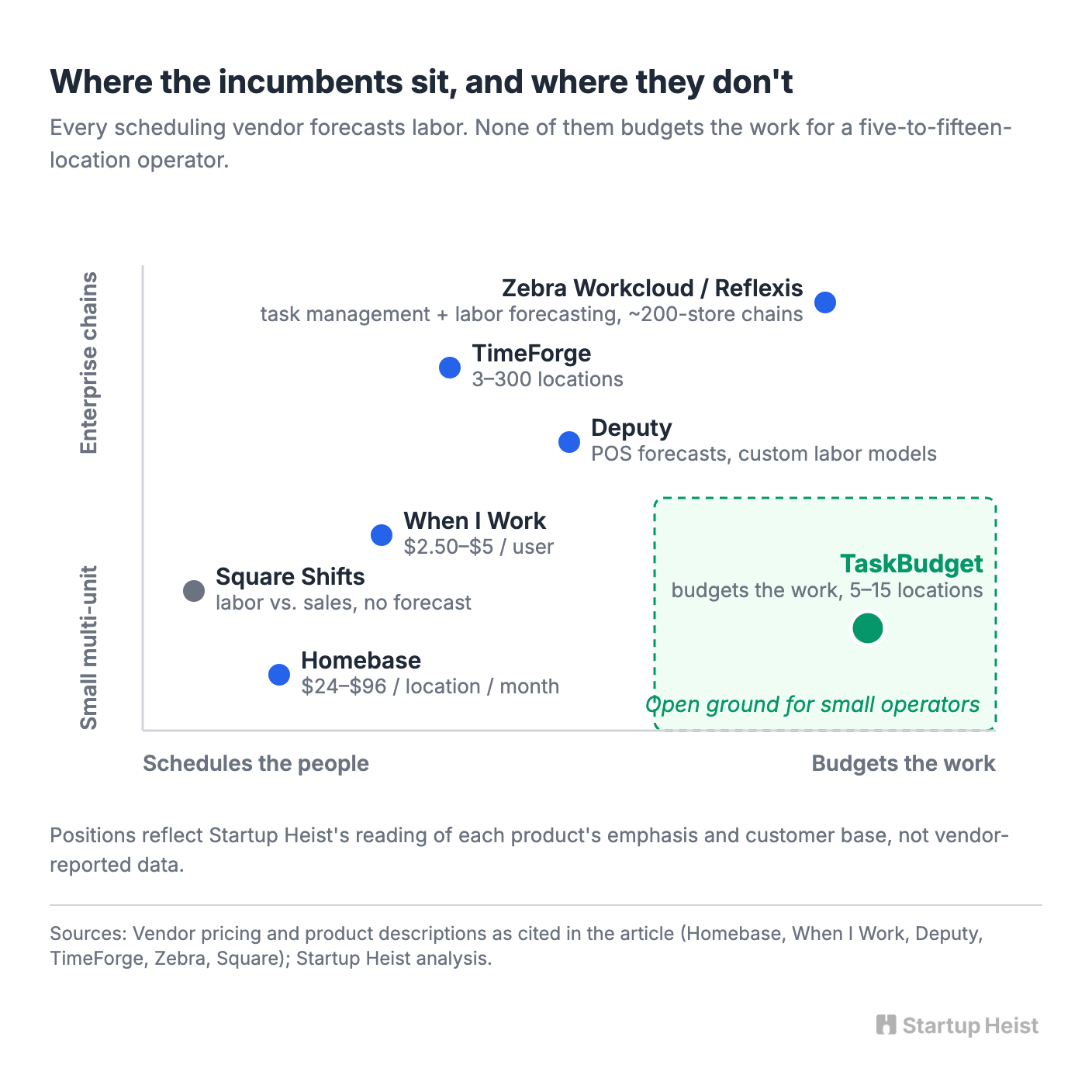
So there's no business in a labor forecasting dashboard that says "AI predicts you need 31 employees tomorrow." That's incumbent territory, and the incumbents are good at it. The opening is narrower. TaskBudget should explain where the 31 hours came from, line by line, in units of work rather than sales or a labor percentage.
A specialty food store needs people because customers want service, three deliveries are arriving, refrigerated cases need replenishing, prepared food has to be made before lunch, closing takes 70 minutes regardless of revenue, and Tuesday's cycle count eats another hour. None of that is visible in a $9,800 sales forecast. The model should expose the arithmetic. Demand labor plus task labor plus minimum coverage equals the earned labor budget, and the manager can click any line and inspect its components. Where the incumbents optimize a schedule, TaskBudget engineers the workload behind it. If that distinction is made operational rather than cosmetic, it's enough for a wedge.
Explainability beats precision
The fastest way to ruin this product is to print "Recommended labor: 31.5 hours" in giant type and behave as though the computer discovered a law of physics. Receiving time changes when the truck is late. A promotion generates questions that transaction counts never capture. The screen should read like a budget with its reasoning attached:
Unlock the Vault.
Join founders who spot opportunities ahead of the crowd. Actionable insights. Zero fluff.
“Intelligent, bold, minus the pretense.”
“Like discovering the cheat codes of the startup world.”
“SH is off-Broadway for founders — weird, sharp, and ahead of the curve.”


