


The Reverse Repurposing Agency: Turn Viral Clips Into Owned Revenue
For five years the creator-tool industry has been obsessed with compression. Take a podcast and cut it into ten Shorts. Take a webinar and turn it into a month of LinkedIn posts. Hand a 30-minute interview to a model and let it find the six clips most likely to travel.
That business is now brutally cheap. OpusClip sells automated long-to-short clipping starting at $15 a month. Descript bundles AI clipping, transcription, and social-post generation into a Creator plan that runs $24 a month on annual billing. Content repurposing is a solved problem, and nobody is going to pay you thousands of dollars a month for what a $15 tool does before breakfast.
The money is in running the machine backwards. Find the creator's 45-second video that already proved an audience cares about an idea. Read the comments to learn what those people still want to know. Interview the creator. Research the subject properly. Build the definitive guide, framework, or checklist around it. Capture the reader's email. Then walk that subscriber toward whatever the creator actually sells.
What you deliver is an owned-audience conversion system built on demand the audience has already voted for. The 3,000-word essay is one component inside it. Selling the system instead of the essay is what turns a commodity ghostwriting shop into a $20,000-to-$50,000-a-month boutique with real pricing power.
The short version, before the mechanics:
The money: Eight clients at $3,250 a month is $26,000 MRR. Talkbox already sells a $2,000-a-month LinkedIn ghostwriting subscription, so the price anchor is public.
Inside:
• Sprint deliverables and a $500 to $5,000 ladder
• Clip-scoring workflow and the creator interview
• The personalized teardown outreach template
• A 30-day launch plan and five agency moats
The signal hiding inside a viral clip
Take an operations consultant with 120,000 TikTok followers. She posts a 52-second video titled "The weekly meeting that is quietly destroying your startup." It does 600,000 views.
The obvious creator move is to make another video. The more interesting move is to scroll down. Hundreds of comments ask variations of the same five questions: how the meeting should actually run, who attends, what the agenda looks like, whether she'll share her template, how it works with a remote team. The creator accidentally ran a focus group with hundreds of thousands of people and located the exact spot where her expertise, her audience's curiosity, and commercial intent overlap.
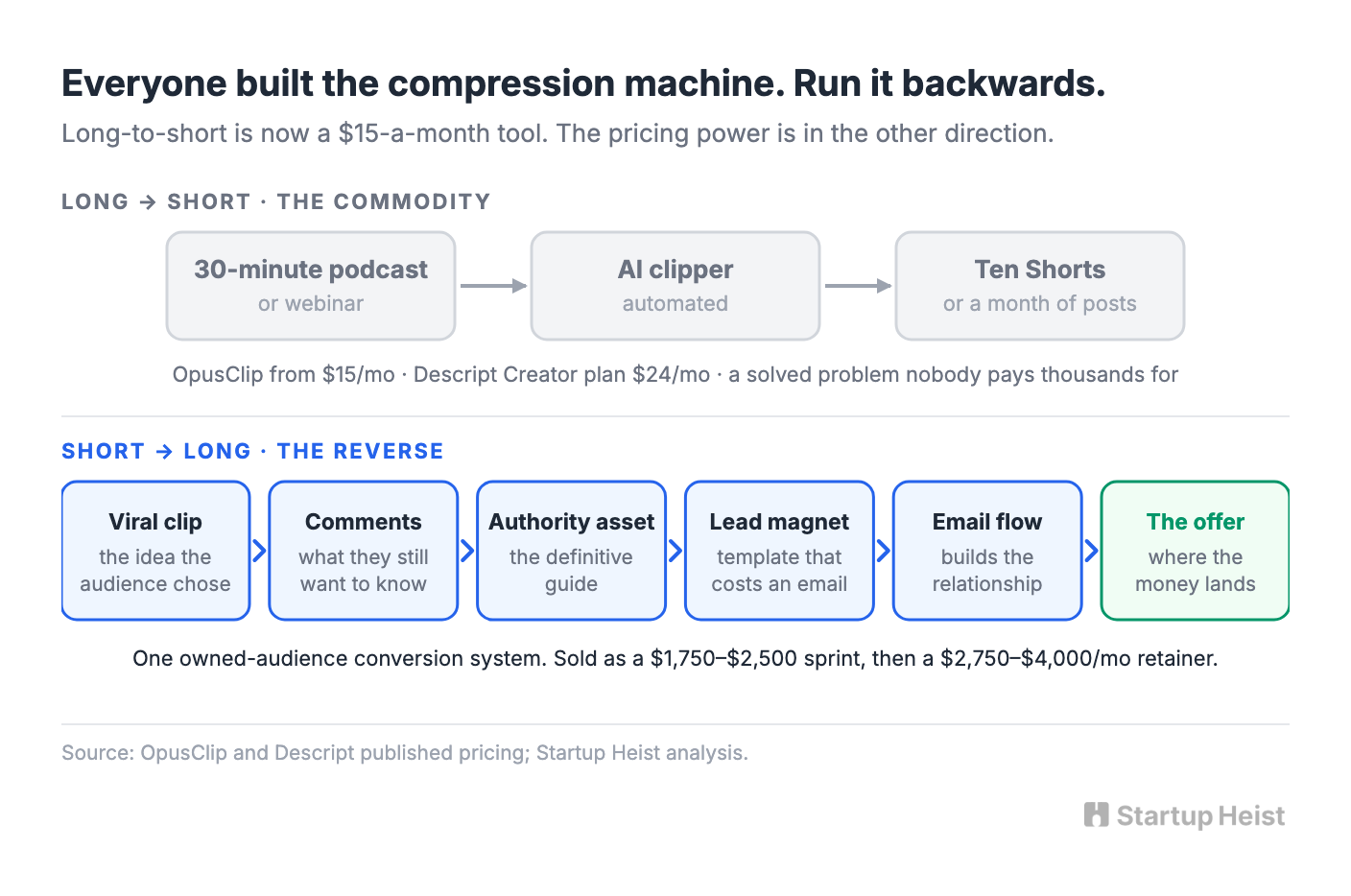
Now build the asset that spot deserves. Call it The 45-Minute Operating Meeting: A Complete System for Running a Weekly Leadership Review. She contributes her real framework. You interview her for the details a transcript never captures. A researcher adds evidence and outside examples. The article links to a downloadable agenda template, and the template costs an email address. New subscribers get four emails: the common operating mistakes, a client story, an implementation checklist, and an invitation to book a $3,000 operating-system audit.
The TikTok sits at the top of the funnel, the essay supplies the authority, the template captures the email, the sequence builds the relationship, and the audit is where the money lands. That chain is the business. As of September 2026, nobody is publicly selling it to creators as a productized service.
Why now
The tempting story is that people are exhausted by short-form and "slow media" is coming back. You don't need that prediction to be true. Short-form can stay enormous and this business still works, because short-form video is the most efficient demand-discovery mechanism ever built.
The shift that matters is economic. Creators are becoming businesses while their audience relationships still live on rented land. The IAB's 2025 Creator Economy Ad Spend & Strategy Report put U.S. creator ad spend at roughly $37 billion in 2025, growing about four times faster than the media industry overall, with $44 billion projected for 2026. Forty-eight percent of ad buyers now call creator media a "must buy." Serious money is flowing to creators through platforms they don't control, and those platforms keep reminding them of it: TikTok spent years under U.S. regulatory threat before its majority-American-owned joint venture with Oracle, Silver Lake, and MGX closed on January 22, 2026. The difference between a follower and an email address is that the platform owns the first and the creator owns the second.
The infrastructure for owning that asset is nearly free. Kit lets creators manage up to 10,000 subscribers at no charge, with unlimited landing pages and forms, broadcasts, and digital products included, though the automation builder is paid-only. beehiiv's Scale plan runs $43 a month on annual billing with a zero-percent take rate on paid subscriptions. Ghost's Publisher plan is $29 a month annually with no transaction fee beyond Stripe. The newsletter platforms are also flush: Substack crossed five million paid subscriptions in March 2025 and raised $100 million at a $1.1 billion valuation that July, and beehiiv told Reuters in January 2026 it has more than 40,000 monthly active users, about 15,000 of them paying, and expects to nearly double revenue to about $50 million in 2026. The tooling is solved. The unsolved part is giving a specific reader a compelling reason to hand over an email address.
Don't build a Substack ghostwriting agency
The obvious version of this business doesn't survive contact with a client. Suppose you pitch a TikTok creator: "We'll turn one of your videos into a beautifully researched 3,000-word Substack post every month for $1,500."
AI made the writing itself cheap, so the client can see your cost structure. Long-form done properly is expensive anyway: interviews, source research, fact checking, editing, graphics, landing pages, email setup, and analytics eat a $1,500 retainer before you finish the first draft. And a published article creates no business outcome on its own. The creator wants subscribers, leads, authority, sponsorship leverage, or recurring revenue, and 3,000 words delivers none of those by itself.
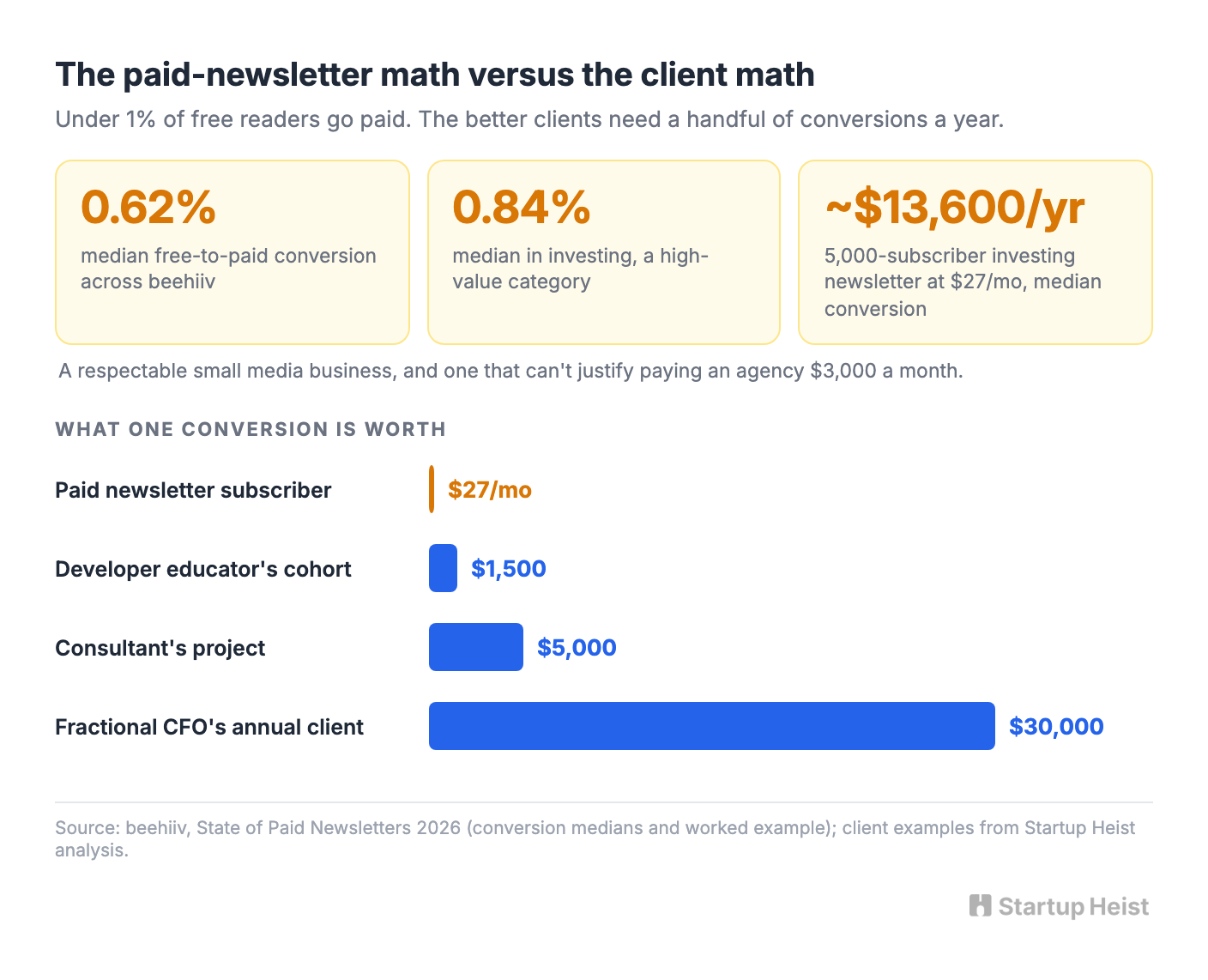
The second obvious version, selling the creator a paid newsletter, fails on the math. beehiiv's 2026 State of Paid Newsletters report puts the median free-to-paid conversion rate at 0.62% across the platform, and 0.84% even in investing, a high-value category. beehiiv works the example: a 5,000-subscriber investing newsletter at $27 a month and median conversion generates roughly $13,600 a year. That's a respectable small media business, and it can't justify paying an agency $3,000 a month.
The better clients have something more valuable behind the list: a consultant selling $5,000 projects, a developer educator with a $1,500 cohort, a fractional CFO who turns one subscriber into a $30,000 annual client, a SaaS founder converting readers into demos, a recruiting expert converting the audience into employer leads. Each of them needs a handful of conversions a year for the math to work.
So sell the outcome. The positioning should read closer to: We turn your highest-signal short-form idea into a searchable authority asset and an owned-email conversion funnel in 14 days. The newsletter is the trust and distribution layer. The product is the infrastructure between attention and monetization, which has a price the writing alone will never command, and it expands the market from "people who could run a paid newsletter" to "every expert with an audience and something worth more than $27 a month to sell."
Who you should target
Don't target "creators" as a category. A comedian with two million followers can be a worse client than an operations consultant with 70,000. What matters is whether expertise converts to economic value.
Unlock the Vault.
Join founders who spot opportunities ahead of the crowd. Actionable insights. Zero fluff.
“Intelligent, bold, minus the pretense.”
“Like discovering the cheat codes of the startup world.”
“SH is off-Broadway for founders — weird, sharp, and ahead of the curve.”


