


Steal the Research Department: Build the Claim-Testing Layer for DTC Brands
Small consumer brands have no shortage of raw market research. Their problem is decision quality.
A $5 million Shopify brand sits on 8,000 customer reviews, years of support tickets, hundreds of ad variations, a Klaviyo list of 80,000 names and a founder who knows the category cold. When that team has to decide whether the next product page should lead with craft, convenience, performance or indulgence, the process collapses into something crude. Someone exports a batch of reviews, asks ChatGPT for themes, writes three completely different headlines, runs an A/B test and ships whichever converts.
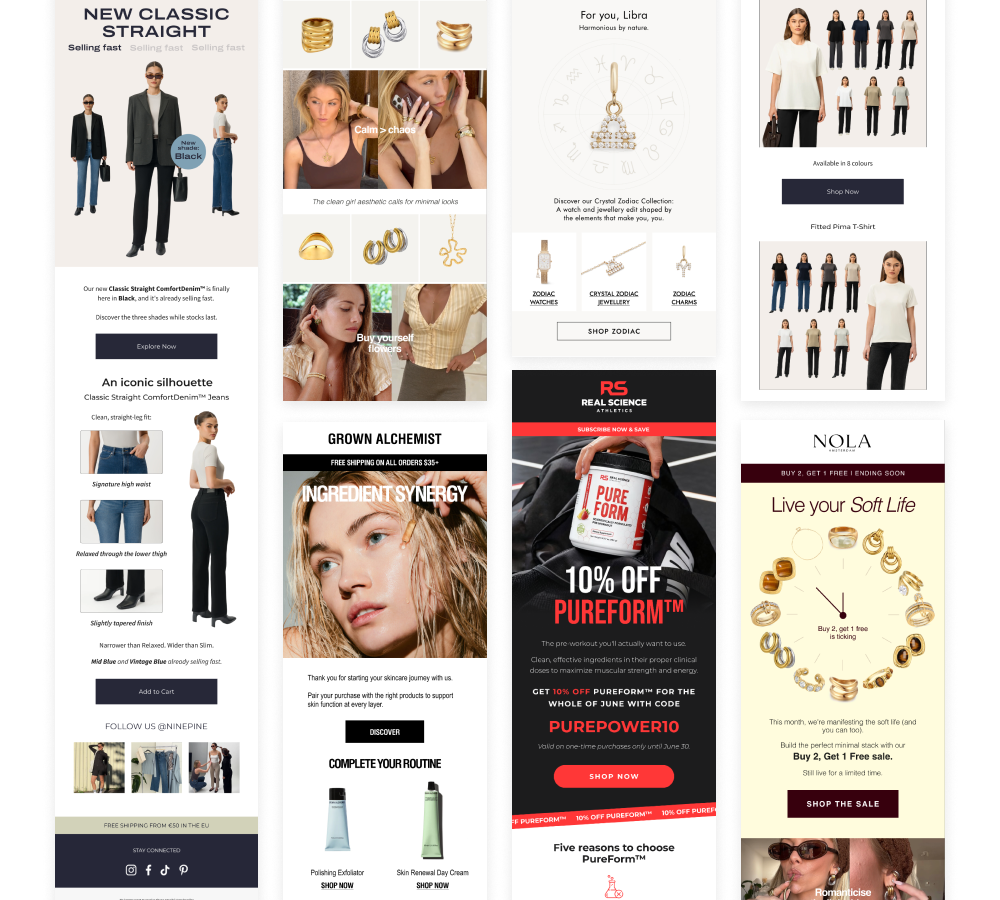
That works often enough that nobody calls it broken. It also confounds almost everything. One headline is shorter, more emotional, more specific, more premium-sounding and more benefit-led than the other. When it wins, the brand learns that the whole piece of copy performed better, and nothing about why. The distinction sounds academic until you're spending $300,000 a month on Meta and making positioning calls off noisy creative tests.
There's a startup hiding in that gap: a vertical research tool that takes the language a brand already owns (reviews, surveys, approved product copy), maps the dimensions along which customers naturally describe the category, then generates controlled claim variants that change one dimension at a time. Nobody will mistake it for Nielsen, and it shouldn't try to be. It answers a narrower question a small brand finds far more useful: which language is worth testing, and is the evidence strong enough to change my marketing.
Call it ReviewLab for now. The short version:
The money: Twenty $2,000 sprints in six months, then ten brands at $399 and five agencies at $999, is about $9,000 MRR, with a credible path to $20,000 to $40,000.
Inside:
• Ten-stage MVP built around a control audit
• Sprint-to-agency pricing ladder, $199 to $1,499
• The agency outreach email, word for word
• Two traps: Amazon's Section 19 and the FTC rule
The timing is unusually good, for reasons that start in an academic journal.
The Academic Paper That Accidentally Wrote the Product Spec
On September 6, 2026, the Journal of Marketing Research published a method called BRIDGE, short for Behavioral Research Through Interpretable, Dimensionality-reduced Generative AI Embeddings, from a team led by Sachin Gupta at Cornell with Anirban Mukherjee and Hannah H. Chang of Singapore Management University. Cornell's business school highlighted the work on September 10, 2026. The paper ships with an open Python package, and the authors demonstrated the method on nearly 120,000 real wine tasting notes. The problem it attacks is called stimulus sampling, and it's the same problem the Shopify brand above has with its three headlines.
Consumer experiments usually test a tiny number of handcrafted examples. A researcher compares two product descriptions, finds a difference, and concludes that some characteristic drives behavior. Those two descriptions differ in dozens of unintended ways, so nobody knows whether the finding generalizes beyond the sentences the researcher happened to write. BRIDGE uses embeddings to turn large collections of real-world language into a small number of interpretable dimensions, then statistically accounts for the nuisance variation so an experiment can isolate the dimension that matters.
You don't need to commercialize the paper. The operating principle is what's worth stealing. Instead of asking an LLM to read 5,000 reviews and list the top themes, you ask which meaningful dimensions differentiate the language in this category, and how to isolate one while holding everything else constant. The first question gets you a word cloud, and the second gets you an experiment. The product is a vertical micro-SaaS that converts a DTC brand's first-party reviews and approved copy into controlled claim variants, runs lightweight customer or panel tests, and reports which language dimensions move measured preference. Four words there are doing the work: first-party, controlled, measured and preference. Each keeps you out of a different trap, and the rest of this piece is mostly about those traps.
There Is Plenty of Research Money. You Need Almost None of It.
The Insights Association put the U.S. insights and analytics industry at $89.3 billion for 2025, up 7.8% year over year, with technology-enabled research (the industry calls it ResTech) now nearly half of it. None of that is your TAM. The useful signal is that companies already pay enormous sums to reduce uncertainty before marketing decisions, and software keeps absorbing work that used to be bespoke research projects.
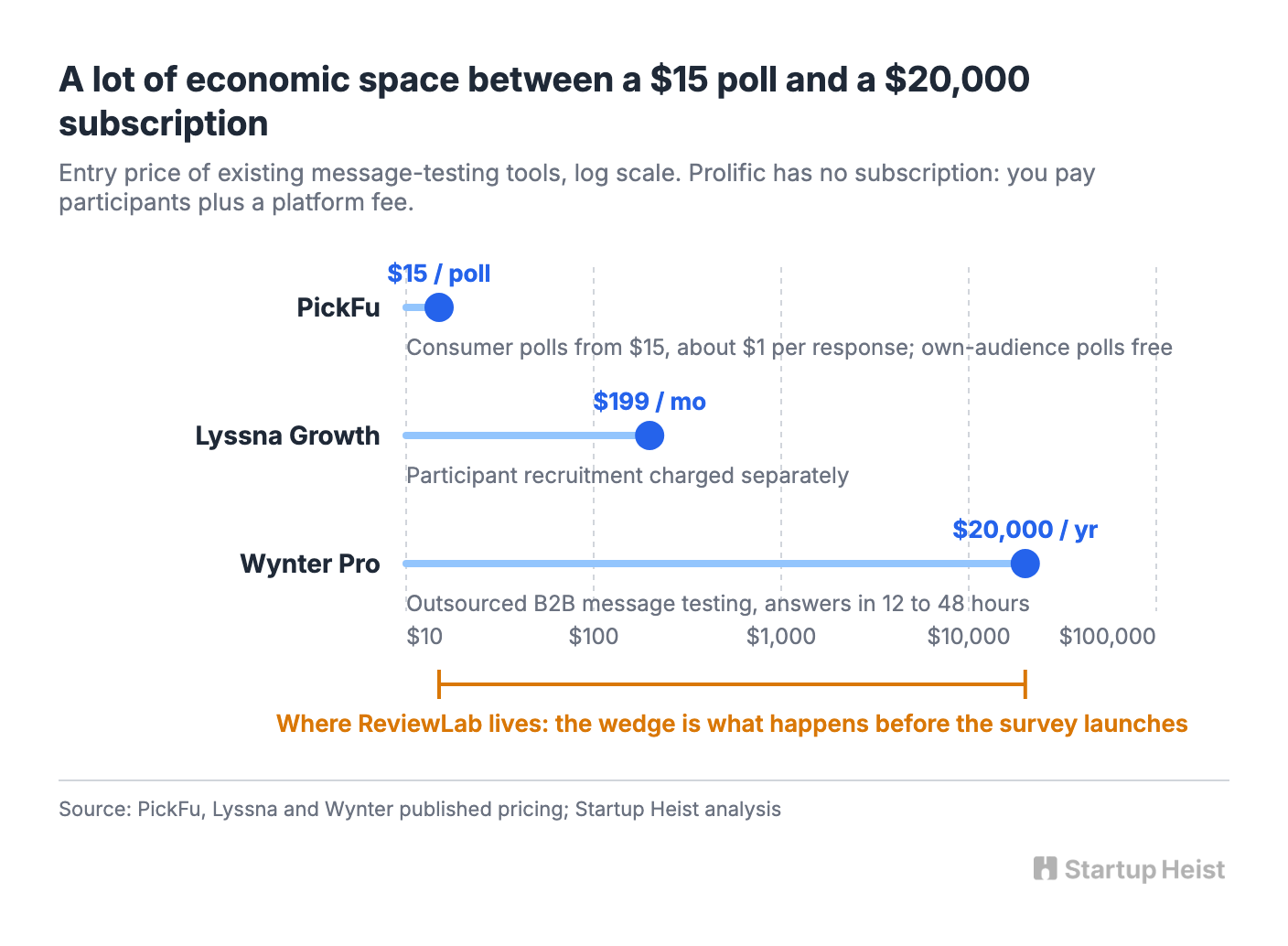
You can read the pricing ladder straight off the existing market. PickFu runs consumer polls from $15, at roughly $1 per response, and lets you poll your own audience through a share link for free. Lyssna's Growth plan is $199 a month, with participant recruitment charged separately. Prolific has no subscription; you pay participants plus a platform fee. At the other end, Wynter charges $20,000 a year for its Pro tier, an outsourced B2B message-testing function with answers in 12 to 48 hours, while Zappi-style automated concept tests for CPG brands run into the thousands of dollars per study.
There's a lot of economic space between a $15 poll and a $20,000 subscription, and that's where ReviewLab lives. It won't get there by recruiting respondents better than PickFu or Prolific. The wedge is what happens before the survey launches. PickFu can tell you which of several options people prefer. ReviewLab tells you which options are worth comparing in the first place, so the result teaches you something reusable on the next product page and the next ad. That sounds like a modest difference in scope, and it's the entire company.
Don't Build Another Review Summarizer
This is where the idea usually dies without anyone noticing. A founder builds a dashboard that ingests 10,000 reviews, embeds them, clusters them and produces cards saying customers care about taste, people mention shipping, convenience sentiment is positive. Congratulations, you've rebuilt ChatGPT with charts. Review analysis is already a feature. Judge.me runs on more than 500,000 Shopify stores and bundles AI review summaries into a $15-a-month plan, and every review platform will follow. The insight layer is commoditized before you start.
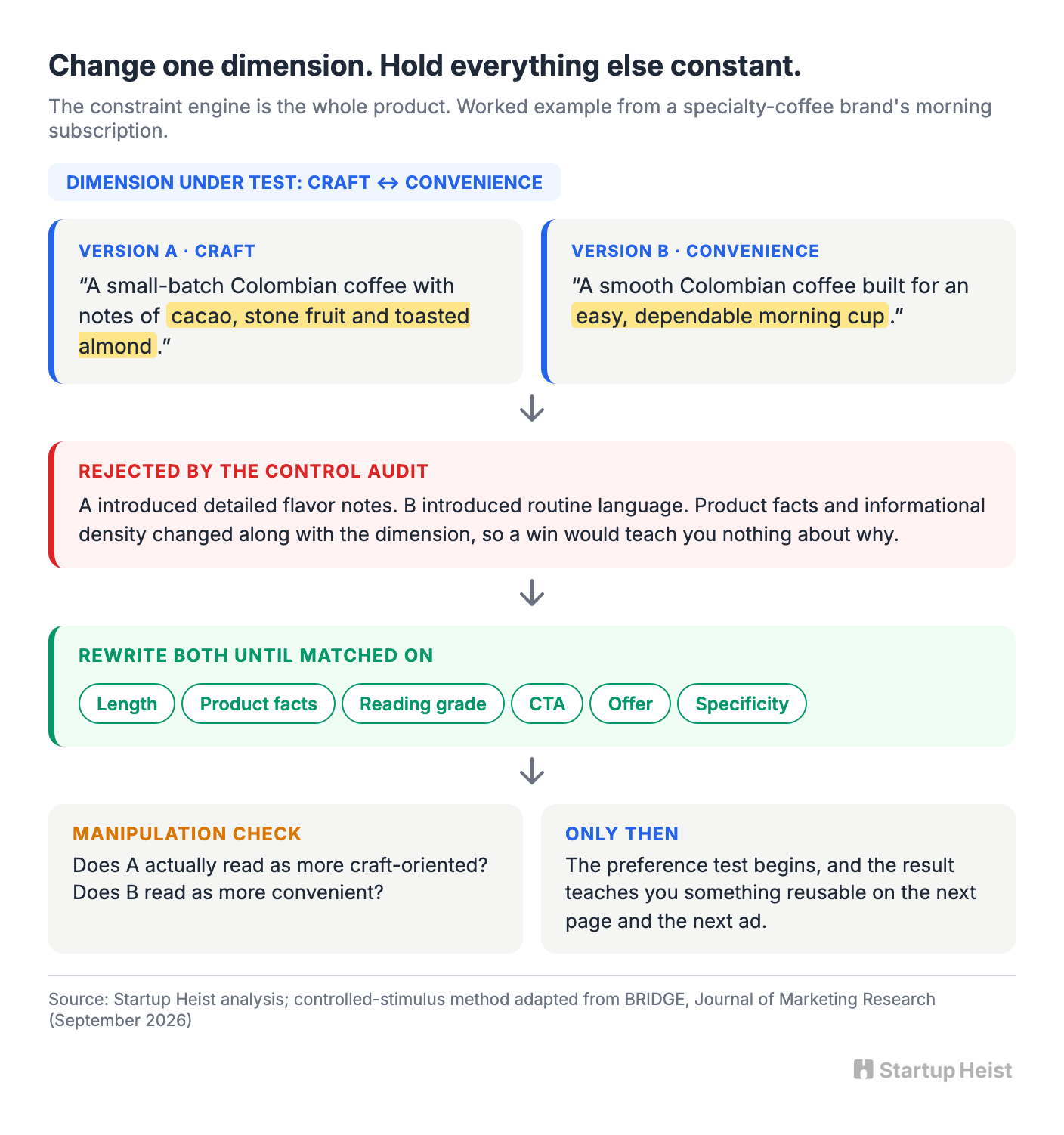
The product has to move one step downstream, from insight generation to decision design. Take a specialty-coffee brand that uploads 6,000 reviews, its current product descriptions and its approved claims. ReviewLab finds the category's language runs along a handful of recurring axes: craft versus convenience, origin specificity versus broad accessibility, sensory indulgence versus functional energy, expert language versus beginner language, ritual versus speed. The marketer picks one hypothesis: for the morning subscription product, convenience-oriented language will increase purchase preference among customers who buy whole-bean coffee less than once a month.
The software generates matched variants. Version A: "A small-batch Colombian coffee with notes of cacao, stone fruit and toasted almond." Version B: "A smooth Colombian coffee built for an easy, dependable morning cup." Then it refuses to accept them, because A introduced detailed flavor notes and B introduced routine language, so the product facts and informational density changed along with the dimension. ReviewLab rewrites both until length, facts, reading grade, CTA, offer and specificity are matched, then runs a manipulation check before anyone votes: does A actually read as more craft-oriented, does B as more convenient? Only then does the preference test begin. The constraint engine is the whole product, and nobody in an $89.3 billion industry has bothered to sell it to a $5 million brand.
Why Coffee Beats Supplements as the Beachhead
Supplement brands spend aggressively and obsess over claims, which makes them tempting. Resist it, at least at first. A tool that generates advertising claims wanders into regulatory territory faster than a founder expects, and skincare, wellness, infant products, supplements and pet health each carry their own claim-review baggage.
Unlock the Vault.
Join founders who spot opportunities ahead of the crowd. Actionable insights. Zero fluff.
“Intelligent, bold, minus the pretense.”
“Like discovering the cheat codes of the startup world.”
“SH is off-Broadway for founders — weird, sharp, and ahead of the curve.”


