


The Retail Launch Assurance Layer Beauty Brands Suddenly Need
On September 10, 2026, Target handed hundreds of small beauty companies a problem they had never had before.
That morning, Target Beauty Studio opened in 611 stores and on Target.com: more than 1,600 products from 90 prestige, emerging, and international brands, more than two-thirds of them new to Target. The format replaces the Ulta Beauty shop-in-shops that closed on August 18, 2026 after a five-year run, and Target built it to feel like a specialty store inside a mass retailer, with uniformed Beauty Advisors, testers on select products, a rotating sampling table, and a minis wall. Kearney's Ally McPartland put it plainly: "The line between 'mass retailer' and 'beauty specialist' is getting thinner from both directions at once."
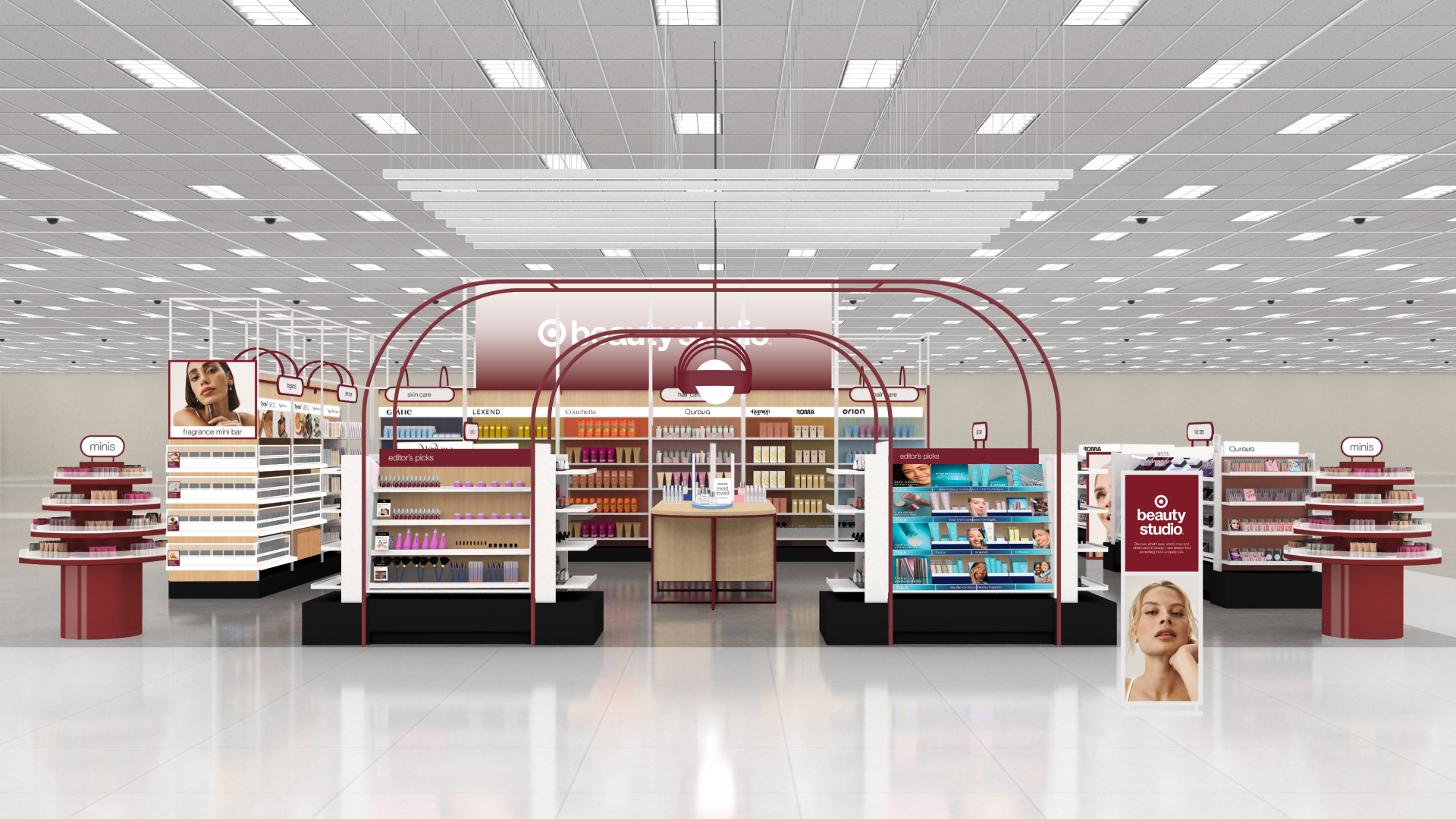
For a founder who just won that account, September 10 was a celebration. It was also the day their product started sitting in hundreds of stores they'll never physically see. Winning the Target account and winning the Target shelf are different things. A product can be "in Target" while store #184 has the wrong price tag, store #392 never put out the tester, store #511 has an empty facing, and store #87 has the display buried behind a competitor. The retailer will eventually send sales data. It won't send a photograph explaining why one location is underperforming.
Someone should. Build the outsourced field-operations layer for beauty brands that suddenly have hundreds of U.S. doors and almost no U.S. field organization: send people into the stores that matter, photograph what's actually there, turn visible failures into standardized evidence, route each one to whoever can fix it, then go back and confirm the fix happened. That last step, the confirmation, is the part clients pay for.
Here's the short version:
The money: Twenty clients averaging $2,500 a month is $50,000 MRR. Managed retail-execution programs already bill $200,000 to $1 million a year.
Inside:
• Five offers, from $1,500 baseline to launch desk
• A 100-point readiness score that won't overclaim
• The escalation pack that earns the renewal
• Cold email script and a 30-day launch plan
The Distribution Wave Outran the Org Chart
Beauty is the right wedge because the distribution is real and the money is large. Circana put U.S. prestige beauty at $36 billion in 2025, up 4%, and mass beauty at $72.7 billion, up 5%, and both segments accelerated to 7% growth in the first half of 2026. Target's beauty net sales hit $3.64 billion in the second quarter of 2026, up 7.2% from $3.40 billion a year earlier, and $7.04 billion through the first half. Ulta Beauty closed fiscal 2025 on January 31, 2026 with $12.4 billion in net sales across 1,505 U.S. stores.
Going from Shopify to Ulta reads as a channel upgrade on the sales side. On the operations side, a 12-person company just became responsible for a physical network the size of a regional bank's branch system.
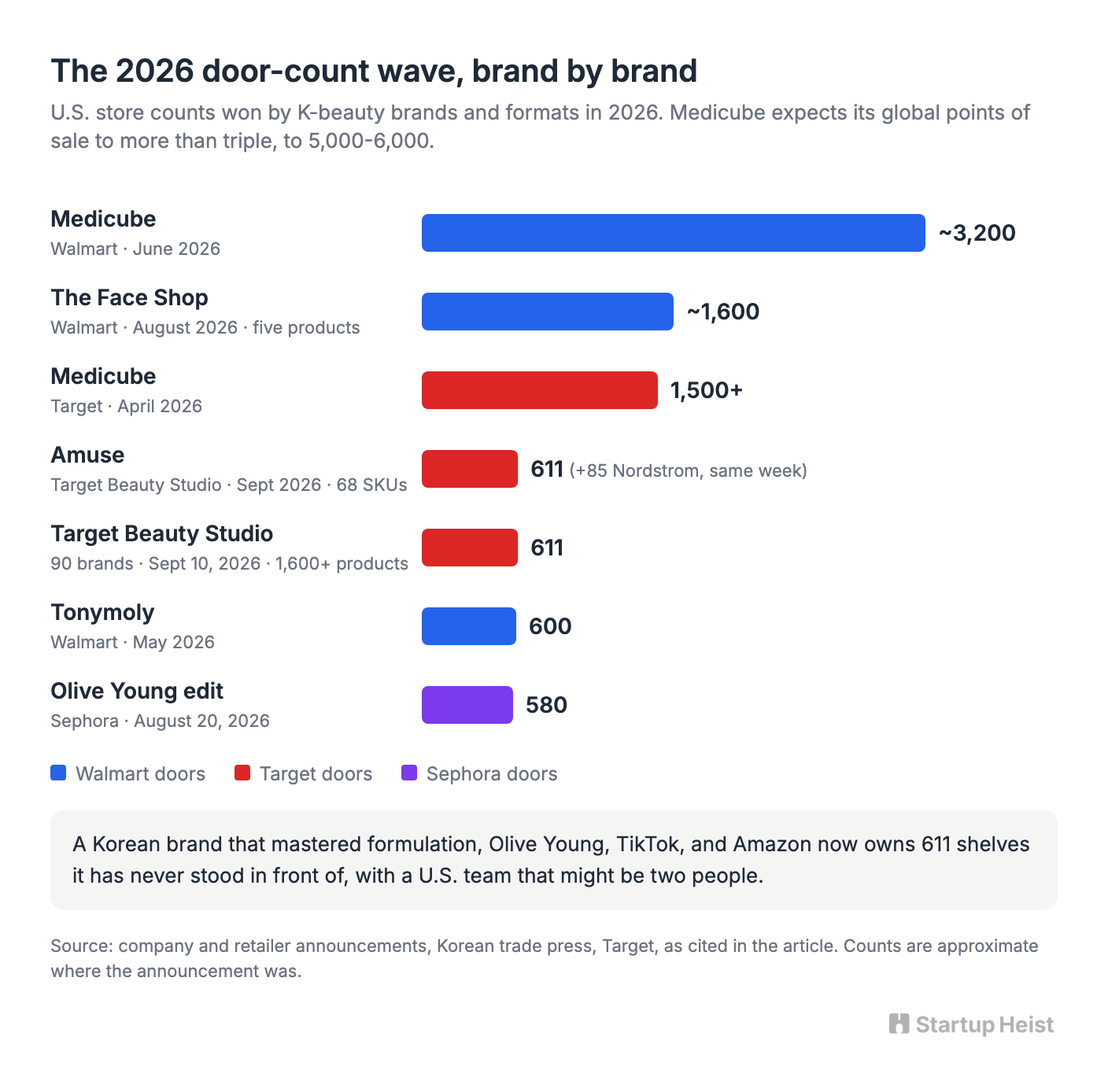
The pace of door-winning has picked up in 2026, and K-beauty is driving it. Medicube, owned by APR, entered more than 1,500 Target stores in April 2026 and roughly 3,200 Walmart stores in June, with a Costco launch planned for September; the company expects its global points of sale to more than triple, to 5,000-6,000. Tonymoly went into 600 Walmart stores in May. LG Household & Health Care's The Face Shop reached about 1,600 Walmart doors in August with only five products. Sephora launched an Olive Young K-beauty edit across 580 stores on August 20. Inside Beauty Studio alone, roughly a dozen of the 90 brands are Korean, including Amuse (Shinsegae International), which launched 68 SKUs in 611 Target stores and 85 Nordstrom locations in the same week.
So a Korean brand that mastered formulation, Olive Young, TikTok, and Amazon now owns 611 shelves it has never stood in front of, with a U.S. team that might be two people and a launch that might be worth eight figures.
What the Retailer Won't Tell You
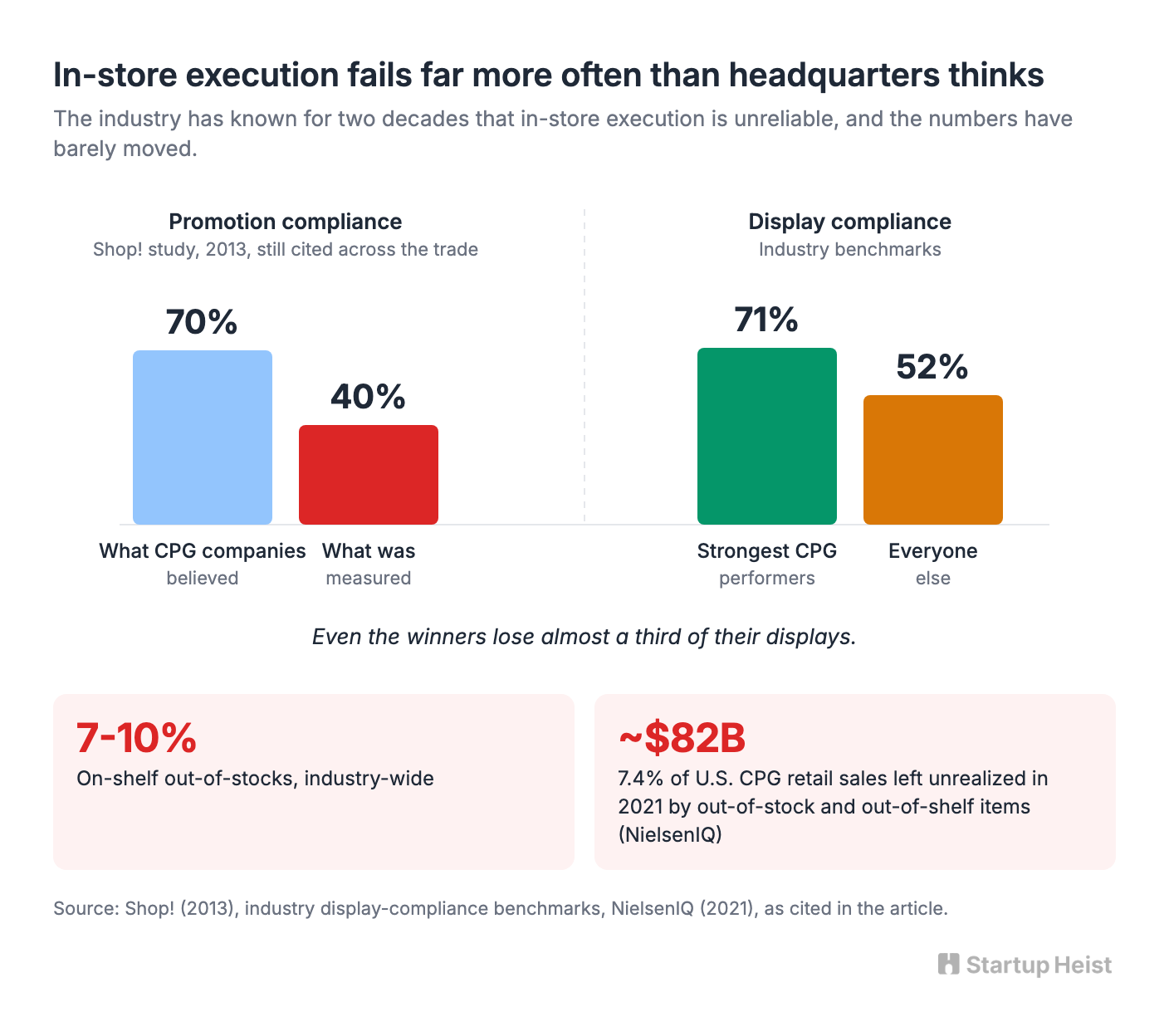
The industry has known for two decades that in-store execution is unreliable, and the numbers have barely moved. A 2013 Shop! study, still cited across the trade, found CPG companies believed their in-store promotion compliance ran around 70% while the measured rate was 40%. Industry benchmarks put display compliance at 71% for the strongest CPG performers against 52% for everyone else, which means even the winners lose almost a third of their displays. On-shelf out-of-stocks sit at 7-10% industry-wide, and NielsenIQ estimated that in 2021 U.S. CPG retailers left 7.4% of sales, roughly $82 billion, unrealized because of out-of-stock and out-of-shelf items.
Those failures cost beauty more than they cost protein powder. A filthy tester, a missing display, a wrong price, or an empty slot damages the discovery experience the retailer just spent a year building. Target SVP Amanda Nusz describes Beauty Studio as "an inspiring destination to discover what's new, now and next in beauty." When testers are the merchandising strategy, a missing tester is a missing product.
The brand finds out in six weeks, when the sell-through report arrives and a buyer asks why Chicago is soft. By then the reset window has closed and the broker has moved on.
The Heist: ShelfProof
Call it ShelfProof. The product is deceptively plain.
A brand sends you its store list, SKUs and UPCs, expected retail prices, launch dates, fixture reference photos, tester requirements, promotional materials, and broker or distributor contacts. You inspect 15, 30, or 50 strategically chosen stores. At each one, an auditor captures a standardized photo set and answers a constrained checklist: product on shelf, correct price visible, tester present and usable, expected display present, facings counted, signage present, any competitor physically interfering.
ShelfProof reviews the submission, scores the store, flags exceptions, and produces an action package:
Target #1847, Chicago, IL. September 18, 2:42 p.m.
Critical: Hero SKU not visible on shelf.
Expected: Four SKUs, one facing each. Observed: Three SKUs visible.
Evidence: Photos 1-3.
Requested action: Confirm replenishment and distribution status.
Owner: Midwest broker. Recheck: September 25.
A folder of 700 JPEGs tells the founder nothing. This tells them where the launch is broken, who should fix it, and whether they did.
Don't Build the Obvious Startup
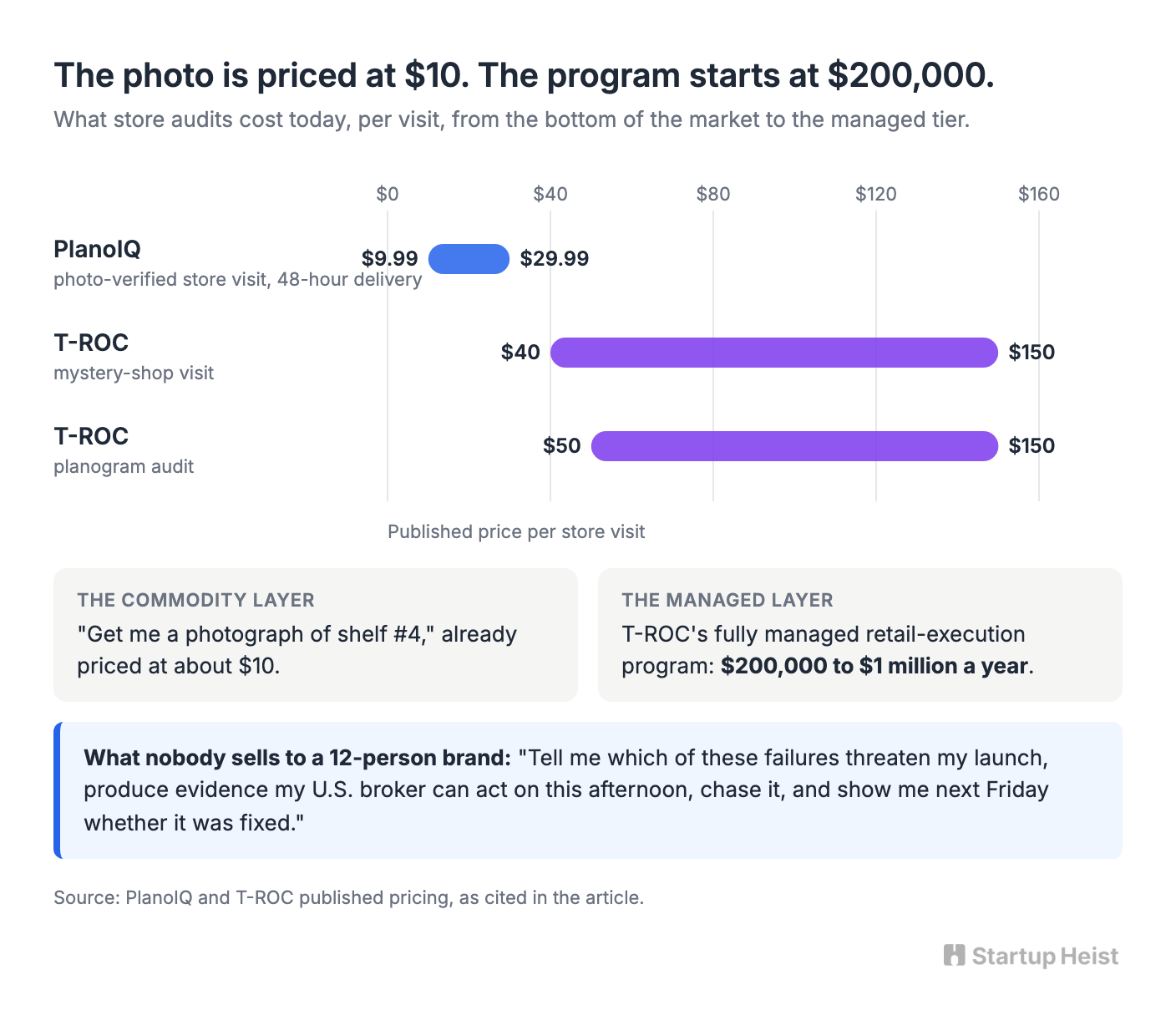
Store audits, mystery shopping, and shelf photography make up a mature business, and the incumbents are formidable. Field Agent has crowdsourced store photos since 2010, its app has been downloaded more than two million times, and it ships GPS verification, timestamps, and a QC process on every job. Trax and FORM merged image recognition with retail-execution workflow; Trax claims 96% SKU-level recognition accuracy and dispatches its own on-demand Flexforce for shelf correction. Repsly sells the scheduling and task layer to brands and retail-service organizations. At the bottom of the market, PlanoIQ advertises photo-verified store visits from $29.99 for new accounts down to $9.99 at volume, delivered within 48 hours, across every major U.S. chain. T-ROC publishes the managed-program economics: $40-150 per mystery-shop visit, $50-150 per planogram audit, $200,000 to $1 million a year for a fully managed program.
Spend six months building "Uber for retail auditors plus AI shelf recognition" and you arrive with 14 shoppers, an API key, and a dashboard, competing against national field-marketing networks and a decade of shelf data.
The commodity layer is "get me a photograph of shelf #4," and it's already priced at $10. What nobody sells to a 12-person brand is "tell me which of these failures threaten my launch, produce evidence my U.S. broker can act on this afternoon, chase it, and show me next Friday whether it was fixed." Use the existing labor supply wherever it's cheaper than your own, own the vertical workflow around it, and sell it to the founders least equipped to buy from Trax: no enterprise budget, no retail-ops hire, no idea what a reset window is, and a launch clock that started on September 10.
Sell the Launch Before the Software
Unlock the Vault.
Join founders who spot opportunities ahead of the crowd. Actionable insights. Zero fluff.
“Intelligent, bold, minus the pretense.”
“Like discovering the cheat codes of the startup world.”
“SH is off-Broadway for founders — weird, sharp, and ahead of the curve.”


