


The Water Meter Is a Financial Statement
A cash-heavy laundromat can argue with its P&L. It has a much harder time arguing with physics, and that gap is a narrow, high-value opening: the diligence layer for laundromat acquisitions.
Buying a laundromat comes with an unusual accounting problem. The seller hands you tax returns, profit-and-loss statements, bank deposits and collection logs, and if the store runs heavily on coins, none of them can prove how many paid wash cycles actually happened. Cash that never hit a bank account leaves no trail. Cash that was counted generously leaves a misleading one.
Every wash cycle consumes water, though. A 40-pound washer pulls a known number of gallons per turn, each turn sells at a known vend price, and the water company meters the building and mails a statement. Work backward from consumption and you get a plausible range for washer revenue that the seller didn't author.
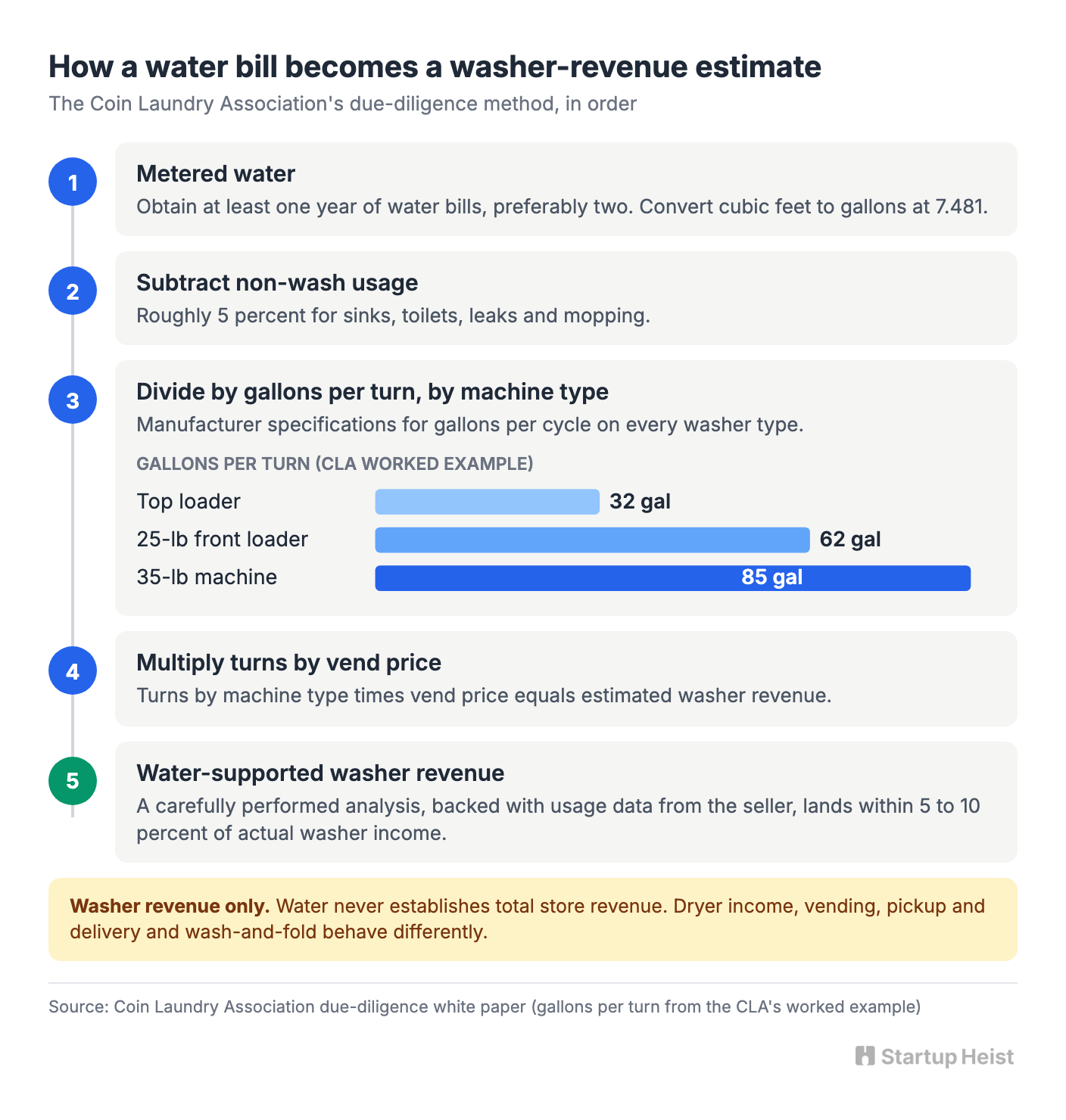
The Coin Laundry Association's due-diligence white paper puts it bluntly: in the trade, "water is the one thing that cannot lie." The association calls water the best utility for revenue verification and says a carefully performed analysis, backed with usage data from the seller, lands within 5 to 10 percent of actual washer income. Its recipe is specific. Obtain at least one year of water bills, preferably two. Pull manufacturer specifications for gallons per cycle on every washer type. Collect vend prices. Subtract roughly 5 percent for sinks, toilets, leaks and mopping. Convert cubic feet to gallons at 7.481.
None of this is new theory. It's established practice, and the closest anyone has come to productizing it is the single-input calculator: upload water bills, get a number. FlowAudit is the most polished example, and nobody has built the workflow around the number.
That unbuilt workflow is the business:
The money: 20 reports a month at $1,250 is $25,000 MRR with $950 of contribution per report; the median laundromat listing asks $500,000.
Inside:
• Seven-module MVP scoped for a solo founder
• Pricing ladder: $199 screen to $10K workspace
• Broker and SBA lender outreach, email included
• Four-layer moat built on the exception library
The method is public, the workflow isn't
Eastern Funding, one of the largest specialty lenders to laundromats, published its own water-bill walkthrough on December 10, 2014, and has taught it to borrowers since: convert the bill to gallons, assign consumption by machine type, estimate turns, translate turns into revenue. Cents, the best-funded software company in the industry, tells buyers to triangulate income three ways, through utility usage, coin collection and the financial paper trail.
The expertise is everywhere. Outside of those calculators, the system is a broker's Excel file, a lender's internal checklist, or a first-time buyer's evening with a calculator and thirty PDFs from a municipal water authority. Billing units never get normalized, nobody records which spec sheet produced the gallons-per-cycle figure, and six months after closing nobody can show which assumption was wrong.
That gap is the product. Call it Suds Diligence for now: an independent, buyer-controlled due diligence system that ingests utility bills, machine inventories, vend prices, payment-system exports, financial statements and leases, and produces an auditable revenue-consistency and capital-risk report.
It isn't a valuation, and it isn't an AI-generated fraud accusation. It never says "this laundromat is worth $412,350." It answers one narrower and far more defensible question: do the physical evidence and the source documents support the economic story the seller is telling? The whole business lives inside that distinction.
What a $1,250 report is worth on a $500,000 decision
Say a seller claims $220,000 in annual washer revenue. The buyer uploads 30 months of water bills. The software normalizes cubic feet, gallons, billing periods and a meter swap in March, matches the store's Speed Queen, Dexter and Continental machines against a specification library, applies vend prices, carves out the known wash-and-fold volume, and applies a range for non-wash usage.
The output reads something like this:
- Seller-stated washer revenue: $220,000
- Water-supported range: $164,000 to $188,000
- Variance from seller claim: roughly 15 to 25 percent
- Evidence quality: High
- Primary sensitivity: utilization assumptions on the 40-lb washers
- Recommended action: reconcile against card-system reports, collection logs and bank deposits before the diligence period expires
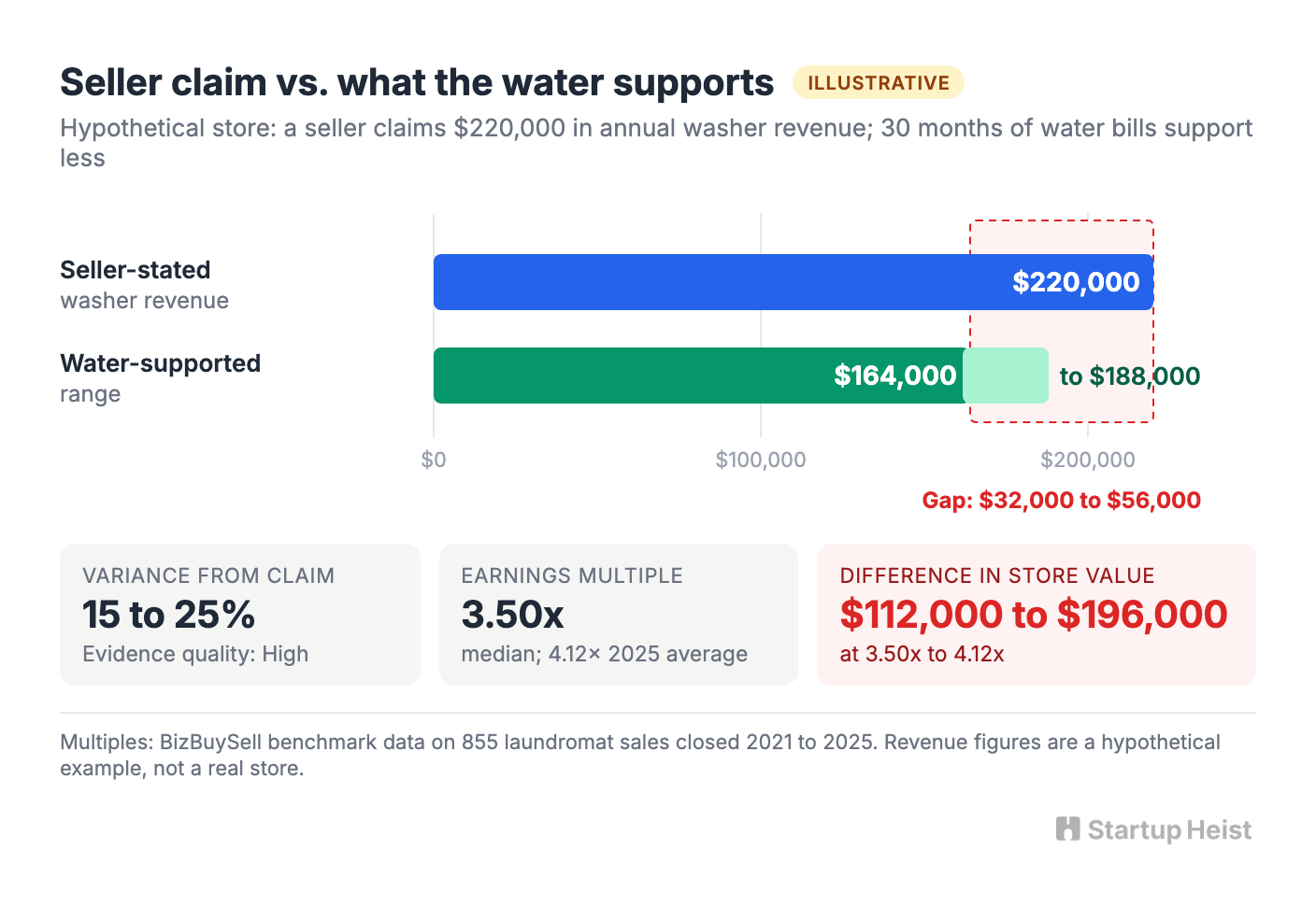
Nobody has been called a liar. The buyer now holds an inconsistency worth $32,000 to $56,000 of annual revenue, and revenue that never existed comes straight out of owner earnings, because the expenses were real. BizBuySell's benchmark data on 855 laundromat sales closed between 2021 and 2025 shows a median earnings multiple of 3.50x, with the 2025 average at 4.12x. At those multiples, the gap above is a $112,000 to $196,000 difference in what the store is worth.
Across those 855 closed deals, the median sale price was $250,000, median revenue $219,878 and median owner earnings $76,560, with a typical 139 days on market. As of September 2026, BizBuySell's median asking price for an established laundromat is $500,000 nationally and $799,000 in California. Closed-sale medians and asking prices are different populations, so don't blend them. Either way, buyers routinely make six-figure decisions on documents the seller controls, and a $1,250 report is a rounding error against being wrong by $75,000. That's why this business works far better at $995 per deal than at $29 per month.
The giant next door cannot take this
The obvious strategic threat is Cents. In August 2024 it raised a $40 million Series B led by Camber Creek and acquired Laundroworks, a card-payment system now installed in more than 6,000 laundry locations. On March 26, 2026, it announced a $140 million Series C from Sumeru Equity Partners. Cents says its platform runs more than 4,500 laundromat locations and processes $1 billion in annual payments, and Laundroworks plans starting at $89 per month already give operators machine-level usage and revenue reporting.
So Cents has something Suds Diligence will never have across its installed base: direct, machine-level transaction data. The defense is independence. Suds has to work when the seller has coins, twenty-year-old Speed Queens, municipal PDF bills, an Excel collection log and a handwritten equipment list. It has to be indifferent to which vendor wins the store after closing, and visibly so. Cents sells the software you run a laundromat on. A buyer deciding whether to purchase one needs an auditor, and the seller's software vendor can never credibly be that.
The nearer competitor is smaller and more instructive. FlowAudit, live as of September 2026, is the water technique as a web product: upload 12 to 24 months of water bills and an equipment inventory, and its AI computes a "physics-based maximum revenue," a discrepancy report and a bank-ready PDF aimed at investors and brokers. Pricing isn't published; the first analysis is free. It is the formula with a front end, one input and one number, with nothing on leases, tax returns or card data and no trail back to the page behind any figure. Its existence settles the demand question. What's still unbuilt is the harder product, one that reconciles water against everything else the seller handed over and shows its work.
Why now: October 1, 2026
Unlock the Vault.
Join founders who spot opportunities ahead of the crowd. Actionable insights. Zero fluff.
“Intelligent, bold, minus the pretense.”
“Like discovering the cheat codes of the startup world.”
“SH is off-Broadway for founders — weird, sharp, and ahead of the curve.”


