


The TikTok Shop Launchability Copilot
TikTok Shop has created a strange new job inside ecommerce, and nobody has built the software for it yet.
A seller can now spend an entire afternoon bouncing between Kalodata, FastMoss, supplier catalogs, creator videos, TikTok Shop listings, Amazon reviews and a spreadsheet, trying to answer a question that sounds simple: should we launch this product?
The existing tool stack is remarkably bad at answering it. Product-research dashboards tell you what has already sold: GMV estimates, sales velocity, top creators, top videos, category rankings. Supplier marketplaces tell you what can be sourced. ChatGPT can generate 20 hooks before lunch. None of those tools resolves the actual capital-allocation decision: is this product demonstrable enough for short-form video, under-saturated enough to enter, profitable after creator commissions and fulfillment, suited to creators you can realistically recruit, and safe enough to sell without wandering into a compliance mess?

Build a Chrome extension for TikTok Shop operators that sits inside the research workflow they already use and converts candidate products into launch decisions. It scores evidence across demonstration potential, market demand, saturation, unit economics, creator fit and compliance risk, then turns the survivors into creator-ready test briefs. Call it a Launchability Copilot. The pitch is deliberately unglamorous. Instead of "AI finds viral products," the tool says: test this, reject that, here's why, here's the margin you need, here are the content angles, here are the claims you can't make. Now go run the experiment. A trend list can't charge for that.
The short version:
The money: 100 agencies and operators at $149 a month is $15K MRR; 500 is $75K. Over 5,700 U.S. stores cleared $1M in GMV in the first half of 2026.
Inside:
• Five-gate scoring rubric with side-panel mockup
• The nine-section Launchability Memo
• Six-week MVP scope and $149 to $499 pricing
• Agency outreach email and the decision-data moat
The market is real, and it's getting crowded fast
TikTok Shop's U.S. business is now large enough to support real software companies around it. Momentum Works and Tabcut estimate U.S. GMV reached $11.8 billion in the first half of 2026, up 103% year over year, making the U.S. TikTok Shop's largest market. EMARKETER forecasts $23.41 billion in U.S. sales for full-year 2026, a 48% increase that would put TikTok Shop ahead of Target's online business. TikTok itself reported more than $500 million in U.S. Shop sales over the four days from Black Friday to Cyber Monday 2025.
You don't need to manufacture a TAM story. More than 5,700 U.S. stores crossed $1 million in GMV in the first half of 2026, eight times the count a year earlier, and 506 stores cleared $10 million. Those are businesses with budgets, teams and a recurring product-selection problem.
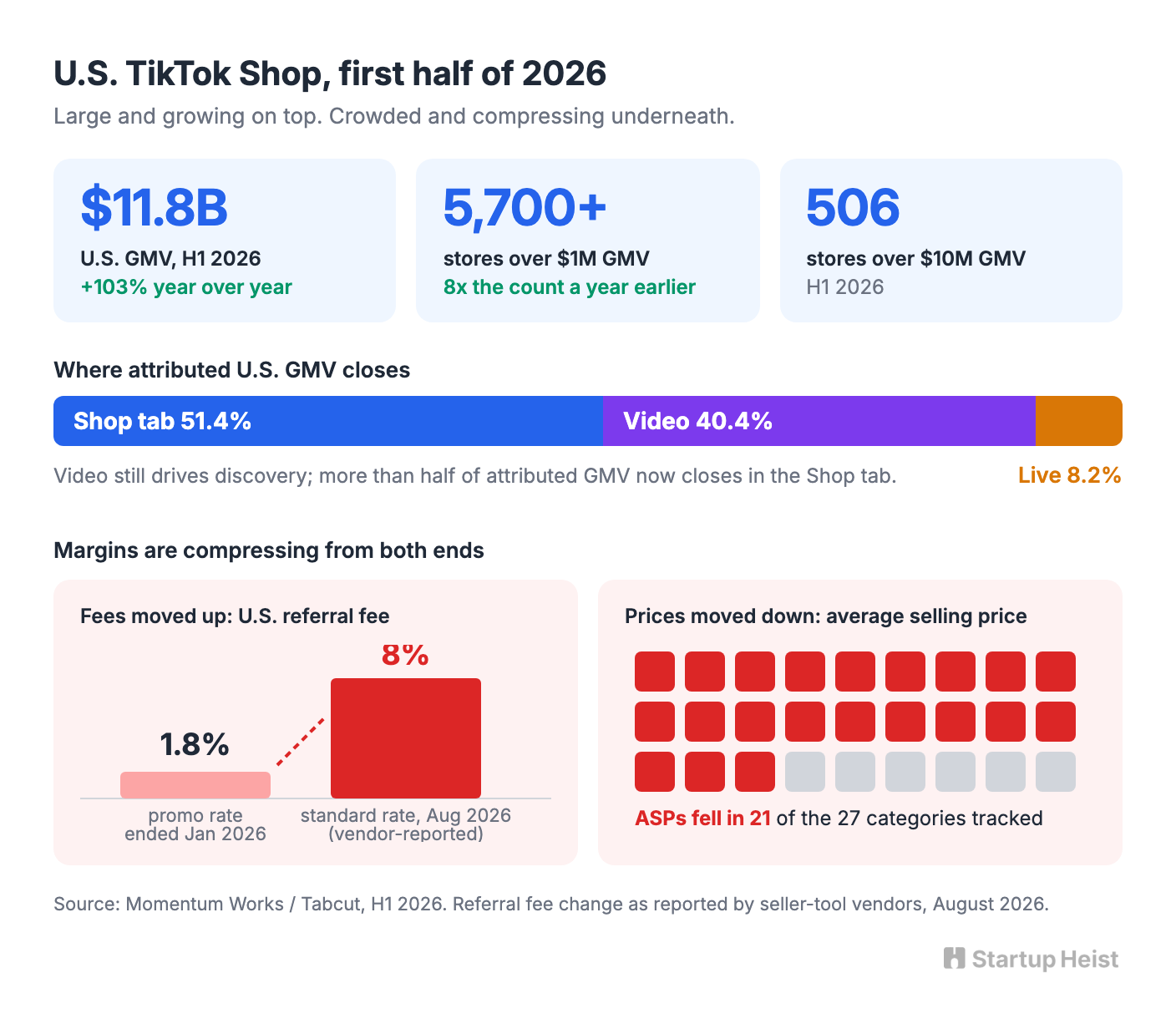
The more interesting signal is what maturity looks like. The same Momentum Works data shows 51.4% of attributed U.S. GMV now closes through the Shop tab, with video at 40.4% and live at 8.2%. Video still drives discovery, but this is no longer a game of finding something visually outrageous, posting one clip and watching orders fall out of the algorithm. Average selling prices fell in 21 of the 27 categories Momentum Works tracks, which is what happens when hundreds of sellers pile into the same products with the same suppliers. Fees are moving the other way: TikTok's 1.8% promotional commission ended in January 2026, and seller-tool vendors report the standard U.S. referral fee moved to 8% in August 2026, so margins are compressing from both ends. Meanwhile TikTok's own Shop Safety Report for the first half of 2025 disclosed more than 700,000 seller accounts deactivated globally and over 70 million listings rejected before going live.
That combination kills the seductive version of this idea. There's no credible evidence of a universal formula where a dramatic transformation in the first three seconds produces a 30% conversion rate, and you don't need that claim. A simpler observation is harder to argue with: some products are materially easier to sell through short-form video than others, and demoability is only one input into whether a product deserves inventory, samples and creator attention. The seller who gets that decision right while prices compress and enforcement tightens is the seller still standing in 2027.
Dashboards stop one decision too early
TikTok Shop research software is already a crowded shelf, and the pricing tells you where the ceiling sits. Kalodata runs from roughly $46 to $99 a month. FastMoss lands between about $47 and $180. Shoplus lists three plans at $39, $49 and $79. SmartScout bundles TikTok Shop product research into its $49 Basic tier alongside Amazon data. At the operating end of the stack, HiveHQ sells profit tracking from free up to $199 a month and prices its affiliate-outreach automation at $350 to $400 a month.
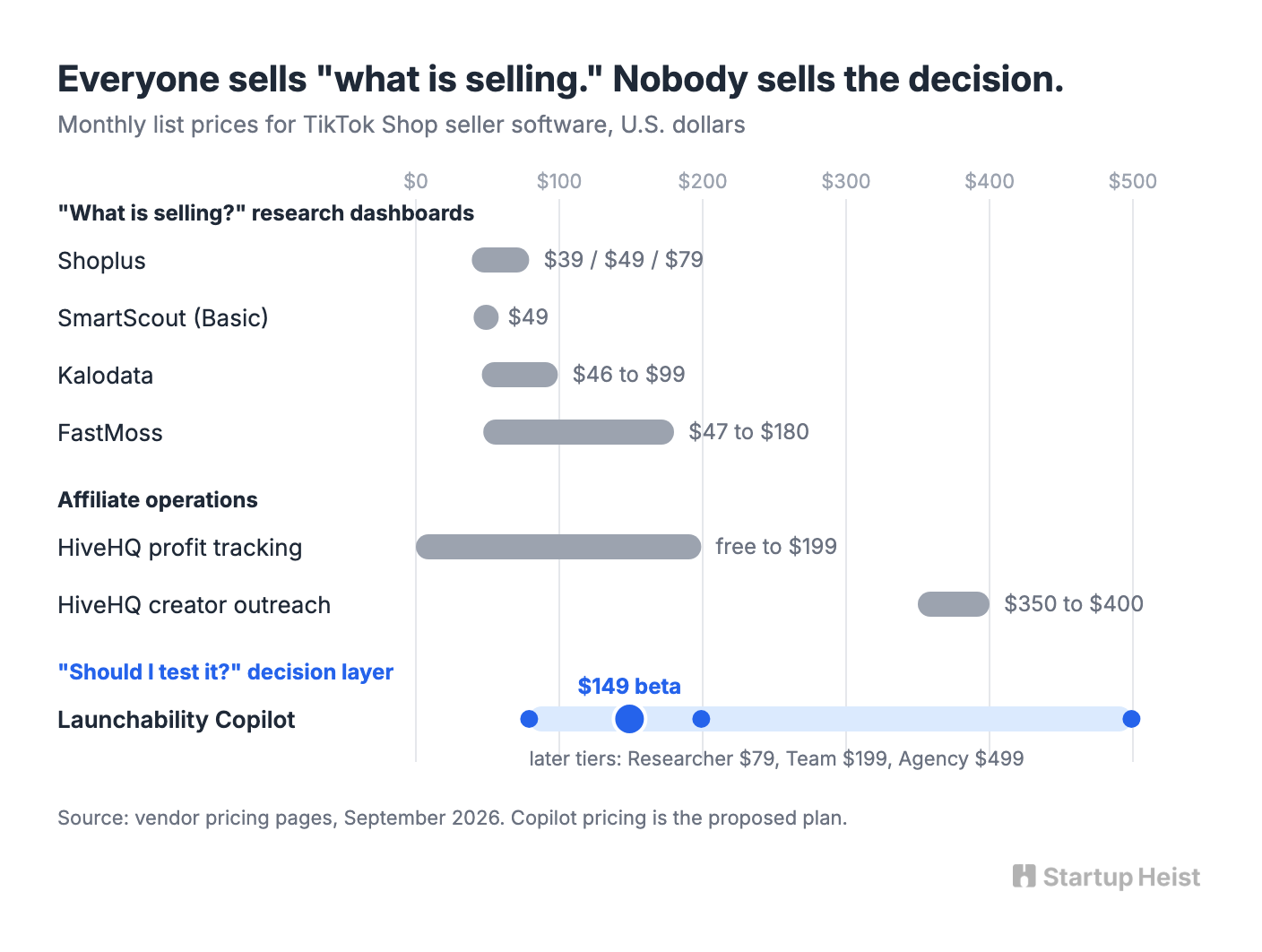
So merchants will pay for TikTok Shop software, and raw data isn't the wedge. Launching another "Top 100 Trending Products" dashboard is a rough business: the incumbent can add your feature in two weeks, and the customer can often reconstruct the answer manually. Every one of these tools answers "what is selling?" So do the Chrome extensions already in the space, TokScout, TikShop Pro, EchoTik and Helium 10's TikTok extension, which put the same data closer to the page. None of them answers "given my economics, my operating constraints and my content capabilities, should I spend money testing this?" The difference sounds subtle until you compare a Bloomberg terminal with an investment committee memo. The terminal is an input. The memo is what gets paid for.
Seller forums already reflect the frustration. The standard complaint is that by the time a product shows up on a trending list, everyone else can see it too, and the margins are gone. The second is products that look fantastic in the data and then die in the spreadsheet once sourcing, shipping and creator commission get entered. These are anecdotes rather than market data, but they describe the workflow failure precisely. Discovering demand is easy; deciding whether you can profitably exploit it is where the afternoon disappears. A product built around that decision looks nothing like a chart.
Five gates, not one magic score
Resist the temptation to slap a big green 87/100 WINNING PRODUCT badge on everything. Fake precision is exactly what would make this product disposable. Every candidate instead passes through five transparent gates, and the interface shows the reasoning at each one.
Unlock the Vault.
Join founders who spot opportunities ahead of the crowd. Actionable insights. Zero fluff.
“Intelligent, bold, minus the pretense.”
“Like discovering the cheat codes of the startup world.”
“SH is off-Broadway for founders — weird, sharp, and ahead of the curve.”


