


The Government Is Telling Customers to Destroy Products and Email Photos. Build the Software.
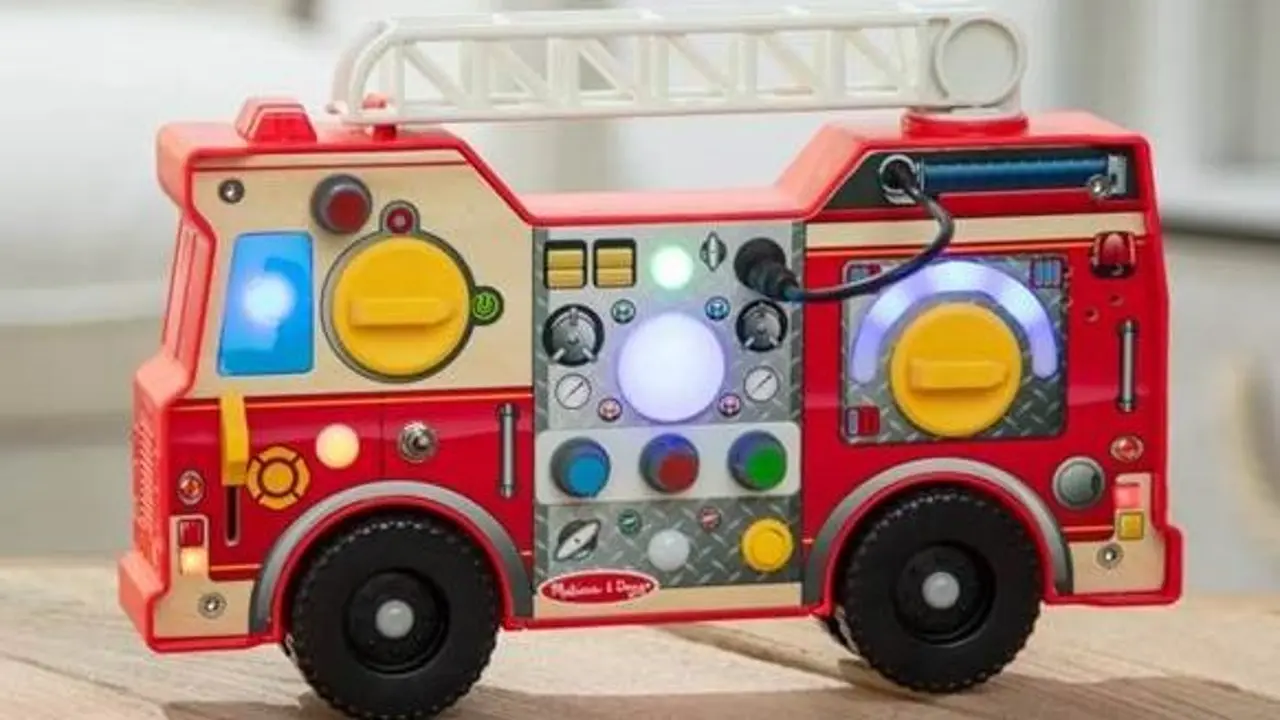
On September 17, 2026, Melissa & Doug recalled about 84,000 Lights and Sound Fire Truck activity boards sold at Target. The hose port can detach and choke a toddler. The refund process reads like a software specification.
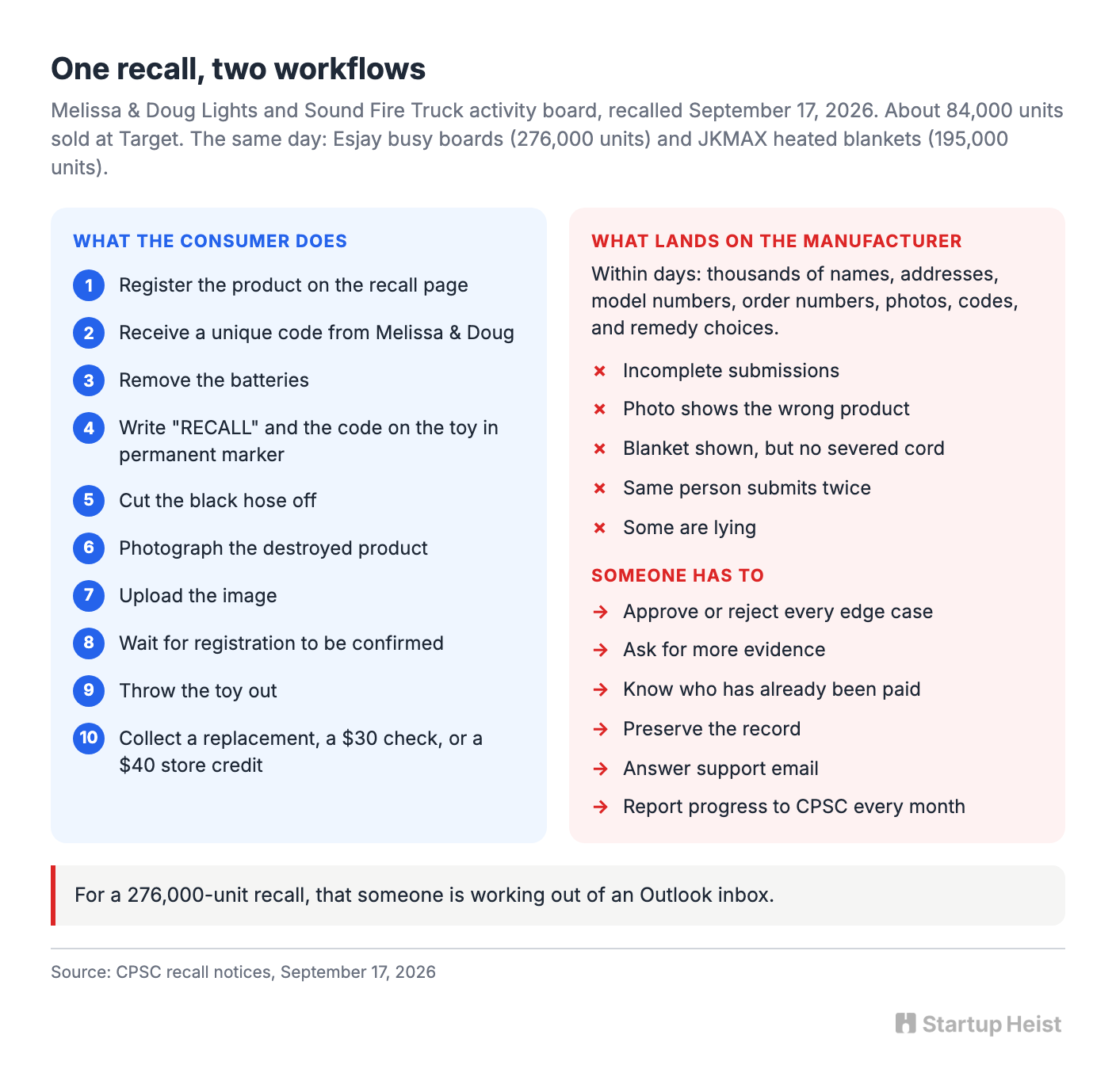
The customer registers the product on the company's recall page. Melissa & Doug issues a unique code. The customer removes the batteries, writes "RECALL" and the code on the front of the toy in permanent marker, cuts the black hose off, photographs the destroyed product, uploads the image, and waits for registration to be confirmed. Only then can they throw it out and collect a replacement, a $30 check, or a $40 store credit.
Thirteen other CPSC recalls went out that same day. SHEIN recalled a Montessori teething toy: cut the silicone strings, photograph the wreckage, email it in. Regfear recalled BedsPick mattresses sold on Amazon: destroy the mattress, write "Recalled" across the top, email the photo to an Outlook address, and no refund until the seller has both the photo and written confirmation of disposal. Esjay recalled 276,000 toddler busy boards: unzip the page with the red knobs, write "RECALLED" on both sides, discard it, and email a photo to esjay-service@outlook.com for a replacement page. JKMAX recalled 195,000 heated blankets after 577 reports of smoking, melting, or burning and 53 burn injuries. Its recall site asks buyers to cut the power cord, mark the controller with "Recalled" and their surname, photograph the blanket, controller, cord, and care label, and email the set with their Amazon order number. A week earlier, Lontcs busy boards recalled for lead paint came with instructions to unscrew the components, mark the board, and send a photo to an address at 163.com.
Now read those procedures from the manufacturer's side. Within days you have thousands of people submitting names, addresses, model numbers, order numbers, photographs, codes, and remedy choices. Some are incomplete. Some show the wrong product. Some show a blanket but no severed cord. Some people submit twice. Some are lying. Someone has to approve or reject every edge case, ask for more evidence, know who has already been paid, preserve the record, answer support email, and report progress to a federal agency every month. For a 276,000-unit recall, that someone is working out of an Outlook inbox.
Returns software has a deranged regulatory cousin, and nobody has built the boring version of it for the companies that need it most.
Here's what the boring version looks like:
The money: Ten $20,000 incidents a year (an $8,000 launch plus 3,000 claims at $4) is roughly $17,000 a month before retainers. The first half of 2026 saw 289 CPSC recalls.
Inside:
• Eight V1 features, claim codes to audit trail
• Three event-priced tiers: Lite, Managed, Partner
• Five-phase 90-day build plus the outreach email
• Sell recall readiness before the recall
The Heist
Build RecallProof: a white-label emergency claims portal for consumer-product recalls.
RecallProof doesn't decide whether a company should recall a product, offer regulatory advice, or let an AI decide whether a consumer deserves a refund. CPSC, the company, and its counsel determine the corrective action. RecallProof turns the approved remedy into a working system:
Identify product → verify basic eligibility → show approved instructions → issue claim code → collect destruction evidence → flag obvious duplicates → route exceptions to humans → track refund or replacement → produce the audit record.
The initial wedge is narrower still: U.S. consumer-product refunds and replacements where the approved remedy requires registration plus photographic evidence that the product was marked, disabled, or destroyed. That is the exact shape of at least five of the fourteen recalls announced on September 17.
Customer acquisition is where this idea usually dies. You don't cold-email a brand the morning its choking hazard hits the news. You sell the rails to the recall consultant, product-safety lawyer, insurer, or third-party administrator who already has the panicked brand on the phone.
Why This Is Suddenly Interesting
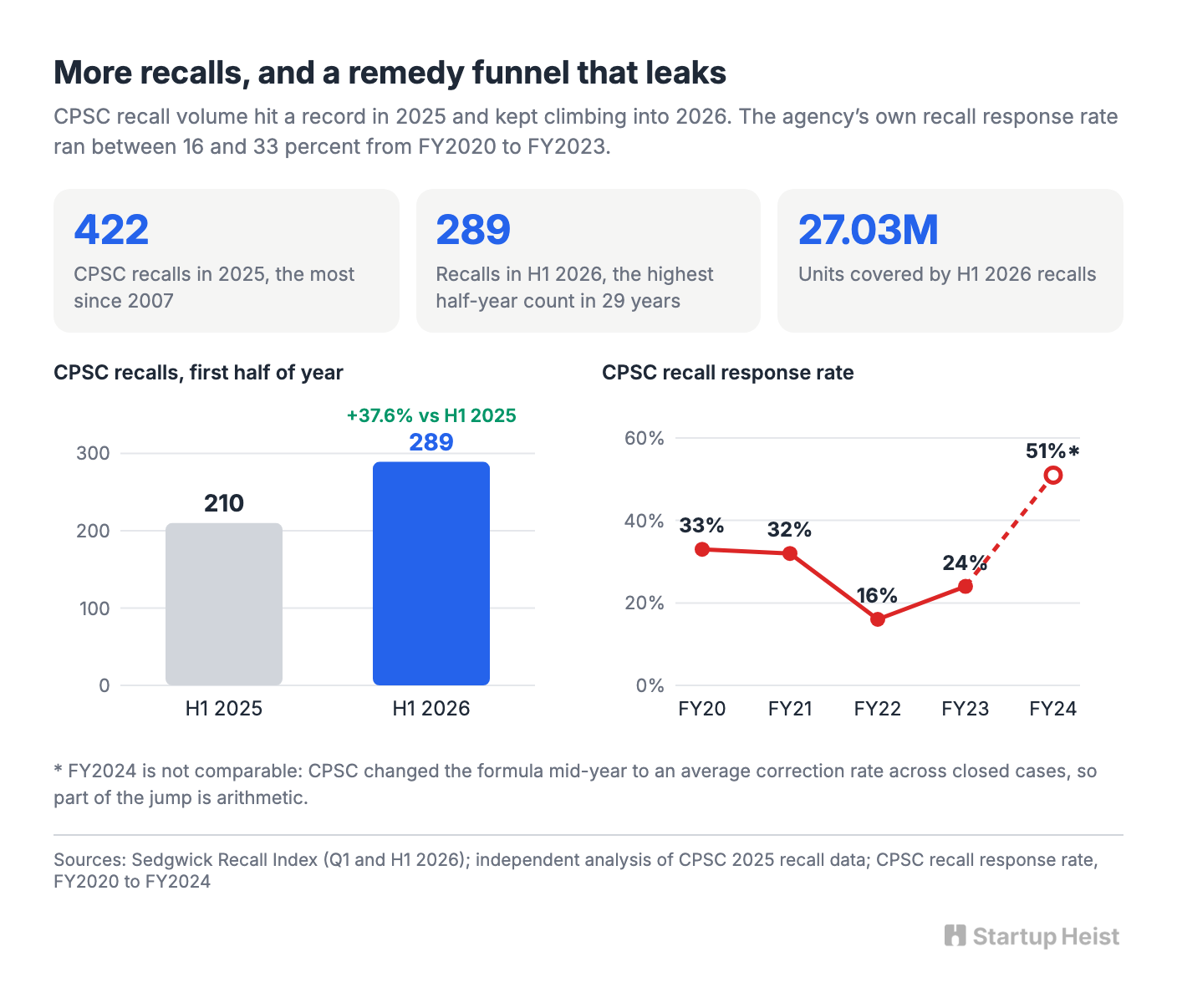
Recalls aren't rare. An independent analysis of CPSC data counted a record 422 recalls in 2025, the most since 2007, with nearly two-thirds involving products made in China and over 90 percent of those sold through Amazon, Walmart.com, Temu, SHEIN, and other marketplaces. Sedgwick's Recall Index then reported 142 CPSC recalls in the first quarter of 2026, up 14.5 percent, and 289 in the first half, up 37.6 percent from 210 a year earlier and the highest half-year count in 29 years, covering 27.03 million units.
Those numbers don't hand RecallProof a billion-dollar TAM. Only a subset of recalls needs a claims portal; some are repairs, some run through retailer returns, and the giants already pay Sedgwick. The opportunity is more specific than the headline count: hundreds of distinct incidents a year, a meaningful slice of which create a temporary claims operation that needs to exist for 30 to 180 days and then disappear. That is a weird software market, and weird software markets are good hunting grounds.
For the recalling firm, the hard part starts after the announcement. Once a corrective action plan is negotiated, the firm files Monthly Progress Reports to CPSC covering units involved, corrections completed, new incidents, and consumer contacts. CPSC's own recall response rate was 33 percent in FY2020, 32 percent in FY2021, 16 percent in FY2022, and 24 percent in FY2023. It printed 51 percent in FY2024, but the Commission changed the formula mid-year to an average correction rate across closed cases, so part of the jump is arithmetic. Getting a consumer from "heard about the recall" to "completed the remedy" is hard, and every unnecessary field and manual support exchange makes it harder.
RecallProof is conversion optimization for a safety-critical funnel: affected consumer → valid claim → hazardous product out of the home → documented remedy. That's a sharper thesis than "recall management software," and the federal government spent the spring making it sharper.
Then Fraud Became a Federal Priority
On April 15, 2026, CPSC published a Request for Information on recall fraud, docket CPSC-2026-0067, asking manufacturers, retailers, recall administrators, and the public about observed fraud, its costs, mitigation tools, and possible Commission action. The notice named generative AI fabricating images, receipts, serial numbers, and identity documents, and fraud shifting from isolated to organized. Twenty comments came in by the June 15 deadline, and they read like a design brief. The National Association of Manufacturers described AI-generated claim photos with "convincing faulty material, handwritten markings, and hyper-company-specific product errors." Sedgwick said photo verification has become unreliable and cited one program with 20,000 suspected fraudulent claims. The Toy Association asked CPSC to reconsider photographic proof entirely until reliable detection exists, arguing physical return of the product or its critical component is the only real fix. Truepic, a content-authenticity vendor, argued for live capture: the claimant shoots the photo inside the flow, in real time, instead of uploading a file.
Unlock the Vault.
Join founders who spot opportunities ahead of the crowd. Actionable insights. Zero fluff.
“Intelligent, bold, minus the pretense.”
“Like discovering the cheat codes of the startup world.”
“SH is off-Broadway for founders — weird, sharp, and ahead of the curve.”


