


The Appointment Economy Is a Media Network Hiding in Plain Sight
Pepsi went to the salon
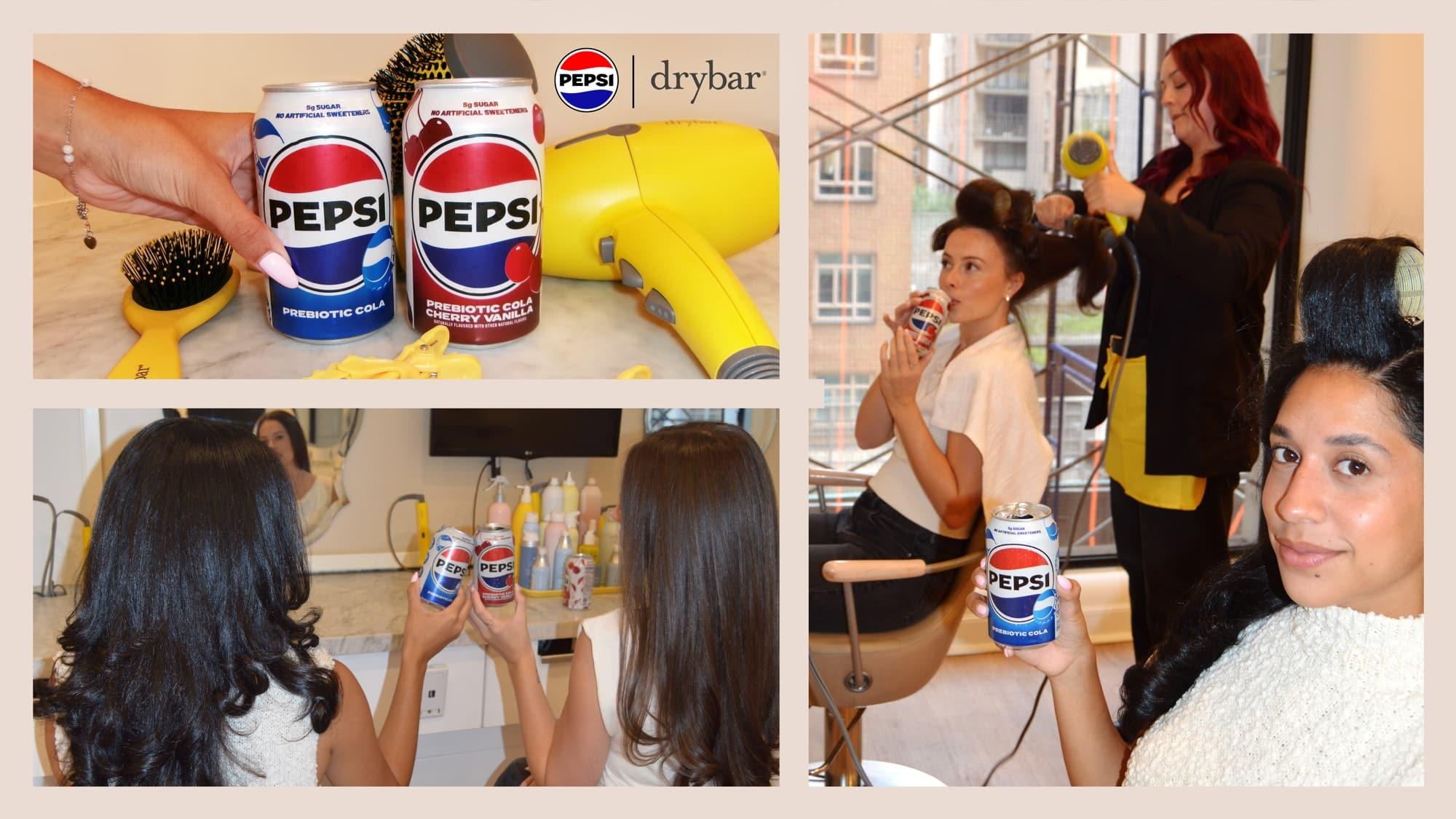
Throughout September 2026, Pepsi is handing out its new prebiotic cola in hair salons. Customers at more than 200 Drybar locations get a complimentary Pepsi Prebiotic Cola, in Original or Cherry Vanilla, while they sit for a blowout. They leave with a code for 30% off the product on Amazon, good through October 31, 2026, and new Drybar clients can use the same code to book a $30 blowout.
Pepsi has every sampling option money can buy. It could staff supermarket end caps, hire street teams for Manhattan sidewalks, or sponsor a music festival. Instead it chose a chair where a woman has walked in on purpose, fits a predictable demographic, and will sit still for 30 to 60 minutes with a free hand. In this deal, Drybar is media inventory.
Thousands of businesses hold the same inventory without knowing it: Pilates studios, independent salons, lash bars, coworking spaces, barbershops, spas, tattoo studios, auto-detail waiting rooms, boutique fitness studios. Each one owns recurring access to a specific type of consumer inside a specific behavioral moment.
The heist is to turn those appointment-based businesses into a measurable local product-trial channel for challenger CPG brands. Call it ChairTime. It starts in one city as a managed service, and the first product is reliable execution plus measurement rather than a platform. Here's the shape of it.
The money: Four $5,000 management-fee campaigns a month is $20,000 in revenue; eight is $40,000. Pepsi bought the same chair at 200-plus Drybar locations in September 2026.
Inside:
• Six-part MVP, none of it an app
• Pricing ladder: $3,000 Proof to $12,000 Metro
• The four-tier attribution report brands trust
• Cold email and 90-day plan to the first pilot
Context plus dwell time is the format
Conventional physical sampling optimizes for throughput: find a busy place, put a person in a branded shirt there, and hand out as much product as possible. Reach and relevance are different things, though. A commuter who grabs a protein bar while sprinting for a train has technically been sampled, and the brand learned nothing about whether she was the target customer, whether she tried it, or whether there was any logical reason for the brand to be standing on that platform.
Appointment businesses solve that by default. A Pilates client has already declared herself someone who spends money on fitness. A blowout customer has entered a self-care, getting-ready ritual. A coworking member spends hours in a place where coffee, snacks, and focus products are consumed as a matter of course. Context does the targeting, and dwell time gives the product a chance to be noticed. Pepsi's move reads exactly that way: a functional beverage inside a getting-ready moment, tied to a digital purchase action.
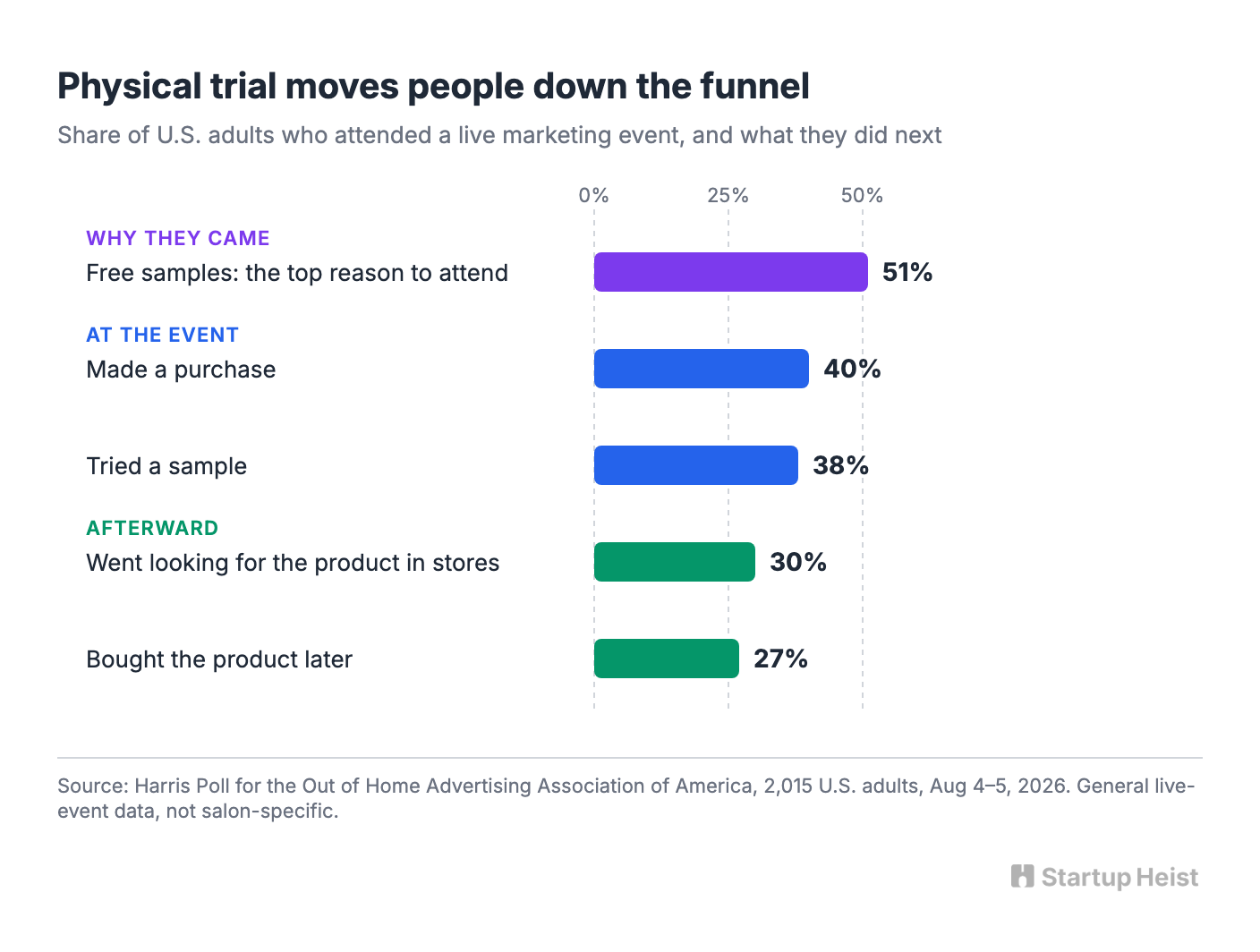
There's broader evidence that physical trial moves downstream behavior. A Harris Poll survey of 2,015 U.S. adults, conducted August 4 to 5, 2026 for the Out of Home Advertising Association of America, found that among consumers who attended a live marketing event, 40% made a purchase and 38% tried a sample. After a memorable brand experience, 30% went looking for the product in stores and 27% bought it later. Product samples were the single biggest draw for attending in the first place, cited by 51%. None of it is salon-specific performance data, and it mostly establishes that people like free product, which nobody doubted. The question a brand will pay to answer is who received it, where, for how long, and what they did next.
This business already exists, so the wedge has to be narrower
The obvious version of this idea is taken. Venue-based sampling is an established category. Recess runs a national network across gyms, coworking spaces including WeWork and Industrious, and colleges; its 2026 clients include Poppi, ZOA Energy, and Rockstar in coworking, and Hero Cosmetics, Simple Mills, and Goodles through Crunch Fitness. Aha! Marketing covers fitness studios, offices, coworking spaces, YMCAs, medical practices, and hotels across the U.S. and Canada, with Dove, Degree, and more than a million V8 Energy samples in its case studies, and Attack! Marketing and Brandshare sell similar access, Brandshare placing Chanel and L'Oréal in fitness studios and on college campuses. On the digital side, SoPost claims more than 30 million targeted samples shipped and 18 million marketing opt-ins for 350-plus brands, Sampl validates each consumer before sending product home and reports back purchase signals, and Bazaarvoice matches products to its 9-million-member Influenster community in exchange for reviews. Sampling isn't the innovation, and neither are QR codes, fulfillment, or reporting. You can't walk into a brand meeting announcing that salons can hand out product.
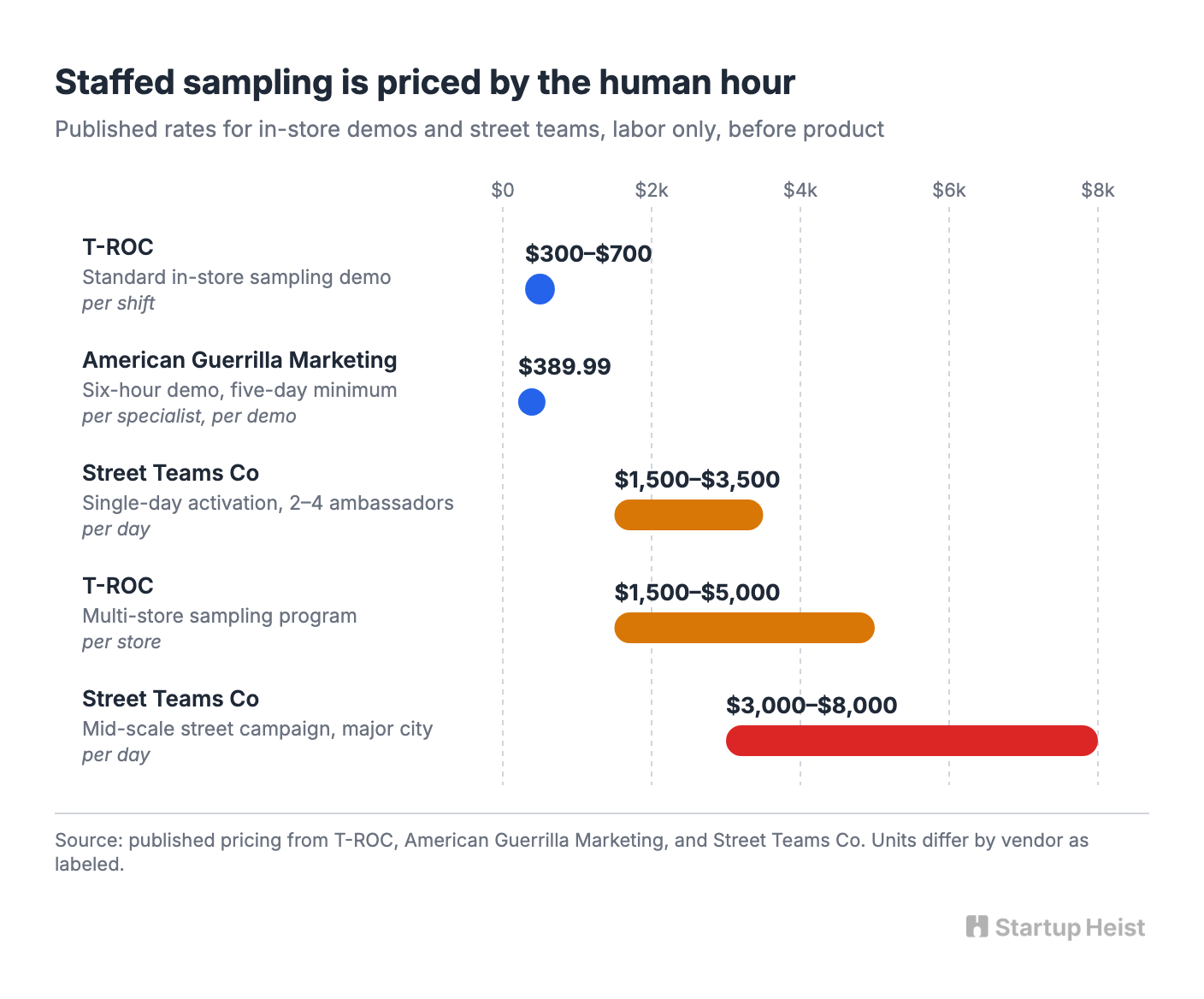
The opening sits between those two camps. Recess and Aha! sell reach across a national network; SoPost and Sampl sell households. A small beverage company launching in Philadelphia doesn't need 30,000 households receiving cans by mail or a slot in a coast-to-coast gym program. It wants 1,000 highly relevant people to try the product where drinking it makes sense, and it wants to know, venue by venue, what happened next. Meanwhile, experiential marketing and field sampling are expensive because humans are expensive. T-ROC publishes $300 to $700 per shift for a standard in-store sampling demo and $1,500 to $5,000 per store for multi-store programs. American Guerrilla Marketing lists its standard six-hour product demo at $389.99 per specialist with a five-day minimum. Street Teams Co, which staffs Philadelphia, puts a single-market, single-day activation with two to four brand ambassadors at $1,500 to $3,500, and a mid-scale street campaign in a major city at $3,000 to $8,000 per day.
ChairTime removes most of that labor because the receptionist is already at the desk, the Pilates instructor is already greeting people, and the coworking kitchen already exists. You're inserting a product into an experience someone else is paying to run. What the national networks don't sell is a measured, reconciled, city-level flight in appointment settings that a brand can buy for a few thousand dollars from the person who recruited the venues. The economics work because of that, and the same insight is what tempts people into the wrong first move.
The marketplace version fails first
The temptation is to register ChairTime.com and recruit 500 venues. A two-sided marketplace is the worst possible opening move, because every brand asks the same questions before wiring a dollar: who are the customers, how many units can each venue really move, what proof do I get, what happens when a location forgets, who is liable. Venues have their own list: which brands, where do I store it, are you paying me, will this make my business look cheap, does it conflict with the retail shelf I already sell from.
Software doesn't answer any of those questions early on; a founder on the phone does. So the company starts as a managed local sampling agency whose first job is to manufacture liquidity by hand, one campaign at a time, and to charge enough that the work doesn't turn into a nonprofit by accident.
The first offer, priced so the fee pays for the work
Unlock the Vault.
Join founders who spot opportunities ahead of the crowd. Actionable insights. Zero fluff.
“Intelligent, bold, minus the pretense.”
“Like discovering the cheat codes of the startup world.”
“SH is off-Broadway for founders — weird, sharp, and ahead of the curve.”


