


The $2,000 Camera Sale Starts With a $79 Weekend
A customer walks into a camera store and picks up a $2,000 body with a $1,400 lens attached. He likes it. He can afford it. He has watched a dozen reviews and read the spec sheet twice. Then he sets it back on the counter and leaves.
For expensive, subjective products, discovery stopped being the bottleneck years ago. The buyer already knows what exists. What he doesn't know is whether the autofocus will keep up with his kid's soccer games, or whether the camera will live in his hands or on a shelf. That's a confidence problem, and no amount of content solves it.
China is running the largest live experiment in what happens when consumers solve confidence with access instead of ownership. The country's rental economy hit ¥4.2 trillion in transaction value in 2024, roughly $580 billion, up 32% year over year across more than 750 million user transactions. People under 30 make up over 60% of the market. In August 2025, searches for camera rentals on Meituan rose 63% year over year, drone rentals 89%, strollers 165%. That isn't a market of people who can't afford things. It's a market of people who want to try things.
Don't extrapolate that into "America is about to rent everything." That's the lazy read, and it has already killed at least one funded startup. The narrow version is the one worth building, and it looks like this.
The money: 150 stores at $199 a month is $30K MRR. There are 1,289 U.S. camera store businesses, and the ones you want already run this workflow on spreadsheets.
Inside:
• Ten-week MVP scope, built week by week
• Pricing ladder from $99 to $399 per store
• Outreach email and 90-day pilot protocol
• The five numbers the dashboard tracks
Start with independent camera stores. Give a retailer the ability to designate specific physical units as rentable, track them by serial number, verify the renter, document condition at pickup and return, collect payment and a security authorization, convert the rental fee into purchase credit, and calculate whether each individual asset actually makes money.
Call the category what it is: rental-to-purchase infrastructure for specialty retail. That's a different animal from a rental marketplace, and considerably bigger than the $29 booking calendars already sitting in the Shopify app store.
Retailers already run this play by hand
You don't have to convince American photographers to rent gear. Lensrentals, BorrowLenses, ShareGrid and dozens of regional rental houses normalized that a decade ago. Lensrentals launched its Keeper program in October 2014, letting customers buy the gear they rented with up to seven days of rental fees subtracted from the price, plus an additional 30% credit on fees paid past day seven.
The more interesting signal is on the independent stores' own websites. Dan's Camera City in Allentown credits 50% of the rental fee toward a camera or lens bought within 30 days, backed by a driver's license and a card authorization equal to half the equipment's value. PROCAM caps the credit at the three-day rental charge, on the same new item, within 30 days, and only on gear it both rents and sells. Midwest Photo in Columbus credits one day of rental cost within 14 days, on a comparable item, new or used. Bergen County Camera applies the rental charge toward the new version of what you rented. Art's Cameras Plus credits the daily rate, redeemable within seven days.
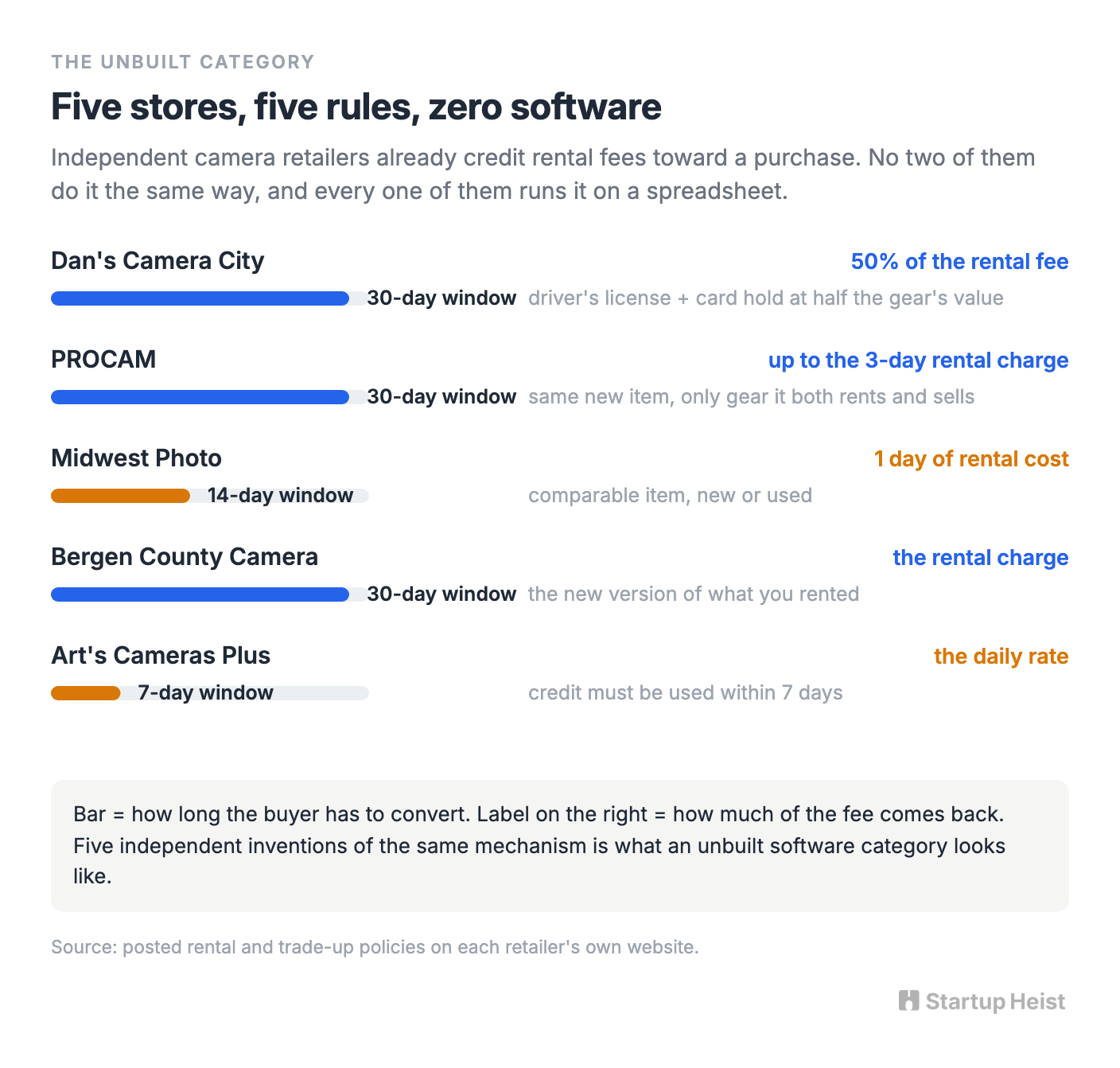
Five stores, five credit percentages, five windows, five eligibility rules. Each invented the same try-before-you-buy mechanism independently, and each runs it on a spreadsheet and whatever the counter staff remembers. Unbuilt software categories tend to look exactly like that.
None of those stores can answer the question that follows. A retailer knows a Sony 24-70mm went out three times last month. The point-of-sale can't say whether those rentals left the lens more profitable after wear and repair, how many renters bought that model afterward, which categories produce customers rather than rental revenue, or which assets take enough damage that they never belonged in the trial fleet.
Those answers are worth real money to a store owner. A widget that lets a customer select Saturday and Sunday on a calendar is worth about $29 a month, which is roughly what it costs.
The trap is building a better rental app
The obvious framing is "add rentals to Shopify." Skip it. That corner of the app store is among the most thoroughly commoditized software markets in existence. Product Rentals Pro hands merchants booking calendars, buffers, returns, rent-or-buy toggles and damage-protection upsells for $19.95 to $89.95 a month. Booqable, the most mature rental operating system in the category, starts at $29 billed annually and runs to $149 for multi-location, with inventory management, contracts, deposits, unique-item tracking and performance reports already built, serving thousands of rental businesses across every vertical.
Circuly is the closest thing to a real competitor. The German company launched on the Shopify App Store in May 2025 with subscriptions, rentals, serial-number asset tracking and buyout conversion, at $49 to $150 a month plus a 1% to 1.5% commission. It's built for European DTC brands running subscription hardware, not for a store in Pennsylvania handing a lens across a counter.
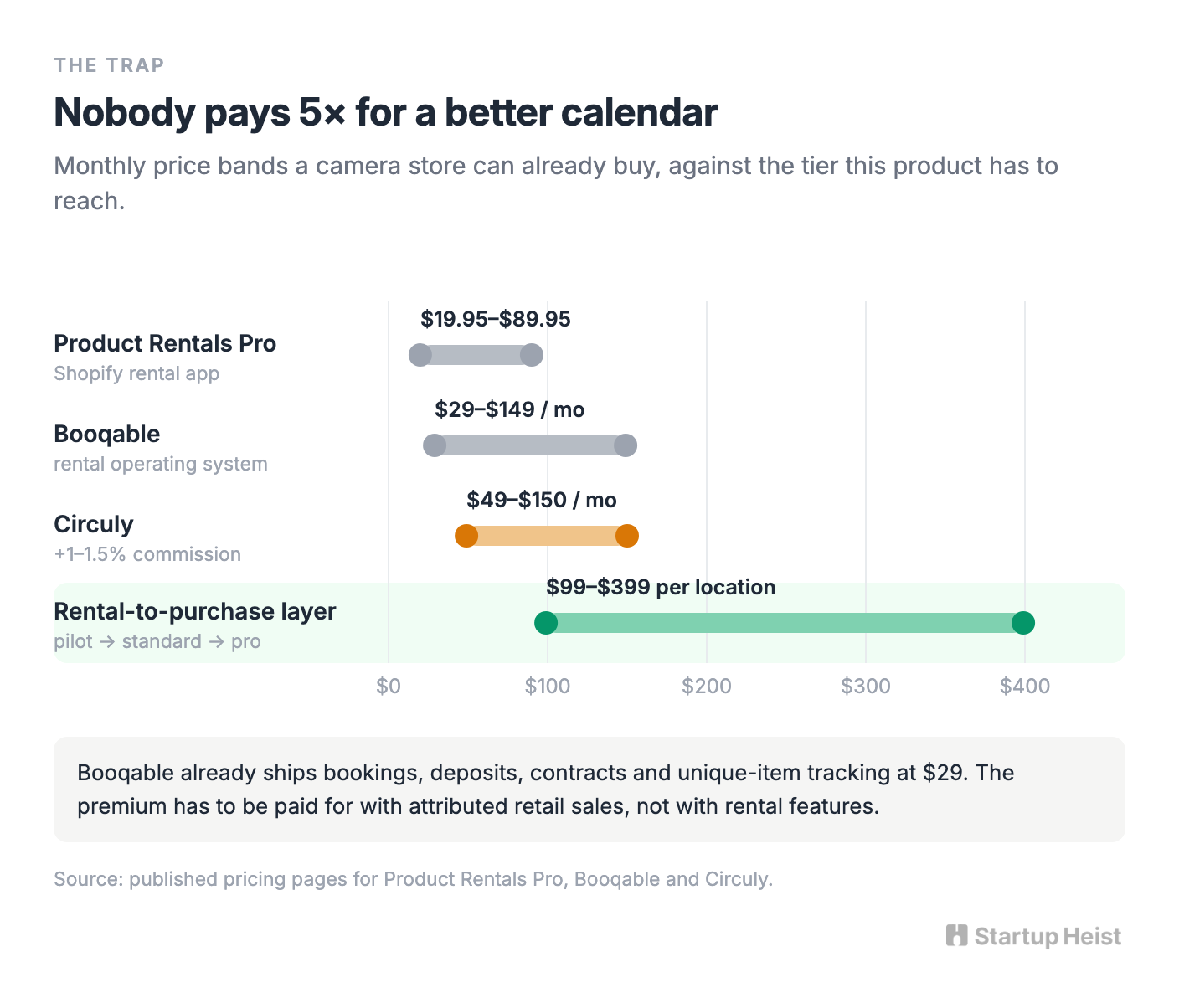
If your pitch is "we do rentals inside Shopify for $199 a month," you lose. No merchant pays five times more for a calendar. The product has to make the store money in a way those systems were never designed to optimize. You're selling a paid product-trial system, and the rental is just how it works mechanically. The sale is what the merchant is actually buying.
There's a second trap, and it has a body count. Lumoid was a Y Combinator company that raised $5.9 million to build consumer gear rental, signed a partnership with Best Buy in 2017 to power try-before-you-buy across the chain, and shut down that December. The deal didn't save it. The company couldn't raise enough money to buy the gear the partnership required.
That's what the marketplace version of this idea costs: you finance the inventory yourself. The software version lets 1,289 camera stores finance it for you, using equipment they already own.
Why cameras are a good beachhead
Camera retail suits this model for reasons that don't transfer cleanly to most categories. The product is expensive enough that being wrong hurts, so against a several-thousand-dollar system a $79 weekend feels rational rather than indulgent. Preference is nearly impossible to establish online, because a spec sheet can't tell you whether the menus will annoy you every time you touch them. Equipment is durable and serializable, so a retailer tracks Sony 70-200 unit #184723 rather than "one Sony lens," and utilization, damage and depreciation become real numbers attached to a real object. And local stores have what Amazon doesn't: immediacy plus expertise. The customer picks up the lens Friday afternoon, gets it configured at the counter, shoots a tournament all weekend, returns it Monday and talks through what worked.
The category also stopped shrinking, which matters more than it sounds. CIPA reported 9.44 million digital cameras shipped globally in 2025, up 11.2% and the highest total since the pandemic, with interchangeable-lens cameras at just over 7 million units. It was the second consecutive year of growth, the first back-to-back increase in nearly two decades. You don't need a booming category for this to work. You need one where people still buy expensive new things.
What the product actually does
It's an operating layer between retail inventory and an eventual purchase.
Unlock the Vault.
Join founders who spot opportunities ahead of the crowd. Actionable insights. Zero fluff.
“Intelligent, bold, minus the pretense.”
“Like discovering the cheat codes of the startup world.”
“SH is off-Broadway for founders — weird, sharp, and ahead of the curve.”


