


The Map That Moves Before the Census
A laundromat closes on a commercial strip. Six months later, a Pilates studio opens two blocks down. A discount furniture showroom becomes a cosmetic dentist. A second specialty coffee shop appears. A dog daycare takes over an old auto-parts storefront. A regional salad chain signs a lease at the corner.
Any one of those is an ordinary business event. Read together, they work as a live sensor for where local commerce is changing.
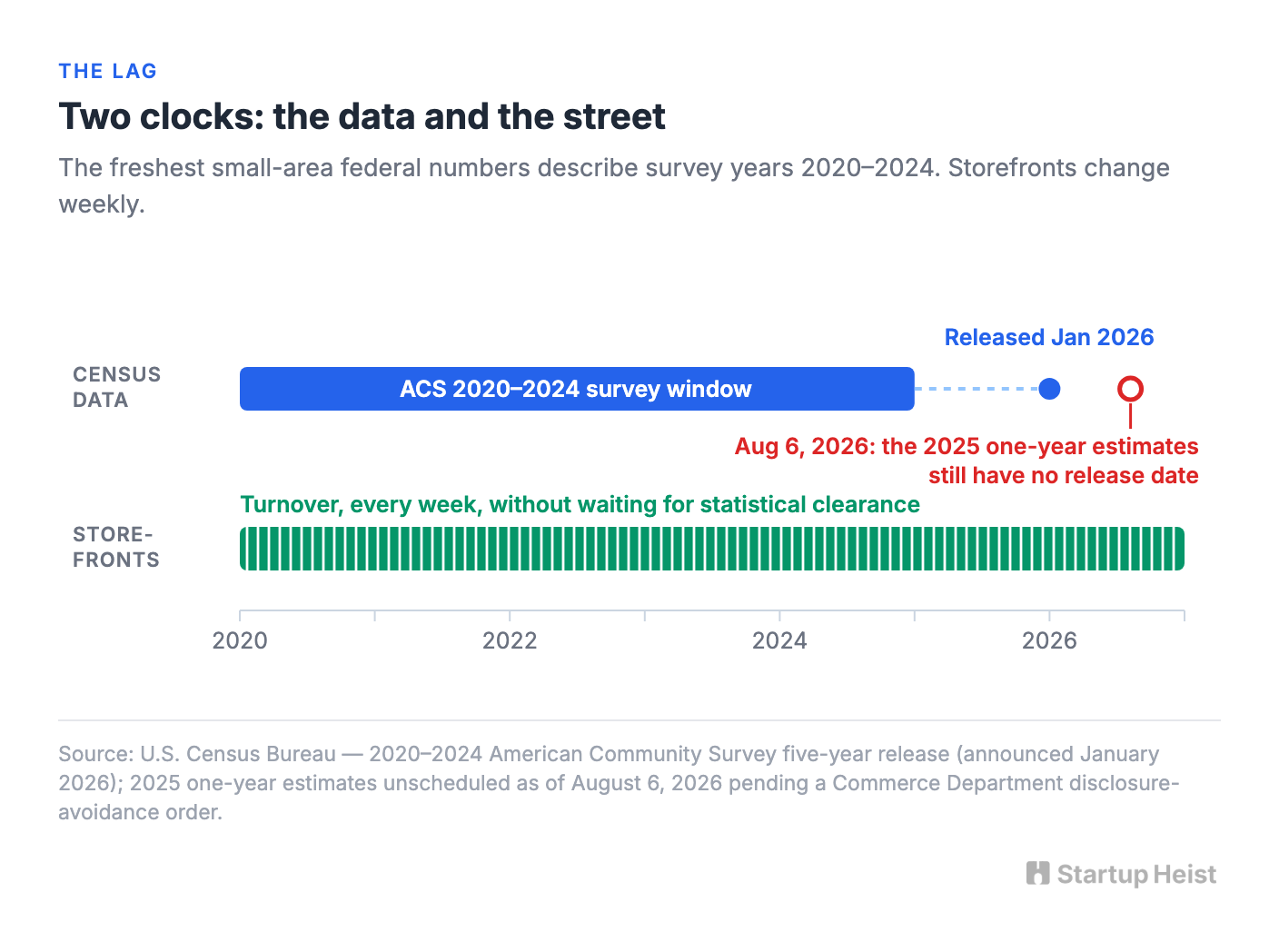
Almost every number used for retail site selection describes the world on a delay. The most current small-area dataset from the Census Bureau is the 2020–2024 American Community Survey five-year release, announced in January 2026. As of August 6, 2026, the Bureau still hadn't set a release date for the 2025 one-year estimates while it worked through a new Commerce Department disclosure-avoidance order. Storefronts don't wait for statistical clearance. They turn over every week.

There's a business hiding in that gap. The version worth building is narrower and far more sellable than "AI predicts which neighborhoods get rich": an early territory signal for one type of location-based business in one city. Track how the commercial landscape is changing, fuse that with conventional demographics and competitor mapping, and tell operators which territories deserve a look before those territories become obvious.
The first product is a report.
The money: Ten operators at $750 a month is $7,500 MRR; twenty-five at $1,250 is $31,250. Location intelligence is already a $28 billion category.
Inside:
• The five-test filter for picking your vertical
• MVP report scope and the three-layer score
• Pricing from $500 pilot to $5K/month
• The 90-day plan and four compounding moats
The evidence that storefronts lead
Two research results frame this opportunity, and the gap between them is where the money sits.
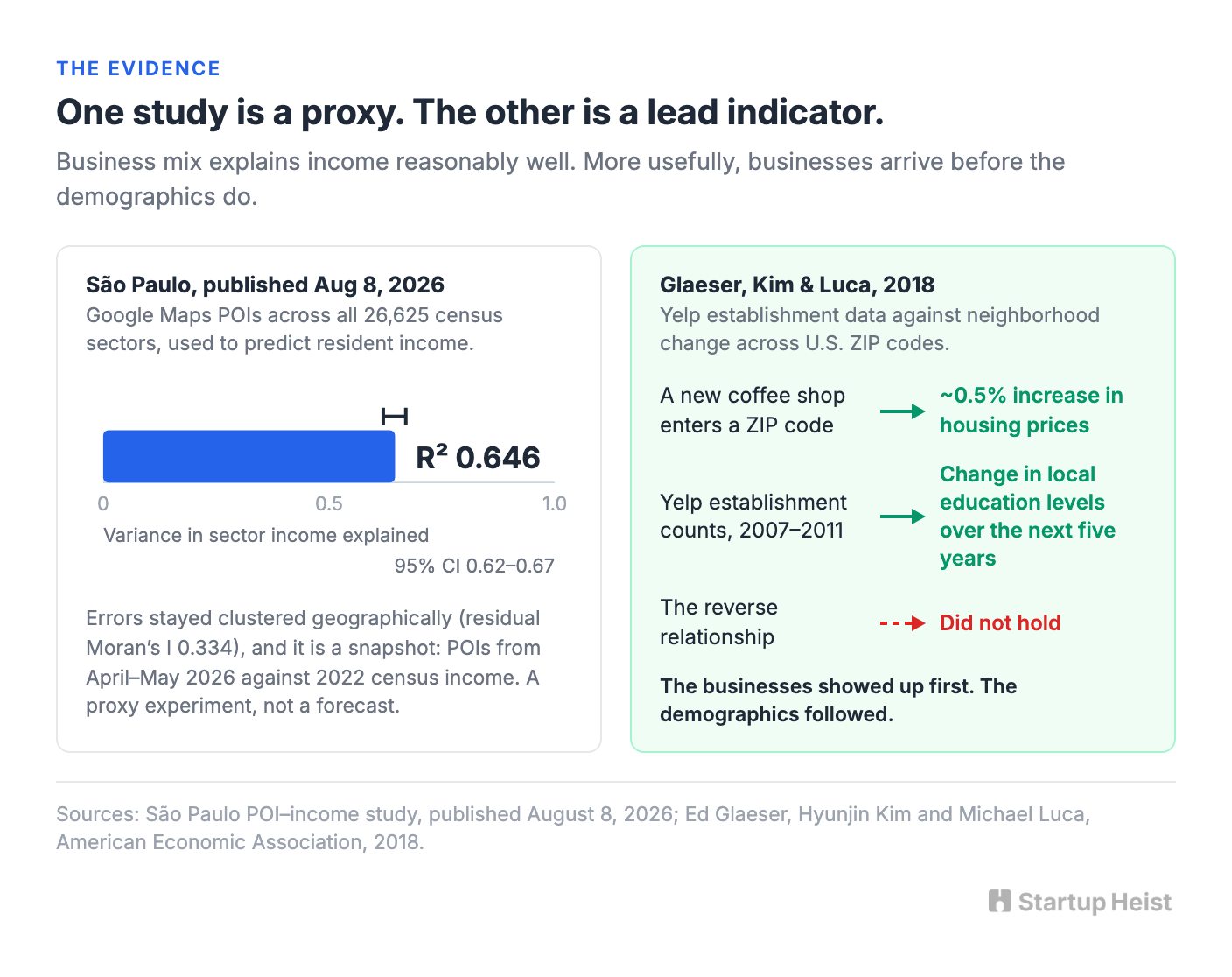
The first landed on August 8, 2026. A research team pulled Google Maps points of interest across all 26,625 census sectors in São Paulo and asked whether the mix of businesses around a neighborhood predicts the income of the people living in it. They compressed the POI categories with non-negative matrix factorization, predicted with gradient boosting, and hit an R² of 0.646, with a 95% confidence interval of 0.62 to 0.67. The number survived a harsh test: the team split the city into parallel stripes separated by three-kilometer buffer zones, so the model couldn't win by memorizing the neighbors of its training data. Healthcare locations and parking tracked with affluence. Religious establishments ran the other way.
The model failed in instructive ways. It underpredicted the richest sectors, overpredicted the poorest, and left errors clustered geographically, with a Moran's I of 0.334 on the residuals. And this was a snapshot: POIs collected in April and May of 2026, income measured by Brazil's 2022 census. A proxy experiment, not a forecast.
The second result is older and, for a founder, more important. Ed Glaeser, Hyunjin Kim and Michael Luca used Yelp data to study neighborhood change across U.S. ZIP codes, and found the arrow of time pointing the useful direction. A new coffee shop entering a ZIP code in a given year was associated with roughly a 0.5% increase in housing prices. Counts of Yelp establishments from 2007 to 2011 predicted changes in local education levels over the following five years, and the reverse relationship didn't hold. The businesses showed up first. The demographics followed.
The American Economic Association published that thesis in 2018. Nobody has turned it into a product for a specific operator making a specific decision with real money.
Skip the gentrification detector
There's an obvious version of this idea worth avoiding: "Neighborhood Wealth Predictor — find the next Williamsburg before anyone else."
It's bad science and worse positioning. A coffee shop can serve commuters rather than residents. A medical cluster exists because a hospital is nearby. Universities, transit nodes, tourism and zoning all scramble the relationship between the businesses in a tract and the people who sleep there. The São Paulo team flags this directly.
You don't need to estimate neighborhood income anyway. Your customer has a more practical question: where should I look for my next location?
So skip the claim that Buckhead tract 42 is getting 17% wealthier. What an operator can act on reads like this: three territories entered your top-ten watchlist this month; one added five complementary premium-service businesses, carries below-average direct fitness competition, sits outside your 12-minute drive-time overlap, and has two suitable vacancies.
That's a product. Call it Territory Signal, Expansion Radar, Market Watch. The line you never cross keeps you honest and keeps you out of court: you're screening territories, not underwriting leases.
The buyer already has a budget
Location intelligence is not a hypothetical category. Esri's Business Analyst bundles demographics, consumer spending and trade-area tools. Placer.ai layers foot traffic and competitive visitation into site decisions, with third-party trackers placing enterprise deployments in the five-figure-a-year range and up. Buxton sells market-potential analysis to chains. GrowthFactor sells a self-serve seat at $200 a month and heavier data-science engagements above it. One market tracker sizes the whole category at $28.36 billion in 2026.
Ignore that number. You're not competing for a slice of $28 billion. You're trying to get ten people to pay you $750 next month.
The competitive read matters far more than the TAM. Every platform above is excellent at answering one question: what do we think about 123 Main Street? They activate after a site exists. Your product lives one decision upstream, where somebody asks which three parts of Atlanta the broker should hunt in this month.
Pitch cheaper site-selection analytics and you lose to a $200 seat. Pitch early warning on what's changing before a site exists, and you're standing in a room nobody else is in.
Pick one vertical and stay in it
Launch with one metro, one vertical, one buyer persona. Something like Atlanta boutique fitness expansion intelligence for operators running two to twenty locations.
Treat that combination as one example among many. Medspas, pet services, tutoring centers and quick-service franchises can all work, if the vertical passes five tests:
- Location materially drives unit performance.
- New units open often enough to generate outcome data.
- Competitor locations are identifiable without heroics.
- Gross profit per unit supports a $500 to $2,000 spend on territory intelligence.
- Enough multi-unit operators exist that expansion is a recurring workflow.
Test five is the one founders skip, and it decides whether you have a subscription or a favor. A single-location restaurant owner will happily buy one $500 report, then disappear for seven years.
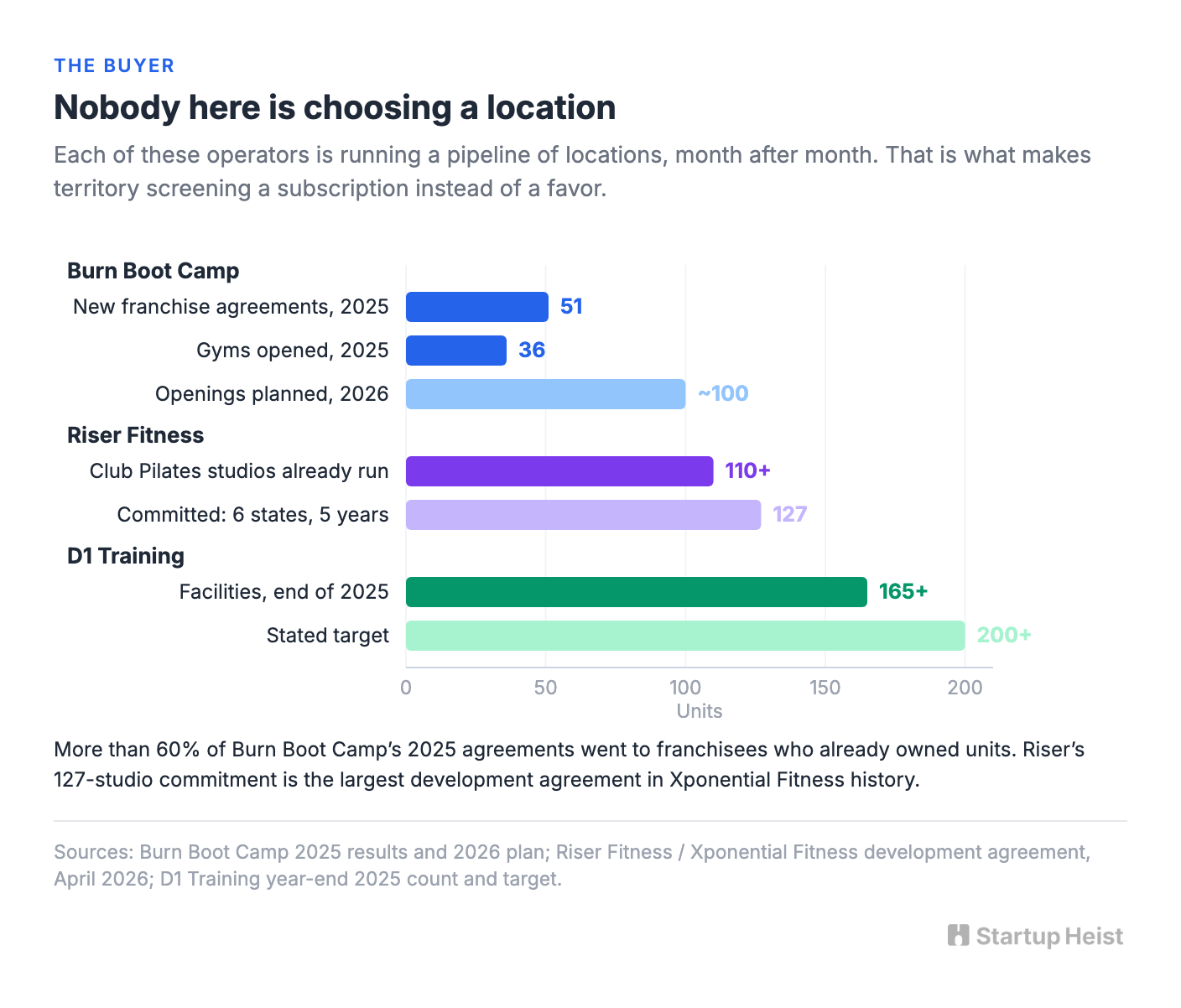
Boutique fitness clears the bar with room. Burn Boot Camp signed 51 new franchise agreements in 2025 and opened 36 gyms, more than 60% of those agreements going to franchisees who already owned units, and has said it plans roughly 100 openings in 2026. In April 2026, Riser Fitness, which already runs more than 110 Club Pilates studios, signed the largest development agreement in Xponential Fitness history: 127 more across six states over five years. D1 Training closed 2025 with more than 165 facilities and a target above 200.
None of those companies is choosing a location. Each is running a pipeline of them, month after month. The tenant-rep broker serving fifteen of them is an even better buyer, because their pipeline never empties.
Your MVP is a PDF
Don't build a dashboard with 42 filters. Build a 15-to-25 page report plus a spreadsheet that answers one question every month: which territories deserve our attention right now?
Five components carry it.
Unlock the Vault.
Join founders who spot opportunities ahead of the crowd. Actionable insights. Zero fluff.
“Intelligent, bold, minus the pretense.”
“Like discovering the cheat codes of the startup world.”
“SH is off-Broadway for founders — weird, sharp, and ahead of the curve.”


