


The Funeral Price Intelligence Heist
15,401 funeral homes are legally required to tell you their prices. Almost nobody asks, and the ones who post them online report that nobody looks. The opening is the reconciliation layer any useful comparison product needs underneath it, and nobody has built it.
Every funeral home in America is required by federal law to hand you an itemized price list and to quote prices over the phone. The FTC's Funeral Rule has been on the books since 1984.
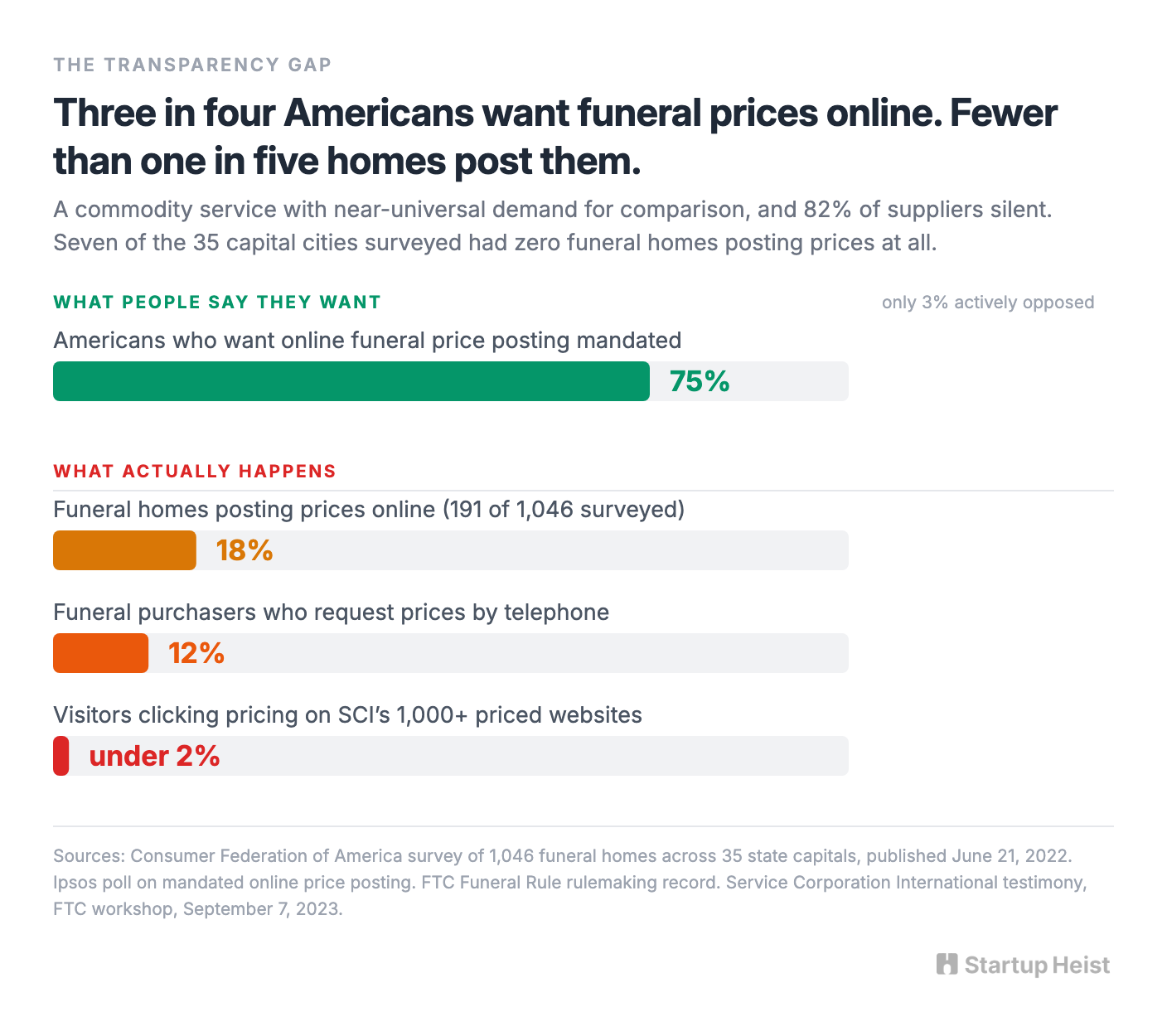
The agency's own rulemaking record puts the usage rate at roughly 12% of funeral purchasers requesting prices by telephone.
Twelve percent, on a purchase that runs several thousand dollars, made by roughly 3.3 million American households a year, with a federally guaranteed right to comparison shop already attached to it.
A right that goes unexercised at that rate isn't really a consumer protection failure. It's a distribution problem, and distribution problems are buildable.
Here's what that opens up:
The money: Fifty independent directors at $99 to $199 a month is $5K to $10K MRR in a single metro, before you sell one qualified lead.
Inside:
• Ten-category price normalization schema
• 90-day plan: one metro, 50+ providers
• Three pricing tiers, free to $199/month
• The PDF that lands the first B2B sale
The Industry Already Ran the Experiment
The obvious fix is to make funeral homes post prices on their websites. The FTC opened an advance rulemaking on exactly that question in November 2022 and held a full-day workshop on September 7, 2023 to argue it out.
At that workshop, a representative from Service Corporation International, the largest death care company in North America, testified about what happened when the company tried it. SCI had posted pricing for over 1,000 of its funeral home locations. Her account was blunt: "people are not coming to our websites for pricing information." Fewer than 2% of visitors to those sites clicked through to look at prices at all. About 85% of the traffic was there for obituaries, service details, and online condolences.
She offered it as an argument against mandating online disclosure. As a market map, it reads differently. Nobody price-shops on a funeral home's own website for the same reason nobody comparison-shops flights on United.com. The demand for comparison exists; it just doesn't live where the incumbents keep insisting it should.
It lives in search, and the search results are close to empty. The Consumer Federation of America surveyed 1,046 funeral homes across 35 state capitals and published the results on June 21, 2022: only 191 of them, 18%, posted prices online. Seven of the cities had zero. In the same study, CFA documented price differences of up to 400% to 500% for identical services in the same market. A separate Ipsos poll found 75% of Americans want online price posting mandated, with 3% opposed.
So you have a commodity service, a five-fold price spread, near-universal consumer demand for funeral price transparency, and 82% of suppliers silent. Mature markets rarely look like that. Unbuilt ones do.
The Product Is a Reconciled Total
This gap is easy to notice and easy to build the wrong thing against.
The wrong thing is a directory: Provider A, $1,095. Provider B, $1,295. Provider C, $1,495. Easy to build, easy to copy, and frequently wrong, because the headline number in funeral pricing is rarely the number the family pays.
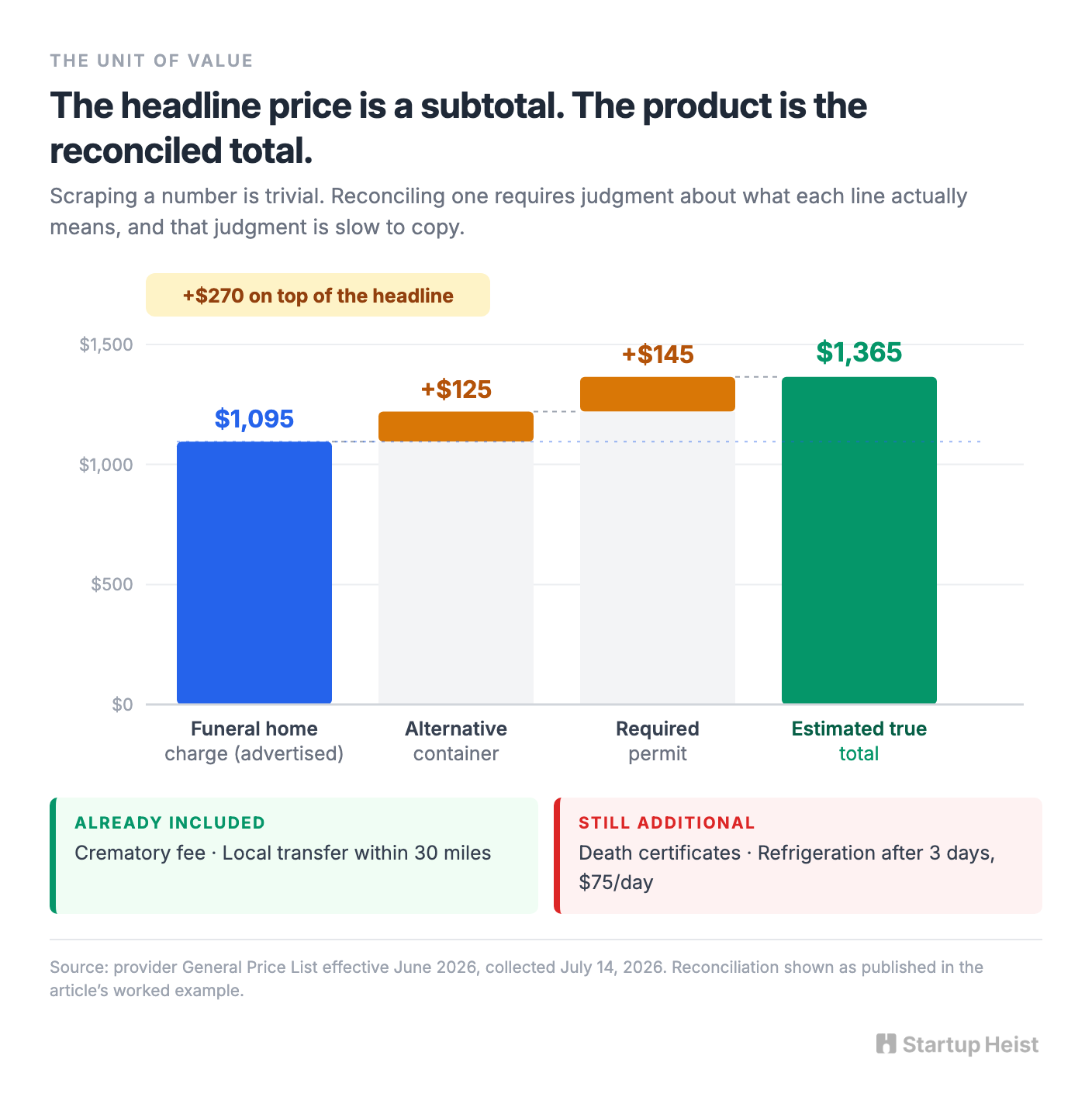
At the same 2023 workshop, FTC staff put a figure on the problem. Comments filed during the rulemaking suggested that 22% to 40% of funeral homes using a third-party crematory list only their own cremation charge on the price list, leaving out the separate crematory fee. The family reads that number as a total when it's a subtotal. Panelists put the missing crematory fee at $250 to $350 under normal conditions, and one attorney described clients who paid around $2,000 during COVID, when crematories were running around the clock.
Layer on the rest of it. One provider's $995 includes transportation, permits, and an alternative container. The provider next door advertises $895 and bills the container separately. A third adds refrigeration charges after three days. Death certificates, medical examiner fees, weekend removals, mileage past a fixed radius, and oversized-remains surcharges land wherever each operator decides to put them.
Which is why the unit of value isn't a price. It's a reconciled total with the work shown:
Estimated standard direct cremation total: $1,365
- Funeral home charge: $1,095
- Crematory fee: included
- Alternative container: $125
- Local transfer within 30 miles: included
- Required permit: $145
- Death certificates: additional
- Refrigeration after 3 days: $75/day
- Source: provider General Price List effective June 2026, collected July 14, 2026
Scraping a number is trivial. Reconciling one requires judgment about what each line actually means, and that judgment is slow to copy.
The temptation is to digitize every line on every price list. Resist it. A traditional funeral touches professional service fees, embalming, viewing and facility charges, hearses, caskets, vaults, cemetery costs, and cash advance items. You could spend a year building the world's most complete funeral taxonomy and finish with zero customers.
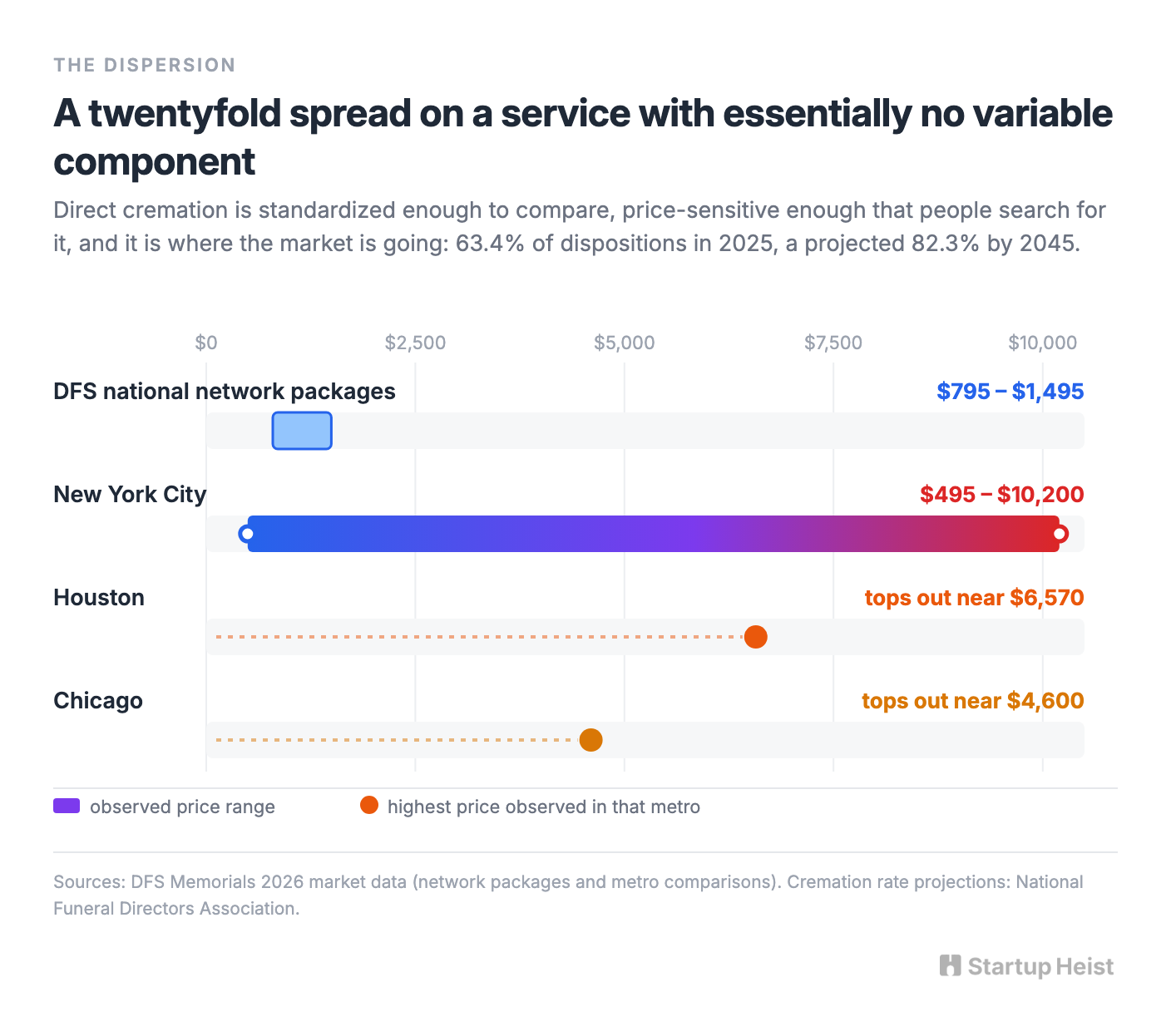
Direct cremation is the opposite. It's standardized enough to compare, price-sensitive enough that people search for it, and it's where the market is going. The National Funeral Directors Association projected the U.S. cremation rate at 63.4% of dispositions in 2025 against 31.6% for burial, and forecasts 82.3% by 2045.
It also happens to be where the dispersion is most absurd. DFS Memorials' 2026 market data puts network packages between $795 and $1,495 nationally, while its New York City comparison runs from $495 to $10,200, a twentyfold spread for a service with essentially no variable component. Houston tops out near $6,570, Chicago near $4,600.
Your first consumer product answers one question: what will a direct cremation actually cost near me?
What the Existing Players Left on the Table
This is not virgin territory, and pretending otherwise will get you laughed out of your first funeral director meeting. Parting has been publishing submitted price lists for years. Funeralocity built a comparison-plus-referral marketplace and calls itself the number one funeral home comparison site. DFS Memorials has run a curated low-cost cremation network since 2012. And venture money has arrived: Meadow, founded in January 2024 by Stripe alum Sam Gerstenzang and Emma Gilsanz, raised a $9 million Series A led by Lachy Groom and Haystack in March 2026, selling roughly $1,300 cremations as a funeral home without the home. It's already the largest independent funeral home in California, with Texas and Washington live and Arizona plus five more states planned for 2026.
What none of them sell is the interesting part. Parting sells listings, Funeralocity sells referrals (three employees on staff as of March 2026), and DFS sells network access. Meadow sells the funeral itself, and every state it enters widens the price gap it's competing against, which is more dispersion for somebody to measure. None of them sells evidence: the document a price came from, the date it was collected, what it includes, and what it will actually cost when the invoice arrives. That's the seam. Directories stay thin because they're cheap to produce.
Somebody Already Proved the Collection Works
The collection work is feasible without any technology at all, and a volunteer group in western Massachusetts already ran the proof.
On January 21, 2026, the Funeral Consumers Alliance of Western Massachusetts convened its price comparison committee and drafted a letter requesting the General Price List from all 83 funeral home locations in the region. They mailed it on January 27 with a March 1 deadline and a stamped return envelope, chased the non-responders by phone, email, and in person, and came back with 78 of 83, north of nine in ten. Every entry was checked against the supplied GPL before publishing.
There was no scraping breakthrough and no API. Letters, stamps, phone calls, and follow-up. The barrier here has never been technical. It's that the work is boring and nobody wants to do it, which is the most durable kind of barrier a solo operator can find.
Unlock the Vault.
Join founders who spot opportunities ahead of the crowd. Actionable insights. Zero fluff.
“Intelligent, bold, minus the pretense.”
“Like discovering the cheat codes of the startup world.”
“SH is off-Broadway for founders — weird, sharp, and ahead of the curve.”


