


The Byproduct Passport
Pennsylvania just priced brewery trash at double its market value
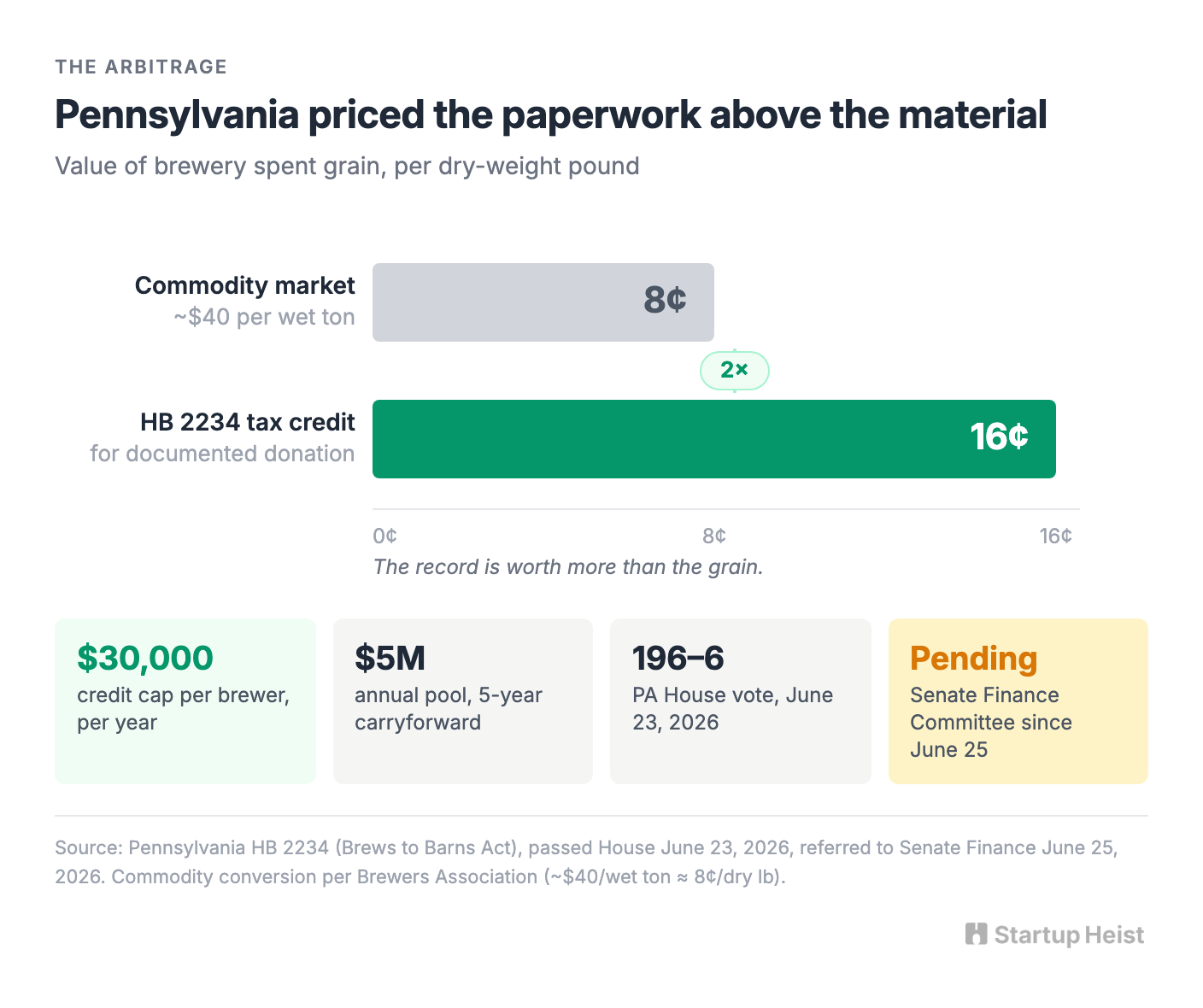
On June 23, 2026, the Pennsylvania House passed House Bill 2234 by a vote of 196 to 6. The Brews to Barns Act would hand brewers an excise tax credit of 16 cents for every dry-weight pound of spent grain they donate to agriculture inside the state. The cap is $30,000 per brewer per year against a $5 million annual pool, with unused credits rolling forward five years. The bill went to the Senate Finance Committee on June 25, 2026, and sits there still.
Spent grain trades at roughly $40 per wet ton. The Brewers Association converts that to about 8 cents per dry pound. Pennsylvania's proposed credit pays 16 cents. If the bill becomes law, the paperwork is worth more than the material.
Nobody in the statehouse asked the operational question. Claiming 16 cents per dry-weight pound means proving dry weight, which means proving wet weight and moisture, which means recording the date, quantity, recipient, and intended agricultural use for every pickup, fifty-two weeks a year, and holding those records through an audit.
Almost no brewery in America has those records. Most have a farmer named Dave and a group text.
The distance between the credit and the recordkeeping is where the business lives.
The money: Sixty producers at an average $249 a month plus coordination fees clears $21,000 MRR in one metro. Massachusetts' organics ban alone generated $194 million in economic value.
Inside:
• The five-block passport spec buyers ask for
• Why the open marketplace dies first
• Pricing from $750 setup to $999 multi-site
• The 90-day plan to ten paid passports
The gap runs well past beer. Juice processors produce pulp, peels, and pomace. Bakeries accumulate predictable offcuts. Coffee roasters generate chaff. Food manufacturers turn out trim and wash solids on a schedule. Every one of those streams can become animal feed, compost, mushroom substrate, fermentation feedstock, or energy, and nearly every one is currently described in a text message.
The material is already spoken for
American breweries generate roughly 4.7 million metric tons of spent grain a year. An average barrel of beer leaves behind more than 65 pounds of it, so a modest 2,000-barrel brewery produces something like 65 tons annually without ever putting it on a balance sheet. ReFED counted 70 million tons of surplus food across the U.S. in 2024, about 29% of the food supply and $380 billion in value, and the first year-over-year decline since the pandemic. Surplus tonnage is finally shrinking; the handling is still a group text.
The inconvenient part: about 90% of spent grain already gets reused, mostly as animal feed or compost.
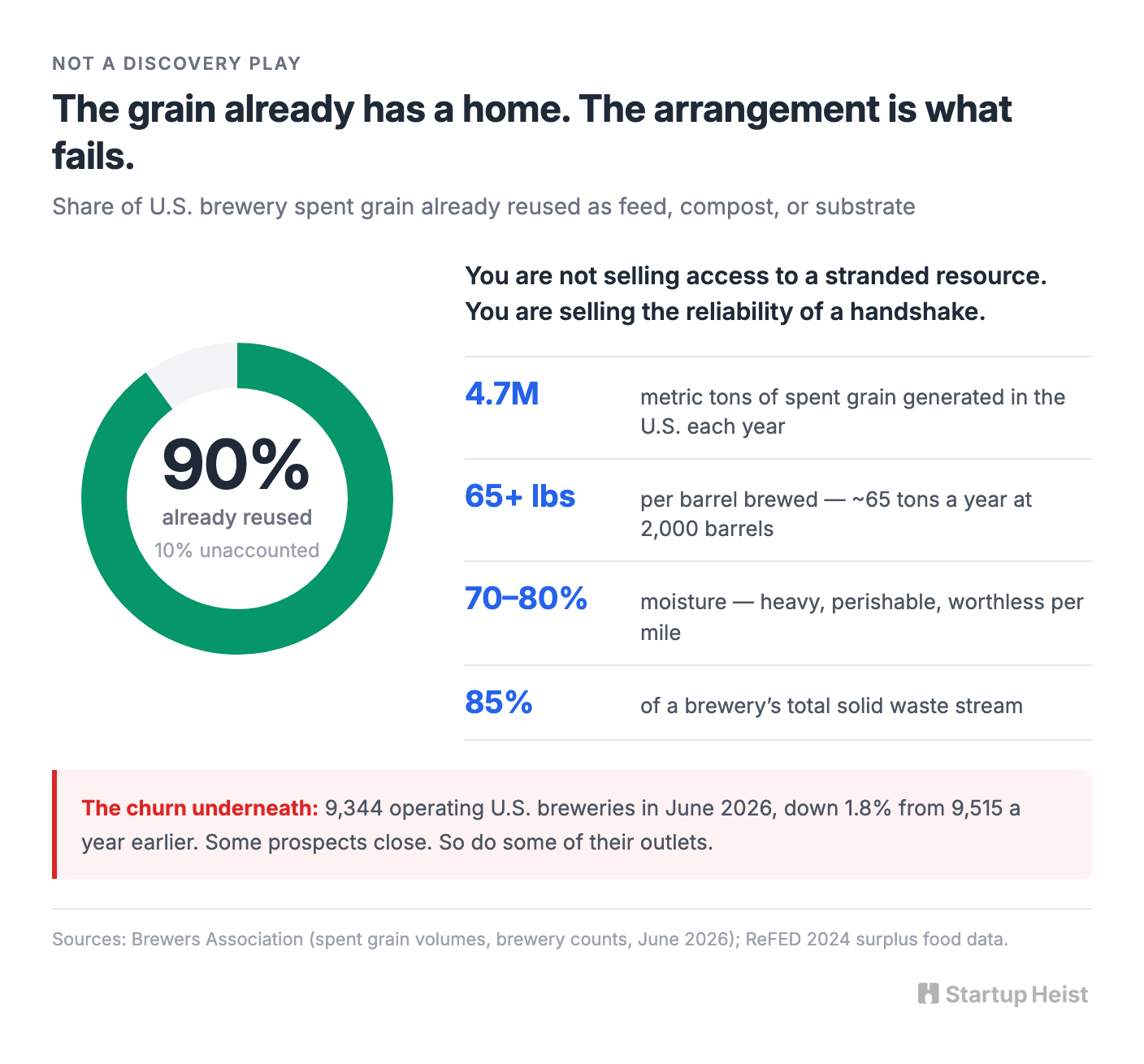
The 90% figure kills the lazy version of this idea. You aren't discovering a stranded resource, and you won't walk into a taproom to tell the owner the wet stuff out back has value. The brewery already has an arrangement, and the arrangement mostly works.
It's also held together with nothing.
The farmer misses a week during harvest. Brewing volume jumps 40% for a seasonal release and nobody tells the pickup. The instructions for where to back the trailer live in one bartender's phone, and that bartender quit. Neither side weighs anything. When a farm sells, switches feed programs, or drops the route, the brewery finds out on a Tuesday morning that three thousand pounds of wet grain has nowhere to go and a shift crew that needs the space.
Spent grain is about 85% of a brewery's solid waste and runs 70% to 80% moisture: heavy, perishable, worth almost nothing per mile. You can't fix a missed pickup with a nicer listing page. You fix it with schedules, backup outlets, real specifications, route density, and a record of who dropped the ball.
What the handshake actually costs
Nobody pays for grain. They pay for what happens when the grain has nowhere to go.
Commercial organics hauling in the United States runs $70 to $400 a ton. California data puts transport and composting of a ton of food waste around $120. New York City set its organics disposal rate at $85 per ton in October 2024. Small-business composting subscriptions land between $50 and $300 a month.
So when the farmer stops coming, a brewery producing 65 tons a year is staring at four figures of annual disposal it used to get for free, plus the staff hours spent finding a replacement, plus a wet pile in the alley in the meantime.
The customer base is churning too. The Brewers Association counted 9,344 operating breweries in June 2026, down 1.8% from 9,515 a year earlier. Some of your prospects close, and so do some of their outlets. A market where relationships break on their own will pay for continuity.
The regulatory calendar is doing your sales work
Three states have already converted food waste diversion from a nice-to-have into a compliance line item.
Massachusetts cut its commercial disposal threshold from one ton to half a ton of organic material per week in November 2022, roughly doubling covered businesses from 2,000 to 4,000. A decade in, ReFED credits the ban with more than 1,670 jobs, $194 million in economic value, and over $390 million in broader industry activity.
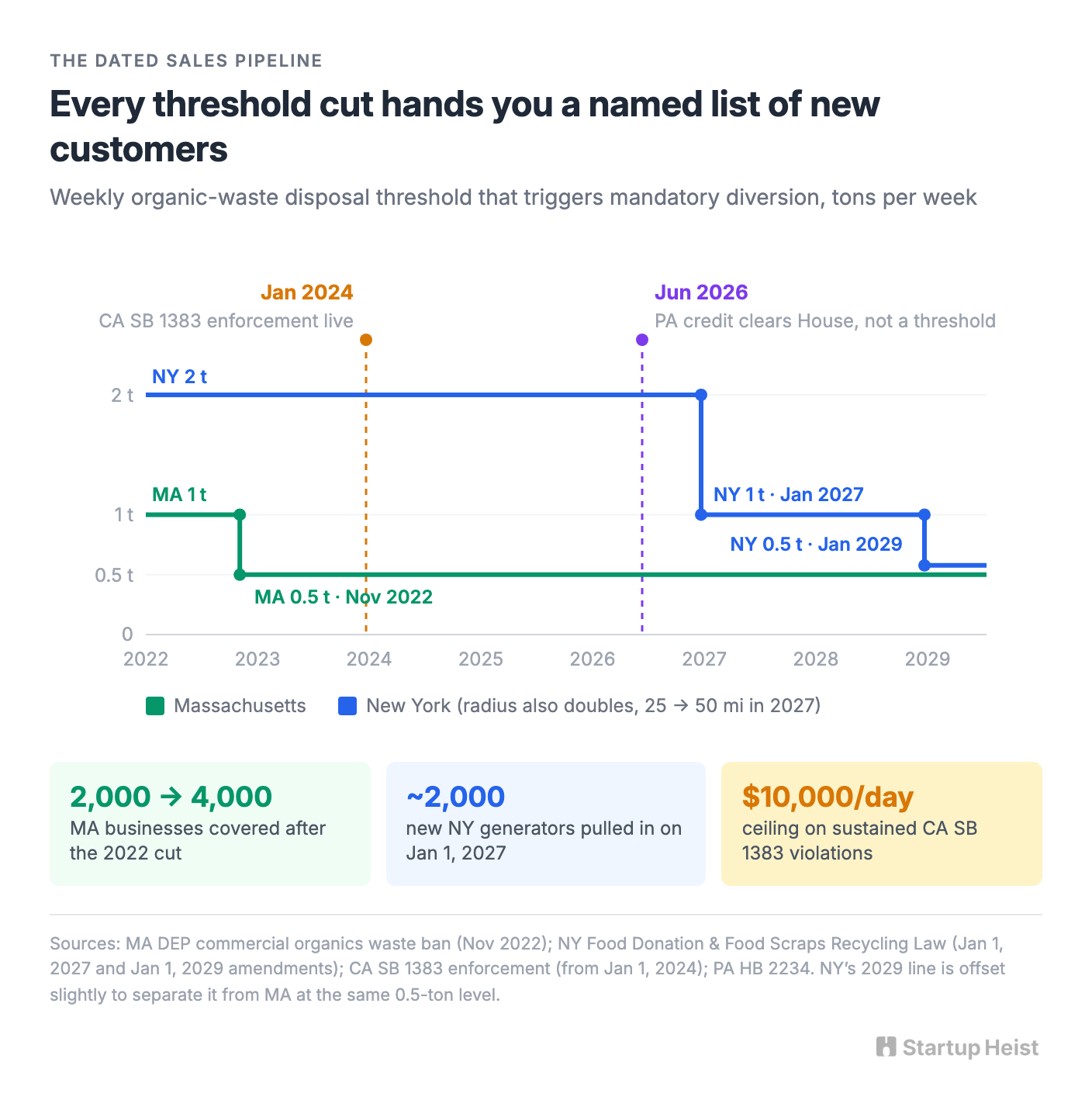
New York is the one to circle. On January 1, 2027, the state's Food Donation and Food Scraps Recycling Law drops its threshold from two tons a week to one and doubles the covered radius from 25 to 50 miles from an organics recycler, pulling in roughly 2,000 new generators. On January 1, 2029, the threshold falls again to half a ton at that same 50-mile radius, adding thousands more.
California has been enforcing SB 1383 since January 1, 2024. Local fines start at $50 to $500 for a first violation, sustained violations can reach $10,000 per day, and businesses that self-haul must document it.
Pennsylvania is the newest clock and the only live one in the brewery lane. Tennessee ran companion bills at 8 cents a pound inside a 100-mile radius, cleared committee in March 2026, and went no further this session; the Brewers Association is working with the state guild toward a 2027 reintroduction while pushing a federal version worth up to $35,000 per brewery. The legislative trend is real and uneven, which is the condition that rewards whoever already keeps records.
Regulation won't build your product. It changes the opening line of every sales call from "why should you care about this" to "how are you documenting this."
Where the existing players stop
The category isn't empty. The money just went somewhere else.
Spoiler Alert has moved 2.0 billion pounds of inventory and nearly $6 billion in product sales since launching in 2019, and landed at number 7 in Logistics on Fast Company's 2026 Most Innovative Companies list, selling to large CPG brands managing excess finished goods. Full Harvest digitized fragmented produce buying, then expanded past surplus into all USDA Grade 1 produce, which is the honest tell: the surplus wedge was a way in, and the volume was up-market. Cyrkl and Excess Materials Exchange run broad secondary-materials exchanges across Europe, and ReFED's directory lists hundreds of providers across prevention, rescue, and recycling.
Every one proves demand for digital materials exchange. None owns the sentence that matters: this material, from this facility, on this schedule, accepted by this buyer, at this hauling cost, with this rejection history. A directory knows a composting facility exists. Nobody knows it takes wet grain from that brewery in those totes on Thursday mornings and has completed 41 pickups with two documented rejections.
The narrower claim is the better business.
The product is a passport, not a certification
What you're building is closer to materials data management, freight brokerage, and recurring vendor coordination than to Craigslist for scraps. The core artifact is a structured record that answers what a serious buyer asks before scheduling a truck. Five blocks.
Unlock the Vault.
Join founders who spot opportunities ahead of the crowd. Actionable insights. Zero fluff.
“Intelligent, bold, minus the pretense.”
“Like discovering the cheat codes of the startup world.”
“SH is off-Broadway for founders — weird, sharp, and ahead of the curve.”


