


The $24 Bug Behind OpenAI's Boardroom TV
Companies spend millions defending their networks and very little maintaining the rooms where their most sensitive decisions get made. A narrow managed service can sell the upkeep between bug sweeps.
On September 30, 2026, OpenAI's technical surveillance countermeasures team swept an executive conference room at the company's San Francisco offices and found something plugged into a USB port on the back of the television. It was wrapped in toilet paper. Court documents identify it as a Seeed Studio XIAO ESP32-S3 Sense, a thumb-sized development board with a microphone, a camera sensor and a microSD slot. It sells for about $14 from the manufacturer and $23.99 on Amazon. Its storage was encrypted.
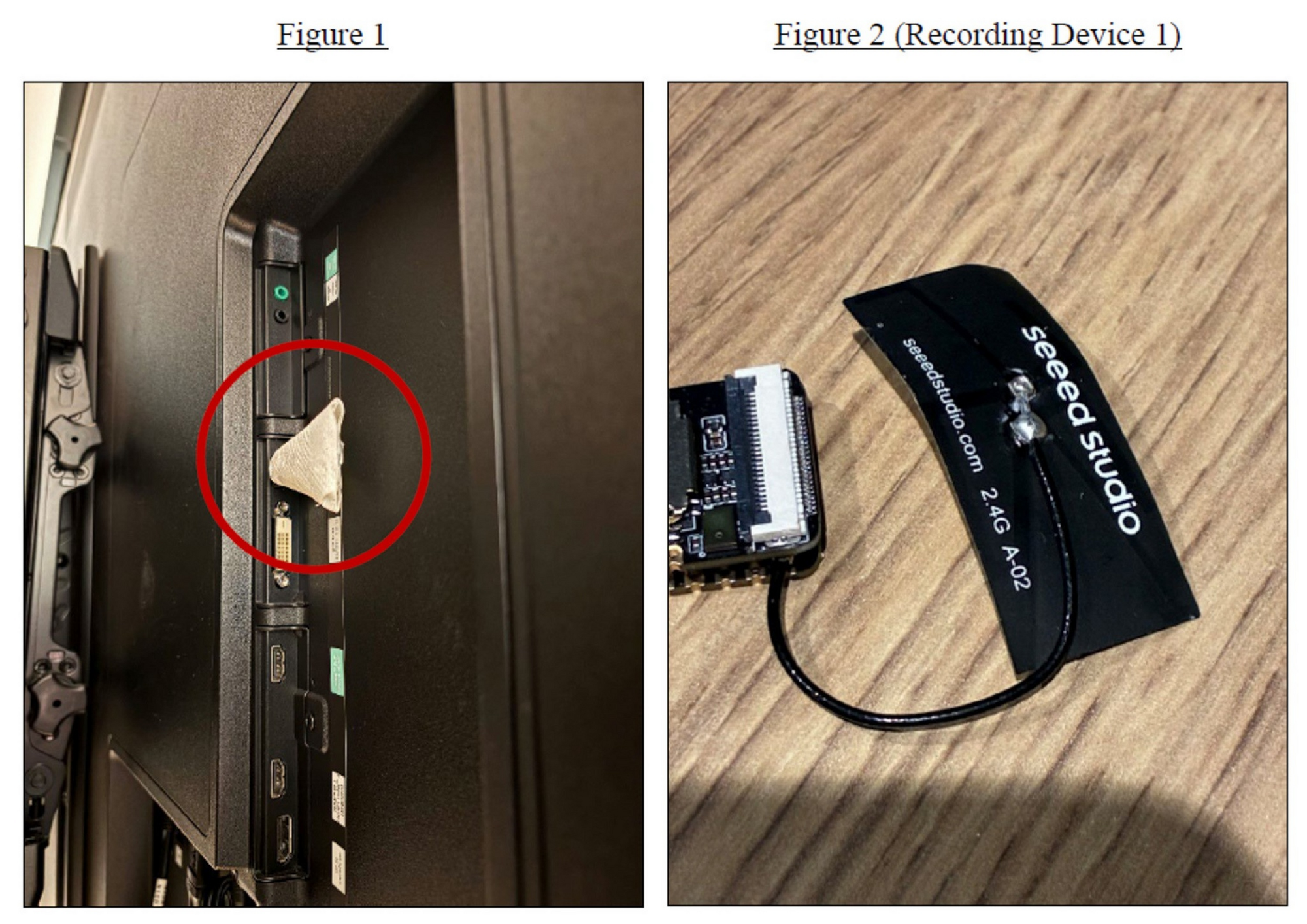
OpenAI says the device went in on or about September 28. Federal agents arrested OpenAI engineer Abdulrahman Alfozan on October 9, and the Justice Department announced the charge on October 13: using or attempting to use a device to intercept oral communications, which carries up to five years in prison. Prosecutors say a chatbot account tied to his household asked how to build a continuous audio recorder, give it Wi-Fi connectivity and live listening, and encrypt its SD card. OpenAI says it used its own models to analyze forensic images of the device's storage, and it reports no indication that model weights, source code or customer data were taken. The allegations are unproven.
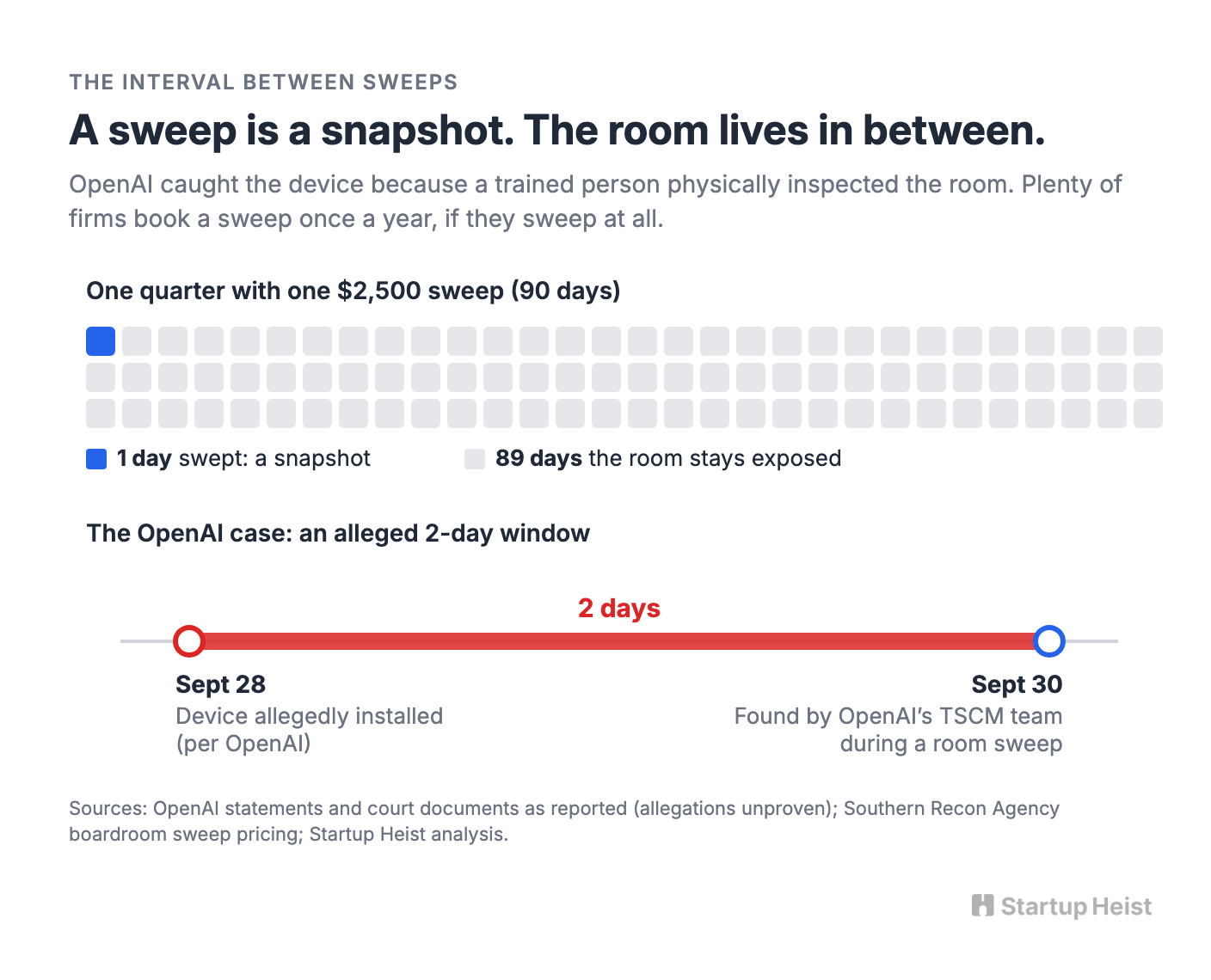
For founders, the useful fact sits underneath the spy-novel details. One of the best-resourced security operations in tech caught a $14 bug because a trained person physically inspected the room, two days after it was allegedly planted. Plenty of firms that hold valuable conversations book a bug sweep once a year, if they sweep at all, and at that cadence the same board could sit behind the TV for months.
The business lives in that interval between sweeps: a managed service that keeps a client's confidential rooms in a known state and calls in a professional when something changes.
The money: 25 sites with two rooms each at $249 per room is $12,450 MRR before install fees. Boardroom sweeps already run $2,500 to $5,000+ apiece.
Inside:
• What a Wi-Fi/BLE sensor can and can't catch
• Open-source sensor stack built on Kismet
• Pricing tiers with ~70% gross margin math
• 90-day pilot plan plus the outreach email
The Room Nobody Owns
Every growing company has someone who owns digital security: accounts, endpoints, patches, cloud permissions. Physical security belongs to facilities, the office manager, building management, and the AV vendor who mounted the screens three years ago. The conference room sits where those jobs overlap. An executive meeting room holds a smart TV, a videoconferencing bar, a wireless presentation dongle, ceiling microphones, a network drop, and a nest of USB and HDMI cables. IT owns some of it and facilities owns the rest, so when a cable gets swapped, nobody writes it down.
The security team can name every managed laptop in the company and still have no idea that a USB port behind the boardroom TV has been live and unwatched since the install. Badge systems wouldn't have helped either, since the accused was an employee with legitimate building access.
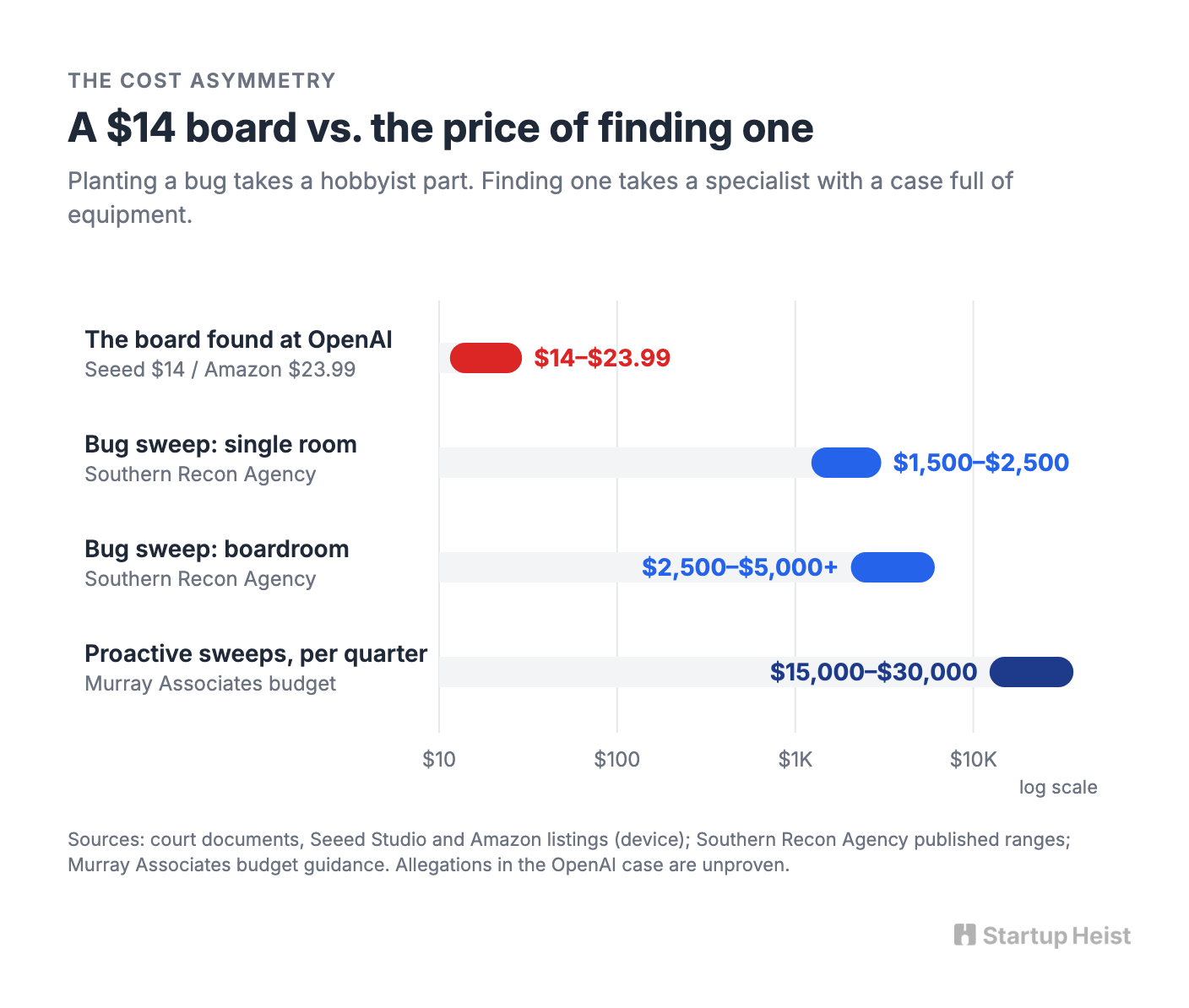
The case also shows how cheap the attack has become. The board allegedly planted in OpenAI's executive room is a hobbyist part sold for maker projects, with a public spec sheet and thousands of tutorials. Anyone with a credit card and a free afternoon can build one, while finding one still calls for a specialist with a case full of equipment.
A Market That Already Pays
Technical Surveillance Countermeasures, or TSCM, is the professional discipline of finding eavesdropping devices, the work most people call a bug sweep. Practitioners physically inspect rooms, analyze the radio spectrum, and use instruments such as nonlinear junction detectors that locate electronics even when they're powered off. Southern Recon Agency publishes ranges of $1,500 to $2,500 for a single room or small office and $2,500 to $5,000+ for a corporate office or boardroom. Murray Associates, one of the field's older firms, says businesses generally budget $15,000 to $30,000 per quarter for proactive sweeps.
The top of the market is spoken for. Bastille Networks sells enterprise wireless threat detection, raised a $44 million Series C led by Goldman Sachs Asset Management in January 2024, and announced on February 11, 2026 that it would deploy across Oracle's global network of AI data centers. CRFS sells fixed, around-the-clock RF monitoring for secure facilities, and TSCM firms such as TSCM America offer live, in-place monitoring for conference rooms, all of it priced for large security budgets.
Below that tier, the market thins out fast. A 20-person M&A boutique, an IP law firm, or an AI startup with one floor and one boardroom is too small for Bastille, and a $2,500 sweep each quarter buys a one-day snapshot of a room that stays exposed for the other 89. These firms need someone to keep the room in a known state between snapshots, and almost nobody packages that as a product for a customer their size.
The Heist: Sell the Upkeep Between Sweeps
Take a boutique M&A advisory firm with 18 employees and two rooms that matter: one for buyer meetings and price negotiations, one for partner meetings and client pitches. The firm has managed laptops, encrypted email and an outsourced IT provider. Ask the managing partner when the AV equipment in those rooms was last physically inspected, which devices and connections are supposed to be there, and what happens when something changes, and you'll likely get shrugs.
Sell the firm a standing answer to all three. Call it Confidential Room Assurance, and define assurance precisely: the specified controls are being maintained. It never means the room is guaranteed clean.
The service has three layers:
- Physical hardening. Inventory every device in the room, block unused ports, apply serialized tamper-evident seals at the spots an attacker would touch, and log every authorized change.
- Wireless-change monitoring. A small managed sensor baselines the room's Wi-Fi and Bluetooth environment and flags persistent, policy-relevant changes for human review.
- Inspection and escalation. A monthly checklist for an in-house room custodian, a dated record of every check, and a direct line to a vetted TSCM partner when the evidence warrants a real sweep.
What the customer buys is an accountable operating process, with the sensor as one input to it.
What the Sensor Can and Can't See
Unlock the Vault.
Join founders who spot opportunities ahead of the crowd. Actionable insights. Zero fluff.
“Intelligent, bold, minus the pretense.”
“Like discovering the cheat codes of the startup world.”
“SH is off-Broadway for founders — weird, sharp, and ahead of the curve.”


