


The Home-Battery Land Grab Needs a Referee
Home batteries used to be a simple purchase. You picked a Powerwall, paid an installer, and kept the lights on when the grid went down. That product barely exists anymore.
In 2026 the battery might be free. A utility might fund part of it, or an electricity retailer might own it outright. A stranger's algorithm charges and discharges it while you sleep. Backup capacity may be reserved for you, or it may not. Electricity supply often comes bundled at a rate pegged to a number you've never looked up. Leaving the program can mean the hardware leaves with it, and selling the house triggers another set of rules entirely.
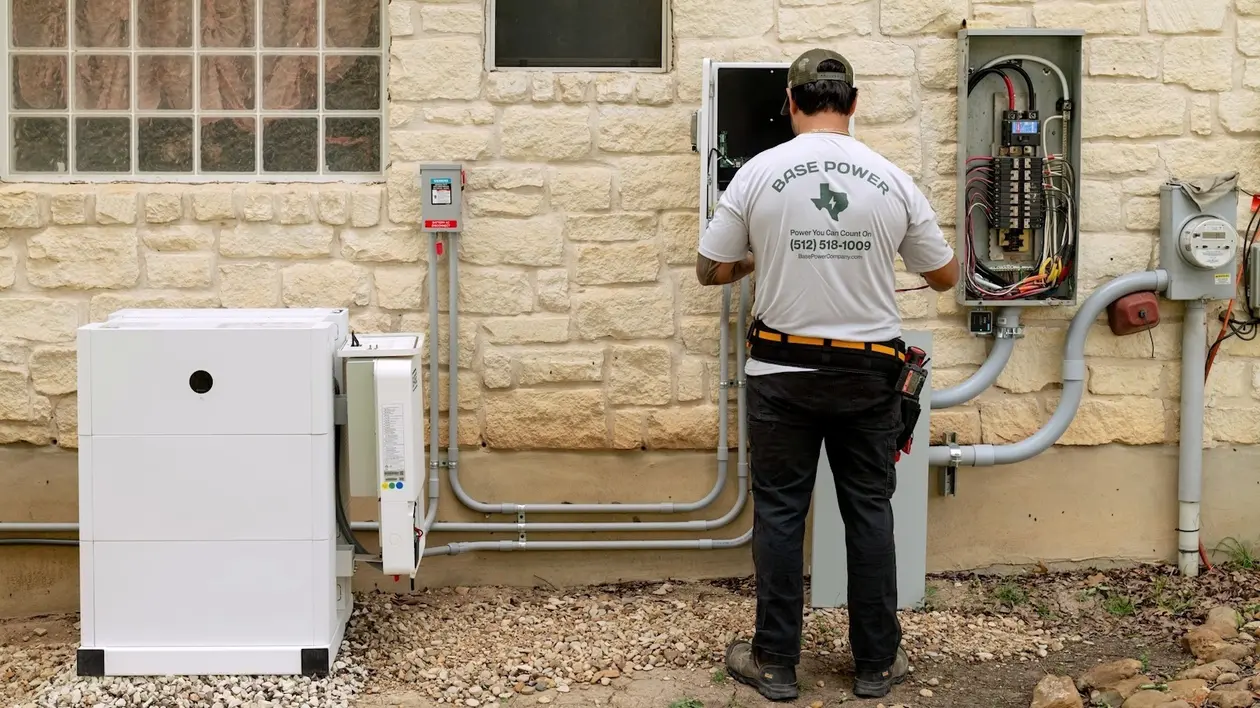
What the homeowner is actually shopping for is a financial contract wrapped around a battery wrapped around an electricity plan. Almost nobody is helping them compare those contracts.
That's the heist. Build the independent decision engine that takes a household's utility, consumption, solar setup, backup needs and actual contract terms, then returns a plain answer: take this deal, take that one instead, buy your own, or walk away. Underwriting for homeowners, which is a different business from ranking the best home batteries of 2026.
Here's the shape of it.
The money: 20,000 household analyses a year, 5% buying a $149 contract audit, plus qualified referrals: roughly $60K MRR before a single B2B seat.
Inside:
• Six-dimension contract scoring framework
• 10-week build plan for the analyzer
• Five-stage monetization ladder to $1M
• Four moats a scraped directory can't copy
The $13 billion signal
On August 3, 2026, Base Power announced a $1 billion Series D at a $13 billion post-money valuation, pushing total capital raised past $2.5 billion. The round was led by Ribbit, Addition, Valor Equity Partners and JPMorganChase's Strategic Investment Group. Alongside it, Base launched Base Core, a 39.2 kWh unit that stacks to 78.4 kWh, built at the company's Austin factory. Its fleet crossed 500 MWh, it signed utility partnerships with El Paso Electric, Austin Energy and CoServ covering more than 200 MW, and it left Texas for the first time to enter Illinois. The company is installing roughly 100 batteries a day and plans to double that pace by the end of 2026.
Base doesn't sell batteries. It installs them, keeps operational control, gives you backup power, and monetizes the fleet as grid infrastructure. The battery in the garage is Base's asset earning Base's revenue. Your outage protection is the compensation.
That distinction is the whole opportunity. What's scaling here is business-model fragmentation, a much messier phenomenon than battery adoption.
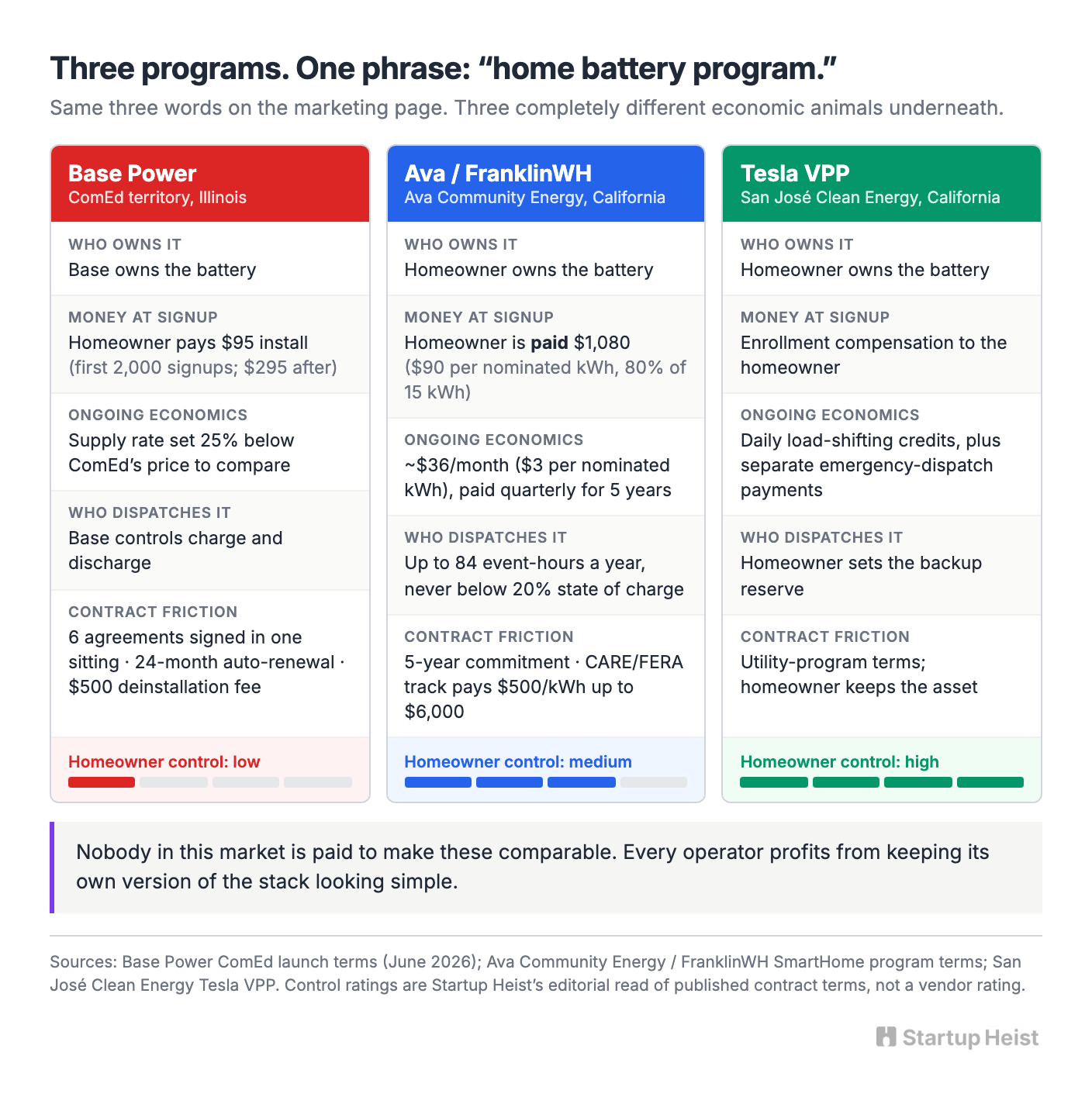
Consider a homeowner in ComEd territory outside Chicago, where Base launched in June 2026. The first 2,000 signups get installation for $95 instead of $295, plus supply rates set 25% below ComEd's peak price to compare. ComEd still delivers the electricity and still charges delivery fees. Activation runs through six separate agreements: an Energy Service Agreement, a Uniform Disclosure Statement, a Battery Services Agreement, a Net Metering Addendum, an Automatic Contract Renewal Notice, and a Letter of Authorization to switch suppliers. Inside that stack sit a 24-month automatic renewal on the supply side and a $500 deinstallation fee for cancelling during the Battery Services Agreement. None of it is hidden. It's spread across six documents signed in a single sitting.
Two thousand miles west, a California household on Ava Community Energy's FranklinWH program nominates 40%, 60% or 80% of a 15 kWh battery for grid use at $90 per nominated kWh upfront. Commit 80% and that's $1,080, plus $3 per nominated kWh per month, roughly $36, paid quarterly for five years. Income-qualified CARE and FERA customers get $500 per nominated kWh, up to $6,000. Ava expects up to 84 hours of events a year and will never discharge below 20% state of charge.
A Tesla owner under San José Clean Energy gets a third structure: enrollment compensation, daily load-shifting credits, separate emergency-dispatch payments, and homeowner control over the backup reserve.
Three programs, three completely different economic animals, all marketed with the same three words: home battery program.
Why the deals fragmented this year
The timing has less to do with hardware getting cheaper than with a line of tax code that expired.
On December 31, 2025, Section 25D died. The One Big Beautiful Bill Act, signed July 4, 2025, killed the residential clean energy credit nearly a decade early with no phase-down and no partial credit. A homeowner who buys a battery in 2026 gets nothing from the federal government.
Section 48E survived. Commercial owners of clean energy property can still claim a 30% investment tax credit on residential installations, provided construction begins by July 4, 2026 and the system is in service before 2028.
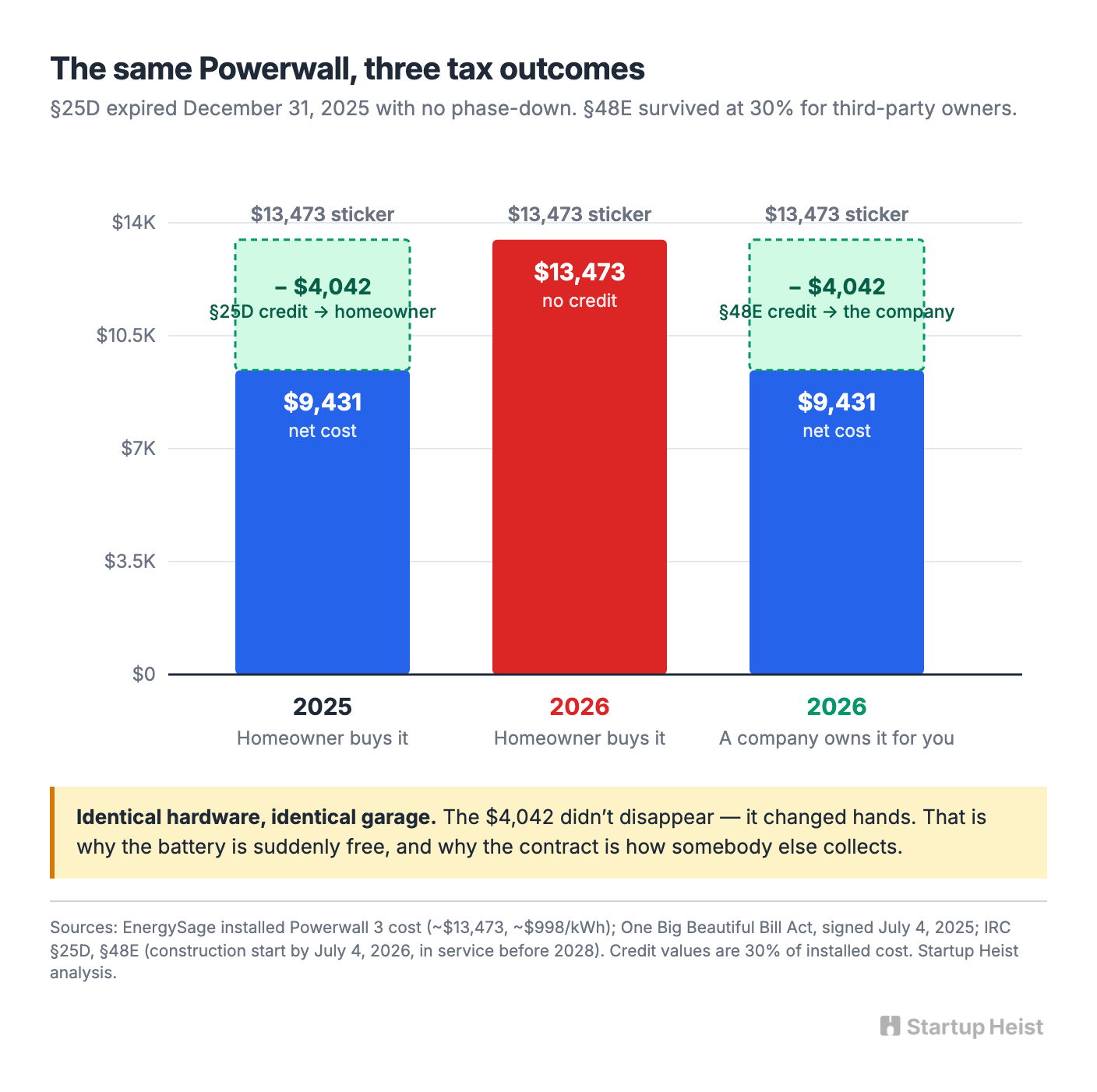
EnergySage puts an installed Powerwall 3 at roughly $13,473, about $998 per kWh. In 2025 a homeowner claiming 25D got about $4,000 of that back. In 2026 they get zero. The identical hardware, in the identical garage, costs 30% more to own personally, while the tax code now pays a company 30% to own it for you.
That's why the battery in your garage is suddenly free. Somebody else is monetizing the credit you lost, and the contract is how they collect.
The macro numbers point the same direction. U.S. residential storage installed a record 1.3 GWh in Q1 2026, up 86% year over year, with solar-plus-storage attachment hitting 45%, up from 38% a year earlier. Wood Mackenzie attributes much of that surge to installations rushed through ahead of the 25D deadline. The Department of Energy has argued that 80 to 160 GW of virtual power plant capacity by 2030 could cover 10% to 20% of national peak demand. Sunrun now runs 17 distributed power plant programs with 106,000 enrolled customers, up from about 20,000 the year before, drawing on a fleet of 217,000 home batteries. It paid participants more than $17 million in 2025 and dispatched nearly 18 GWh.
One battery can now throw off nine kinds of value: outage protection, time-of-use arbitrage, solar self-consumption, capacity payments, emergency-dispatch payments, supply discounts, utility incentives, installation subsidies and wholesale grid-service revenue.
Someone decides who gets each of those dollars, and right now that someone is always the company selling the deal.
Illinois already ran this experiment
Retail energy has done bundled-savings promises before, and there's a receipt.
The Illinois Commerce Commission's Office of Retail Market Development released its 2026 annual report in August. ComEd and Ameren residential customers lost more than $206 million to alternative electricity suppliers over the prior year, and the Citizens Utility Board's companion analysis puts the total since 2015 above $2.3 billion. The worst variable rates the ICC found ran 35.32 cents per kWh in ComEd territory and 38 cents in Ameren territory, which works out to roughly three to four times the default utility price at the time.
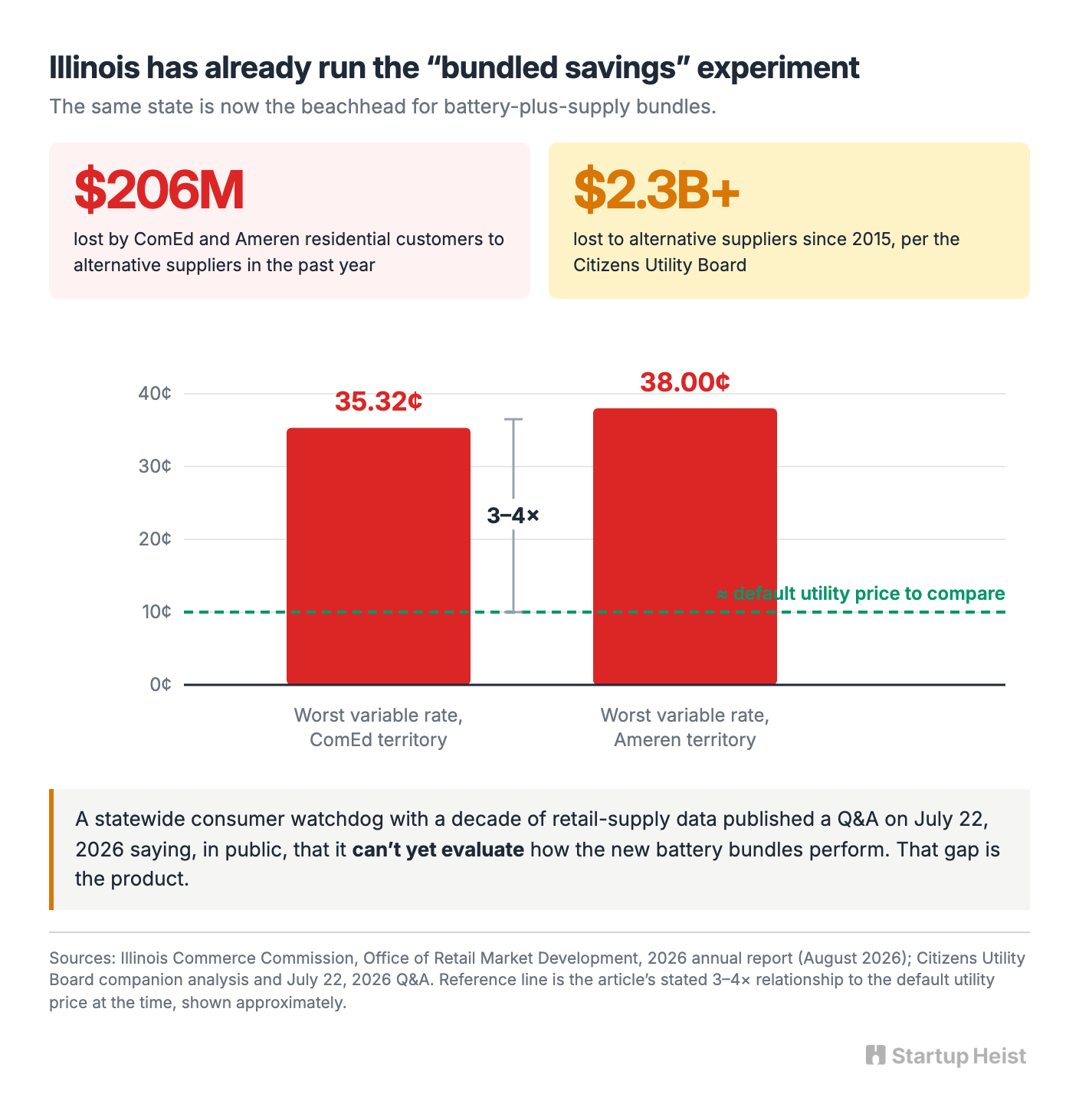
Now the same state is the beachhead for battery-plus-supply bundles. The Citizens Utility Board published a Q&A on July 22, 2026 walking Illinois homeowners through two of them, Base and Energywell, and its honest conclusion was that it hasn't yet heard from consumers who've been through the process and can't evaluate how the plans perform in practice.
A statewide consumer watchdog with a decade of retail-supply data is saying in public that it doesn't yet know whether these deals are good.
Energywell shows why. For a $99 deposit and no other money down, it installs and owns the battery in exchange for enrollment in a time-of-use supply plan guaranteed to beat ComEd's price to compare by at least 25%. The battery program runs 15 years. The rate agreement renews every two. Each renewal is guaranteed to beat the price to compare again, which sounds airtight until you remember that "beats the price to compare" is exactly the promise behind that $2.3 billion.
And the field is about to get more crowded. In June 2026 Illinois regulators approved ComEd's own Scheduled Dispatch Virtual Power Plant, launching in 2027 with equipment rebates and dispatch compensation, expanding to EVs by 2029. The utility itself becomes a competing offer, on top of the retailers, the aggregators and the hardware brands.
Every one of those players has a structural incentive to make its own offer look simple, and nobody in the market is paid to make them comparable.
What you actually build
Don't start by building Zillow for every battery program in America. Start with a scorecard for one decision.
The real question a homeowner faces is who should own and control the battery attached to their house, which is a different question from which battery to buy. That splits into four paths, and your product has to be able to recommend any of them.
Unlock the Vault.
Join founders who spot opportunities ahead of the crowd. Actionable insights. Zero fluff.
“Intelligent, bold, minus the pretense.”
“Like discovering the cheat codes of the startup world.”
“SH is off-Broadway for founders — weird, sharp, and ahead of the curve.”


