


The Exit Door
Small businesses would replace their old software tomorrow if their records could come with them. Sell them the way out.
Consider a funeral home that has run the same desktop software since 2006. The owner finally decides to retire it, and picking the replacement is easy: a cloud product with e-signatures, remote access and a family portal for about $250 a month. Training takes a week.
Then the owner asks what happens to 20 years of records. The old system holds thousands of cases, family contacts, signed authorizations, photographs, contracts and payment histories. Some of it exports cleanly. Some sits in database tables nobody at the firm has ever opened, and some will never fit the new vendor's import template. In December 2023, Tribute Technology, itself a funeral-software vendor, published one funeral director's account of a provider that quoted $10,000 just to hand over an export of the firm's own data.
That leaves the owner three bad options: rebuild the missing history by hand, keep the old PC humming in a back office indefinitely, or leave part of the firm's past behind.
A fourth option exists, and it's a business. Build a specialized legacy data migration service that extracts customer-authorized records from one legacy application, verifies every count, and delivers them in portable formats. Then offer a searchable, read-only archive for customers who need ongoing access. The owner already has replacement software picked out. What you sell is the confidence to leave the old system without abandoning anything that matters. And a second customer already spends money on this exact problem: the cloud vendor trying to win the account. Here's the opportunity:
The money: Twenty migrations at about $3,500 is $70,000 in year one, and 100 archives at $99 a month is $9,900 MRR. One funeral director was quoted $10,000 for their own data.
Inside:
• Three-tier offer, $750 assessment to archive
• HMIS, Gather's gap map and target scoring
• 90-day build with verification and kill gates
• Vendor and owner outreach emails
The exit is where the records get left behind
The U.S. funeral industry makes a clean first test. The National Funeral Directors Association counts 15,401 funeral homes, roughly 75% family- or privately owned, employing 105,300 people and generating $16.3 billion in revenue (figures last updated September 29, 2025). That's a count of funeral homes, and it says nothing about how many are stuck on obsolete software. Many already run cloud tools they like. The market worth chasing is the narrower slice whose old systems hold records that standard migrations can't carry across.
At first glance, data migration looks like a free commodity. Noorelia charges $250 a month or $2,499 a year and hand-imports cases, contacts and event schedules from "any source" within five business days at no charge. Wrenbook's $149 and $249 monthly plans include free migration of cases, contacts and price lists from SRS, Frazer, Osiris, Passare or spreadsheets. Passare imports basic data from your existing system for an additional fee. Read the fine print and every offer moves the records a new system needs to run. Passare's own terms for importing into its platform list photos, files and attachments, Rolodex contact details, and embalming and preparation details as unsupported.
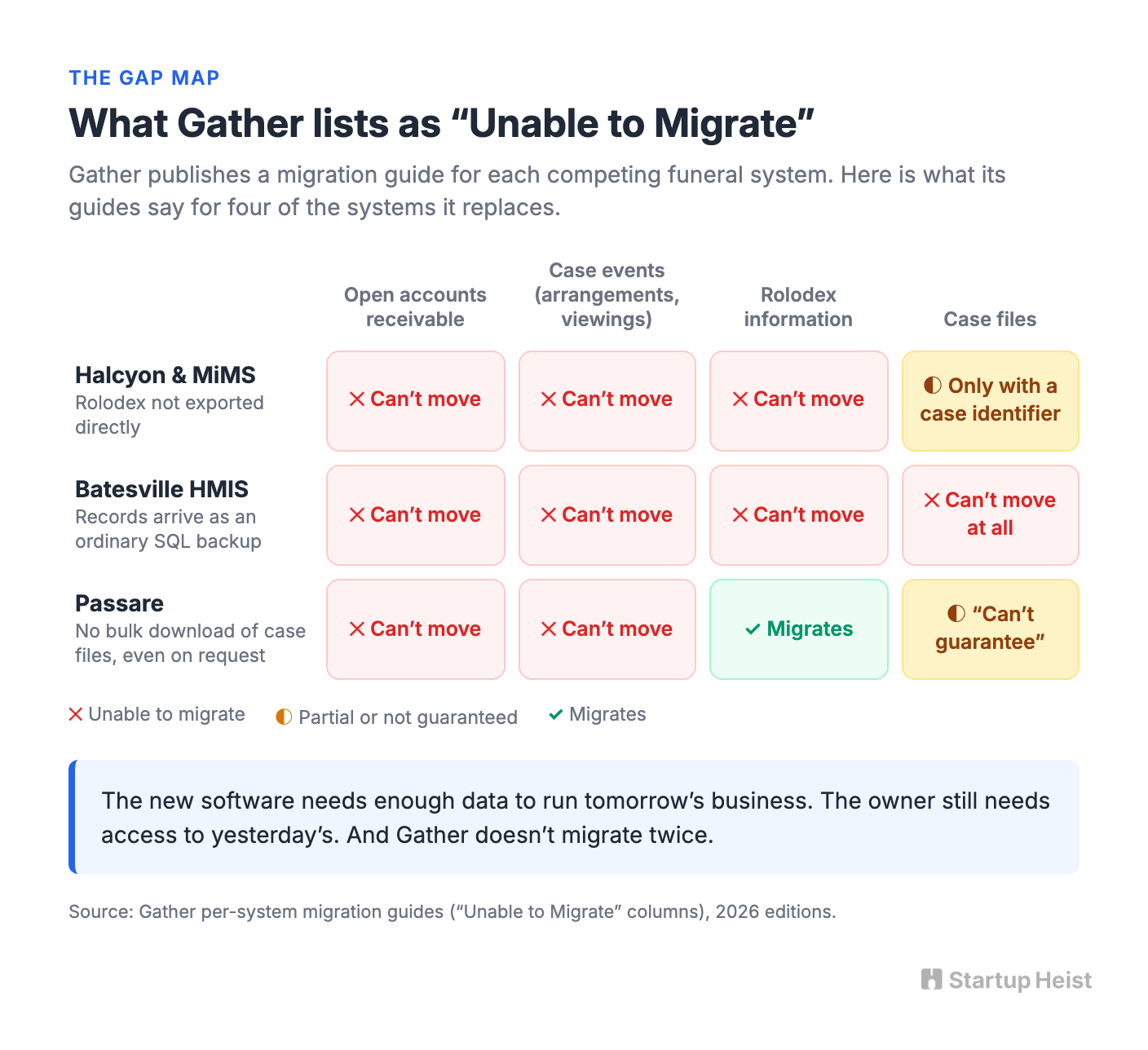
The clearest map of the gap comes from Gather, which publishes a migration guide for each competing funeral home software system, each with a column titled "Unable to Migrate." From Halcyon and MiMS, Gather can't move open accounts receivable, case events like arrangement meetings and viewings, or Rolodex information, which neither system exports directly, and case files come over only with an identifier tying them to a case. From Batesville's HMIS, which hands over an ordinary SQL backup, Gather can't move case files at all. Passare doesn't provide a bulk download of case files even on request, so for Passare files Gather says it "can't guarantee" they make it. And Gather doesn't migrate twice. The new software needs enough data to run tomorrow's business, while the owner still needs access to yesterday's. Every vendor is built around the first need, and the second has no obvious owner.
Enterprises already pay for this
Large organizations solved this years ago. OpenText and a field of application-decommissioning vendors extract data from retired ERP, healthcare and financial systems, verify it, and keep it searchable so the old application can be switched off for good. Their pricing assumes an IT department and a multiyear contract. A five-person funeral home needs the same service at its own scale, and the obstacle was always the cost of decoding one obscure format for a small customer base. That cost has fallen.
Why now: an agent that reads binaries
Decoding an undocumented desktop application used to mean hiring a specialist to trace compiled code, inspect memory and hand-write a parser for a binary format. In early October 2026, an open-source project called REA (Reverse Engineer Anything) went viral and changed that math. REA is an MIT-licensed server that plugs coding agents such as Claude Code, Codex and Cursor into analysis tools through the Model Context Protocol. It inspects native binaries through Ghidra, Hopper or IDA, reads .NET assemblies, maps Electron apps, and walks SQLite tables, indexes and triggers. Its main Hacker News thread passed 800 points within days, and the repository has since passed 300,000 GitHub stars.
The value sits in the interface. Hand an agent an authorized copy of a legacy application and its database, and it can help answer the questions that matter: where case records live, what identifies a family or an attachment, how tables reference each other, and what transformations happen before a record reaches the screen. The limits are real. .NET inspection is static, Windows support varies by analysis engine, and REA's own disclaimer rules out circumventing license checks or bypassing access controls. Inferred structures still need independent testing, and no agent will recover a lost encryption key or repair a corrupted backup.
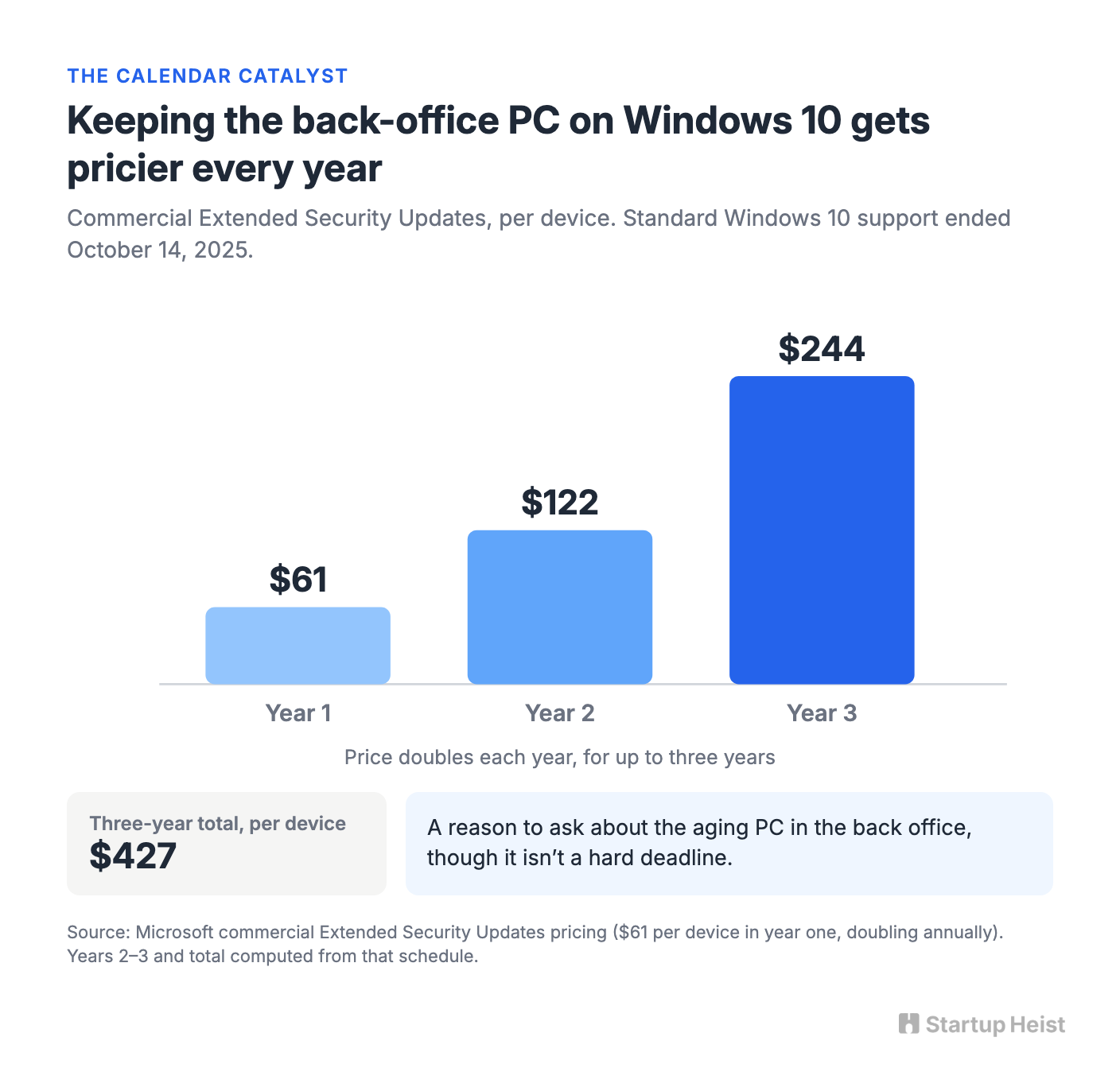
A modest calendar catalyst helps. Microsoft ended standard Windows 10 support on October 14, 2025, and commercial Extended Security Updates cost $61 per device in year one, doubling each year for up to three years. That gives you a reason to ask about the aging PC in the back office, though it isn't a hard deadline. The opening is an extraction job that was never worth quoting for a few dozen customers and may now be worth productizing.
Pick one application, then get absurdly specific
Unlock the Vault.
Join founders who spot opportunities ahead of the crowd. Actionable insights. Zero fluff.
“Intelligent, bold, minus the pretense.”
“Like discovering the cheat codes of the startup world.”
“SH is off-Broadway for founders — weird, sharp, and ahead of the curve.”


