


The Second User of the Internet Just Hit Cities Like a Truck
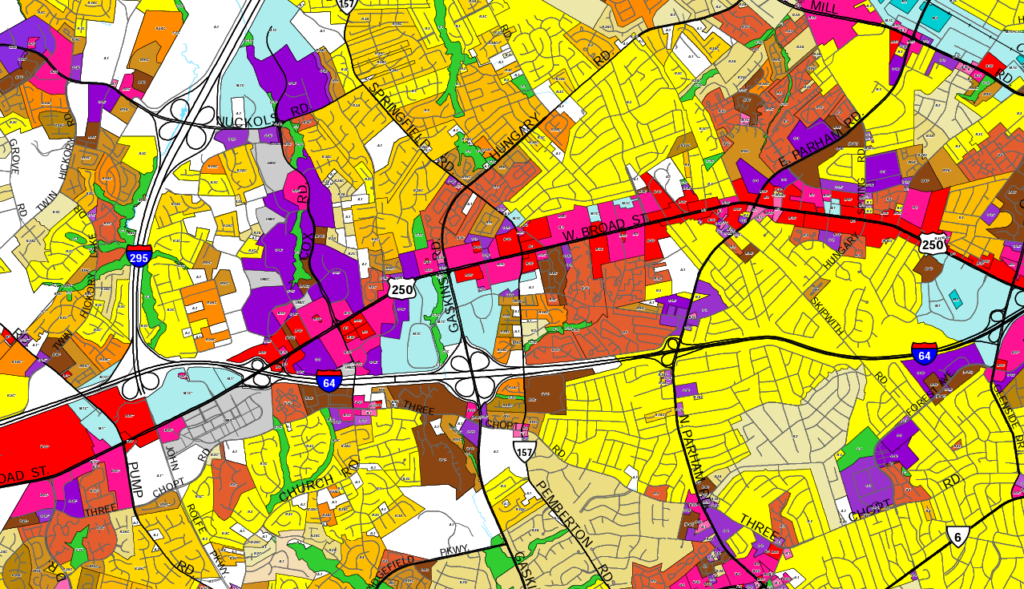
Open any American city's website at 11 p.m. and try to figure out whether you can convert a duplex into a triplex. You'll click through six pages, three PDFs, two zoning maps, a fee schedule from 2017, and a permit portal designed for someone who already knows which department to call. The information is technically public. It isn't usable.
That gap used to be an annoyance. Now it's a market.
The internet has a new customer, and it isn't a person clicking around. It's an agent. A real estate underwriting bot. A site-selection copilot. A construction workflow assistant. A lender's risk model. All trying to answer the same brutally simple question: can this property support the thing we want to build?
Here's the opportunity:
The money: 25 customers at $2,000/month is $50K MRR. 20 enterprise data licenses at $25K/year is $500K ARR. Permit software is a $1.85B North American market.
Inside:
• 50-jurisdiction California ADU MVP scope
• Four-tier API pricing from $99 to $50K
• Two outreach emails: operator and API buyer
• Five compounding moats around the data graph
In most American cities, the answer is trapped across zoning PDFs, municipal code pages, scanned planning documents, GIS overlays, council amendments, fee schedules, and forms written for humans who already know which department to call.
Build the layer that makes this answerable. A structured municipal intelligence API for builders, brokers, lenders, architects, zoning consultants, and the AI software companies that need reliable zoning and permitting answers without scraping city websites themselves.
The Funding Signal
On April 29, 2026, Parallel Web Systems announced a $100 million Series B at a $2 billion valuation, led by Sequoia. The company, founded by former Twitter CEO Parag Agrawal, sells web search and research APIs aimed specifically at AI agents. Customers include Clay, Harvey, Notion, and Opendoor. More than 100,000 developers are now building on the platform. Total capital raised: $230 million in roughly five months.

The pitch behind the round is simple. Agents are becoming a primary user of the open web, and they need better tools than brittle scraping and token-heavy browsing.
You don't have to compete with Parallel to ride this wave. Parallel wants to build broad roads for AI agents. The opening is to build the zoning map, the permit decoder, and the structured data layer for one painful vertical where mistakes cost real money.
Why This Is Happening Now
Zoning has always been messy. What's new is how much the mess costs.
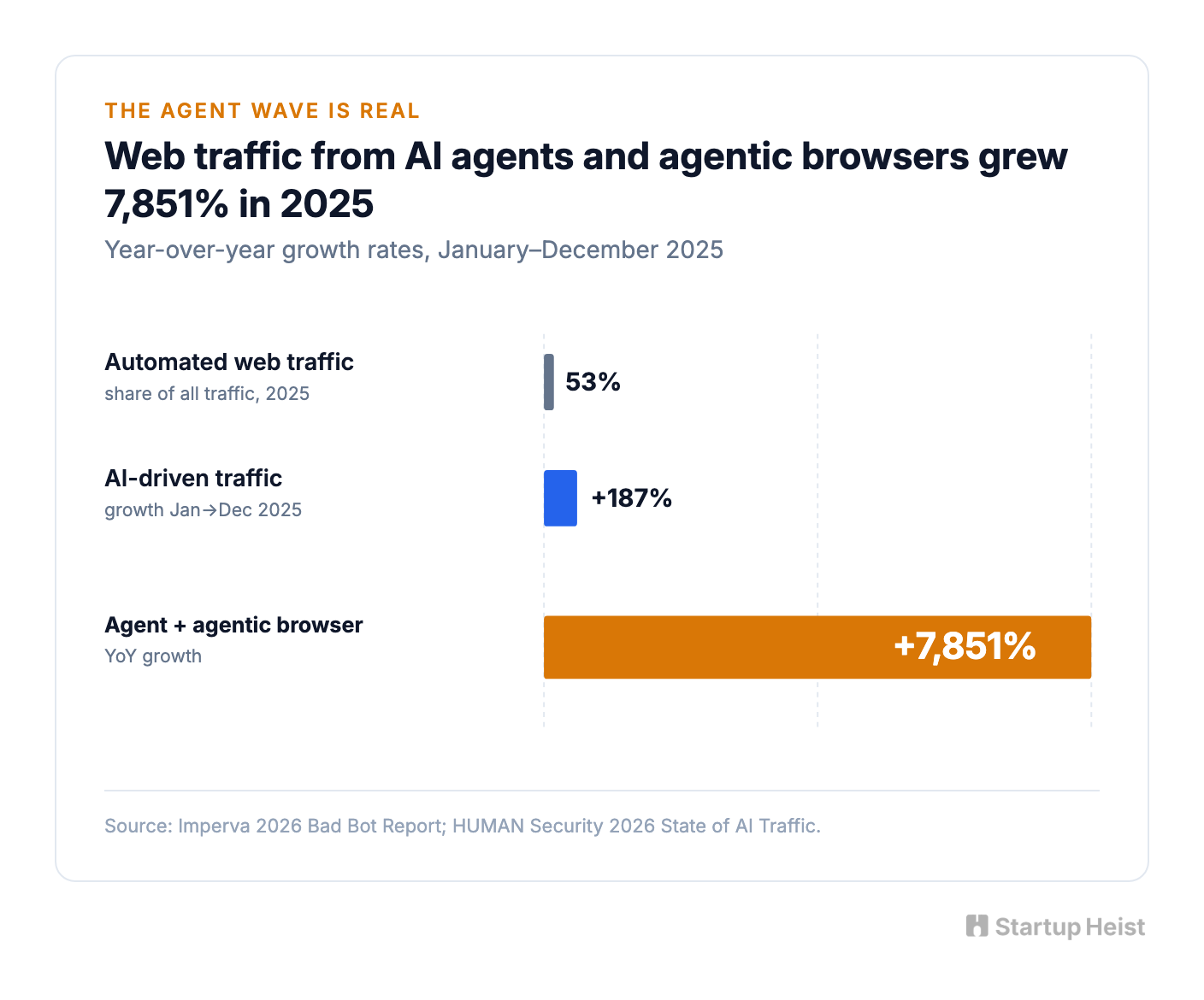
Imperva's 2026 Bad Bot Report puts automated traffic at 53% of all web traffic in 2025, up from 51%. HUMAN Security's 2026 State of AI Traffic benchmark adds the texture: AI-driven traffic grew 187% from January to December, and traffic from AI agents and agentic browsers grew 7,851% year-over-year. A few years ago, a clunky city website was just a clunky city website. Now it's an automation tax. Every proptech company, every real estate AI assistant, every internal operations agent has to decide whether to build its own fragile extraction system or buy clean structured data from someone else.
The buyers exist. Permit management software in North America generated roughly $1.85 billion in 2025, about 38.5% of the global market. OpenGov contracts run from $20,000 a year for small cities to $175,000+ for larger deployments. Tyler EnerGov implementations start at $50,000 and reach $2.7 million for large counties. Accela contracts span $136,000 to $8 million.
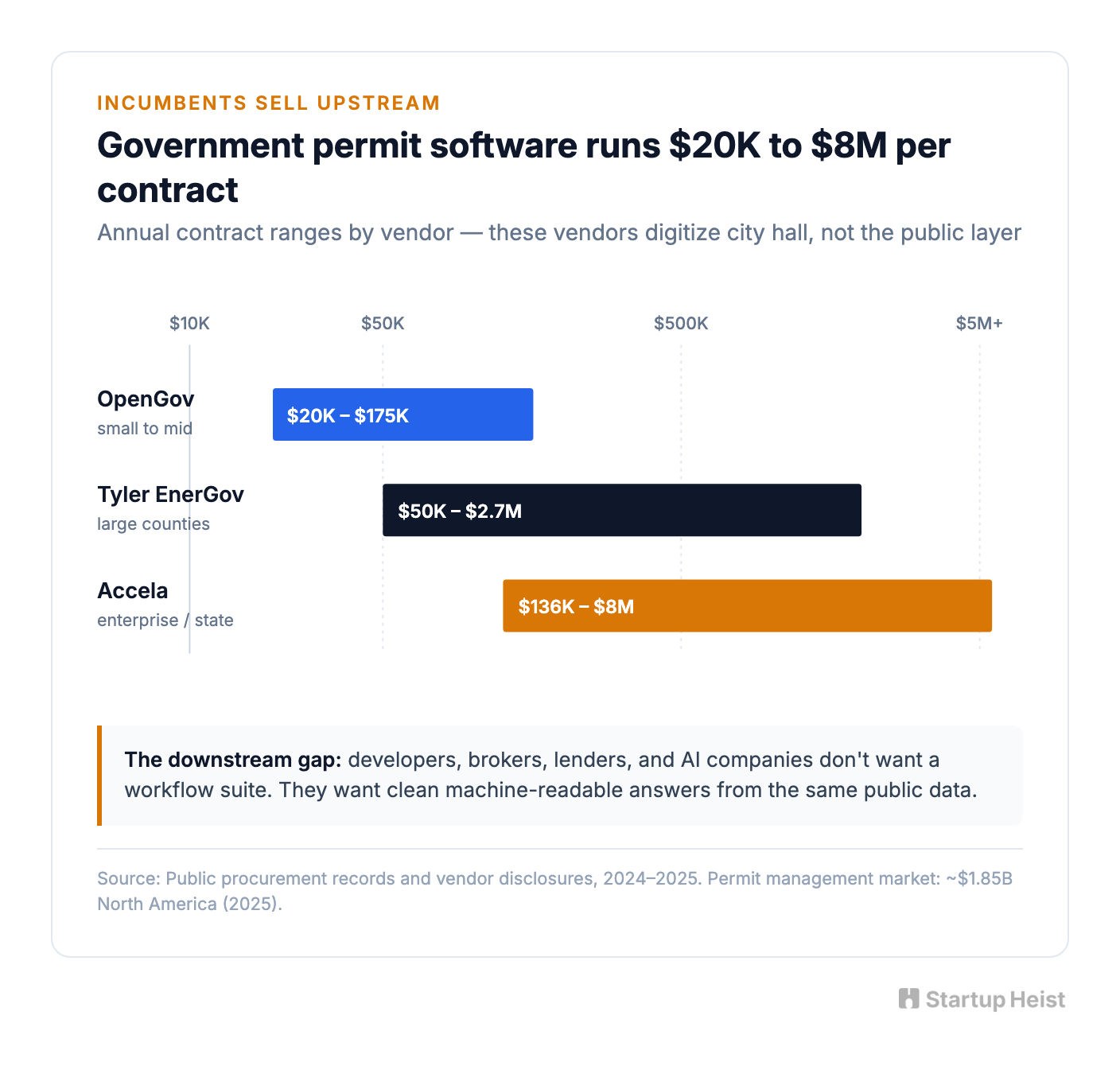
Those vendors sell workflow systems to governments. They digitize the inside of city hall. The gap downstream is wide open. Developers, brokers, lenders, architects, consultants, and AI companies don't want to buy a permitting workflow suite. They want clean, machine-readable answers from public municipal data.
The incumbents digitize government process. You productize the messy public layer.
The Players Already Trying
This wedge isn't unclaimed. A few companies have planted flags worth knowing.
Zoneomics now covers 20,000 U.S. municipalities and offers a developer API with monthly updates. In 2025 it served over 8 million zoning tiles and 1 million bulk API calls, and just launched an AI assistant called Bassett. Regrid added a Standardized Zoning product on top of nationwide parcel data and partners with Zoneomics for coverage. Symbium took the consumer angle: a free ADU planning tool that has digitized 12.6 million parcels across all 58 California counties and 482 cities, with built-in compliance checks against zoning and building codes. The National Zoning Atlas, an academic effort, is mapping more than 33,000 jurisdictions, with roughly 9,000 live in its public viewer so far.
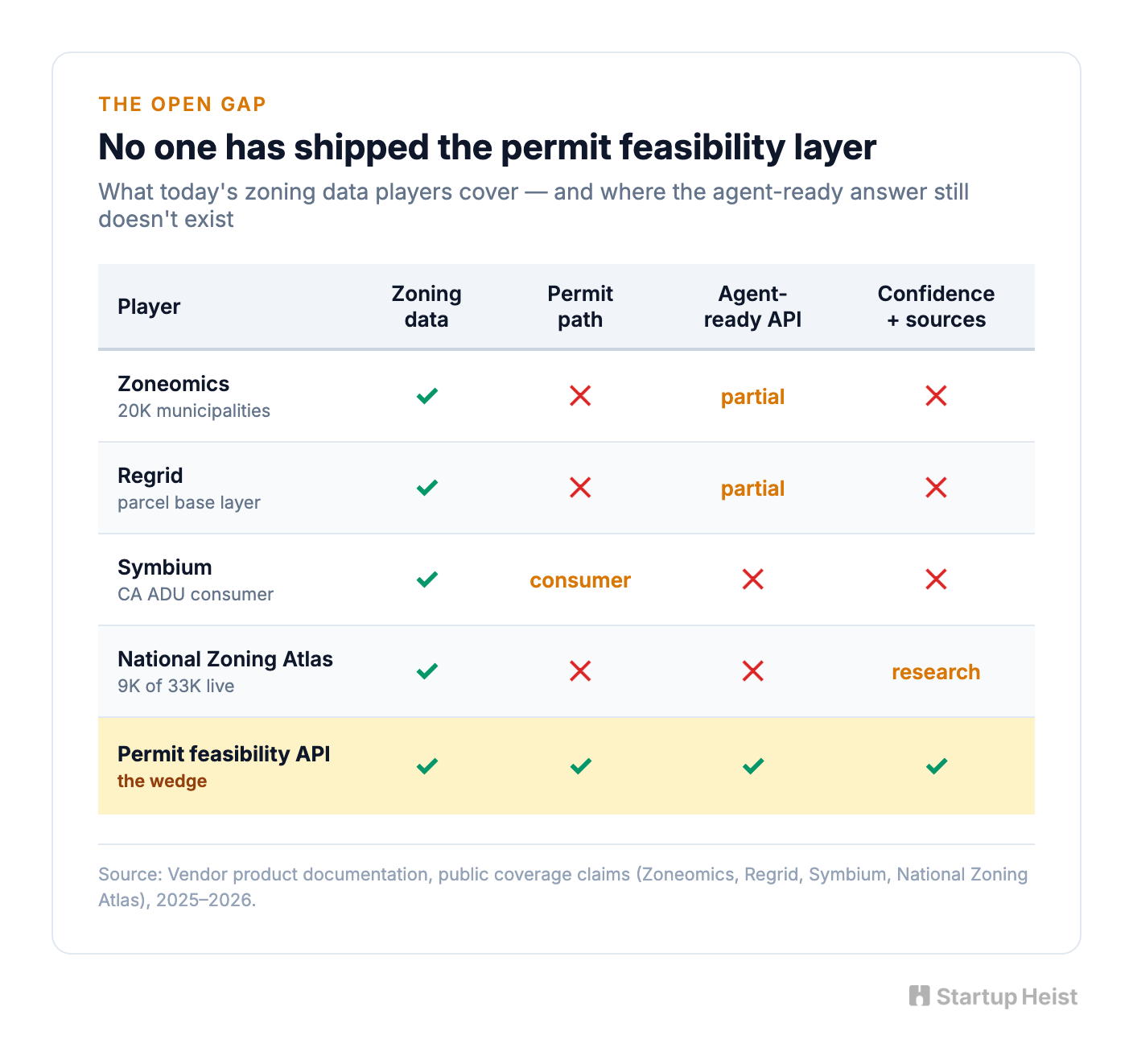
None of them have closed the gap. Zoneomics gives you zoning districts and standards, but not the permit path: which forms, which department, which review steps, and how confident the answer is. Regrid sells parcel and zoning attributes without feasibility verdicts. Symbium answers ADU questions for homeowners, not the underwriting bot or the broker screening 200 lots at once. The National Zoning Atlas is research-grade, not production-grade.
The opening isn't "the first zoning API." It's the first structured permit feasibility layer: one that takes "address + project type" and returns an answer with a permit path, a confidence score, source links, and a last-checked date. The one designed to be called by a machine, not just embedded in a SaaS dashboard. Different product, different buyer, and the one the agent economy actually needs.
The Product
Call it ZoningLayer, PermitGraph, CivicSchema, or ParcelRules API. The name matters less than the architecture, which has three layers:
Unlock the Vault.
Join founders who spot opportunities ahead of the crowd. Actionable insights. Zero fluff.
“Intelligent, bold, minus the pretense.”
“Like discovering the cheat codes of the startup world.”
“SH is off-Broadway for founders — weird, sharp, and ahead of the curve.”


