


The Invisible Caller
Multi-location businesses measure almost everything that happens before the phone rings. They know which ad generated the lead, the keyword, the campaign, the landing page, the cost per click, the cost per call. Then a prospective customer dials one of their locations, and the measurement goes dark.
One receptionist asks the right questions, reassures the caller, and offers an appointment. Another gives half an answer and waits for the customer to decide. A third quotes the wrong price. A fourth says "someone will call you back," and the lead evaporates. The company sees four phone calls. It does not see four completely different sales experiences.
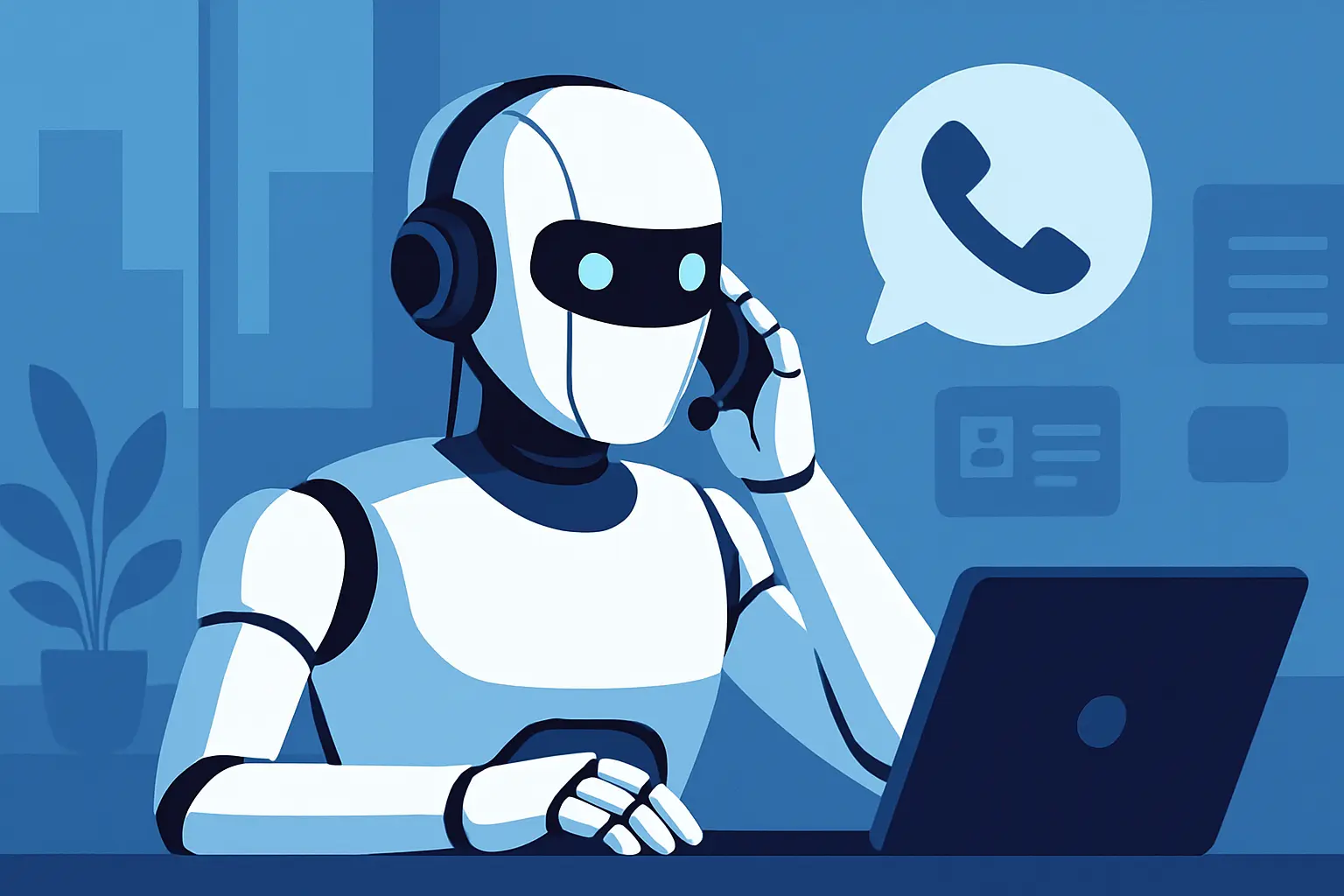
That gap is the opportunity. Call it The Invisible Caller: an AI mystery shopper that places controlled calls to every location, behaves like a real prospect, and scores how the front desk handles the interaction. It runs recurring scenarios — an anxious first-time patient, a price shopper, a Spanish-speaking parent, an insurance question, an urgent-appointment request — and delivers a weekly report showing exactly where revenue leaks out.
Positioning matters here. Where an AI receptionist answers calls for the practice, this works the opposite way: it places calls into the practice to test how the front desk performs. Standardized demand, injected into a live operating environment, so management can finally see whether every location runs the same playbook. Unit testing for the front desk.
Here's the opportunity:
The money: At $149 per location per month, 200 subscribed locations is about $30K MRR. A small team can reach 100 to 300 locations for $15K to $50K monthly.
Inside:
• Five-scenario library + 10-point scorecard
• Constrained engine so the AI can't improvise
• TCPA-safe compliance architecture
• Four-tier pricing + outreach template
The leak hiding behind the marketing dashboard
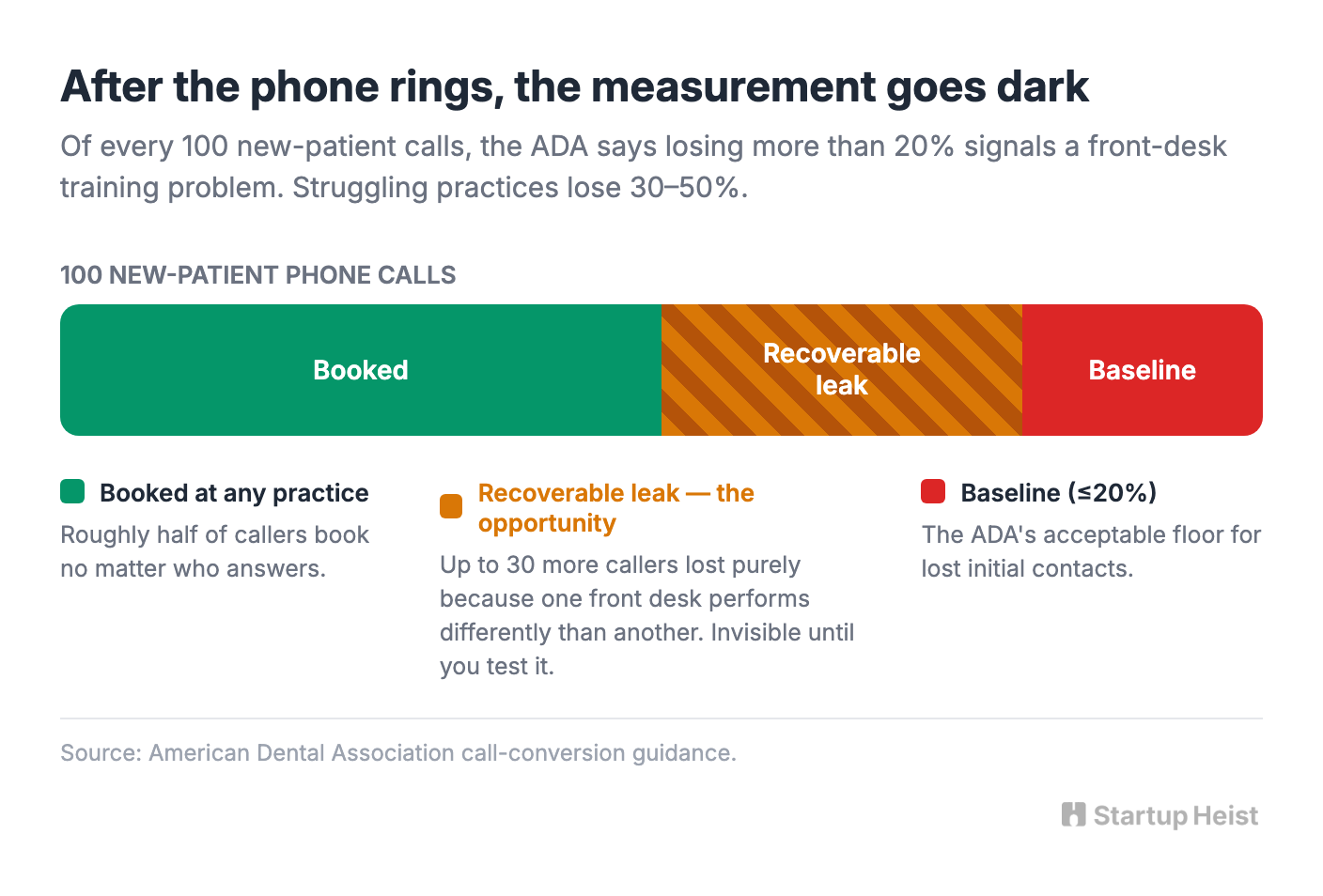
Dentistry shows the problem cleanly. The American Dental Association tells practices to track how many prospective callers become scheduled patients, and warns that some lose 30% to 50% of initial contacts. Anything above 20%, the ADA says, signals a staff-training problem. The same guidance hands operators a ready-made checklist: identify the caller's concern, collect their information, invite them to schedule.
But the real issue is not that calls get missed. It is that the experience varies in ways nobody can measure consistently. A regional operator might run 20 locations, five regional managers, dozens of front-desk staff, and a few outside marketing agencies. Management can publish a script, run training, and spot-check recordings. It still cannot answer the basic questions: Does every office offer an appointment instead of just answering the question? Are prices and financing quoted the same way? Does the team capture a callback number before hanging up? Are anxious callers reassured? Are Spanish inquiries handled or fumbled? Do Monday mornings sound different from the hour before closing?
Real calls give clues, but real calls are messy — different customers, different questions, different times. Comparing one office to another is guesswork. The Invisible Caller replaces the guesswork with a control group. Every location gets the same scenario, the same essential questions, the same known-correct answer, the same scorecard. Phone performance stops being anecdote and becomes comparable operational data.
Why now
On July 8, 2026, OpenAI introduced GPT-Live, a family of full-duplex voice models that listen and speak at the same time. They handle interruptions, pauses, quick back-and-forth, and the little conversational acknowledgments that make a bot feel less like a turn-based menu. GPT-Live is powering ChatGPT Voice first, with API access to follow.

A founder does not have to wait for it. OpenAI already ships GPT-Realtime-2 for developers — the July 2026 refresh cut latency and improved alphanumeric readback, which matters when a caller has to repeat back a phone number or confirmation — plus realtime transcription and translation models, with support for voice-agent sessions, SIP connections, and server-side controls that can monitor a live call and inject private business logic. Bridge that into a telephony provider like Twilio and you can originate a call today.
The technical shift matters because scripted voice bots break the moment a receptionist interrupts, asks something unexpected, or reorders the conversation. A believable mystery caller has to hesitate, clarify, wait on hold, answer follow-ups, and recover when the call goes sideways. Earlier systems could technically dial the number. This generation can plausibly finish the conversation.
The model itself is not the business, though. Voice intelligence will keep getting better and cheaper, and that improvement accrues to everyone. The durable asset is the testing system built around it: the scenarios, the scorecards, the policy data, the benchmarks, and the line you eventually draw between phone behavior and booked appointments.
Start with dental groups, not everyone with a phone
The eventual market is huge: med spas, veterinary groups, HVAC, auto repair, legal offices, any appointment-driven business. The first version should serve exactly one vertical, and dental groups are the right beachhead.
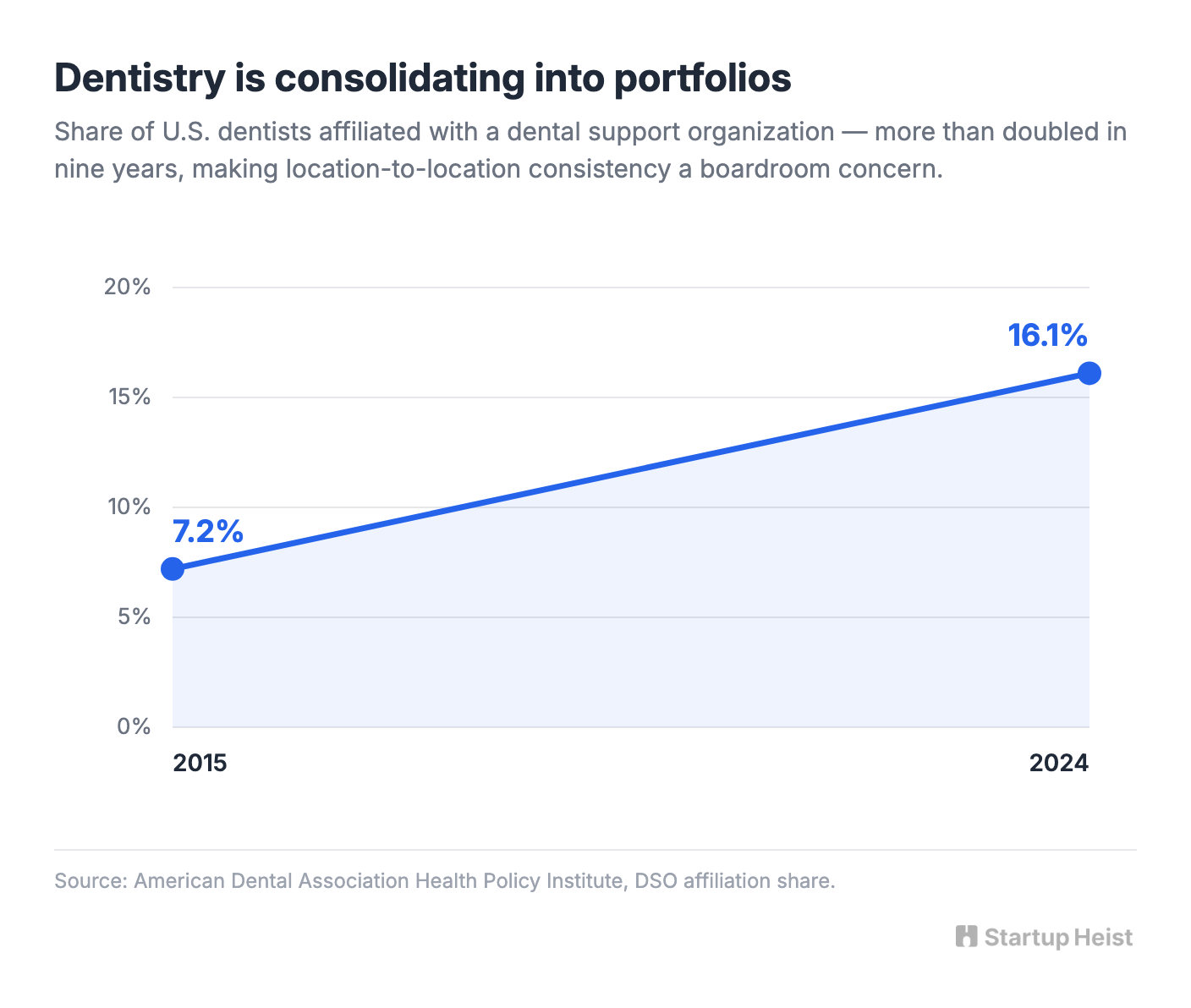
The phone still runs new-patient intake, and the ADA's own guidance supplies the backbone of a scoring rubric. The market is consolidating fast: the share of U.S. dentists affiliated with a dental support organization (DSO) rose from 7.2% in 2015 to 16.1% in 2024, which means more practices are managed as portfolios where location-to-location consistency is now a boardroom concern. And the buyer already believes the premise. Dental call-intelligence vendors have spent years teaching operators that phone conversion drives patient acquisition, so you are not inventing a budget line from scratch.
The ideal first customer is not the solo dentist with one receptionist. It is a group of roughly five to 30 locations with a centralized operations leader who cannot personally inspect every office. Big enough to feel the inconsistency, small enough to say yes to a managed service without a year of procurement.
The product is not "call analytics"
There are already strong companies reading phone conversations. Patient Prism scores patient calls and pinpoints why appointments were lost, letting operators compare by agent, location, region, and manager. CallSource tracks calls and coaches dental, auto, and home-service teams. Invoca analyzes lead intent and conversion across real customer traffic. Rilla records and grades sales conversations for field-service and dental crews. Trying to out-analyze them at general conversation intelligence would be a bad heist.
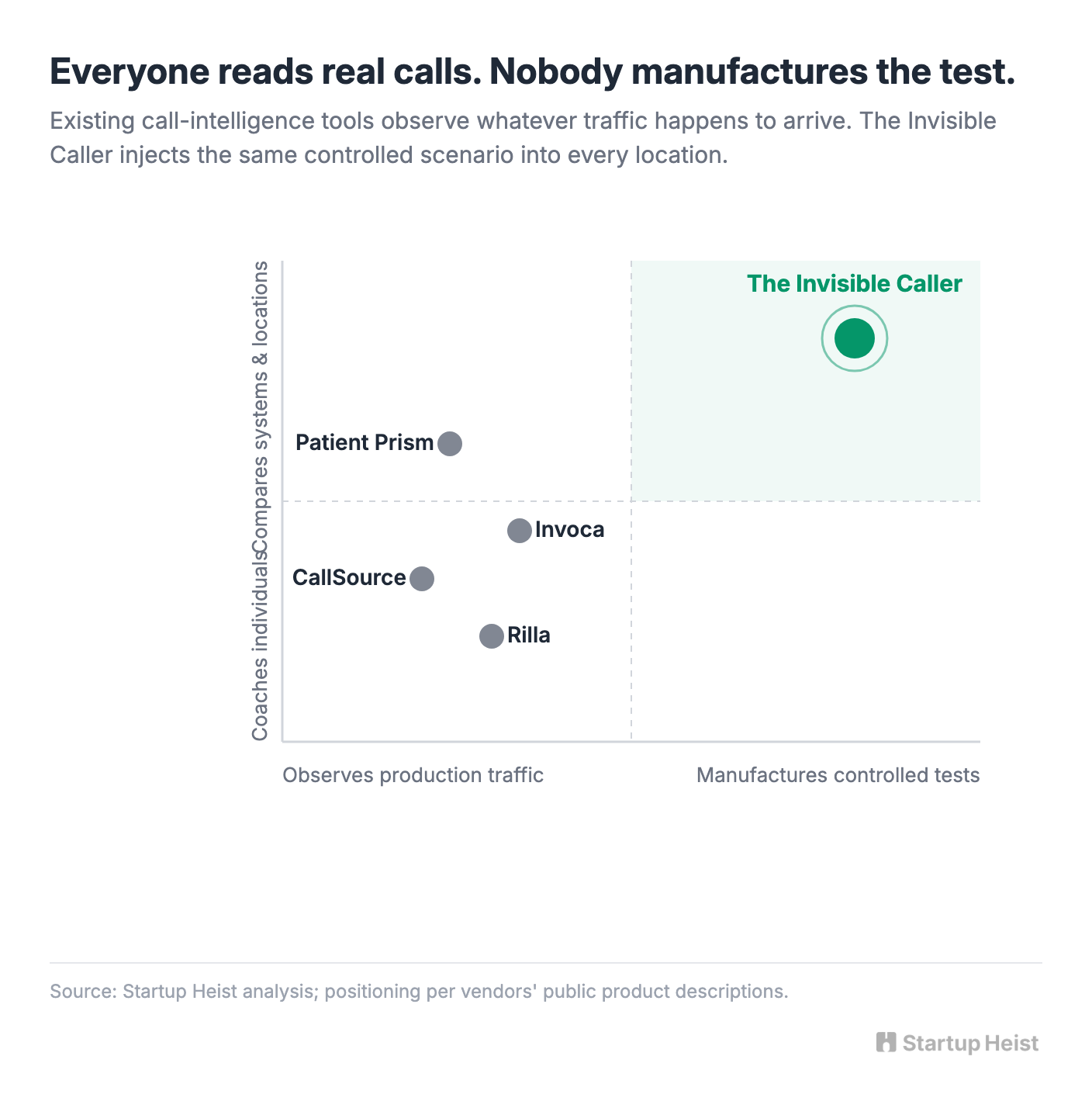
The wedge is controlled synthetic testing. Those platforms observe production traffic — whoever happens to call, whatever happens to get said. The Invisible Caller manufactures the test.
| Production-call analytics | The Invisible Caller |
|---|---|
| Observes real customer conversations | Generates controlled test conversations |
| Call mix varies by location | Every location gets comparable scenarios |
| Often requires recording large volumes | Can run in a limited, non-retained audit mode |
| Finds problems after a real lead is affected | Finds problems before the next real lead arrives |
| Measures what happened | Tests whether the intended process works |
| Great for coaching individuals | Great for comparing systems and locations |
Sell it as a complement to CallRail or Patient Prism, not a replacement. A group may already know that 28% of its new-patient calls fail to book. The Invisible Caller explains why the same failure keeps happening at seven specific offices under the same conditions.
That framing tells you what the customer is actually buying, and it isn't AI phone calls. It is three outcomes: consistency, so every location holds the same standard; leak detection, so management catches failures before spending more on marketing; and actionable coaching, so regional managers know precisely what to fix this week.
A good report does not open with sentiment graphs. It answers operational questions in plain language:
Seven of 12 locations failed to ask for contact information when the caller said she needed to check her work schedule. Four incorrectly said the practice offers no payment plans. Spanish-language callers were offered an appointment 38% less often than English callers. The Center City office aced normal hours but failed three of four scenarios placed after 4:30 p.m.
An operations leader can read that and know what to do before lunch. That clarity is the whole product. Everything after the gate is how you build it.
The first scenario library
Each scenario needs a clear objective, a controlled set of facts, and a defined list of acceptable outcomes. It is not an open-ended acting prompt. A dental MVP can launch with five.
Unlock the Vault.
Join founders who spot opportunities ahead of the crowd. Actionable insights. Zero fluff.
“Intelligent, bold, minus the pretense.”
“Like discovering the cheat codes of the startup world.”
“SH is off-Broadway for founders — weird, sharp, and ahead of the curve.”


