


Steal the Video Department
Build a faceless content studio for the podcasters sitting on years of unused stories
The podcast industry spent two decades building audio libraries. Then discovery quietly walked out the back door and moved to video.
Look at where people find their next favorite show. In 2026, YouTube is the service the largest share of weekly U.S. podcast consumers name as their most-used platform, ahead of Spotify and Apple. Separately, roughly 40% of listeners say they discovered a favorite podcast through YouTube or social video. Most people watch while they listen, and YouTube alone reports more than a billion monthly viewers of podcast content.
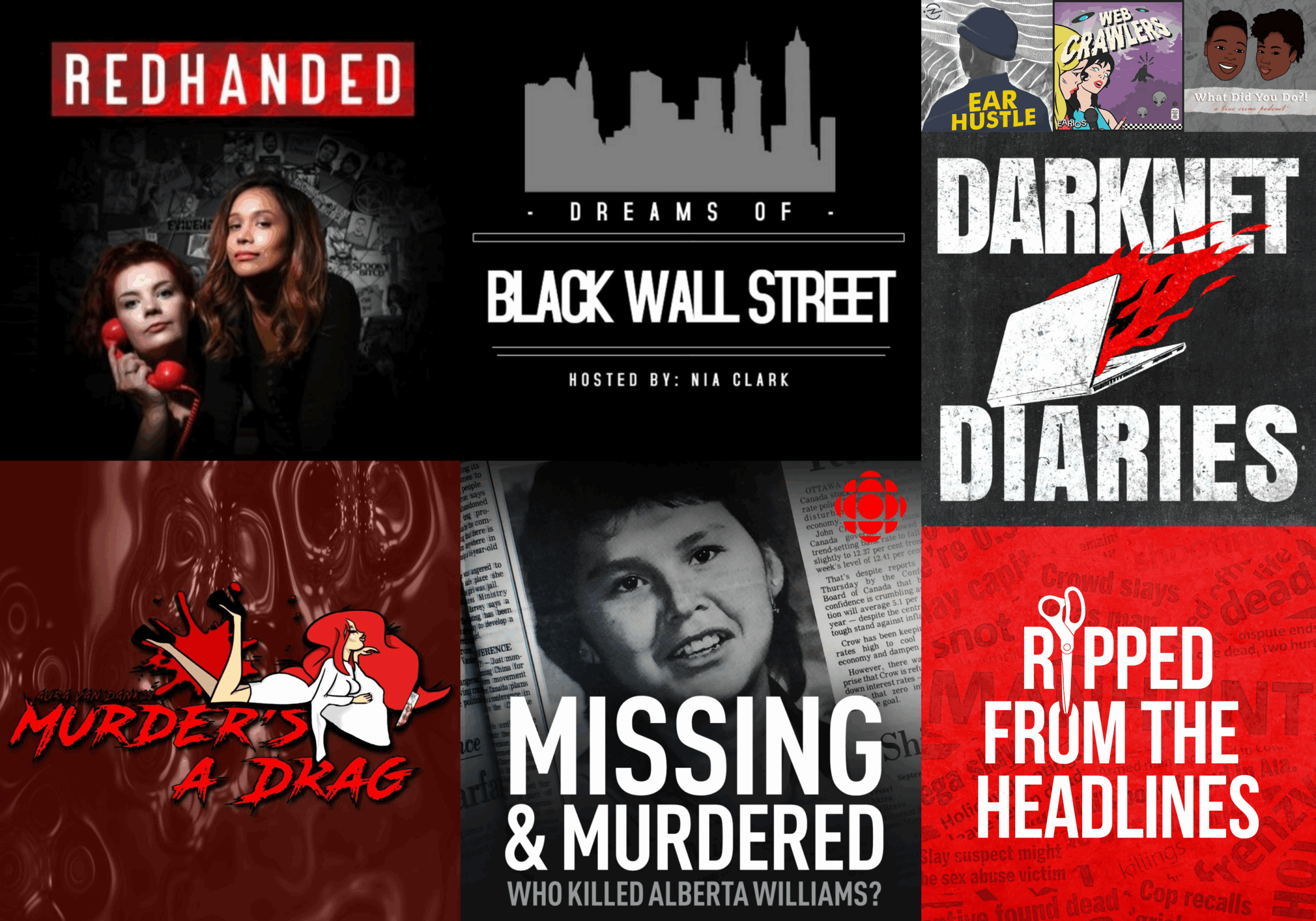
Now look at true crime, a top-three podcast genre by listenership and one of the largest by advertiser spend. There are close to 30,000 true crime shows indexed, with more than 13,000 still actively publishing. The average show carries a backlog north of 50 episodes, and weekly cadence is the norm.
These creators do not have a content problem. They have hundreds of hours of narration, investigation, suspense, and unresolved questions sitting in an archive. What most of them lack is a repeatable way to turn that library into video.
The obvious advice is to tell them to install a camera. The better business removes the camera entirely.
Build a productized video studio that takes episodes from true crime, paranormal, history, and other narrative podcasts and turns them into 20 to 30 faceless vertical videos a month. Keep the host's real voice. Add cinematic reconstructions, archival imagery, maps, documents, and captions. Ship finished short-form assets for TikTok, Reels, and Shorts.
You are not selling AI content. You are selling a video distribution department to people who never wanted to become video personalities.
Here is the opportunity in one frame:
The money: Ten retainers at $2,250 a month is $22,500 MRR a founder plus one editor can run. True crime already pulls 19 million weekly listeners.
Inside:
• Four-week MVP: five clips to paid pilots
• Four-tier pricing from $650 to $3,500
• Cold outbound with a sample-first email
• Five-layer moat beyond the AI model
The mismatch is the whole opportunity
Most repurposing services start with a talking-head recording and chop it into smaller talking-head clips. That works for interview shows. It falls apart on narrative audio.
A true crime host might spend 45 minutes reconstructing a disappearance or picking apart contradictory testimony. A generic clipping tool can slap subtitles over a waveform and drop in stock footage, but it cannot decide which detail creates suspense, where the reveal should land, or what evidence belongs on screen. Narrative audio needs adaptation, not clipping.

Picture the raw material as a host saying: "The police searched the apartment twice. But no one looked inside the wall." A watchable vertical video needs more than that line. It needs a first-frame hook, a floor plan, a highlighted section of wall, a clearly labeled reconstruction, a document establishing the second search, the host's revelation, and a closing question that leaves the loop open. Cheap software extracts the words. Your job is to understand what the words are doing. That gap is where the margin lives.
Why true crime is the wedge, not the ceiling
True crime combines three things you rarely get together: deep supply, proven demand, and obvious visual potential.
The supply is a standing archive of 13,000-plus active shows, most sitting on 50 or more episodes that can be repackaged without waiting for anything new to record. The demand is enormous and sticky. Edison Research found that 42% of Americans age 13 and up have listened to a true crime podcast, and weekly true crime listeners number around 19 million. People come for the suspense, the forensic detail, and the chance to help solve something. Every one of those instincts translates cleanly into short visual narrative.
The genre also hands you a set of recognizable archetypes: the overlooked clue, the disputed timeline, the last known sighting, the suspect who changed their story, the local case nobody remembers. Those become production templates without making every client look identical. Prove the workflow here and it extends to historical mysteries, paranormal, investigative reporting, and narrative documentary. True crime is the spearhead. The market behind it is much larger.
Faceless should not mean humanless
The weak version of this business replaces the host with a synthetic narrator. The strong version keeps the original performance and uses AI only to build the visual layer.
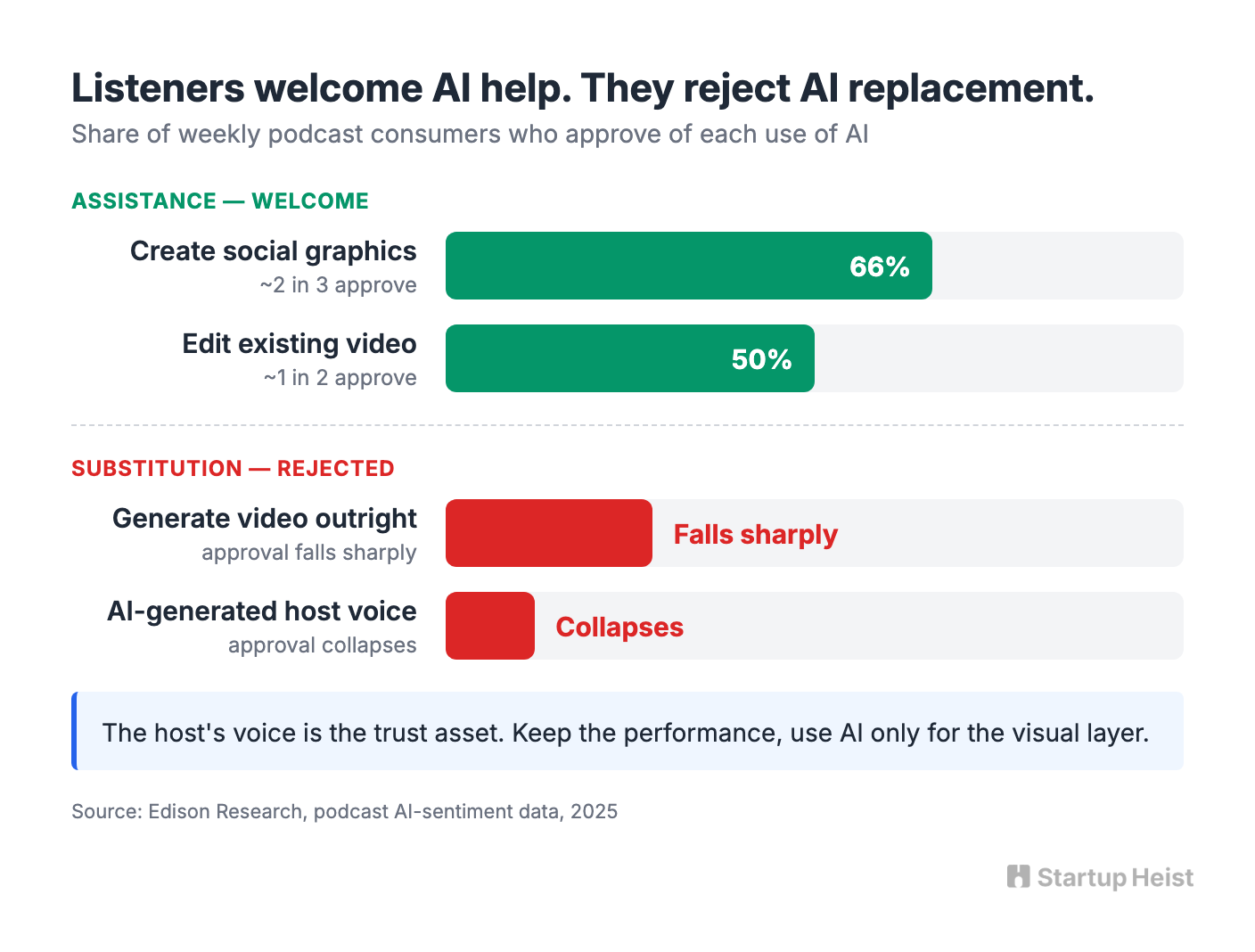
This is not a taste preference. It is where the audience draws its line. Edison's podcast research found roughly two-thirds of weekly consumers approve of AI used to create social graphics, and about half approve of using it to edit existing video. Approval falls sharply for generating video outright, and collapses for an AI-generated host voice. The message is blunt: AI assistance is welcome, AI substitution is not. The host's voice is the trust asset you were hired to repurpose. Strip it out and you have degraded the thing that made the show worth watching. Synthetic voice belongs in client-approved corrections or translations, never as the default narrator. Sell human-led, AI-assisted storytelling. The host stays the storyteller. The studio makes the story visible.
What the client is actually buying
Frame the whole service in one line: episode in, feed out, no camera required.
Each month the client hands over an RSS feed, files, or a shared folder. The studio handles transcription and analysis, moment selection, hook and script adaptation, storyboarding, visual sourcing, vertical editing and captions, platform copy, AI disclosures, optional scheduling, and a monthly performance read.
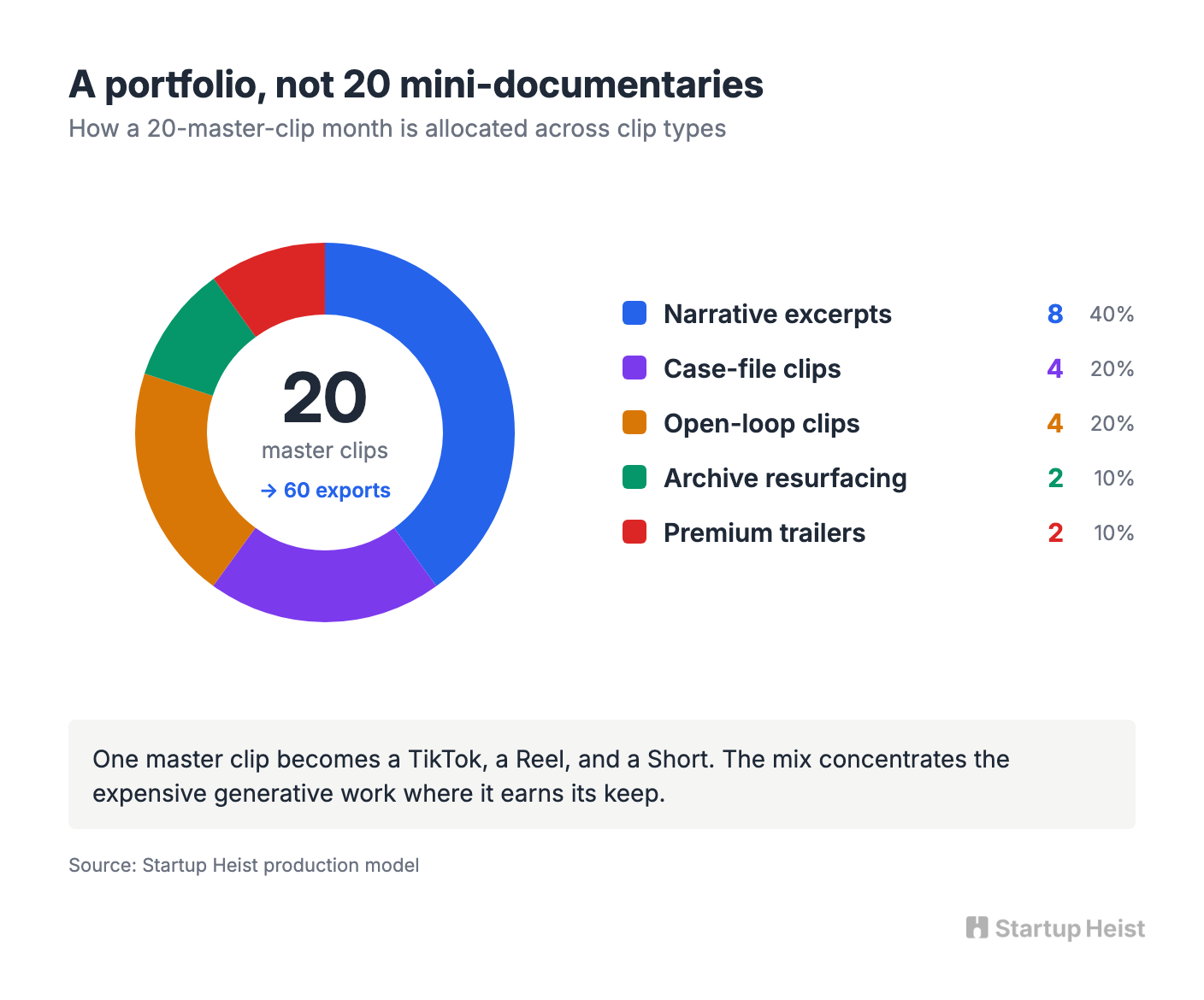
Measure the deliverable in master clips, not exports. One master clip becomes a TikTok, a Reel, and a Short. Twenty master clips turn into 60 platform-ready files, but you never sell "60 videos." That framing invites the client to compare you with bulk automation software. Sell the creative unit and include the distribution variants.
For a 20-clip package, run a portfolio instead of 20 mini-documentaries: eight narrative excerpts built around a single reveal, four case-file clips of timelines and evidence, four open-loop clips designed to spark comments, two archive clips resurfacing older episodes made newly relevant, and two premium trailers for the strongest cases. The mix keeps output consistent and concentrates the expensive generative work where it earns its keep.
That is the pitch. The rest of this is how you build it, price it, sell it, and defend it.
The MVP: five clips, one visual system, one measurable promise
Do not build an app. Prove you can make clips a podcaster would publish and an audience will actually watch. A four-week push:
Unlock the Vault.
Join founders who spot opportunities ahead of the crowd. Actionable insights. Zero fluff.
“Intelligent, bold, minus the pretense.”
“Like discovering the cheat codes of the startup world.”
“SH is off-Broadway for founders — weird, sharp, and ahead of the curve.”


