


Your Therapist's Newest Client Is a Chatbot They've Never Met
A therapy session lasts about an hour. The client's relationship with an AI chatbot runs all week.
Between appointments, clients ask ChatGPT to interpret their symptoms. They use Character.AI for companionship, rehearse hard conversations with Gemini, and text a general-purpose model for reassurance at 2 a.m. on a Tuesday. Some ask the bot whether their therapist is even right. The chatbot knows exactly what happened during that anxious spiral. The therapist hears a compressed version four days later, if the client mentions it at all.
There's a new participant in the room now: influential, always available, poorly documented, and usually invisible to the licensed professional legally responsible for the client's care.
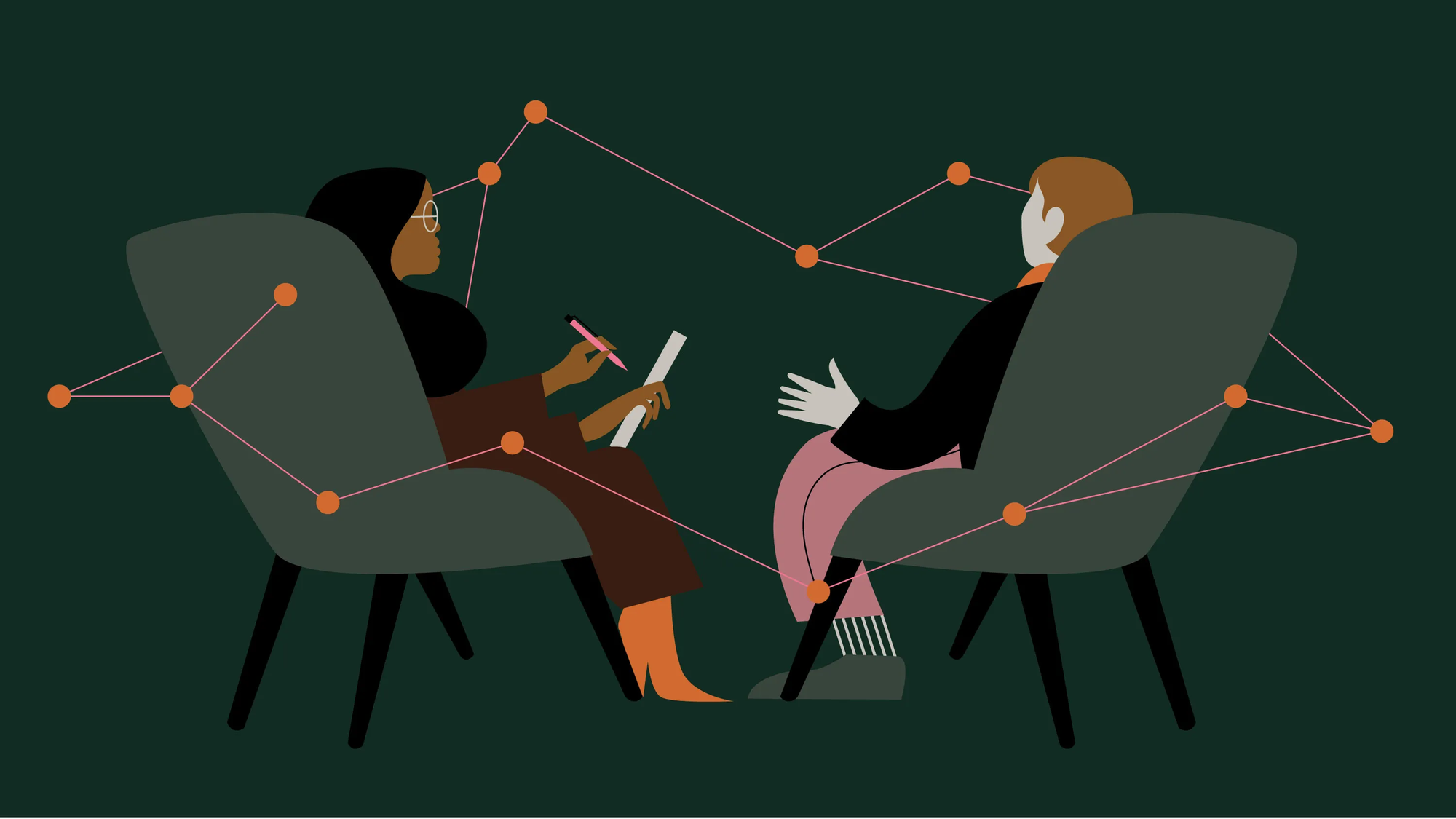
The obvious startup here is another AI therapist. It's also the wrong one. That race is crowded, clinically dangerous, and walking straight into regulators. The cleaner play sits one step to the side: a HIPAA-conscious workflow product that helps human therapists find, document, review, and respond to the AI tools their clients are already using. Think of it as AI-use reconciliation for mental health care. The chatbot is the shadow account nobody put on the books. You're building the ledger.
Here's the opportunity:
The money: 2,000 clinicians at roughly $30/month is about $700K ARR. A high-margin vertical SaaS play inside an estimated 600,000 U.S. therapists.
Inside:
• Four-moment workflow: disclose to follow-up
• Three-tier pricing, $24 solo to org plans
• Design-partner GTM with a policy-kit magnet
• Four moats and a five-phase expansion path
The behavior already escaped the lab
None of this is speculative. The American Psychological Association has the numbers.
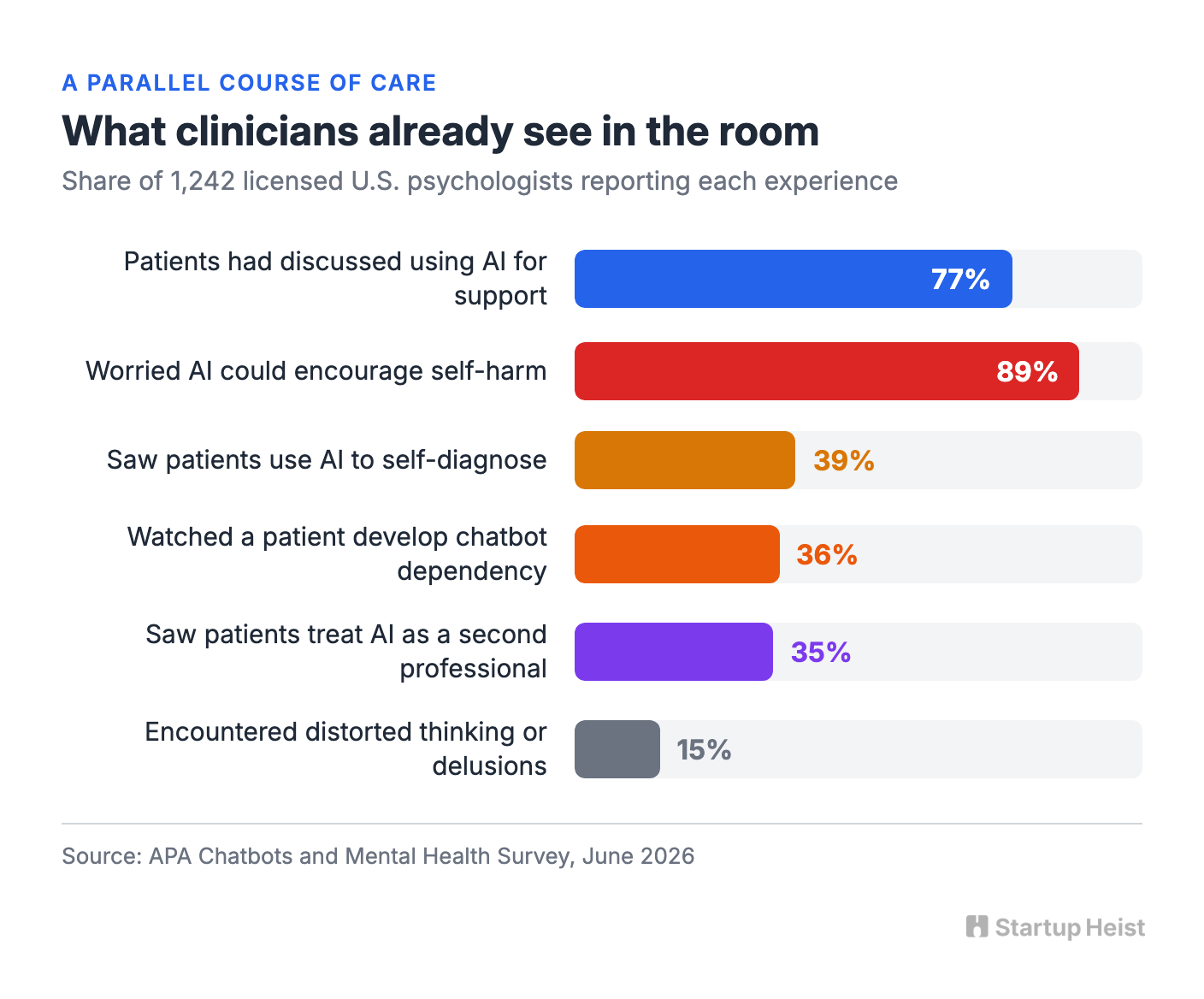
In June 2026, the APA published its Chatbots and Mental Health Survey of 1,242 licensed U.S. psychologists. Seventy-seven percent said patients had discussed using AI for support. Thirty-nine percent had seen patients use it to self-diagnose, and thirty-five percent had encountered patients treating AI as a second mental health professional. This isn't book-summary territory. Patients are running a parallel course of care their clinician never sees.
The consequences are already in the chart. In the same survey, 36% of psychologists had watched a patient develop some dependency on a chatbot, and 15% had encountered distorted thinking or delusions tied to chatbot use. Nearly every respondent worried these tools could reinforce harmful beliefs, and 89% worried they could encourage self-harm.
The pattern is sharpest among the young. A nationally representative RAND study in JAMA Pediatrics found that 19% of Americans ages 12 to 21 had turned to AI chatbots for advice when they felt sad, angry, nervous, or stressed, up from 13% a year earlier. Among those users, 43% did it at least monthly, and most had told no one. This is happening inside a mainstream habit, not a fringe one: Pew found that 49% of U.S. adults now use AI chatbots, and among adults under 30, roughly one in five has used one for emotional support.
Not every chatbot conversation harms someone. Plenty of people feel genuinely supported, and some clinicians are fine with careful, bounded use. The insight that matters to a founder is quieter. AI use has become clinically relevant behavior without becoming a standard part of the clinical workflow. There's a gap between what matters and what gets recorded, and gaps like that are where vertical software gets built.
Why the AI therapist is a trap
The instinct is to build a safer therapeutic chatbot. That's the most dangerous reading of this opportunity, and regulators have made sure of it.
A direct-to-consumer AI therapist has to make live judgments about crisis escalation, suicidality, delusional thinking, dependency, diagnosis, age-appropriate interaction, and consent, across millions of open-ended conversations with people whose histories it doesn't know. When it gets one of those wrong, the confident wrong answer is the product.

The law is closing in on exactly that product. In August 2025, Illinois became the first state to restrict it outright. The Wellness and Oversight for Psychological Resources Act bars anyone from offering AI-delivered therapy to the public and forbids licensed professionals from letting an AI make independent therapeutic decisions or even detect a client's emotional state without human review. Violations run up to $10,000 each. Crucially, the same law explicitly permits AI for administrative and supplementary support under licensed oversight. The legislature drew a line, and it drew it right through the middle of this opportunity.
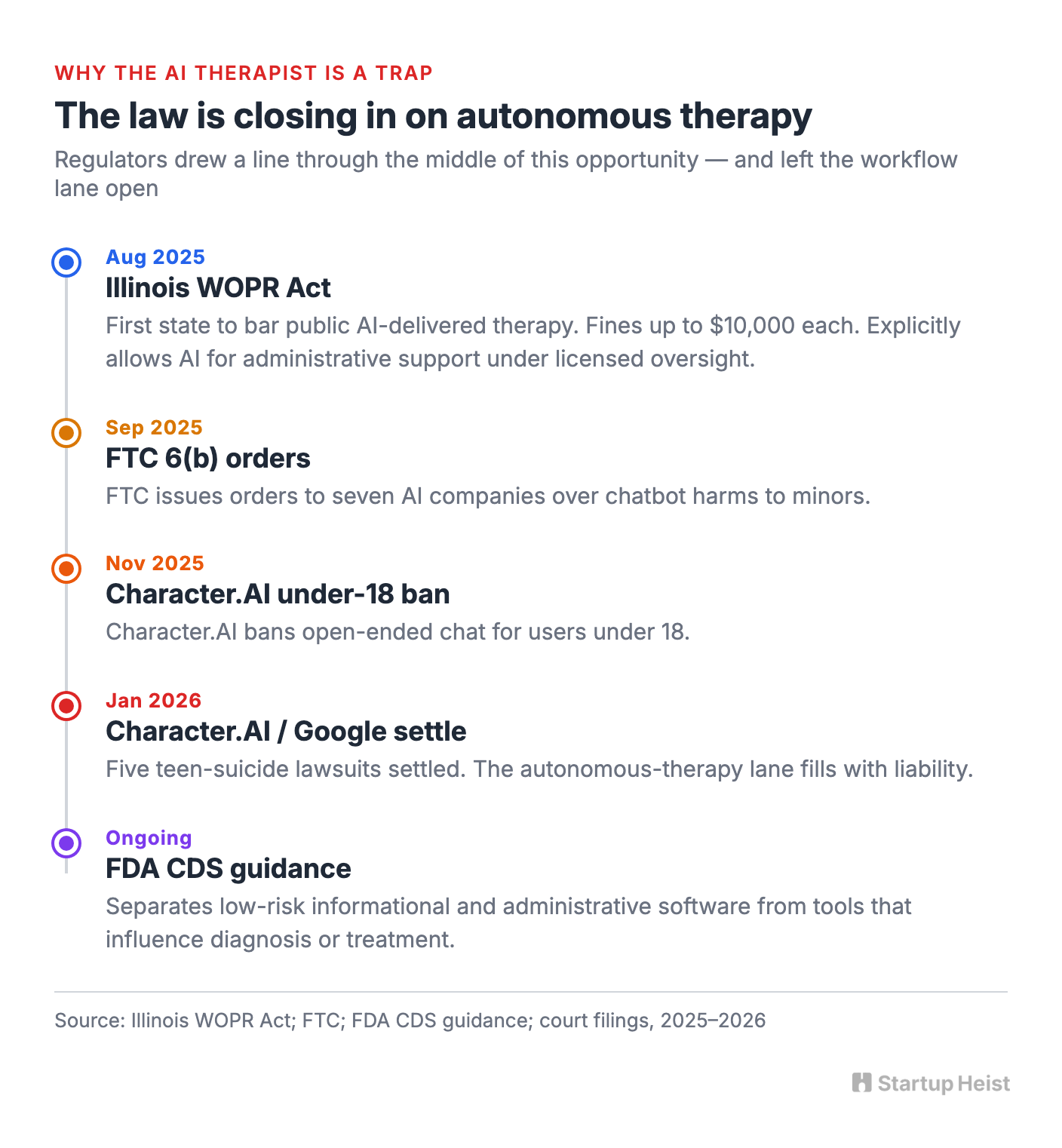
The federal picture points the same way. The FDA's clinical-decision-support guidance separates low-risk informational and administrative software from tools that influence diagnosis or treatment, and in September 2025 the FTC issued 6(b) orders to seven AI companies over chatbot harms to minors. By January 2026, Character.AI and Google had settled five teen-suicide lawsuits and Character.AI had banned open-ended chat for users under 18. The autonomous-therapy lane is filling with liability.
So take the wedge the law already carved:
Don't replace the therapist. Give the therapist visibility into a new source of influence on the client.
That version is safer, easier to sell, and aligned with where every regulator is heading. A founder who walks in saying "AI will disrupt therapy" triggers the immune system. A founder who says "your clients are already using AI, and here is a safer way to talk about it and write it down" gets a meeting.
The product is a workflow, not a model
The temptation is to plug into every chatbot and pull the transcripts. Resist it. The first version connects to nothing. It builds a repeatable clinical routine around four moments: disclosure, preparation, documentation, and follow-up.
Unlock the Vault.
Join founders who spot opportunities ahead of the crowd. Actionable insights. Zero fluff.
“Intelligent, bold, minus the pretense.”
“Like discovering the cheat codes of the startup world.”
“SH is off-Broadway for founders — weird, sharp, and ahead of the curve.”


