


Steal the Black Sesame Ritual
The café trend has arrived. The category-defining at-home brand has not.
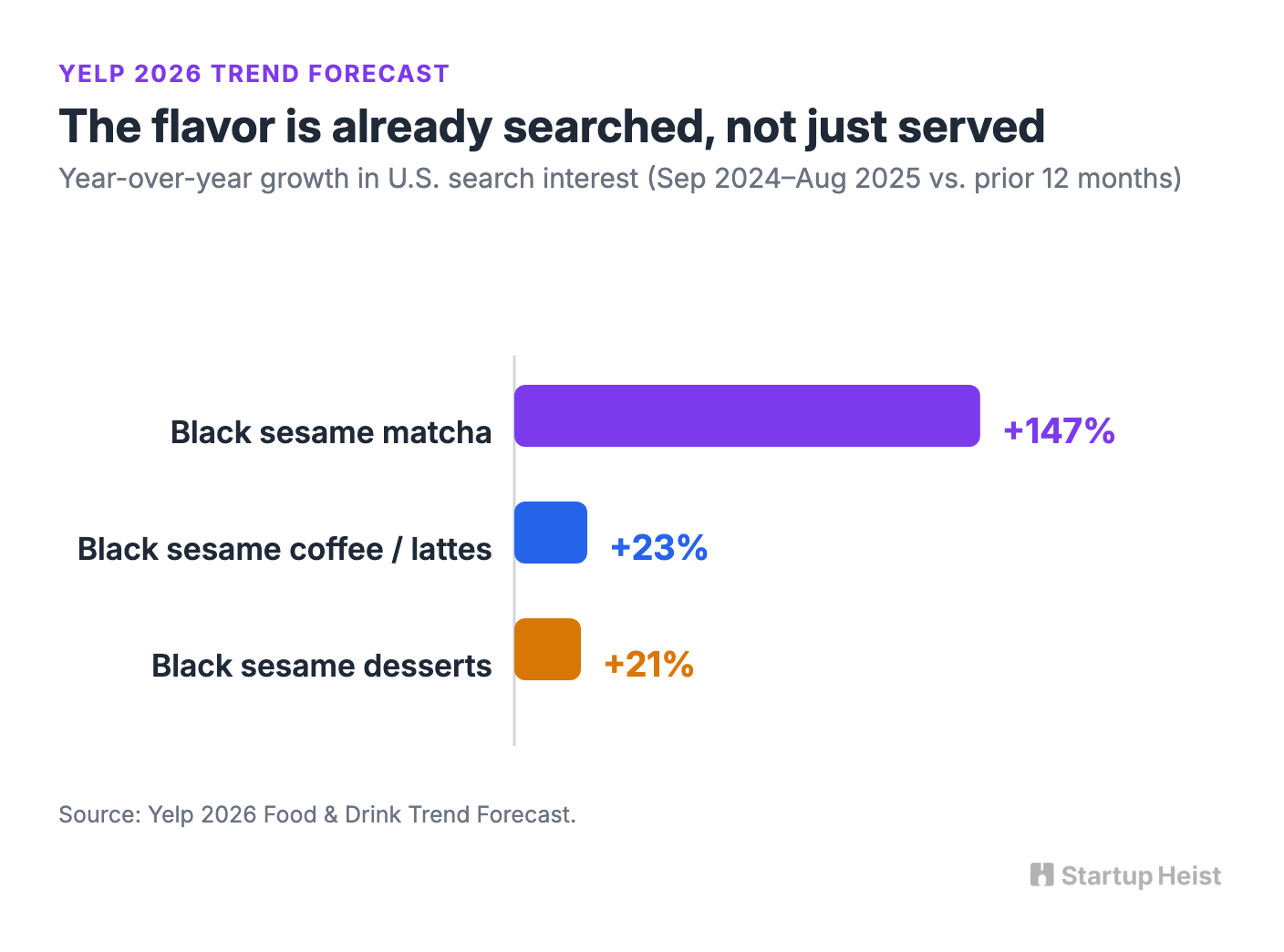
Black sesame is moving from the Asian grocery aisle to the American café menu, and the numbers are hard to argue with. Yelp's 2026 Food and Drink Trend Forecast found that searches for "black sesame matcha" rose 147% year over year. Searches for black sesame coffee and black sesame lattes climbed 23%, and black sesame desserts rose 21%.
The comparison runs September 2024 through August 2025 against the prior twelve months. That signal is sturdier than a viral moment. Multiple national food-trend desks have named black sesame a defining flavor of 2026, which tells you the trend is broader than a single forecast. People are typing the flavor into a search bar and then going to find it.
Right now the café market is doing the expensive work for you. Customers are learning what black sesame tastes like, discovering that its gray-black swirl photographs beautifully, and getting comfortable paying café prices for it. Nana's Green Tea, Japan's largest matcha café chain, has been expanding across the United States with a menu that puts a black sesame latte float near the seven-dollar mark, and it is opening in new markets from Boston to Northern California. Every one of those cups is a paid consumer-education campaign that no startup had to fund.
That's the opening. Build the first U.S.-native brand that turns black sesame from an occasional café order into a replenishable daily ritual at home.
The money: 2,000 orders a month at $60 is roughly $117K in monthly revenue. Yelp searches for black sesame matcha rose 147% in a year.
Inside:
• Formulation brief and the pouch-first MVP
• Three validation gates before you scale
• Creator and café outreach templates
• Six stacked moats and the kill conditions
Be honest about what this is. There's no new ingredient here, no patentable formulation, and probably no billion-dollar standalone company. What you have is a speed-dependent consumer-brand arbitrage: take an ingredient with proven menu demand, drop it into a familiar functional-latte format, package it for American wellness buyers, and win the customer relationship before a larger beverage company decides black sesame deserves a line extension. Done well, this becomes a profitable $1 million to $5 million specialty brand. With wholesale distribution and a tight portfolio of adjacent café rituals, it could go further. But the first goal is not to build the operating system for Asian wellness. The first goal is to sell one extremely good black sesame latte mix.
The gap is not availability
You can already buy black sesame latte powder in America. Kuki, a Japanese sesame house founded in the nineteenth century, sells a mix of black sesame, roasted soybean powder, sugar and salt through specialty importers and Amazon, usually around $8 to $12 a package. Other Asian grocery brands sell sesame powders, grain drinks and pastes at similar prices.
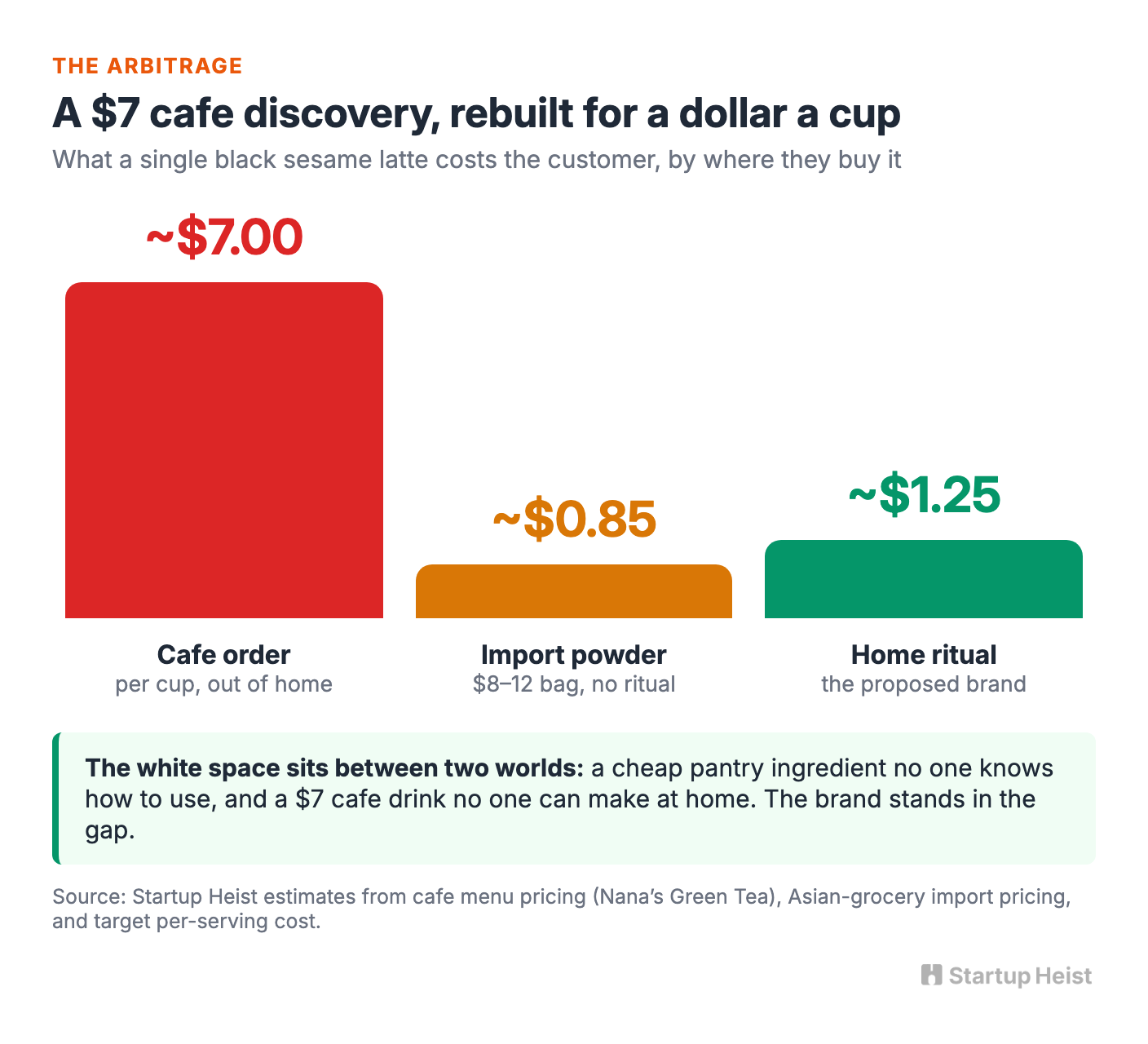
That availability points to the opportunity rather than closing it. The market does not need another bag of generic sesame powder. It needs the missing translation layer between an Asian pantry product and an American wellness ritual. The imported products are sold as ingredients. Their packaging assumes you already know what black sesame is, and they sit beside tea and flour and rice rather than on a wellness shelf. There's almost no onboarding, recipe content, or habit design, and subscription and retention are afterthoughts. The brand answers existing demand instead of creating a new use occasion.
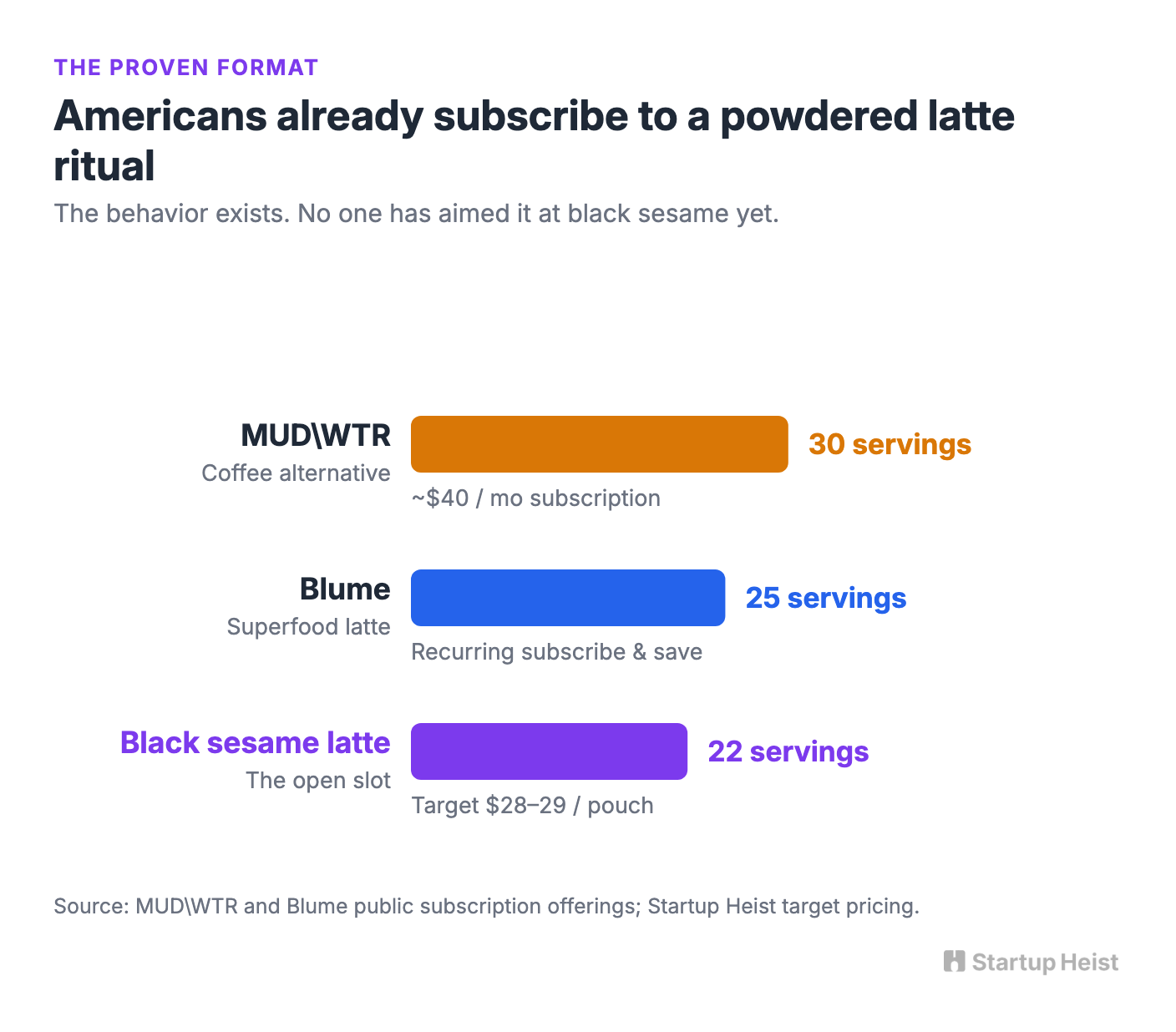
Meanwhile, the functional-latte category has already proven that Americans will subscribe to a powdered drink ritual when it is understandable and convenient. Blume sells 25-serving superfood latte pouches on recurring discounts. MUD\WTR sells a 30-serving coffee alternative for roughly $40 on subscription and wraps it in a starter kit, a free frother, and scheduled delivery to convert a powder into a routine. The behavior already exists. Nobody has aimed it at black sesame yet. The white space is narrow and believable: no one has become the obvious American DTC brand for making a café-quality black sesame drink at home.
Why Korea matters, and why it doesn't
Black sesame belongs to a wide East Asian food tradition. It runs through Chinese soups and desserts, Korean grain drinks, Japanese sweets, and Taiwanese beverages. A credible founder does not pretend Korea invented it or spin a pan-Asian ingredient into a fake medical origin story. Korea matters for a narrower reason. It has become unusually good at industrializing a traditional ingredient, packaging it as a modern ritual, and exporting the result.
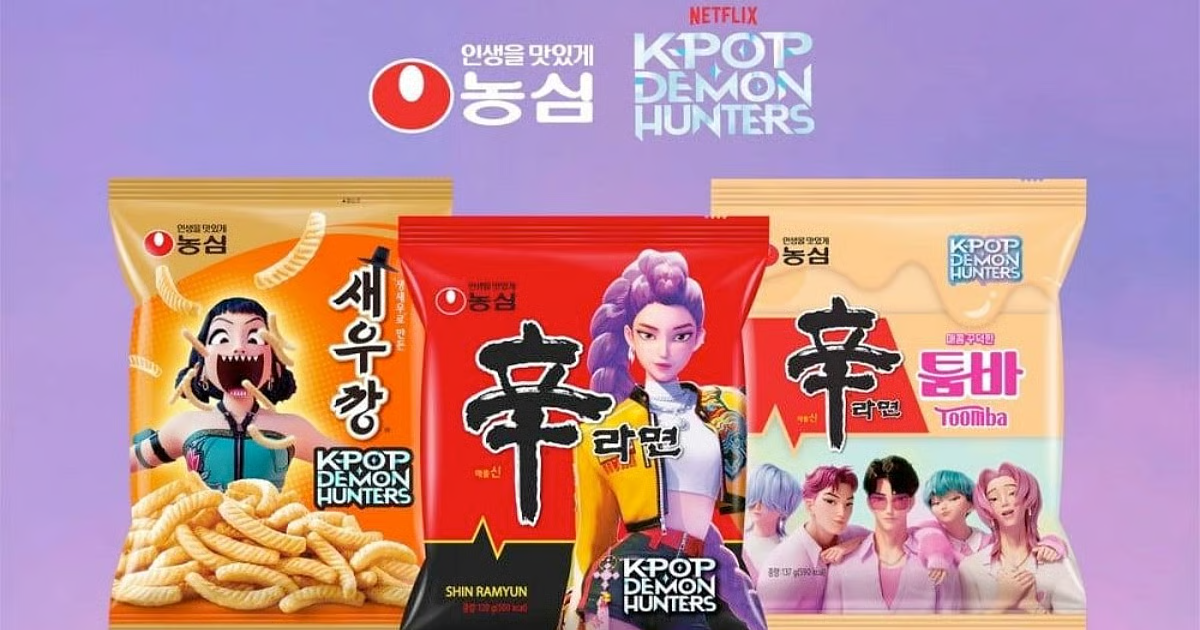
The scale behind that machine is real. Korea's Ministry of Agriculture reported record K-Food Plus exports of $13.62 billion in 2025, with agri-food shipments topping $10 billion. Instant ramen led the surge with a 21.9% jump, proof of how efficiently the country turns a humble food into a global product. Exports to the United States reached roughly $1.8 billion, up 13.2% year over year, making the U.S. Korea's largest agri-food market for the second straight year. Its health-functional-food industry adds a second layer: a domestic market around $4 billion, a formal system of standardized nutrients and authorized functional ingredients, and manufacturers fluent in powders, stick packs, jellies and liquid concentrates. For this business, Korea is a commercialization engine, not a marketing costume. It supplies manufacturing know-how, ingredient inspiration, and cultural momentum. The American startup's job is to translate that engine into a product built for how U.S. consumers actually shop.
Keep the product simpler than your instincts want
The temptation is to launch a K-wellness superblend stacked with black sesame, red ginseng, collagen, probiotics, mushrooms, adaptogens and six trademarked extracts. Resist it. Every added ingredient makes the flavor harder to control, confuses what the product even is, raises cost before demand exists, complicates your labeling, and excludes someone. Collagen loses the vegans, ginseng adds bitterness, and dairy and soy add allergens. The first product should be a black-sesame-forward latte base, not a supplement dressed up as a drink.
Unlock the Vault.
Join founders who spot opportunities ahead of the crowd. Actionable insights. Zero fluff.
“Intelligent, bold, minus the pretense.”
“Like discovering the cheat codes of the startup world.”
“SH is off-Broadway for founders — weird, sharp, and ahead of the curve.”


