


Steal the Design Step
The machines get the attention. The software gets the recurring revenue.
That split has already played out across consumer crafting. People buy cutting machines, heat presses, embroidery rigs, and tufting guns because they want to hold something physical at the end. But the hardware is rarely the hard part. The friction shows up one step earlier, in the gap between having an idea and having something a machine (or a person holding a tufting gun) can actually produce.
For rug tufters, that gap is still a mess. A creator starts with a photograph, a logo, a cartoon character, a pet portrait, or a customer's rough sketch. Then they bounce among Canva, Photoshop, Photopea, vectorizers, paint-by-number apps, projectors, spreadsheets, and back-of-envelope yarn math before a single strand touches the cloth.
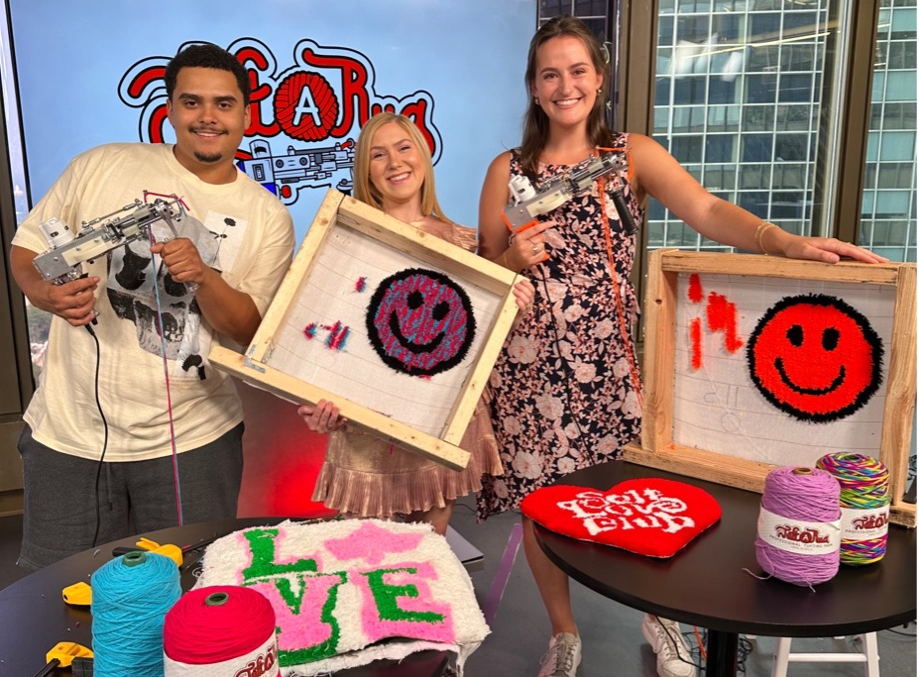
There is a clean micro-SaaS hidden in that scramble: a small, paid image-to-tufting-pattern tool that turns artwork into a production-ready rug plan. This is not the next Adobe, and probably not even the next Cricut. But it could become a profitable $5,000–$20,000 MRR business by solving one narrow problem better than any general design tool: converting an image into a pattern that is practical to trace, tuft, price, and buy materials for.
The heist isn't "AI for yarn." It's owning the ten minutes between "I want to make this" and "I know exactly how to make it."
Here's the shape of the steal:
The money: Roughly 1,000 subscribers at $59 a year plus 100 studios equals about $7,300 in MRR-equivalent. Cricut proves crafters pay for design software: over 3 million subscribers.
Inside:
• Six-screen MVP shippable in four to six weeks
• Blended credit and subscription pricing
• Concierge-first, four-phase launch playbook
• Four moats built on completed-rug data
The hardware boom leaves a software trail
Consumers will pay real money to turn digital ideas into physical objects. In 2025, eufyMake's E1 UV printer became the most-funded campaign in Kickstarter history, pulling $46.76 million from 17,822 backers. The E1 has nothing to do with fiber, and that's what makes it useful evidence: the appetite for making-machines is enormous, and it doesn't stop at any one category.
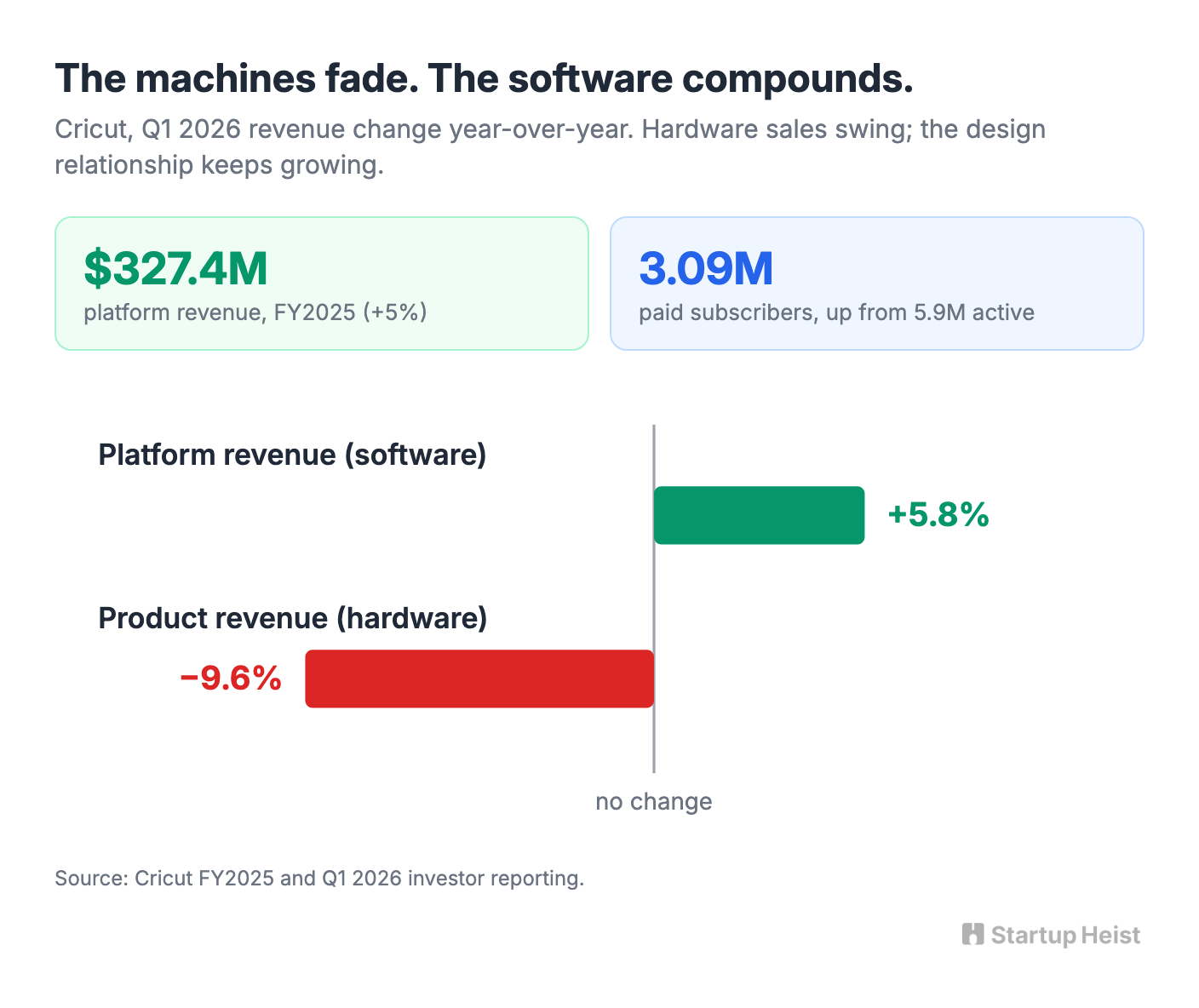
Cricut is the sharper analogy, because it shows where the money actually lands. Cricut closed 2025 with nearly 5.9 million active users and just over 3.09 million paid subscribers. Its platform revenue rose 5% to $327.4 million while product revenue fell. In the first quarter of 2026 the split widened: platform revenue up almost 6%, product revenue down 9.6%. Cricut even used that quarter to launch an AI Project Designer and lean into a platform-first strategy, a sign the incumbent is racing toward AI-assisted design tools of its own. Hardware sales bounce around. The design relationship compounds. Standard access runs $9.99 a month, Premium $14.99, both cheaper paid annually, bundling tools, content, and materials discounts, and hobbyists pay it because they have already been trained to buy software that removes uncertainty from a physical build.
Fiber crafters are an unusually good version of that buyer. A 2025 survey of 6,300 yarn consumers found an average household income of $100,000, roughly 19 projects started per year, and online spending up across every age group. That doesn't tell you how many rug tufters will subscribe to software, since tufting is a small corner of the fiber world. It tells you these are repeat makers, not one-skein tourists. A tool that helps plan a project gets to show up for every single one.
The current workflow is a stack of compromises
Follow one commissioned rug. A customer sends a photo of their dog. Before the tufter can quote it, they have to crop it to the rug shape, kill the background, flatten shadows and fur into a handful of yarn colors, smooth details too fine to tuft, flip the whole thing (the rug is worked from the back), scale it to finished size, project or print the outline, match screen colors to yarn they can actually buy, estimate how much of each color they need, and price it without eating the loss.
Generic graphics software handles pieces of this. It doesn't understand the physical constraints. Tufting Europe, for instance, teaches makers to run photos through Photopea's bitmap vectorizer to cartoonize them, a legitimate free workaround that still leaves the user to pick colors, fix details, prep the projection, and guess at materials.
That is the whole gap. A generic vectorizer asks how to simplify an image. A tufting tool has to ask how to simplify an image so a person can reproduce it with a tufting gun, six yarn colors, a four-foot frame, and the supplies already on the shelf. The second question is worth money because it connects the picture to the purchase.
Competition exists, and that is good news
Nobody would mistake this for an untouched opportunity. Several products already own pieces of the workflow, which is exactly what you want to see before you build. TuftLab is the closest to a calculator: upload a design, set dimensions, pile type, height, density, strands, yarn weight, price, and wastage, and it analyzes colors, supports custom palettes, estimates yarn, and exports PDF and CSV.
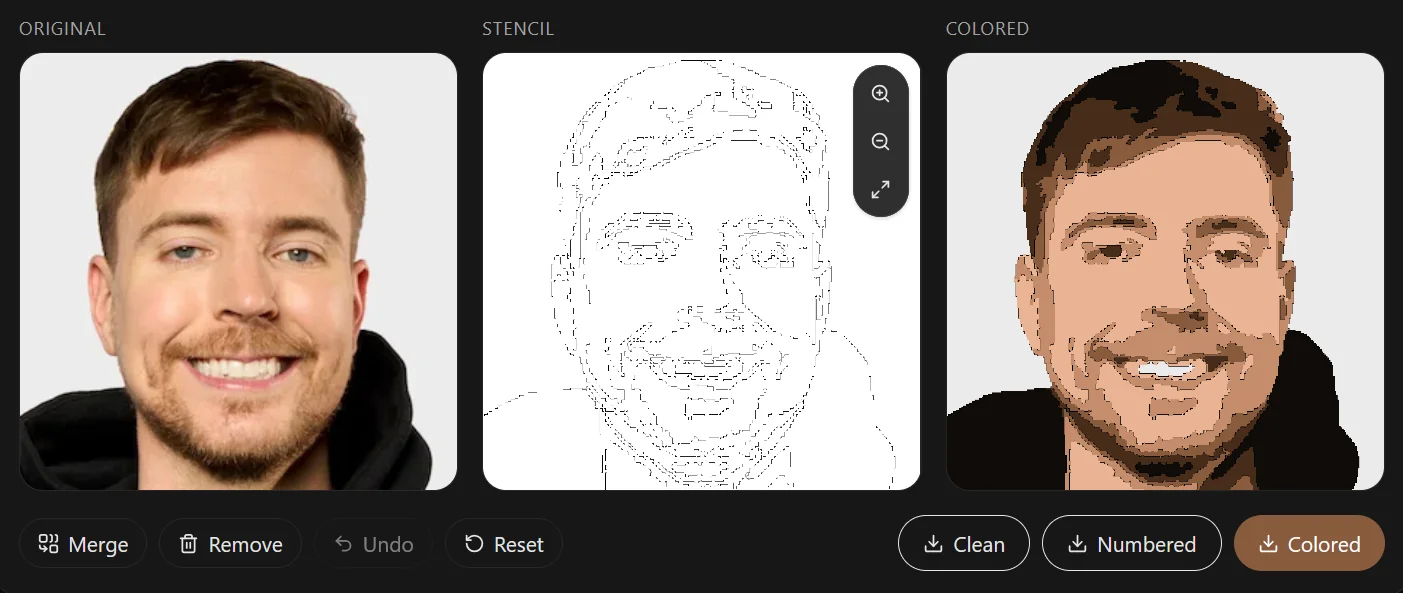
Tuftify is the closest to the wedge: it turns uploaded artwork into simplified flat-color stencils with adjustable outlines, and it has been layering on social and marketplace features. One tufter described trying several ways to break images down before limping along with a paint-by-numbers app, the exact improvised stack a focused tool replaces. One step out, Stitch Fiddle ($33/year) and Wooltasia already do image-to-pattern for crochet, cross-stitch, knitting, and other grid crafts, proving the model supports a durable niche business. At the industrial ceiling, NedGraphics runs simulations, machine interfaces, and yarn-requirement math for carpet factories, which shows what mature tufting software eventually becomes: not a filter, a production system.
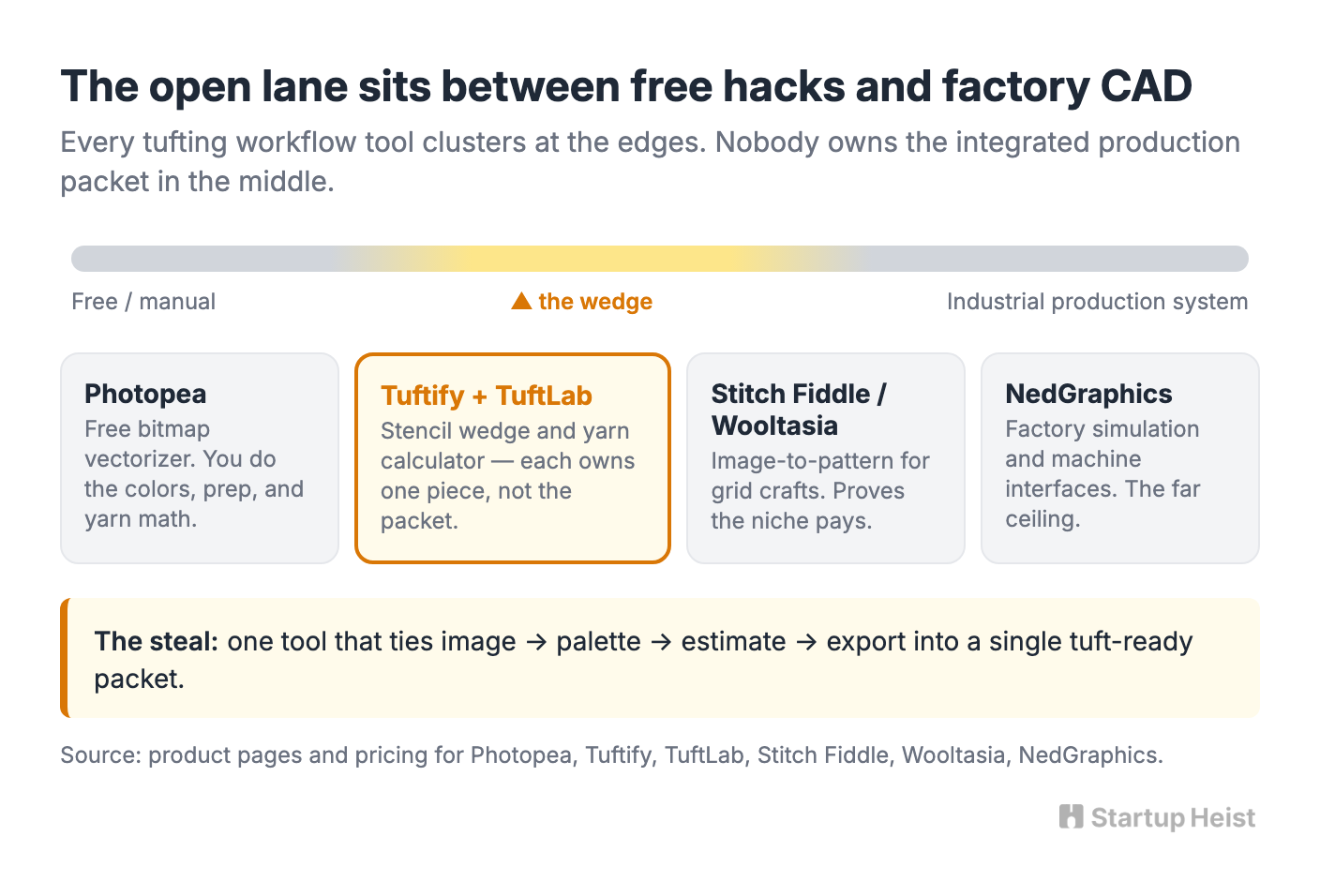
Read those together and the map is clear. The opportunity sits in the open lane between the free Photopea workaround and industrial CAD. Tuftify's rush toward community and marketplace is a gift too, because it shows you exactly which shiny distraction to skip.
The real wedge: a production packet, not a pretty filter
Don't position this as an image generator. The user already has the image. Position it as a pre-production compiler: it takes a picture and outputs instructions that survive contact with yarn, cloth, a projector, and a gun. The promise fits on one line. Upload a design, get a pattern you can actually tuft.
The temptation is to brand this an AI craft platform. Resist it. An AI button raises expectations to "perfect transformation," and you will miss them. A production tool promises assistance, controls, and a reliable export, which is a bar you can actually clear. The stronger line is dull on purpose: accurate project planning for rug makers.
A strong output bundles the simplified color preview, an adjustable number of yarn colors, clean traceable outlines, automatic removal of details too small to tuft, a mirrored projection file, a numbered or color-coded pattern, finished dimensions with scale calibration, a yarn palette matched to real inventory, estimated quantities by color, a materials-cost estimate, a downloadable production PDF, and a customer-facing proof for commissions.
The load-bearing word is adjustable. Automatic conversion will get things wrong constantly. It will erase the dog's eyes while lovingly preserving a patch of background. It will merge two colors that look similar on screen but carry the design. It will spray out dozens of tiny color islands that render fine on a monitor and are miserable to tuft. So the user needs a light editing layer: merge these colors, protect this detail, delete this area, thicken this line, smooth this boundary, swap this color for yarn I own, show me six colors instead of nine. The winner won't have the cleverest algorithm. The winner will make correction so fast the user still feels like the software did the work.
That framing sets the roadmap. Instead of chasing prompt-based design generation, you invest in minimum feature-size detection, line-thickness warnings, color-region cleanup, real yarn inventories, projection calibration, material estimation, actual-versus-estimated tracking, and reusable studio presets. None of it demos well. All of it matters on the fifteenth project, which is the project that decides whether anyone renews.
The MVP
A solo founder can ship the first paid version in four to six weeks. The image processing isn't the hard part. Making the outputs trustworthy and the interface legible is.
Unlock the Vault.
Join founders who spot opportunities ahead of the crowd. Actionable insights. Zero fluff.
“Intelligent, bold, minus the pretense.”
“Like discovering the cheat codes of the startup world.”
“SH is off-Broadway for founders — weird, sharp, and ahead of the curve.”


