


The Rave Moved to 10 A.M. Now Sell the Operating System
The opportunity: Build the sober-morning event kit that lets any café or local organizer launch a repeatable coffee rave, land beverage sponsors, sell tickets, and prove the results, then aggregate that sponsor demand into a network.
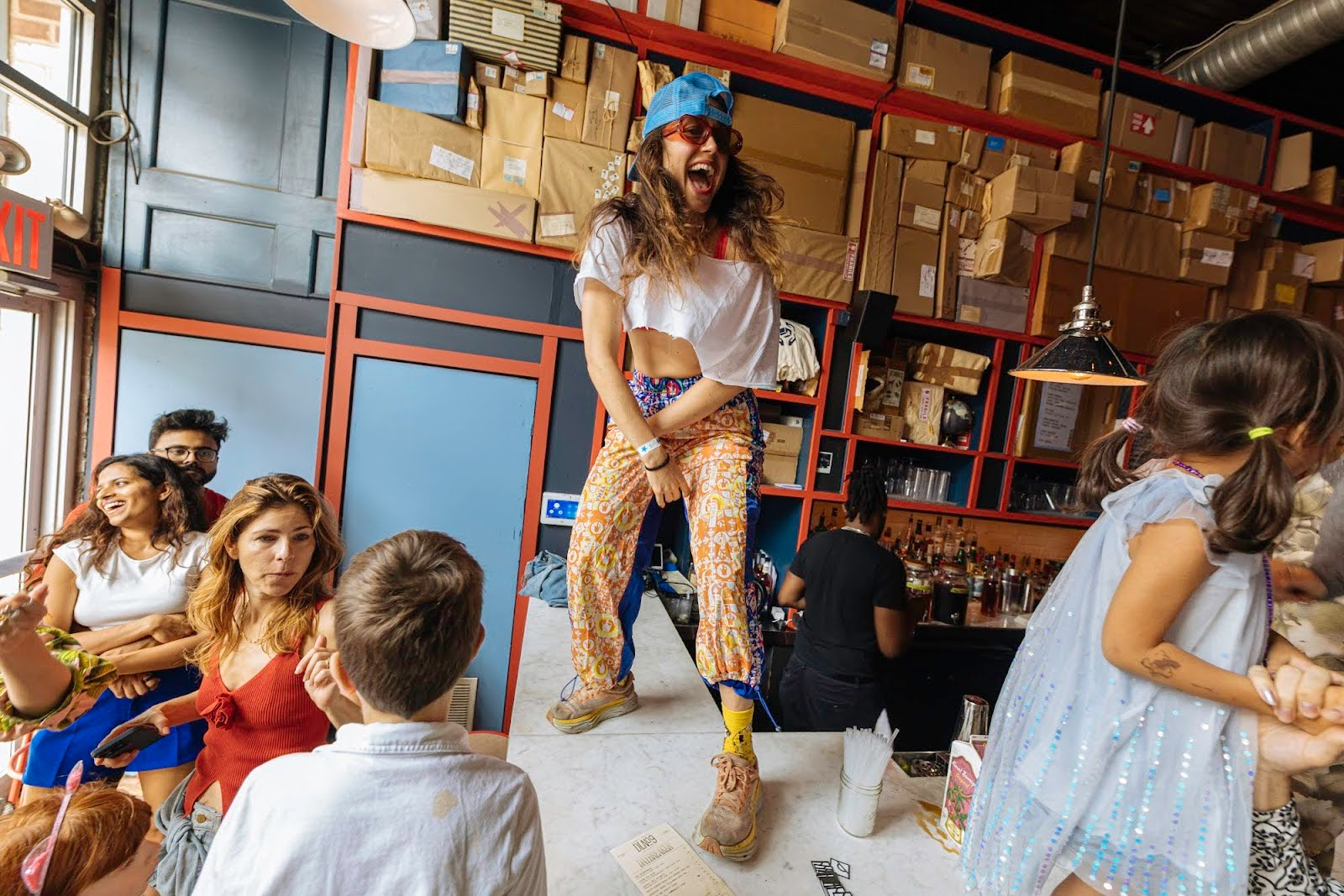
At 10 a.m. on a Sunday, a DJ drops a house track. The crowd is already moving. There's a line at the espresso machine, a matcha brand is handing out samples, and almost everyone will be home before lunch.
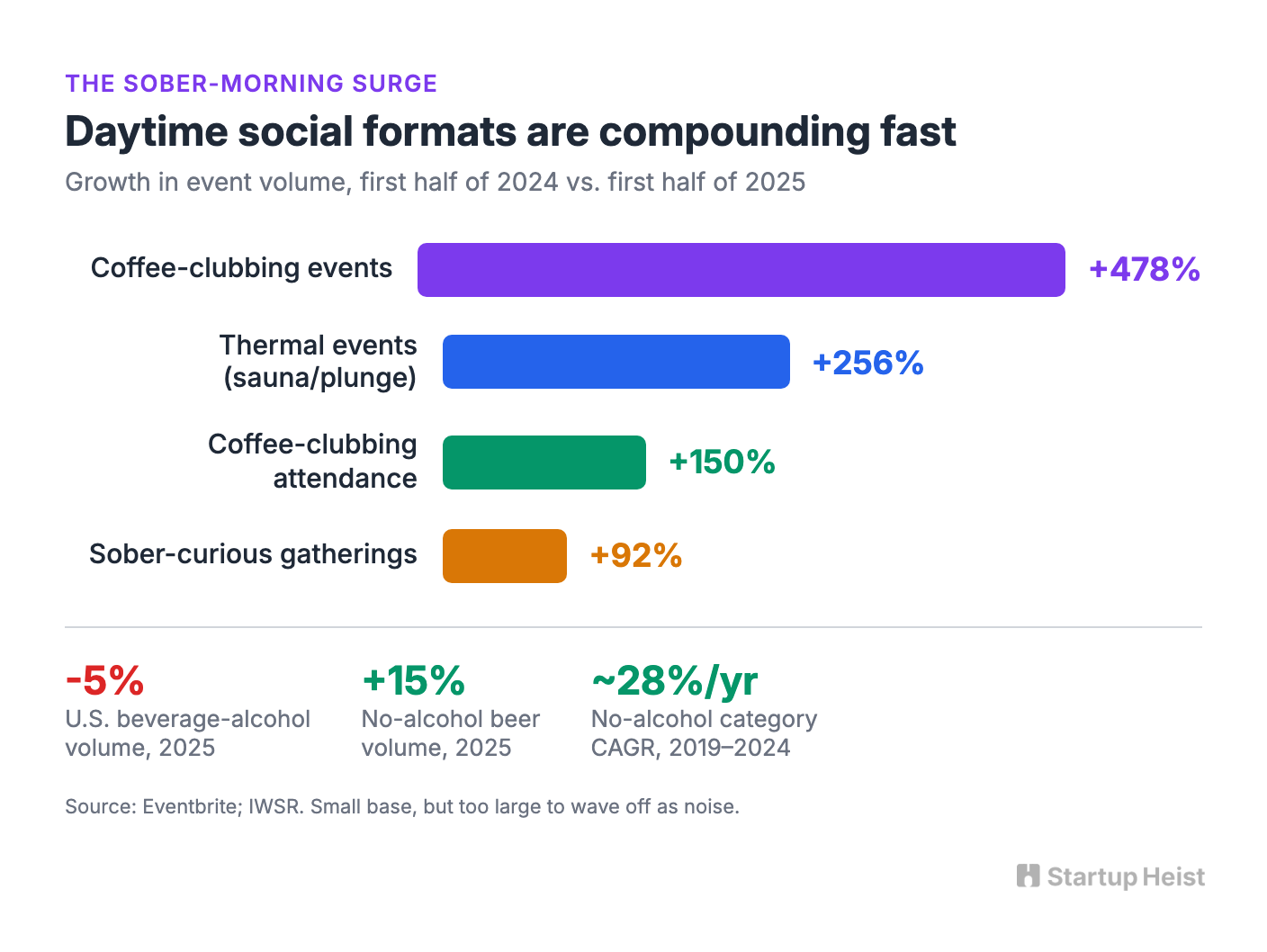
This is soft clubbing: the energy and social ritual of nightlife, moved into daylight and stripped of the alcohol, the velvet ropes, and the next-day damage. Eventbrite reported that coffee-clubbing events grew 478% between the first halves of 2024 and 2025, with attendance up 150%. Sober-curious gatherings grew 92%, and thermal events like sauna raves and cold-plunge socials jumped 256% in volume. It's a small base, but too large to wave off as noise.
The behavior shows up in the money, too. U.S. beverage-alcohol volume fell 5% in 2025, according to IWSR, while no-alcohol beer volume rose 15% and the broader no-alcohol category has compounded at roughly 28% a year between 2019 and 2024. People still want to go out. They're reconsidering what going out has to include.
Strip it to what a builder can act on:
The money: $300,000 a year from 50 operators running 300 activations at $1,000 each; the toolkit alone is a six-figure licensing shop.
Inside:
• Three-layer moat: kit, sponsor engine, data
• Full 150-cap event P&L breakdown
• Four-tier pricing: $750 to multi-city
• Venue and sponsor outreach templates
The obvious business is to throw a coffee rave. The better business is to sell the system behind hundreds of them.
Build the operating kit that hands a café or organizer everything a credible sober-morning party requires: the run-of-show, ticketing flow, venue agreement, sponsor deck, staffing checklist, financial model, marketing assets, and reporting infrastructure. On day one this isn't a venture-scale software company. It's a focused event-operations business with a software layer. Run it well and it becomes a lean six-figure licensing and services shop. Run it exceptionally and it becomes the network non-alcoholic beverage brands buy to reach sober-curious consumers across cities.
The first version stays simple: prove the format locally, package what works, sell that package to other operators, then aggregate the sponsorship demand.
Why the format is moving now
The coffee is almost beside the point. What it provides is permission.
Traditional nightlife asks customers to swallow several costs at once: expensive drinks, late-night transportation, wrecked sleep, physical discomfort, and social pressure to keep up. A morning party strips those costs out and keeps the good part, the music, the movement, the novelty, the chance to dress up and meet people. The result opens the door to groups conventional clubbing underserves: occasional drinkers, parents and older ravers who still love dance music but not a 2 a.m. bedtime, wellness communities, people in recovery who want energy without a room organized around abstinence, and younger consumers who treat drinking as a choice rather than the cover charge. Eventbrite found that 61% of Gen Z want to drink less, against 41% of all U.S. adults.
The event feels less like a sobriety program and more like a redesign of nightlife, and that difference decides whether people show up. Alcohol-free networking sounds medicinal. Reggaeton, cold brew, and dancing before brunch sounds fun.
The operators already prove the range. Daybreaker, born in Brooklyn in 2013, now runs sober morning dances across 66 cities and well over 100 events a year. In Chicago, Cafetón grew from small café takeovers into a daytime gathering that drew an estimated 4,400 to 5,000 people, built around Latino coffee vendors, reggaeton, and cultural identity rather than generic wellness, with related content reportedly drawing millions of views across TikTok. In Los Angeles, Early Birdz went from zero to 250 guests at its first event and landed a Red Bull partnership, pairing its rave with a cold-drink bar, zero-proof cocktails, and food. That last detail matters. The sponsor isn't buying logo placement; it's becoming part of the physical experience.
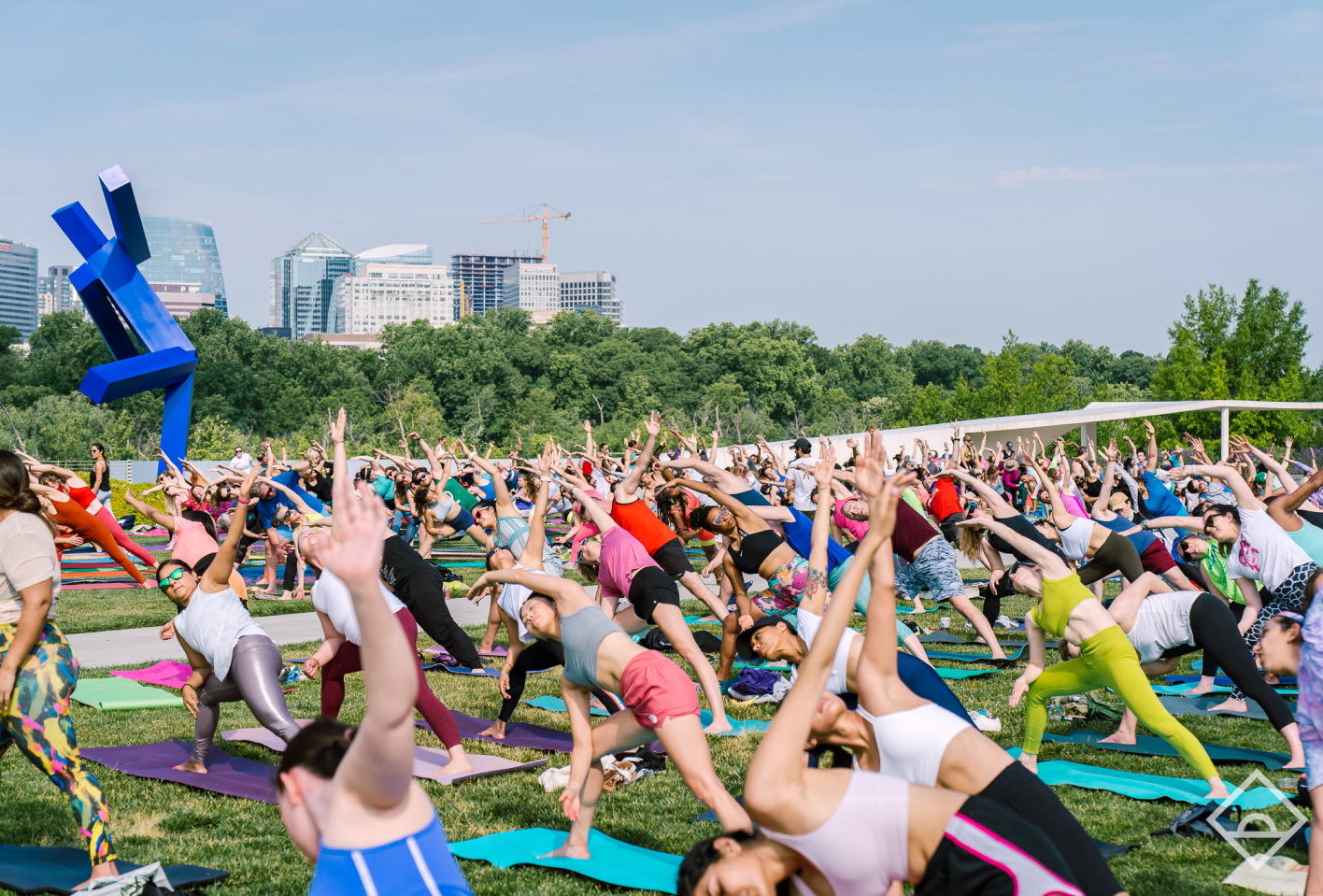
The category grows because the product is modular. Coffee is one setting. The same operating system runs matcha parties, chai and South Asian music nights, run-club afterparties, pilates-plus-DJ mornings, cold-plunge socials, vinyl brunches, parent-friendly dance parties, and industry mixers for nurses, founders, designers, or hospitality workers. The winning operator sells something more flexible than a coffee-rave template: a configurable daytime-social format that localizes by music, community, venue, and sponsor.
The three customers
The opportunity works because three groups have complementary problems.
The venue wants incremental revenue. A café, restaurant, coworking space, hotel lobby, gallery, or daytime-dark nightclub wants traffic when its capacity sits idle. But "9 a.m. to noon is dead time" isn't a universal truth. For many cafés, those are peak hours; Square's Canadian data found café traffic clustering between 9:30 a.m. and 1 p.m. A rave that clogs a venue's strongest window destroys value instead of creating it. So the kit needs a venue-fit calculator, not a blanket promise. Pull six to eight weeks of sales by half-hour, find the actual soft window, and place the event where it adds sales: 7–9 a.m. before the rush, 10:30 to 1 in a commuter café that empties after breakfast, 1–4 p.m. in a weekend restaurant, 9 to noon in a bar or gallery that would otherwise be closed, or 5–8 p.m. for an after-work session. Sell profitable use of an underused space, not a specific clock time.
The organizer wants a repeatable event business. Local DJs, community builders, run-club leaders, and hospitality pros can often gather a crowd. What they lack is the commercial system: what to promise the venue, how many staff to hire, how to price tickets, how to build a sponsor package, how much production is enough, which metrics sponsors expect afterward, how to convert a first-timer into a regular, and how to avoid losing money on a sold-out room. Generic ticketing platforms handle checkout. They don't handle the event business, and that's the gap.
The sponsor wants targeted product trial. Non-alcoholic beverage brands face one hard problem: customers have to taste the product. A feed makes a can look good but can't deliver flavor, mouthfeel, or the association with a good occasion. A coffee rave assembles a self-selected audience already leaning toward no-alcohol, functional, and premium drinks. Freeman's 2025 research found 95% of surveyed attendees trusted brands more after an in-person event, with the lift often lasting weeks. A 100-person rave won't match a trade show, but the principle holds: physical experience does work a paid impression cannot. And the sponsor pool runs well past NA spirits, into cold brew, matcha, functional sodas, electrolytes, protein snacks, apparel, fitness studios, wellness apps, skincare, coworking, dating apps, and micromobility. A brand manager should be able to say "2,500 product trials among wellness-oriented adults in five cities next quarter" and get back a standardized package, audience profile, schedule, cost per sample, and reporting plan. That answer is the long-term asset.
The money is not in the PDF
A folder of Canva templates and a Notion playbook can be copied. It helps you land the first customers, but it isn't the company. The real product has three layers.
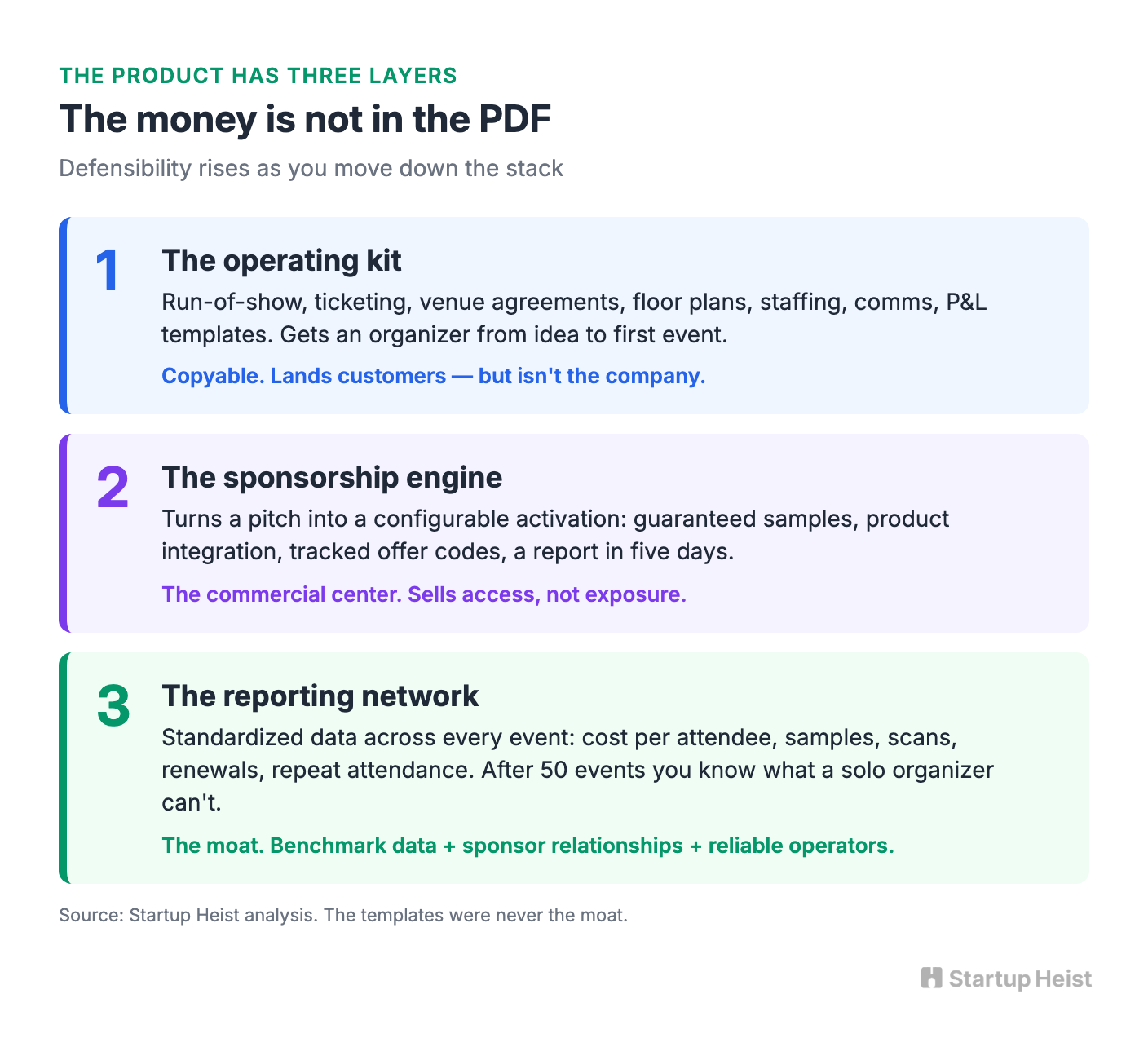
Layer one, the operating kit. This gets an organizer from idea to first event: venue-selection criteria and the hourly utilization calculator, outreach scripts, sample venue agreements and deal structures, capacity and floor-plan worksheets, run-of-shows at 90 minutes, two hours, and three, DJ briefings and music programming, sound and power and noise checklists, ticket-page copy and guest FAQs, email and SMS and social sequences, check-in and waiver language, incident and evacuation and medical plans, sponsor rate cards and activation menus, post-event surveys, and P&L and cash-flow templates. Version one lives in Notion, Airtable, Google Drive, and Canva. Don't spend six months building software before you produce an event.
Layer two, the sponsorship engine. This is the commercial center. The kit turns a sponsor pitch into a configurable proposal: audience demographics, expected attendance, samples distributed, category exclusivity, on-site signage, product integration, email and social mentions, content deliverables, QR scans, coupon redemptions, survey responses, post-event photo and video, and a renewal option. The pitch sells an activation, not exposure. A weak package says the logo appears on a flyer. A strong one says: your product goes into the hands of 125 attendees, gets introduced by the host, anchors one signature drink, appears in two pieces of short-form content, and gets tracked through a unique offer code, with a report inside five business days. Charge a fixed campaign fee, a percentage, or both.
Layer three, the reporting network. This is where the moat starts. Every operator reports the same core data: tickets sold, attendance rate, cost per attendee, samples distributed, unique QR scans, email opt-ins, coupon redemptions, social assets produced, organic reach, demographics, product ratings, purchase intent, sponsor renewal, venue sales during the event, and repeat attendance. After 50 events, the company knows what a solo organizer can't. It knows matcha outperforms NA spirits at 9 a.m., that run-club integrations lift attendance but shorten dwell time, that a certain ticket price maximizes turnout in a 75-person café, that Latin-music events drive unusually high beverage sales. The templates were never the moat. The moat is the benchmark data, the sponsor relationships, the roster of reliable operators, and the ability to run a measured campaign across cities.
Start as an operator, not a software founder
Nobody should buy an event playbook from someone who's never run the event. The first three to five gatherings are research, not promotion, and that's where you learn the business.
You need the details that look trivial from a laptop and turn out to decide the night: how much floor the DJ booth actually eats, whether the espresso grinder screams over the sound system, how fast the bar backs up when 50 people order at once, whether the crowd dances immediately or needs a warm-up, how many people leave the second they get the included drink, whether the sponsor samples were served cold, where jackets and bags pile up, what happens when the neighbors call, how long it takes to hand the venue back to normal service, which photo angles make a modest crowd look alive without lying, and what sponsors ask for afterward that they never mentioned before. That's the knowledge that turns a generic template library into credible operating expertise. Come at this as an event operator who develops software, rather than a software founder hunting for event customers.
Illustrative event economics
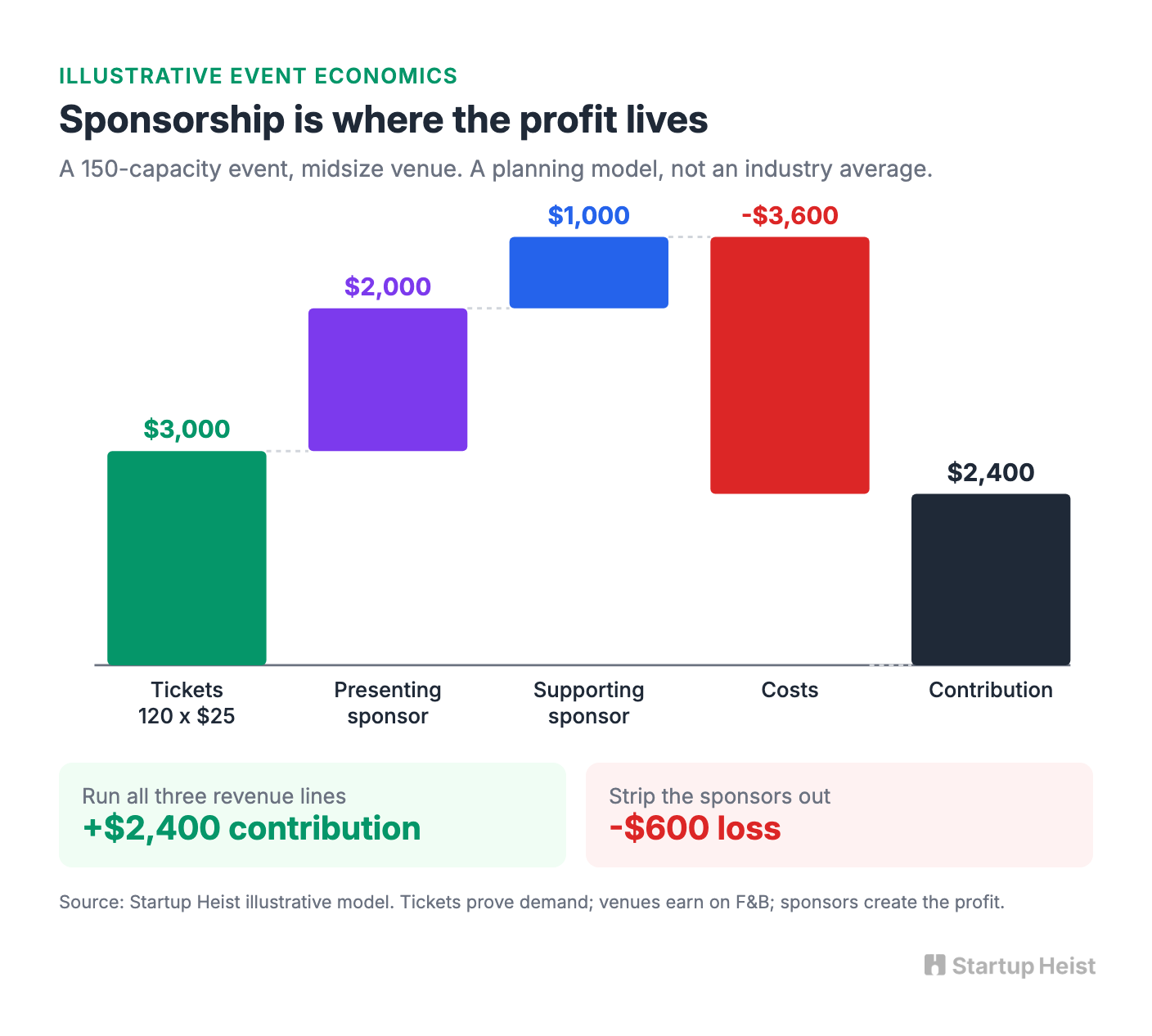
Take a 150-capacity event in a midsize venue. These aren't industry averages, just a planning model that shows where the math works.
Revenue. 120 paid tickets at $25 is $3,000. A presenting sponsor at one activation is $2,000. A supporting sponsor is $1,000. Total revenue, $6,000. The remaining capacity absorbs staff, creators, venue personnel, sponsor guests, and a few community invites.
Costs. Venue guarantee or revenue share, $600. DJ, $500. Sound and minimal lighting, $500. Check-in, floor staff, and security, $700. Paid promotion and creator fees, $650. Insurance, permits, and a music-license allocation, $350. Photography, design, software, and miscellaneous, $300. Total cost, $3,600.
Illustrative contribution: $2,400. Strip the sponsors out and the same event loses about $600. Tickets prove demand and limit no-shows. Venue sales make the partnership attractive. Sponsorship creates the profit. Treat sponsorship as optional and the business stays fragile. Give away tickets and lean entirely on sponsors and you lose the proof that anyone values the event. The healthy structure runs all three: attendees pay enough to show intent, venues earn on food and beverage, sponsors pay for measurable access.
Pricing the operator-in-a-box
Don't open with a $29 template bundle. Cheap information products attract curious buyers, not committed operators.
Unlock the Vault.
Join founders who spot opportunities ahead of the crowd. Actionable insights. Zero fluff.
“Intelligent, bold, minus the pretense.”
“Like discovering the cheat codes of the startup world.”
“SH is off-Broadway for founders — weird, sharp, and ahead of the curve.”


