


The Retail Media Network Hiding Inside 50 Shopify Stores
Somewhere in the last few years, retailers found a second business hiding inside the first one.
The first business sells products. It buys inventory, pays for fulfillment, eats returns, and fights for a few points of margin.
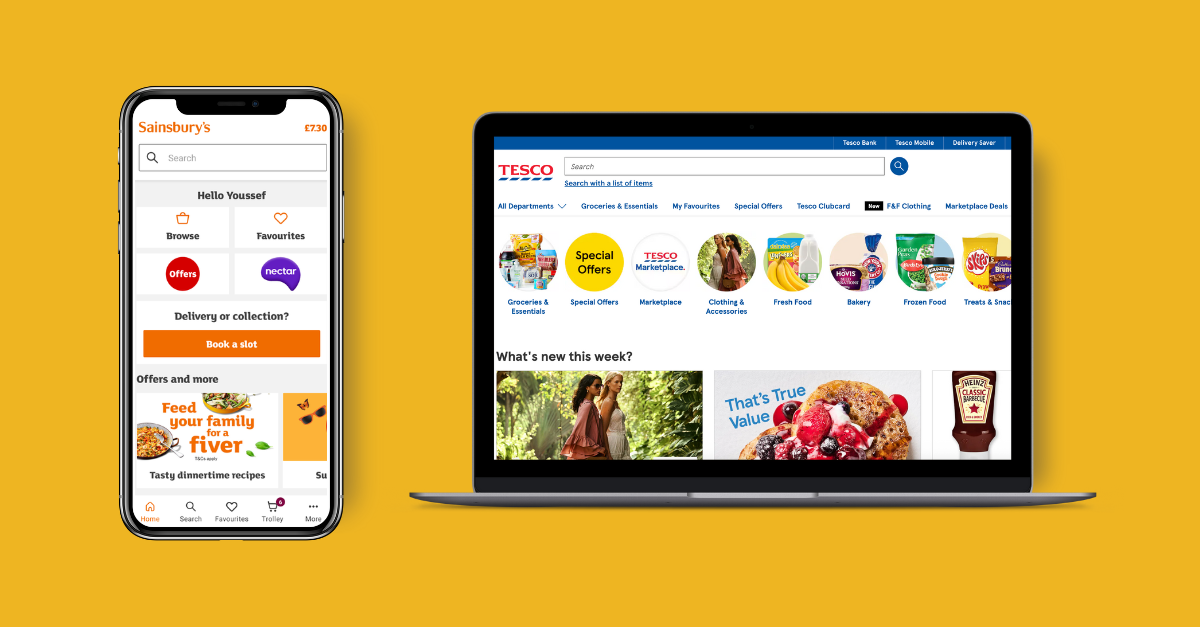
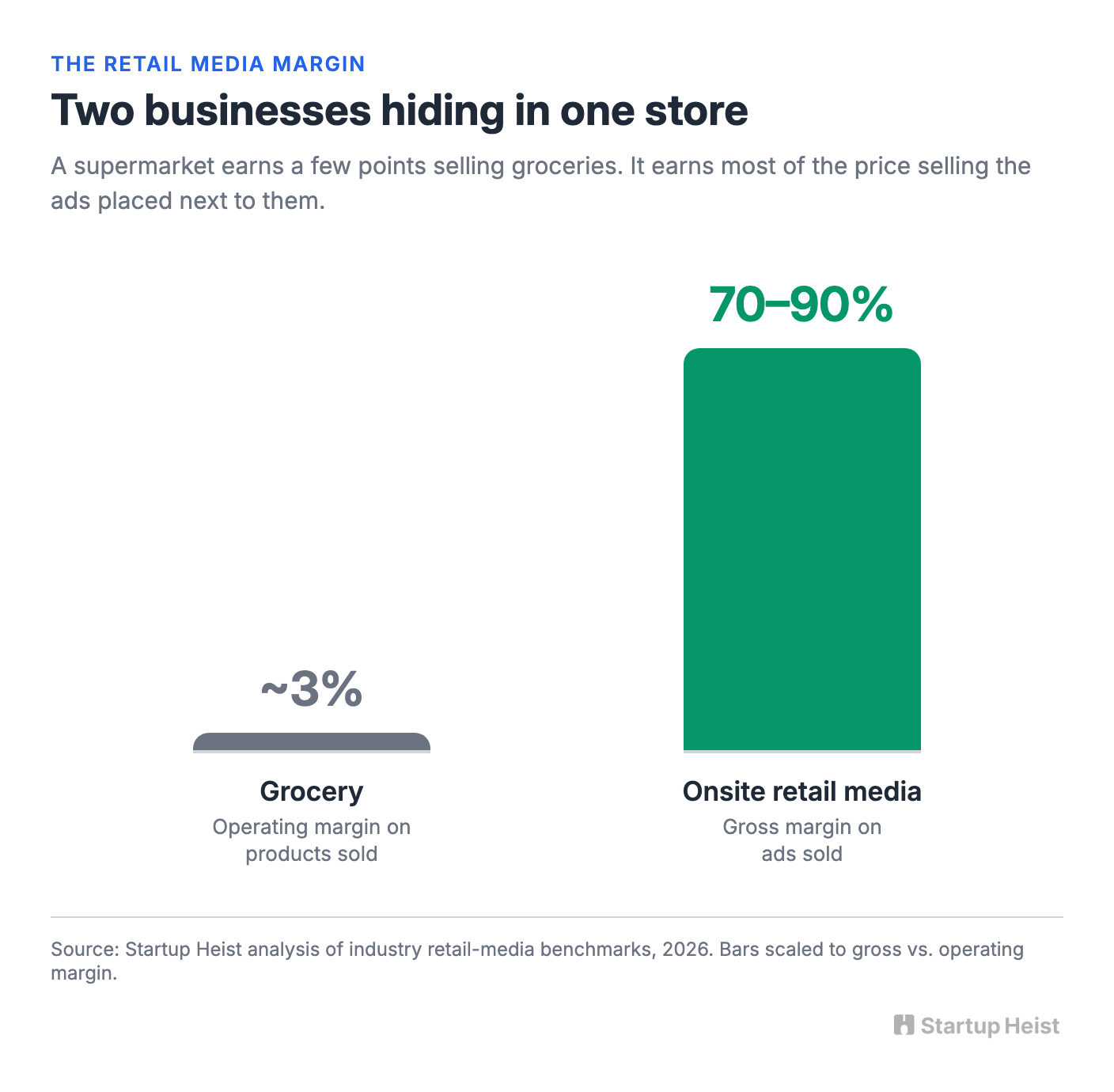
The second business sells access to shoppers. It carries no inventory, almost no fulfillment cost, and margins the first business can only dream about. That second business is retail media, and it has quietly become the most profitable thing happening inside modern retail.
Amazon, Walmart, Target, Instacart, Kroger, and Chewy now charge brands to appear in search results, category pages, emails, apps, physical aisles, and offsite advertising. U.S. advertisers are on track to spend roughly $69 billion to $70 billion on retail media in 2026, up from the high-$50-billion range a year earlier. The reason everyone wants in is the margin: onsite retail media runs at 70% to 90% gross, against the low-single-digit operating margins that define grocery. A supermarket earning 3% on groceries can earn 70% on the ads it sells next to them.
The giants own that margin. The opportunity is everyone they overlook:
The money: Four packaged $15,000 campaigns running at once is $18,000 a month to the collective; fifty quality stores scales that toward $48,600.
Inside:
• Three campaign types that avoid channel conflict
• Four-phase MVP that sells before it builds
• Advertiser and retailer outreach templates
• Five compounding moats for the network
Almost all of that money flows to retailers with enormous audiences. Walmart and Amazon alone are absorbing roughly 89% of the incremental retail-media dollars in 2026.
Now look down the long tail. A Shopify store selling premium dog harnesses might pull tens of thousands of high-intent shoppers a month. A specialty pet-food retailer knows when a visitor is reading about puppy nutrition, sensitive stomachs, or senior-dog joints. That is exactly the commercial signal brands pay Amazon a fortune to reach.
Yet that store will never hire a media sales team, integrate an enterprise ad platform, negotiate a campaign with General Mills, or explain viewability to an agency. Individually, these merchants are too small to become media networks.
Collectively, they might not be.
The Heist
Build a vertical retail-media collective for independent ecommerce retailers.
The first version pools 10 to 20 noncompeting Shopify pet stores into a single sellable advertising package. Instead of asking a pet brand to negotiate separate deals with fifteen merchants, the collective sells one insertion order, one set of approved formats, one campaign calendar, one invoice, one report, and reach across every participating store.
The advertiser buys a pet audience. The retailers earn incremental revenue. The collective runs sales, campaign operations, technology, reporting, and payouts, and keeps roughly 30% of net media revenue. Retailers keep the other 70%.
The brokerage is the near-term business. The larger prize is turning it into the operating layer for hundreds of small retail-media properties.
Why Pets Is the Right First Vertical
Pets is large enough to support a network, specific enough to sell as a coherent audience, and fragmented enough that no single merchant can solve the problem alone.
The supply is real and unusually easy to find. Store Leads counted 69,432 live Shopify stores in the broader Pets & Animals category in July 2026, including 49,317 under Pet Food & Supplies. More than 26,000 sit in the United States, and roughly 62% publish an email address. Most of them are irrelevant. Many are tiny, dormant, or selling generic junk. You do not need most of them. You need fifteen with real traffic, clean brands, and complementary shelves, then fifty, then a hundred.
What makes the category valuable is that shopping intent arrives with a need attached. Someone researching puppy food. A dog owner comparing joint supplements. A cat owner pricing litter systems. A customer reading about allergies or digestive trouble. Each is a live commercial signal, caught the moment it fires.
The economics are already proven at the top of the market. Chewy launched Chewy Ads in 2023 and grew advertising revenue more than sixfold in three years, with advertiser participation expanding nearly twentyfold; sponsored ads were the main driver of its gross-margin improvement in fiscal 2025. Chewy says roughly one in three ad clicks ends in a sale and that about half of engaged shoppers discover a brand new to them. In Australia, Petbarn built a dedicated pet retail-media network called PetAds, spanning sponsored search, category placements, display, and in-store screens across 2.9 million loyalty members. The value of a pet-commerce audience is not in question. The opportunity is to bring those economics to the long tail no giant will bother to aggregate.
The Pivot That Makes or Breaks It
The obvious version of this idea is also the worst one.
Slap a banner for a dog-food startup on twenty pet stores, send the clicks to the startup's website, split the money. Any competent retailer will reject it on sight. They paid to acquire that customer. They will not ship that customer to a competitor for a few dollars in ad revenue. A careless collective reduces conversion, erodes trust, and manufactures channel conflict.
The inventory has to be built around merchant interests, which leaves three campaign types that actually work.
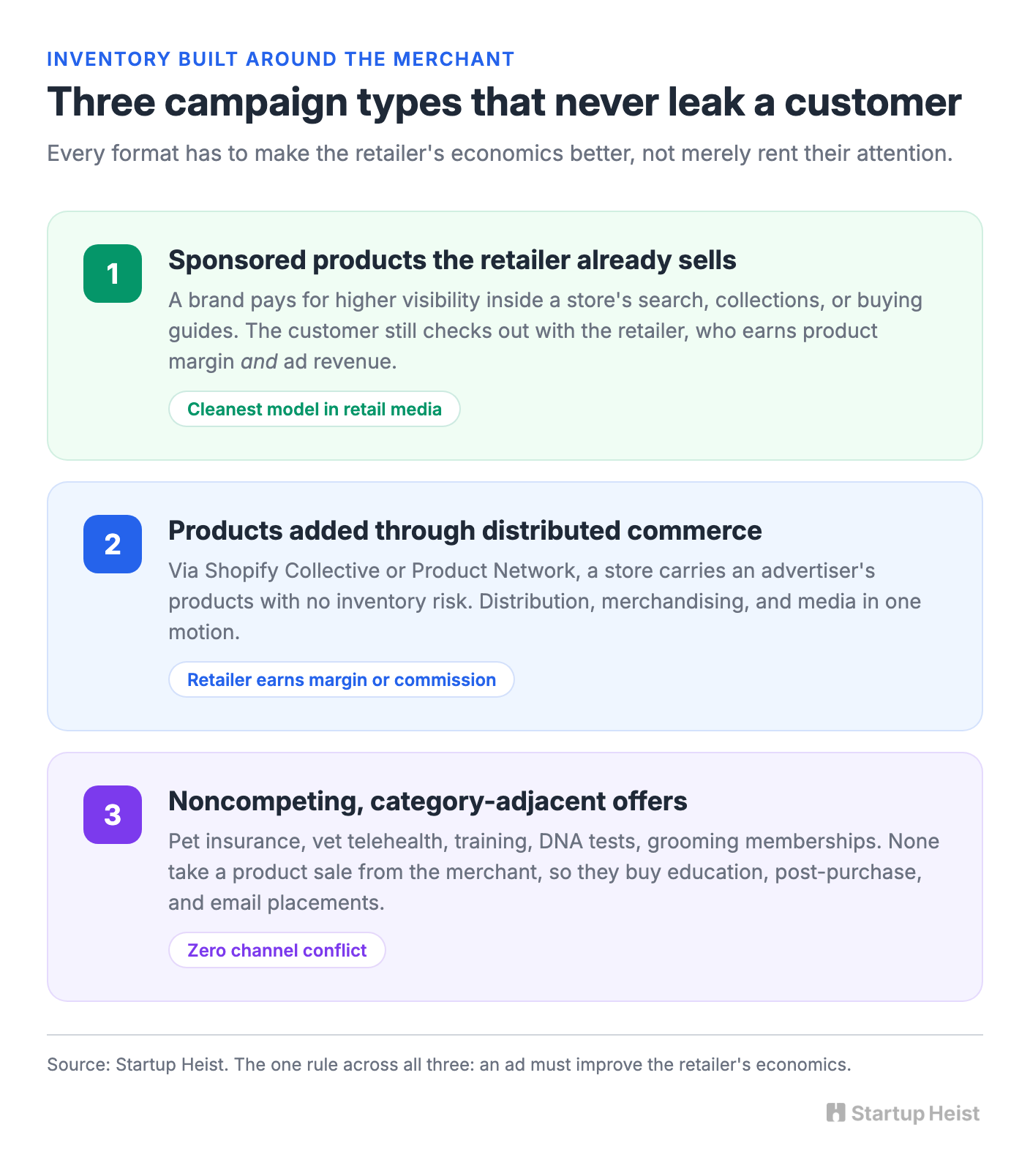
One rule governs all three: an advertisement has to make the retailer's economics better, not merely rent the retailer's attention.
Shopify Is Both the Proof and the Threat
Shopify has already decided that merchant traffic can be pooled into a network. Its Product Network lets eligible U.S. merchants display products from other Shopify stores for a commission, and its Shop Campaigns distribute an advertiser's products across the Shop app, the Product Network, and outside channels including Meta, Google, and now ChatGPT.
So do not pitch yourself as "Shopify ads for small merchants." Shopify is building that, and it will win the horizontal fight.
But the same product reveals the opening. Product Network recommendations are automated. Host merchants can exclude categories or brands, but they cannot hand-pick the exact products and advertisers that appear. Advertisers set acquisition goals through Shop Campaigns; they cannot buy a curated vertical package across a named group of specialist stores. Shopify optimizes an algorithm across millions of merchants. It will not assemble a controlled, category-specific package with merchant approval over every advertiser, guaranteed placements, category exclusivity, and cross-retailer reporting. Shopify builds the pipes. The collective builds the market that runs through them.
What You Are Actually Selling
Do not launch with seventeen ad formats and a self-service bidding engine. Launch with a four-week managed campaign and three standardized placements. Call it the Pet Discovery Package.

Sponsored discovery: native product or content placements inside relevant collections, search results, recommendation modules, and buying guides.
High-intent display: a standardized native unit on product and category pages, shown only in approved contexts such as puppy care, dental health, senior pets, or skin and coat.
Owned-media amplification: optional inclusion in retailer newsletters, social posts, and post-purchase emails.
Then deliver one report covering delivered and viewable impressions, clicks and click-through rate, product-detail views, add-to-carts, attributed orders and revenue, new-to-brand orders where measurable, and performance broken out by retailer, placement, creative, and context.
The report is the product. The IAB and the Media Rating Council recommend placement-level reporting, viewability, invalid-traffic filtering, transparent attribution, and clear outcome reporting for retail media. A small network does not win repeat budgets because its audience sounds interesting. It wins them by making its inventory measurable next to the giants.
The Economics
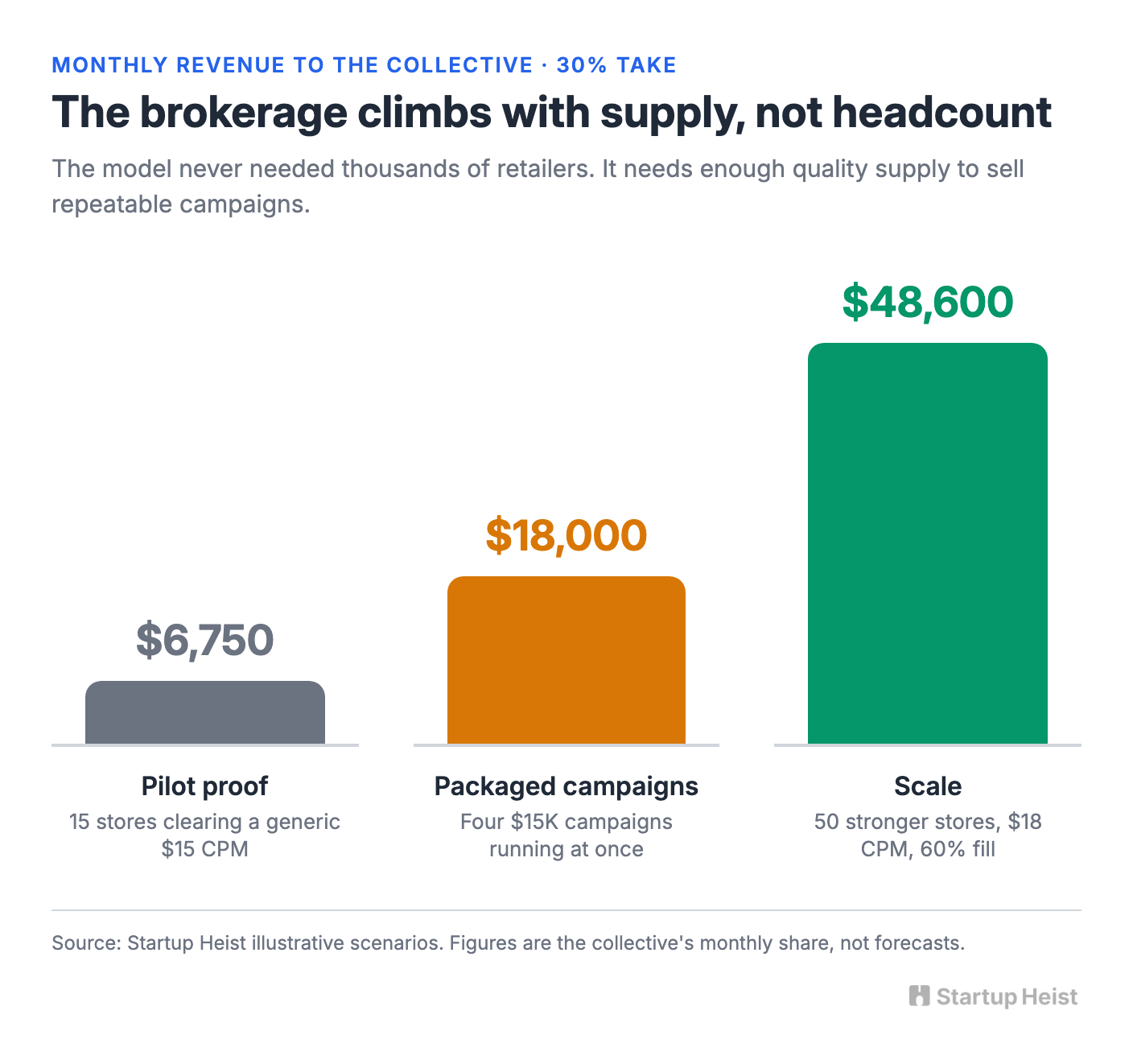
This is a specialized media brokerage with technology underneath it, not a billion-dollar software company on day one. The brokerage math is what you have to believe first.
Take an illustrative pilot: 15 retailers, 100,000 monthly sessions each, two eligible impressions per session, 50% fill, and a $15 effective CPM. That is 1.5 million sold impressions and $22,500 in gross monthly media revenue, of which the collective keeps $6,750 and retailers split $15,750. On its own, that is not a business, only proof that the inventory exists.
The economics change when you sell packaged campaigns instead of waiting for impressions to clear at a generic CPM. A four-week campaign priced at $15,000, with guaranteed native placements, retailer approvals, creative adaptation, reporting, and an email component, leaves the collective $4,500. Four running at once is $18,000 a month before costs.
Scale the supply and it starts to matter. Fifty stronger retailers at 150,000 monthly sessions, two eligible impressions, 60% fill, and an $18 CPM produce about $162,000 in monthly media spend and roughly $48,600 in monthly brokerage revenue at a 30% take.
These are scenarios, not forecasts. Real revenue depends on traffic, eligible inventory, campaign performance, seasonality, and how much the merchants let you sell. The point is that the model never needed thousands of retailers. It needs enough quality supply to sell repeatable campaigns.
Pricing Strategy
Unlock the Vault.
Join founders who spot opportunities ahead of the crowd. Actionable insights. Zero fluff.
“Intelligent, bold, minus the pretense.”
“Like discovering the cheat codes of the startup world.”
“SH is off-Broadway for founders — weird, sharp, and ahead of the curve.”


