


Shopify just placed roughly five million merchants inside AI shopping channels. Someone needs to help the smaller ones become worth recommending.
For twenty years, ecommerce optimization revolved around the page. Merchants improved landing pages, rewrote headlines, compressed images, redesigned navigation, bought backlinks, and obsessed over the checkout funnel. The assumption underneath all of it was simple: a shopper would arrive at the website, look around, and decide what to buy.
AI shopping changes the sequence. A shopper can now type one sentence into a chat window: "Find me a machine-washable wool blanket under $180, made in the United States, that ships within three days and has a generous return policy." The customer may never visit a single store. The AI reads catalogs, interprets attributes, compares offers, and hands back a shortlist.
In that world, the merchant's first storefront is no longer the website. It is the product record the agent reads before the website ever loads.
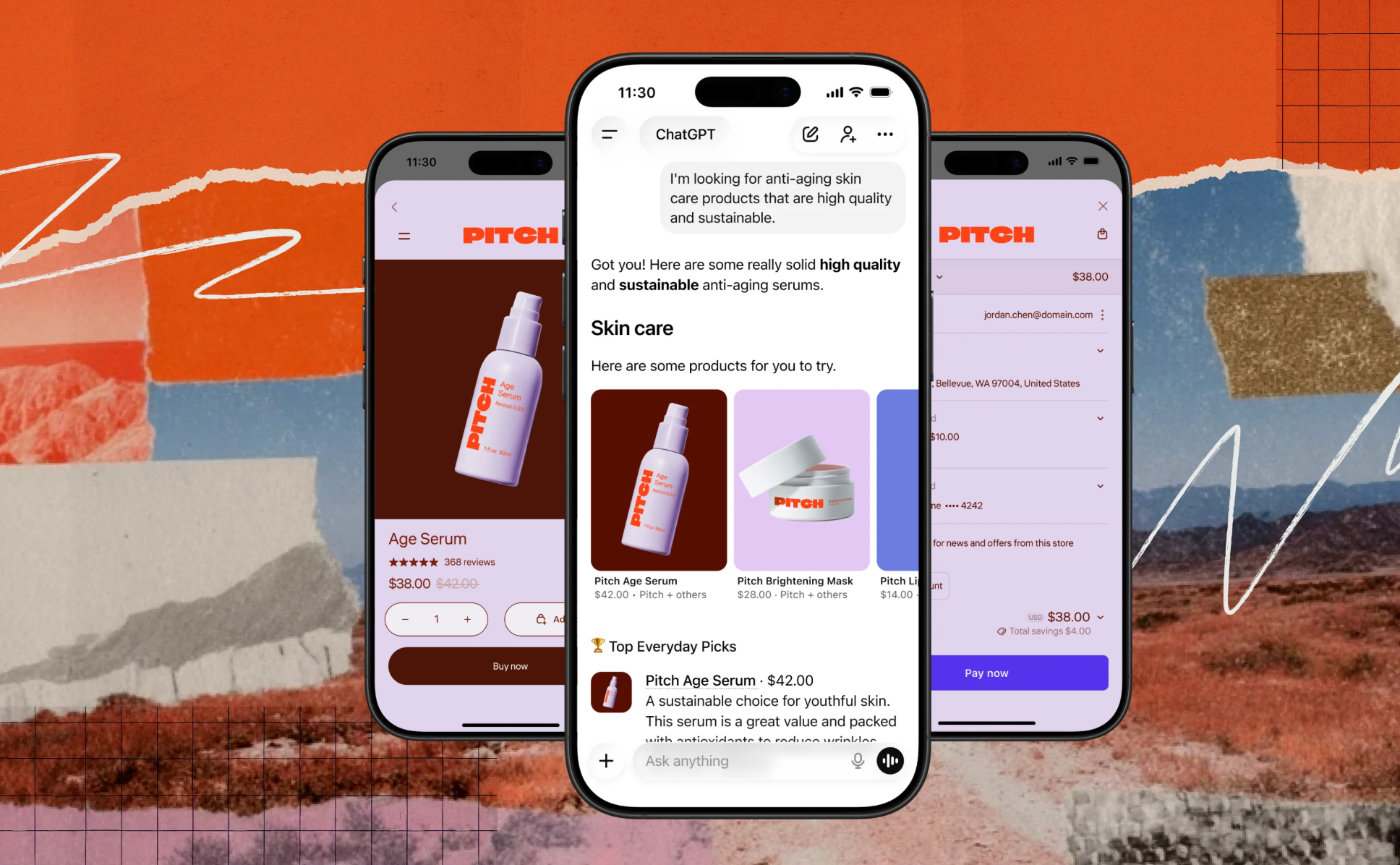
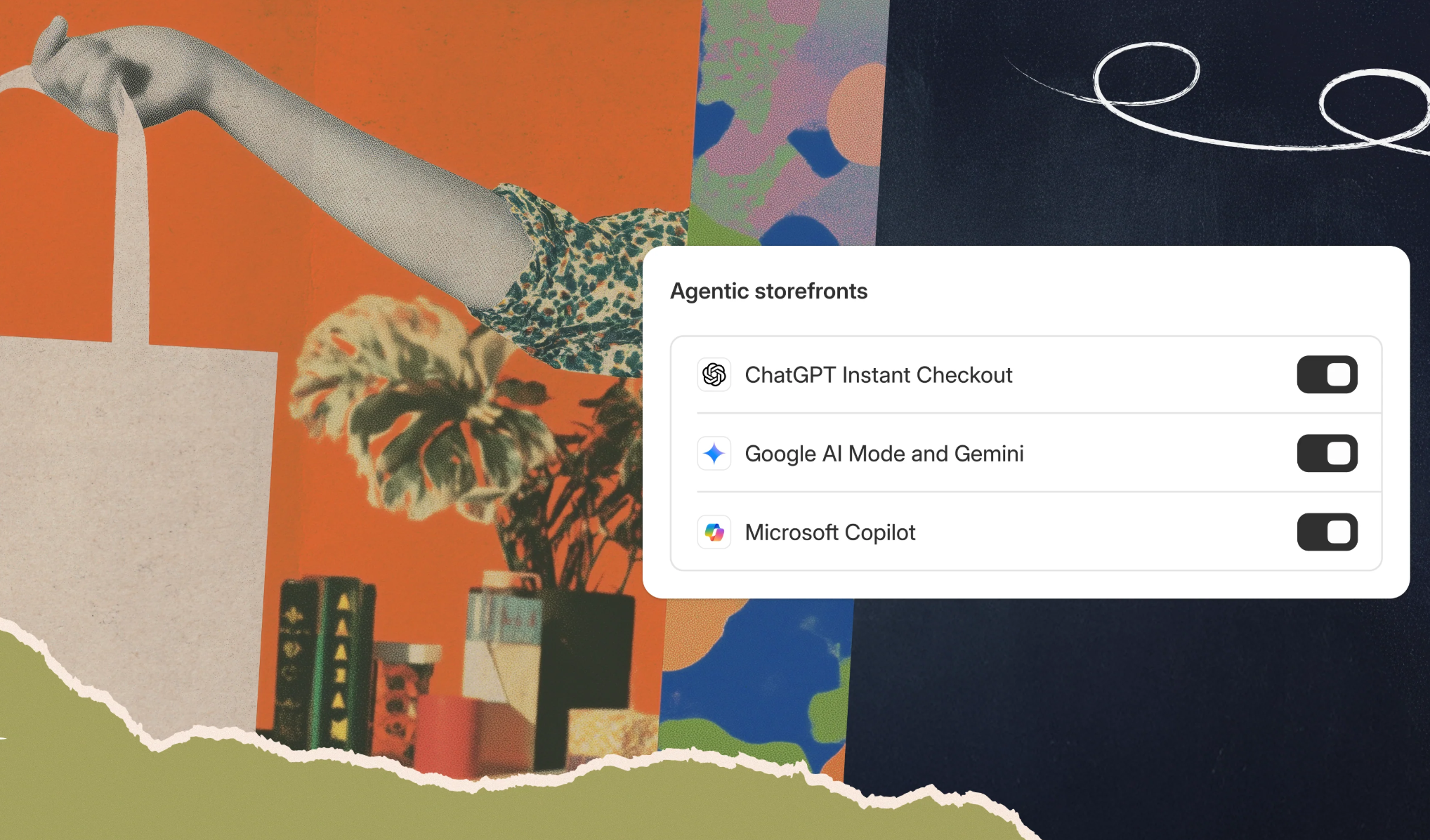
On March 24, 2026, Shopify flipped this on for everyone. Through what it calls Agentic Storefronts, eligible merchant products now flow into ChatGPT, Microsoft Copilot, Google AI Mode, Gemini, and Shopify's own Shop channel. The channels are active by default for eligible stores. Shopify Catalog feeds them structured titles, descriptions, images, prices, availability, and variant data in real time. Shopify serves nearly five million businesses across more than 175 countries, processed $378 billion in GMV in 2025, and now accounts for more than 14% of U.S. ecommerce. In one edition update, that entire base became discoverable inside the assistants people already use.
Distribution is not the same as visibility. Every eligible merchant enters the catalog. Only a fraction get matched confidently to a specific customer request. That gap is the opening: a low-cost catalog-operations tool for the merchant who is technically distributed to AI channels but commercially unprepared to compete inside them.
Here's the shape of it:
The money: A blended $55 plan puts 500 merchants near $27,500 MRR and 1,000 near $55,000. AI-driven orders to Shopify stores grew roughly thirteenfold in early 2026.
Inside:
• Full MVP scope for catalog repair
• Five-tier pricing: free to $1,500 cleanup
• Agency and consultant GTM playbook
• Four compounding moats worth building
This is not another enterprise "agentic commerce platform." It is a tool priced for a founder running a store, one that answers four questions:
- Which products are poorly represented to shopping agents?
- Which customer requests are those products losing right now?
- Which attributes, policies, images, or descriptions are causing it?
- What can be fixed safely, in bulk, without breaking the brand?
Call it the AI catalog mechanic.
The New Shelf Reads Data, Not Design
AI shopping gets described as a new checkout experience. That framing is already wrong.
OpenAI launched Instant Checkout inside ChatGPT in September 2025, promising to bring over a million Shopify merchants into a buy-without-leaving-the-chat flow. Five months later, in March 2026, OpenAI shut it down. Roughly a dozen Shopify merchants ever went live. Shoppers preferred completing purchases on the retailer's own site, and syncing millions of live SKUs proved harder than the demo suggested. ChatGPT's shopping experience reverted to what actually works: discovery inside the assistant, then a handoff to the merchant's own checkout.
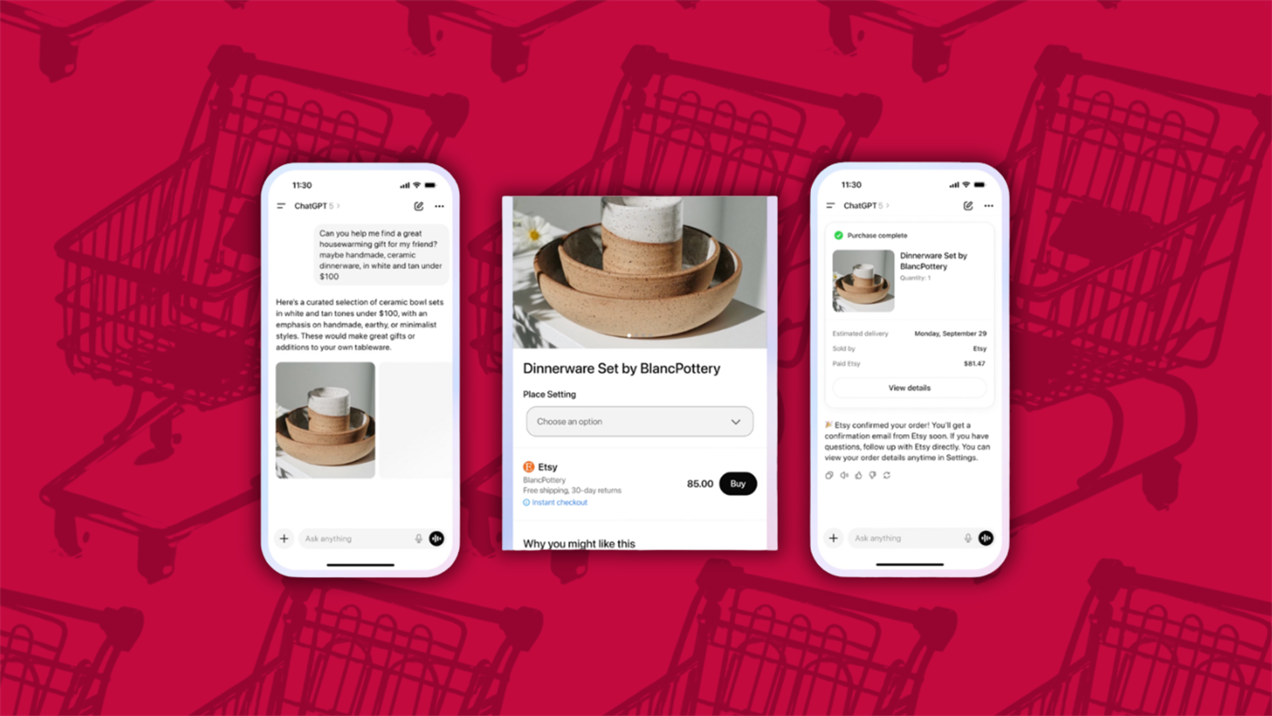
That retreat matters more than the launch did. When the payment step leaves the chat, the one thing standing between a merchant and a sale is whether the agent found and ranked their product in the first place. Discovery is the whole game now, and discovery runs entirely on catalog data.
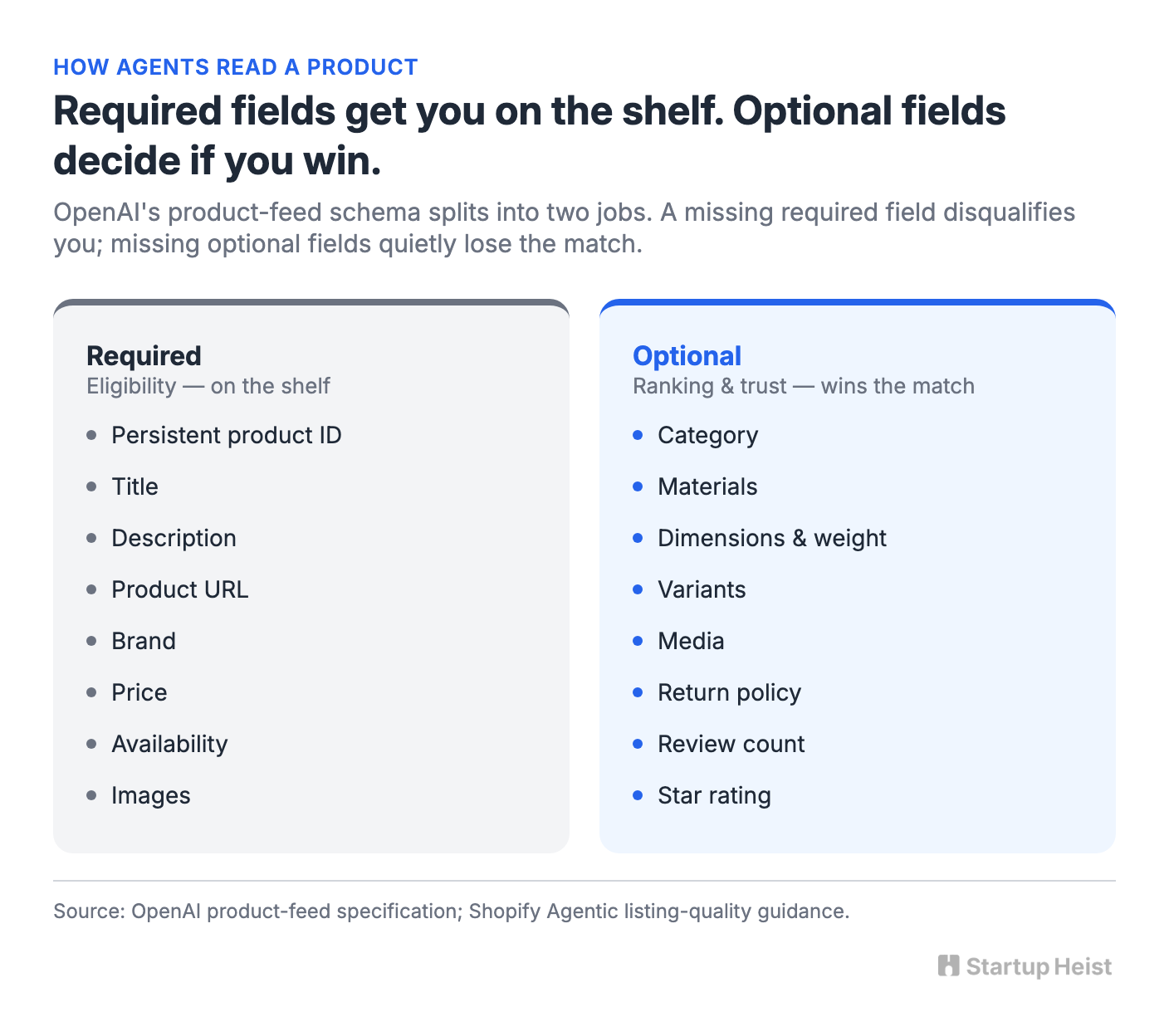
OpenAI's own product-feed specification shows what these systems want. Its schema runs to dozens of fields. A required core keeps a product eligible at all: persistent IDs, titles, descriptions, URLs, brand, price, availability, images. A much larger optional set drives ranking and trust: categories, materials, dimensions, weights, variants, media, return policies, review counts, and star ratings. Required fields get you on the shelf. The optional fields decide whether an agent believes your product fits the request.
Shopify's own guidance points the same direction. Its Agentic dashboard rates each listing with a colored quality indicator built on description completeness, image coverage, product reviews, variant information, and store policies. It offers a query preview showing how a product renders inside each channel, and it tells merchants which listings failed to reach the top results and why. Shopify states plainly that natural-language descriptions help agents match products to requests, and that complete variant data helps agents understand intent around size, color, and style.
This looks less like traditional SEO than it first appears. A search engine could send traffic to a mediocre page because the domain carried authority. A shopping agent has to answer a narrower question: Is it the right material? Is the requested size in stock? Will it arrive in time? Can it be returned? Does it actually fit the use case? A missing fact doesn't cost you a keyword. It disqualifies you. A merchant can sell the perfect product and still lose, simply because the system cannot confirm it qualifies.
Shopify Handles Distribution. Merchandising Is Still on You.
The naive pitch writes itself: "Install our app and get your products into ChatGPT." That pitch is already dead.
OpenAI pulls Shopify product data straight from Shopify Catalog. Individual merchants submit nothing. Shopify now handles AI-crawler discovery natively, automatically serving the machine-readable files that agents look for, and it openly tells merchants they don't need a third-party app to generate them. Within weeks of that rollout, an entire category of "add an llms.txt to your store" apps became pointless. That is the clearest warning any builder in this space will get: undifferentiated plumbing gets absorbed by the platform fast.
Shopify goes further. It gives merchants channel controls, per-channel sales and conversion reporting, a query preview, a listing-quality meter, and recommendations for products that missed the top results. A generic scanner that detects structured data and spits out an "AI readiness score" is not a business. Shopify already ships the score. The commodity tier on the App Store proves it: a cluster of agentic-readiness apps launched in early 2026, most priced between $10 and $50, most sitting at near-zero reviews. The checklist is filling in. The winner has not emerged.
So the opening is narrower and more defensible than "get discovered." It is the remediation and experimentation layer that sits above Shopify's native diagnostics. Shopify tells a merchant a listing is weak. The independent tool repairs hundreds of weak listings at once, preserves the brand's voice, tests the results, and proves which changes actually moved the needle. Diagnosis is the platform's job. Fixing weak listings at catalog scale is the gap it leaves open.
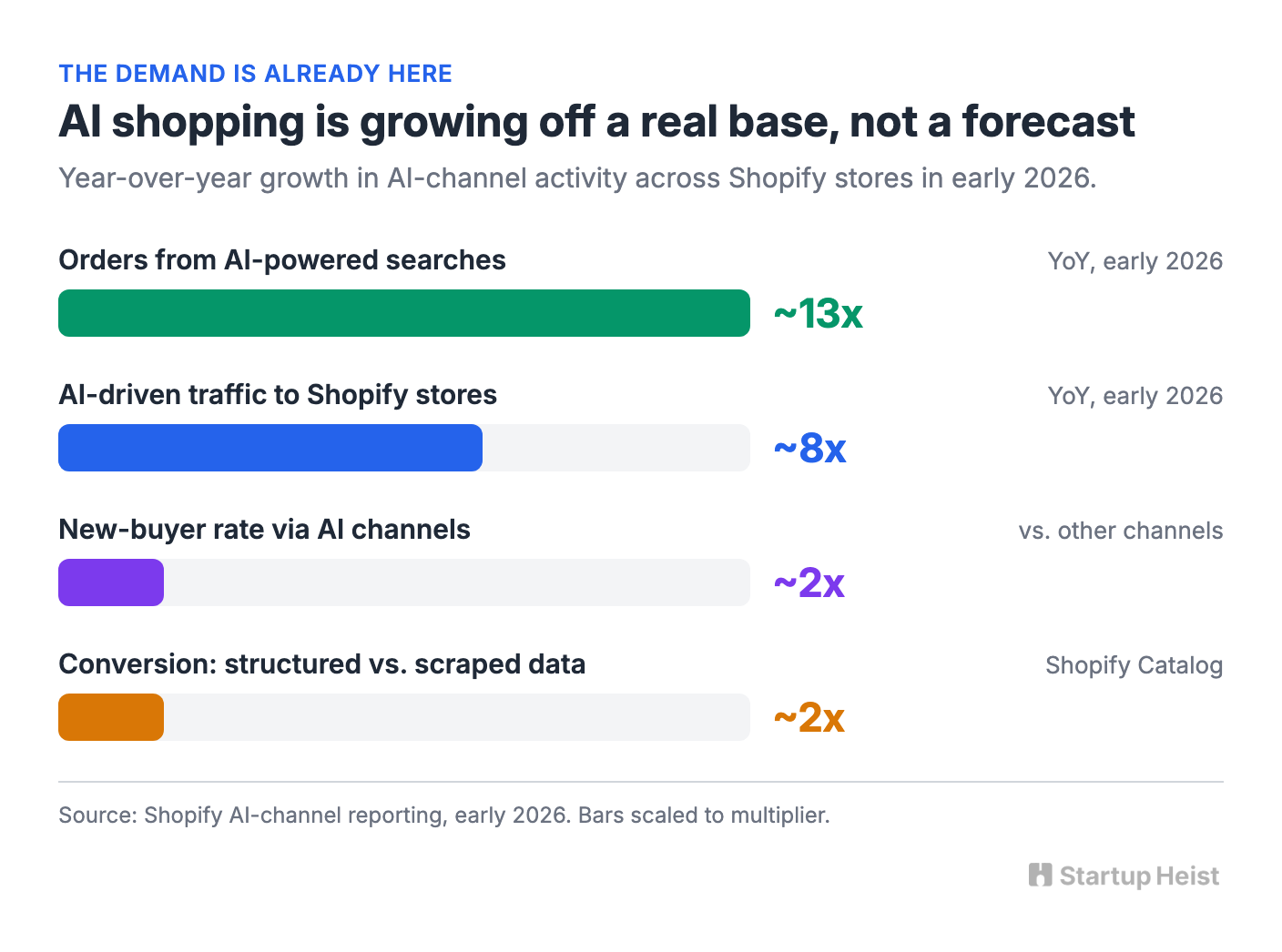
And the demand underneath is real, not speculative. In early 2026, AI-driven traffic to Shopify stores grew roughly eightfold year over year. Orders from AI-powered searches grew about thirteenfold. New buyers arrive through AI channels at roughly twice the rate of other channels. And Shopify reports that searches drawing on its structured Catalog data convert at roughly double the rate of those relying on scraped data. That makes clean catalog data a conversion lever with a number attached, not a housekeeping chore.
The Product: A Catalog Operations Copilot
The best first customer is not the Etsy hobbyist with four listings. It is a Shopify merchant with 50 to 2,000 SKUs, somewhere between $250,000 and $10 million in annual online sales, a small marketing team or a solo founder, and years of messy product data no one has ever cleaned up. They sell things with real attributes: apparel, home goods, beauty, specialty food, sporting goods, pet products, gifts. And they have no feed-management specialist on staff. Big enough to care about incremental discovery. Too small to buy an enterprise platform.
The product does four jobs.
Unlock the Vault.
Join founders who spot opportunities ahead of the crowd. Actionable insights. Zero fluff.
“Intelligent, bold, minus the pretense.”
“Like discovering the cheat codes of the startup world.”
“SH is off-Broadway for founders — weird, sharp, and ahead of the curve.”


