


The Design Evidence Layer: Sell Coding Agents Approved References, Not Another Inspiration Search
AI coding agents can generate a pricing page in seconds. That speed is the problem.
Ask Claude Code, Cursor, or Codex for a "clean modern SaaS pricing section" and you get something competent and forgettable: three cards, one highlighted plan, a monthly/annual toggle, rounded corners, a gradient somewhere. The model knows the statistical shape of a pricing page. What it doesn't know is which specific pattern you want it to imitate, what constraints made that pattern work, whether it passes an accessibility audit, whether it fits your stack, whether your client has approved anything like it before, or whether the reference is safe for commercial reuse.

That missing layer is turning into a business, and several companies have already noticed the first-order version of it. Mobbin, Refero, Fudge, Lazyweb, and 21st.dev all sell design references for AI coding agents over MCP now, with corpora in the hundreds of thousands of screens. The lazy version of this opportunity is dead on arrival: a founder crawls 20,000 websites, embeds the screenshots, and announces "finally, AI with taste."
The heist is one layer deeper. Instead of another design inspiration search engine with an MCP server bolted on, build a structured design-reference dataset that an agent can interrogate while it writes code, with provenance, accessibility evidence, implementation notes, and the customer's own approval history attached to every record. You're selling design evidence as infrastructure, and the defensible part is everything the big galleries can't copy by looking at your UI.
Here's the short version:
The money: 100 Builders at $29 plus 40 Studios at $149 is $8,860 MRR, and Lazyweb already charges $39 a month for MCP access alone.
Inside:
• The V1 stack, schema fields, and five MCP tools
• Three moats a 600K-screen gallery can't copy
• Five-tier pricing from $0 to Agency at $299
• Eight-week launch and the agency cold email
MCP moved the reference library inside the agent
Model Context Protocol matters here because it changes where a design-reference product lives.
In the old workflow, a designer opens Mobbin or Dribbble or a bookmarks folder, finds examples, translates them into a brief, and hands the brief to an engineer. A human searches, a human interprets, a human prompts, and only then does the agent generate. With an MCP server in the loop, the agent asks for evidence itself, mid-implementation: it searches, the dataset returns approved evidence, and it generates within those constraints. That's a far better place to sell data, because the buyer is the tool doing the work rather than the person who has to remember to look.
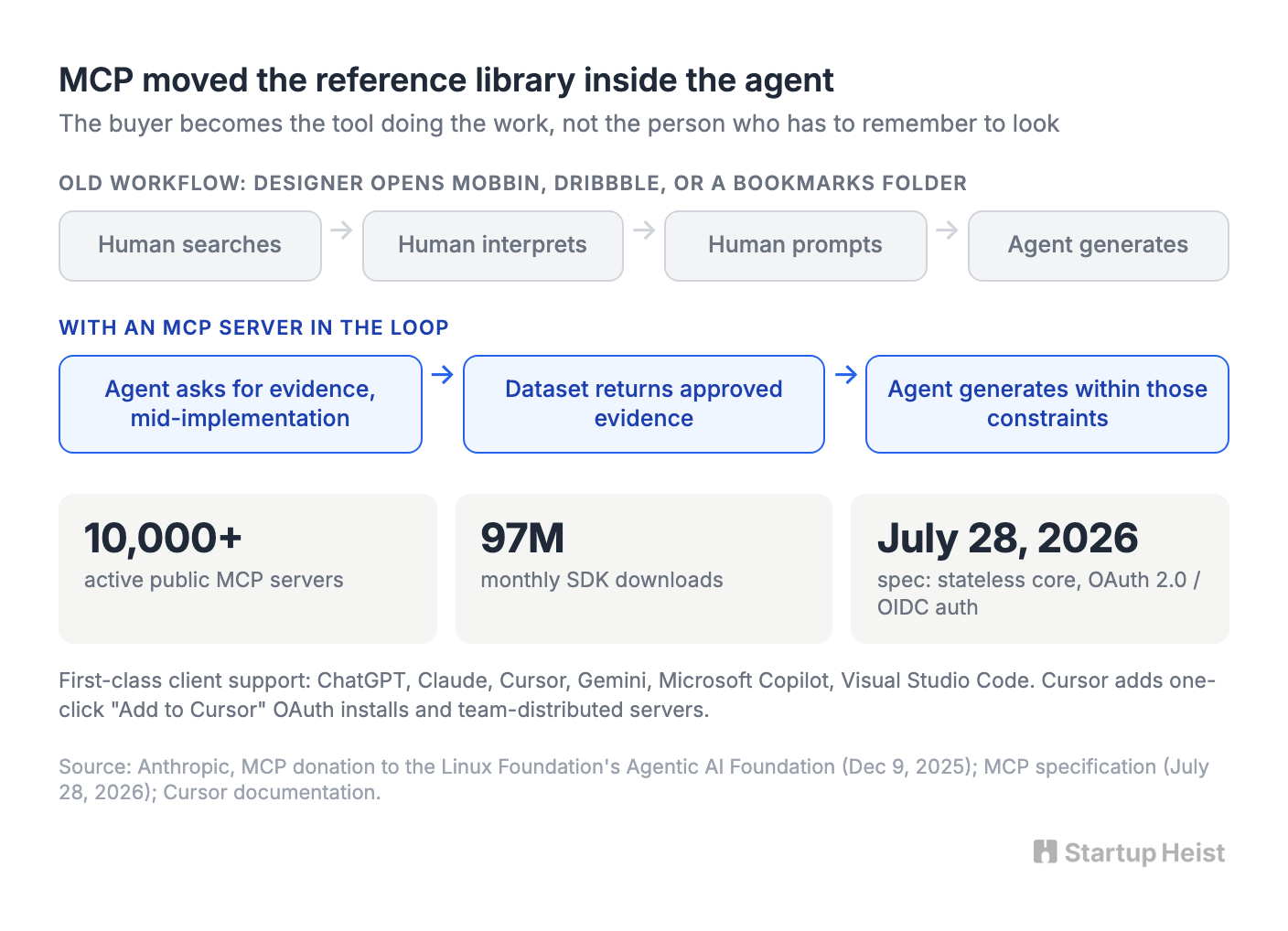
The distribution layer is no longer experimental. When Anthropic donated MCP to the Linux Foundation's Agentic AI Foundation on December 9, 2025, it reported more than 10,000 active public MCP servers, 97 million monthly SDK downloads, and first-class client support across ChatGPT, Claude, Cursor, Gemini, Microsoft Copilot, and Visual Studio Code. The July 28, 2026 specification pushed the protocol further toward ordinary production plumbing: a stateless core, routable `Mcp-Method` and `Mcp-Name` headers so load balancers can handle MCP traffic like any HTTP API, cache-control-style `ttlMs` fields on list results, and authorization aligned with standard OAuth 2.0 and OpenID Connect. Cursor now supports remote HTTP servers, "Add to Cursor" one-click OAuth installs, and team-distributed servers that an admin configures once for every seat.
Team-distributed servers are the detail worth sitting with. An agency can install a shared reference source across its entire team in an afternoon, which means the pipe is already built and the only open question is what flows through it.
"Give AI design taste" is already a crowded shelf
Fudge markets almost exactly that proposition: search roughly 10,000 real websites by font, color, component, page type, and visual similarity, with 30-plus measured design data points per site, a Chrome extension for capture, and hosted MCP access on plans priced at $69 per quarter for Pro and $165 per quarter for Studio. Mobbin went bigger. Its MCP server advertises 621,500-plus shipped product screens, comes included on Pro and Team plans from roughly $10 a month billed yearly, and Mobbin sells a REST API to Team and Enterprise customers on top of that. Refero exposes 142,000-plus screens and 12,000-plus user flows, each carrying structured metadata (description, UX patterns, UI elements, layout) before the agent ever looks at the image, with 8,000 MCP tool calls per month per licensed user. Lazyweb indexes 257,000-plus screens and charges $39 a month for full MCP reports. A1 Gallery goes the curated route with roughly 1,200 hand-tagged sites and measured tokens per section.
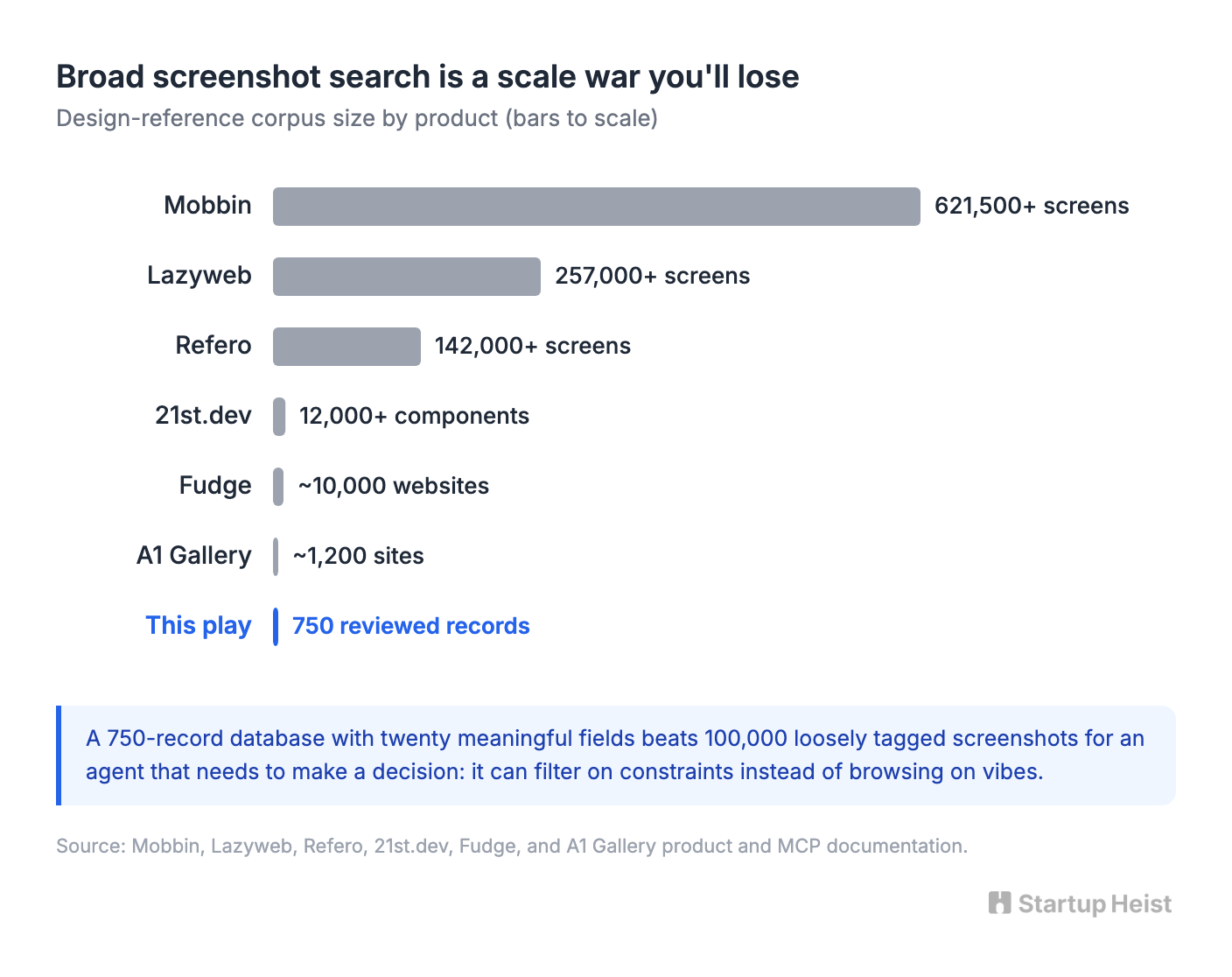
Then there is 21st.dev, which attacks from the implementation side rather than the screenshot side: 12,000-plus React components, templates, and shadcn themes, retrievable through MCP and CLI, with a Builder plan at $6 a month billed yearly and a Team plan at $7.50 per seat that already includes private team components and shared collections. Figma's MCP server plus Code Connect covers the other flank, handing agents a company's own design tokens and component mappings straight from the design file.
So the shelf is full at both ends. Broad screenshot search is a scale war you'll lose to companies with hundreds of thousands of screens, existing audiences, and working ingestion pipelines. 21st owns installable components, and Figma owns design-file fidelity. What none of them sells is the answer to a constrained question: "Give my coding agent three licensed, accessible, implementation-aware UI patterns that satisfy this exact product brief, filtered by what this client has already approved." That gap is where the business lives.
Sell evidence, not inspiration
Consider the request an agent actually receives inside an agency's codebase:
Build a pricing section for a developer infrastructure product. Three plans, monthly/annual billing, a usage-based element, WCAG-compliant contrast, keyboard-accessible billing controls, responsive behavior below 768px, React/Tailwind. Use patterns approved for this client.
A generic inspiration database answers that with pretty pricing pages. A design-evidence system answers with something closer to this:
| Field | Example |
|---|---|
| Component | SaaS pricing section |
| Buyer context | Developer infrastructure |
| Commercial model | Seat + usage hybrid |
| Interaction | Monthly/annual selector |
| Information hierarchy | Recommended plan → usage allowance → overage explanation |
| Accessibility | Keyboard-operable radio group, text-visible savings indicator, contrast reviewed |
| Framework | React / Tailwind |
| Responsive behavior | Cards stack below tablet breakpoint; feature comparison collapses |
| Provenance | Contributor-submitted original |
| Commercial rights | Licensed for reference and agent retrieval |
| Review status | Human-reviewed |
| Implementation notes | Avoid JS-only layout measurement; billing state controlled by URL parameter |
| Source | Named creator/project |
| Workspace policy | Approved for Client A |
| Reviewer rationale | Good fit for technical buyer with usage-sensitive pricing |
The screenshot is the least interesting field in that record. The value sits in the structure around it. A 750-record database with twenty meaningful fields beats 100,000 loosely tagged screenshots for an agent that needs to make a decision, because the agent can filter on constraints instead of browsing on vibes. That's the wedge: a much smaller corpus with dramatically richer records, positioned as "approved interface references for AI coding agents" rather than "search beautiful websites with AI."
Seven hundred and fifty rights-clean, human-reviewed records have to come from somewhere, and where they come from is your first moat.
Provenance is the hidden killer feature
Unlock the Vault.
Join founders who spot opportunities ahead of the crowd. Actionable insights. Zero fluff.
“Intelligent, bold, minus the pretense.”
“Like discovering the cheat codes of the startup world.”
“SH is off-Broadway for founders — weird, sharp, and ahead of the curve.”


