


Housecall Pro Drew the Map. Build Where It Won't Go.
On July 15, 2026, Housecall Pro launched its first trade-specific software packages. It picked HVAC, plumbing, and electrical, and built the packages from patterns across more than 100 million service jobs and feedback from over 200,000 home-service professionals.
The choice of trades was predictable. HVAC, plumbing, and electrical are enormous, well-funded categories with enough technicians and software budget to justify dedicated product teams. The useful part of the announcement is what it implies: field-service platforms are following the path enterprise software took years ago, horizontal tools splitting into specialized vertical workflows, starting with the trades large enough to repay the product investment. Housecall Pro, whose pros already serve one in four American homes, will go deeper into its big three. ServiceTitan already owns the enterprise end of the same trades. Jobber sells breadth.
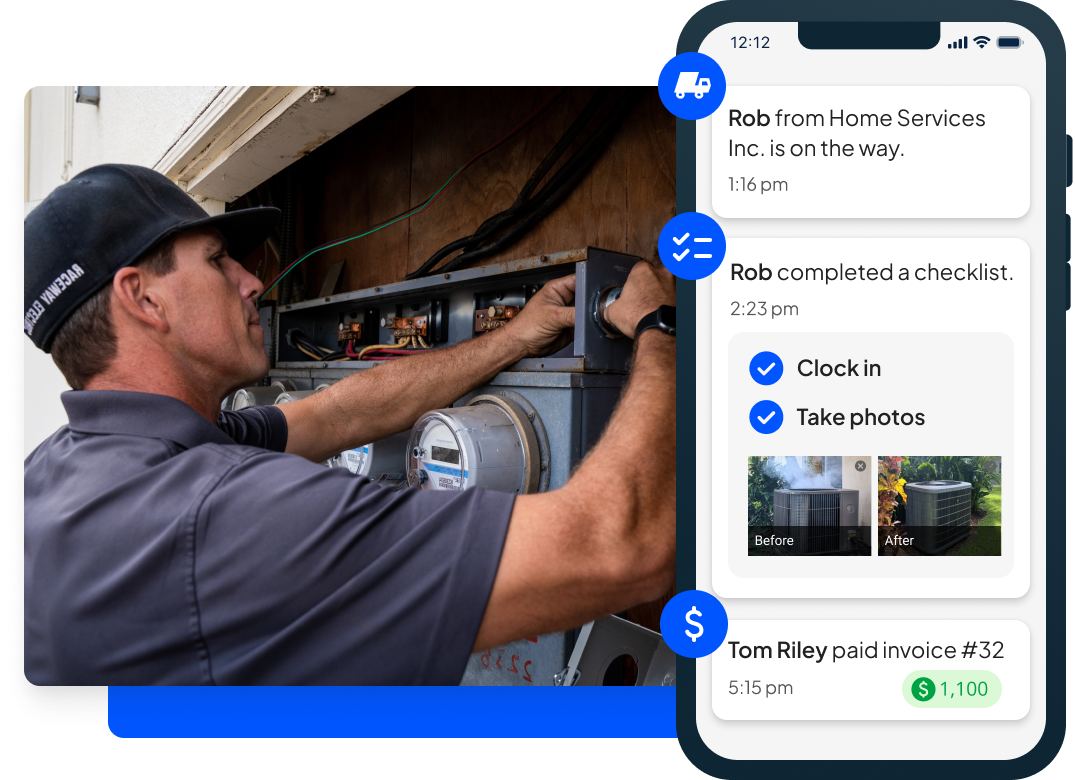
Every smaller trade gets left with two options: run the business on paper tickets, spreadsheets, QuickBooks, and somebody's memory, or buy a broad field service management platform and bend a generic plumbing workflow until it approximates what the company actually does.
Competing with Housecall Pro across home services would be a terrible heist. The real opportunity is one neglected trade where the paperwork is operationally important, the customer returns on a predictable schedule, and generic software can't express the real workflow. The clearest opening is septic pumping.
Here's the opportunity:
The money: Five percent of a 7,717-company market at $249 a month is roughly $96K MRR. One recovered pumping job covers an operator's subscription.
Inside:
• Six-module MVP scoped to 8-12 weeks
• Truck-based pricing that beats tier caps
• Overlay-first wedge that dodges replacement risk
• Four moat layers plus a validation scorecard
Septic sits inside a large service economy. The broader U.S. septic, drain, and sewer cleaning industry generated an estimated $8.7 billion in 2026 across 7,717 businesses. Those figures bundle septic with adjacent drain and sewer work, so treat them as the neighborhood rather than the addressable market. The point is that thousands of small operators run real businesses here, and almost none of them are anyone's priority customer.
This is a path to a durable, capital-efficient vertical SaaS company doing low-single-digit millions in annual recurring revenue, with expansion paths beyond that. The winning product is a compliance-native repeat-revenue system for small septic operators.
The Business Is Recurring. The Software Usually Isn't.
A septic company's product is a long-lived physical asset attached to a property: a specific tank with known capacity, installation history, access notes, site photos, prior pumping records, and a future date when it needs service again.
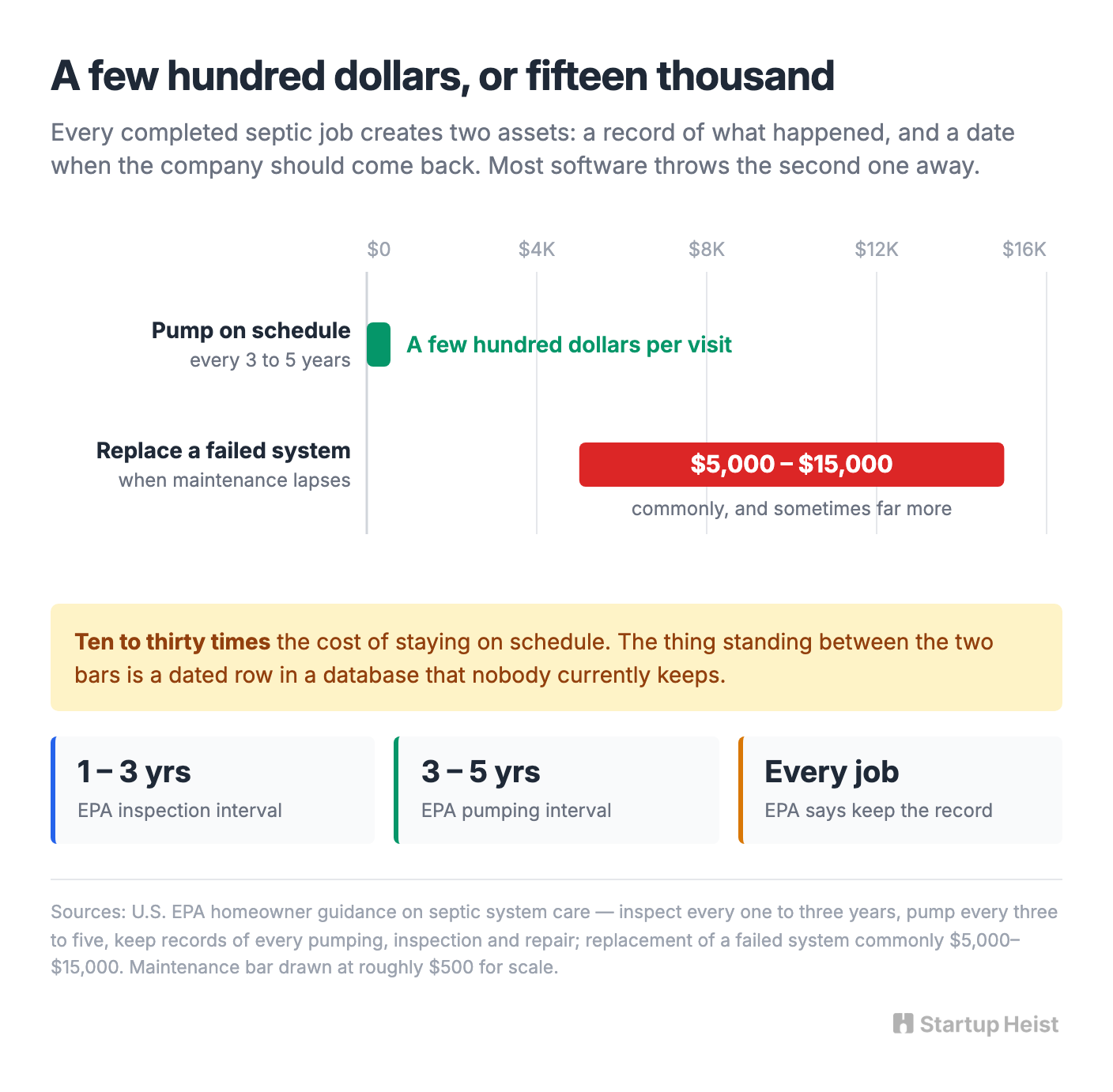
The EPA tells homeowners to have the average household system inspected every one to three years and pumped every three to five, depending on household size, tank capacity, and accumulated solids. It also tells them to keep records of every pumping, inspection, and repair. The economics behind that guidance are stark: a few hundred dollars of maintenance every few years, while replacing a failed system commonly runs $5,000 to $15,000, sometimes far more.
So every completed job creates two assets: a compliance record of what happened, and a future revenue opportunity showing when the company should come back. Most software treats the completed invoice as the end of the transaction. In septic, the invoice should open the next one.
Consider a small operator with 3,000 historical customers. If those records hold reliable last-pumped dates, the company is sitting on a multi-year book of future demand, most of it buried in filing cabinets, QuickBooks notes, and a veteran employee's head. The pitch to that operator is simple: give us your old customer list, and we'll show you which tanks are coming due, contact the homeowners, book the work, dispatch the truck, and keep the paperwork straight. It sounds like operational software, but what it really sells is recovered revenue.
Why Septic Beats "Software for Weird Trades"
Picking an unfashionable trade and rebuilding Jobber with different labels is the losing version of this strategy. Obscurity alone is no moat. Septic clears three bars.
First, fragmented operators. Thousands of independently owned companies, most running one to ten trucks, large enough to feel administrative pain and too small to survive an enterprise implementation. A market like this lets a small software company win customers one at a time.
Second, high-friction records. Pennsylvania requires anyone hauling residential septage to register with the Department of Environmental Protection, which reports roughly 605 million gallons of residential septage generated in the state each year and publishes a spreadsheet of active haulers. Every state draws these rules differently. That fragmentation is a nuisance for a horizontal platform and a product for a focused vendor: correct fields, correct forms, retention rules, transporter IDs, and clean jurisdiction-specific exports translate into fewer missing records and calmer audits.
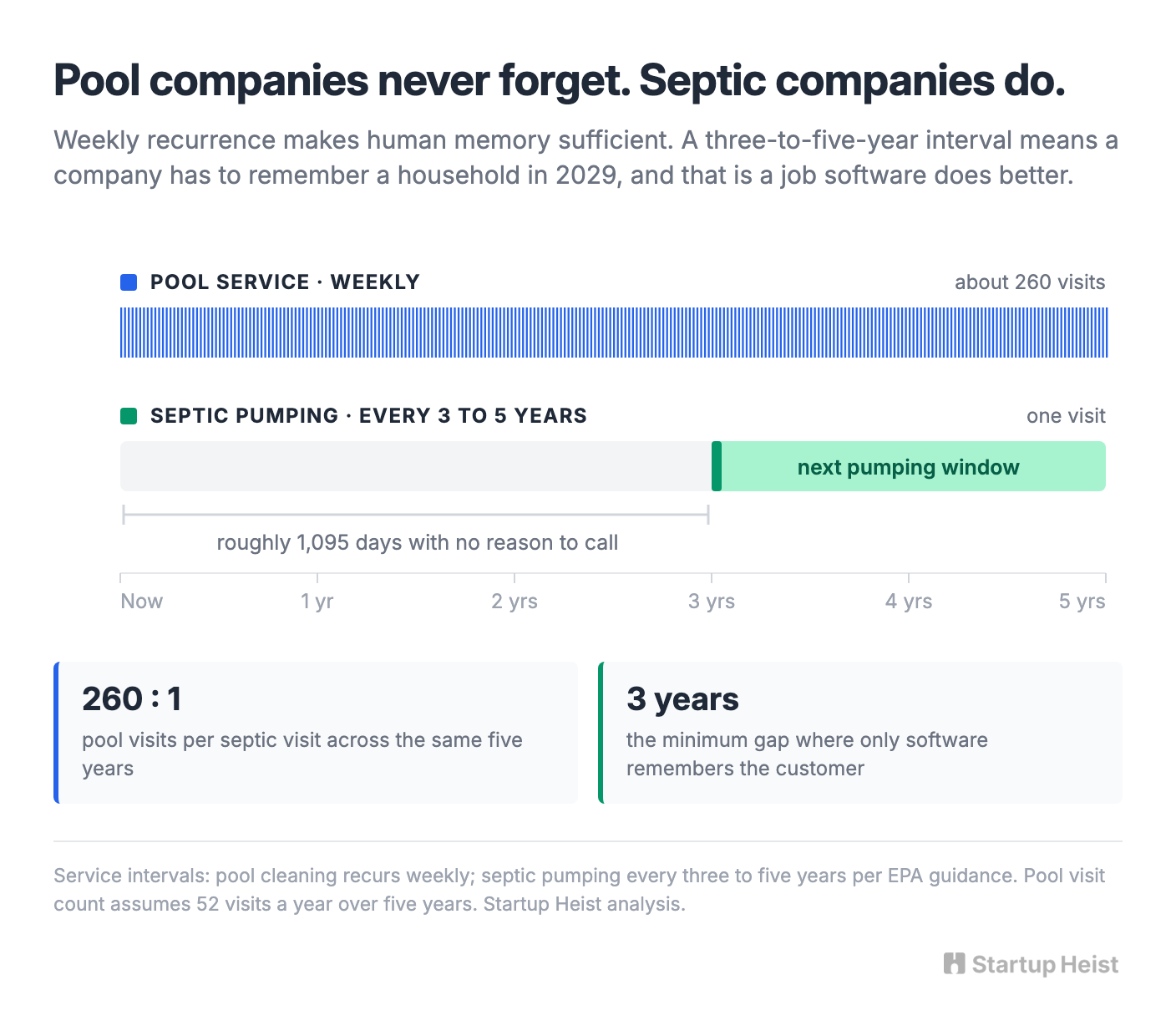
Third, predictable repeat service on a long cycle. Pool cleaning recurs weekly, so the operator never forgets a customer. Septic recurs every three to five years, long enough that a company has to remember a household in 2029, and that is a job software does better than human memory. In this trade the reminder engine is infrastructure.
The Market Is Not Empty, and That's Useful
Septic software already exists. ServiceCore serves septic alongside portable sanitation and dumpster operators. SepTechPro and SepticCycle both market septic-native dispatch, compliance records, and homeowner reminders. PumpDocket sells dispatch, field closeout, trip tickets, and recurring scheduling to pumping companies at published prices from $99 to $454 per month. Look closer at those tiers and the gap shows: the $99 Starter plan caps at 75 active customers and excludes both recurring reminders and regulatory trip tickets. The features this entire thesis treats as the core value only appear at $230 per month. The one-truck operator with 3,000 dusty customer records, the exact business sitting on the most recoverable revenue per dollar of software spend, is priced out of the loop that would recover it.
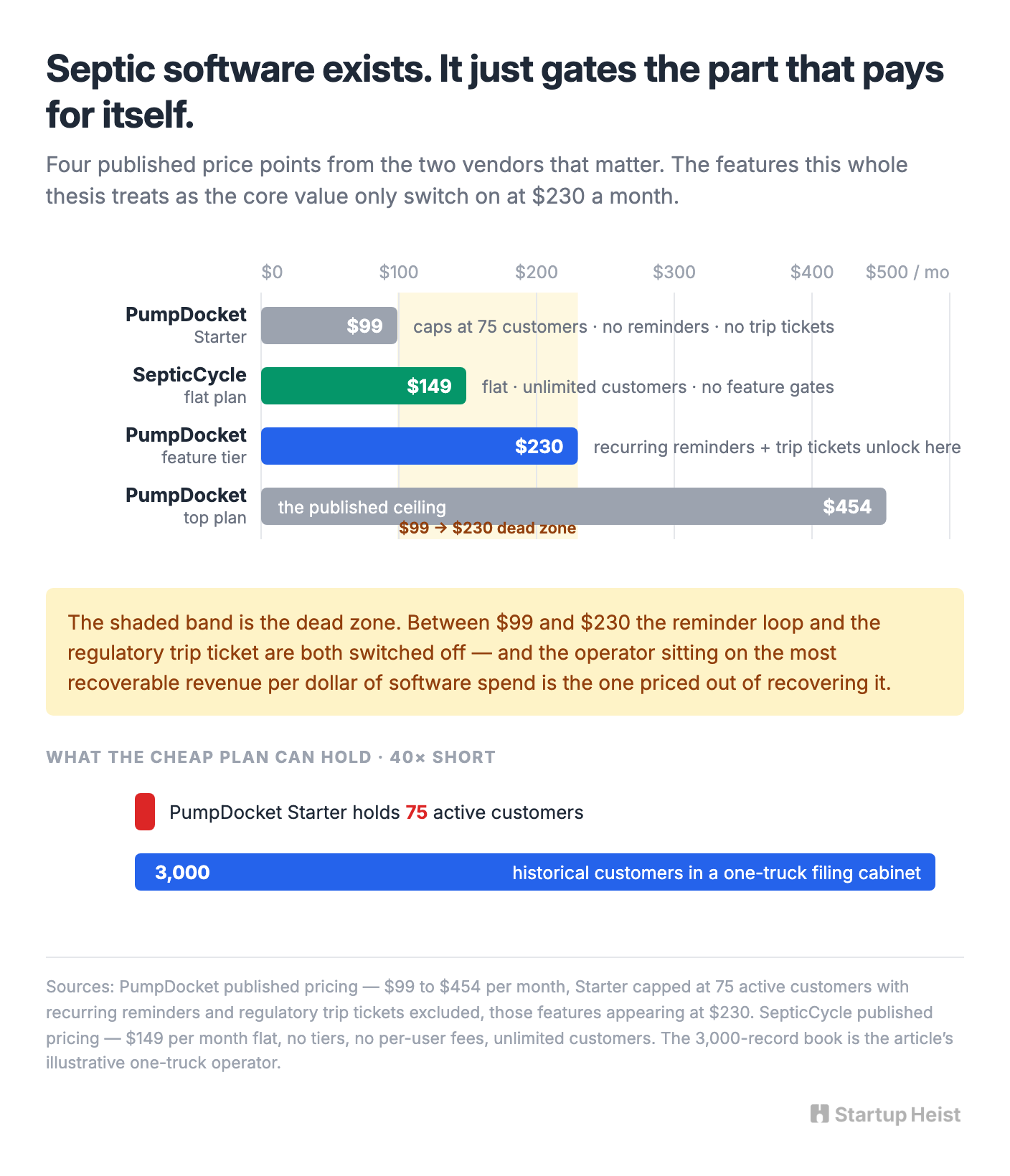
SepticCycle is the sharper comparison, because it already sits on this plan's price point: $149 per month flat, no tiers, no feature gates, no per-user fees, unlimited customers. An operator can buy septic-native dispatch and compliance records today for exactly what the Starter tier below charges. What SepticCycle doesn't sell is the motion this thesis is built on: a due-book that mines historical records for revenue and attributes every booking to the reminder that produced it, a compliance roadmap deeper than one state, and done-for-you migration of the filing cabinet. Several vendors have validated the demand, and the long tail is no longer wide open. The unclaimed ground is narrower: nobody leads with revenue recovery.
The Product: A Due-Book for Septic Companies
Call the core product the due-book: the forward schedule of every system the operator has ever serviced, when it needs attention next, what was found last time, and what should happen now.
Unlock the Vault.
Join founders who spot opportunities ahead of the crowd. Actionable insights. Zero fluff.
“Intelligent, bold, minus the pretense.”
“Like discovering the cheat codes of the startup world.”
“SH is off-Broadway for founders — weird, sharp, and ahead of the curve.”


