


The Blue-Collar Storage Arbitrage Nobody Packaged
There's a gap in U.S. commercial real estate that most operators walk past every day. On one side: a plumber who needs a secure place to park a van, stash copper fittings, and take a monthly pipe delivery. On the other: a landlord with a fenced corner of a 40,000-square-foot building that no full-bay tenant will touch. These two people need each other. They almost never find each other.
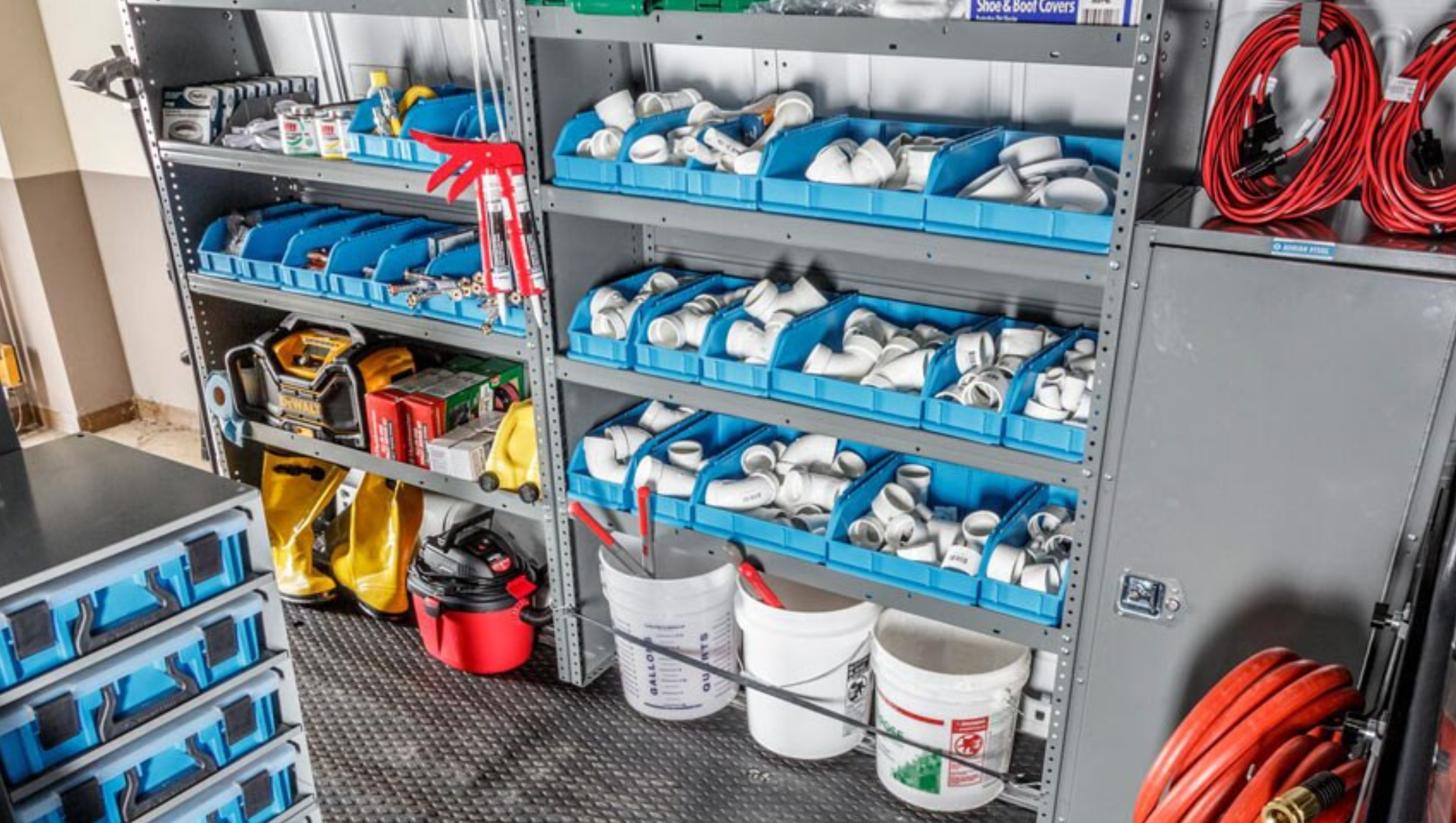
Fixing that mismatch is a real business. Not a venture moonshot on day one. A sharp, local, cash-flowing arbitrage in small-bay industrial real estate that can compound into something bigger over three to five years.
The opportunity is a tightly scoped brokered micro-leasing marketplace that translates awkward industrial inventory into use cases small contractors and tradespeople understand, and collects fees on the match.
Here's the shape of it:
The money: 30 closed matches a month at a $400 placement fee is $12K MRR solo. Layer a tenant membership at $49/mo and local density compounds.
Inside:
• One-city launch playbook and target markets
• Three revenue models with real math
• Airtable + Softr MVP fields and workflow
• Cold outreach template for landlords
The Market Isn't Collapsing. It's Splitting.
The usual industrial real estate headline is noise. Cushman & Wakefield pegs national industrial vacancy at roughly 7% in Q1 2026, and leasing demand has started to recover. That story is about warehouses the size of a Target. You want the other story.
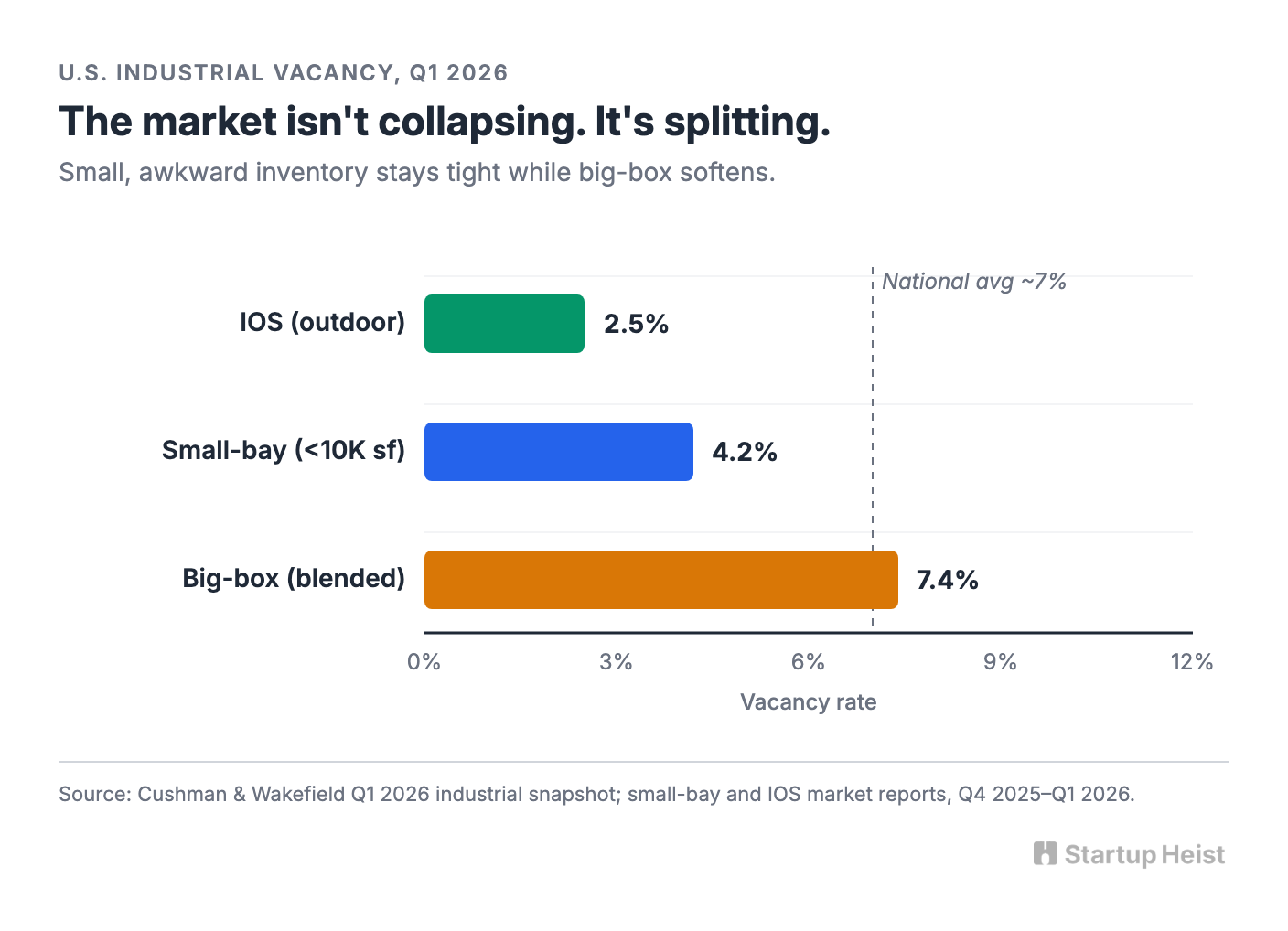
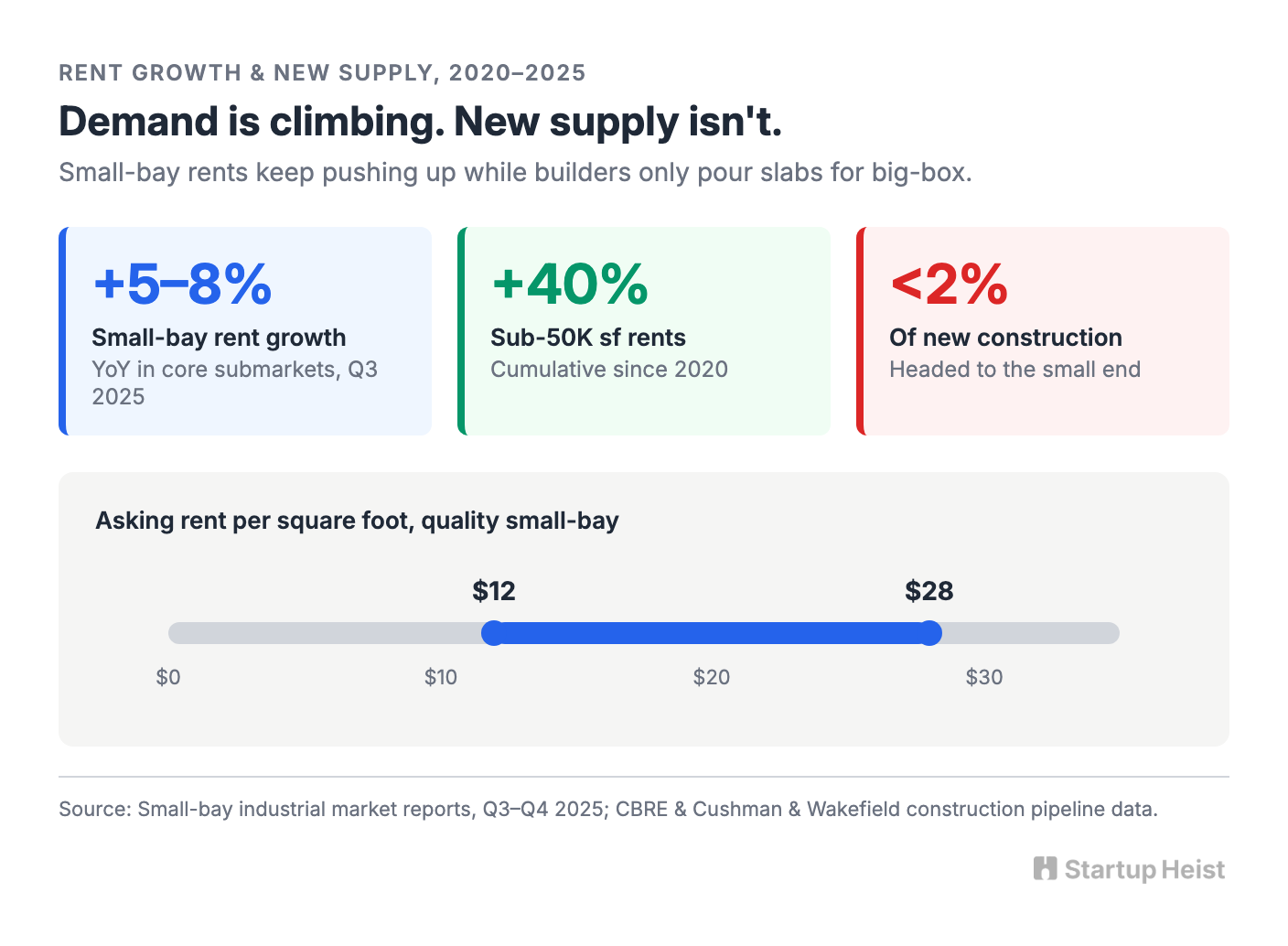
Small-bay vacancy — everything under 10,000 square feet — sits closer to 4.2%. Big-box is around 7.4% blended, and closer to 10-11% in true large-format product. Small-bay rents in core submarkets grew 5% to 8% year over year in Q3 2025 while big-box rents stayed flat or fell. Asking rents on quality small units now run $12 to $28 per square foot, and sub-50,000-square-foot space is up more than 40% since 2020. Less than 2% of new industrial construction is small-bay.
A durable structural gap. Too little supply, steady demand, almost no new construction headed for the small end.
The Quiet Arbitrage Hiding in Big Buildings
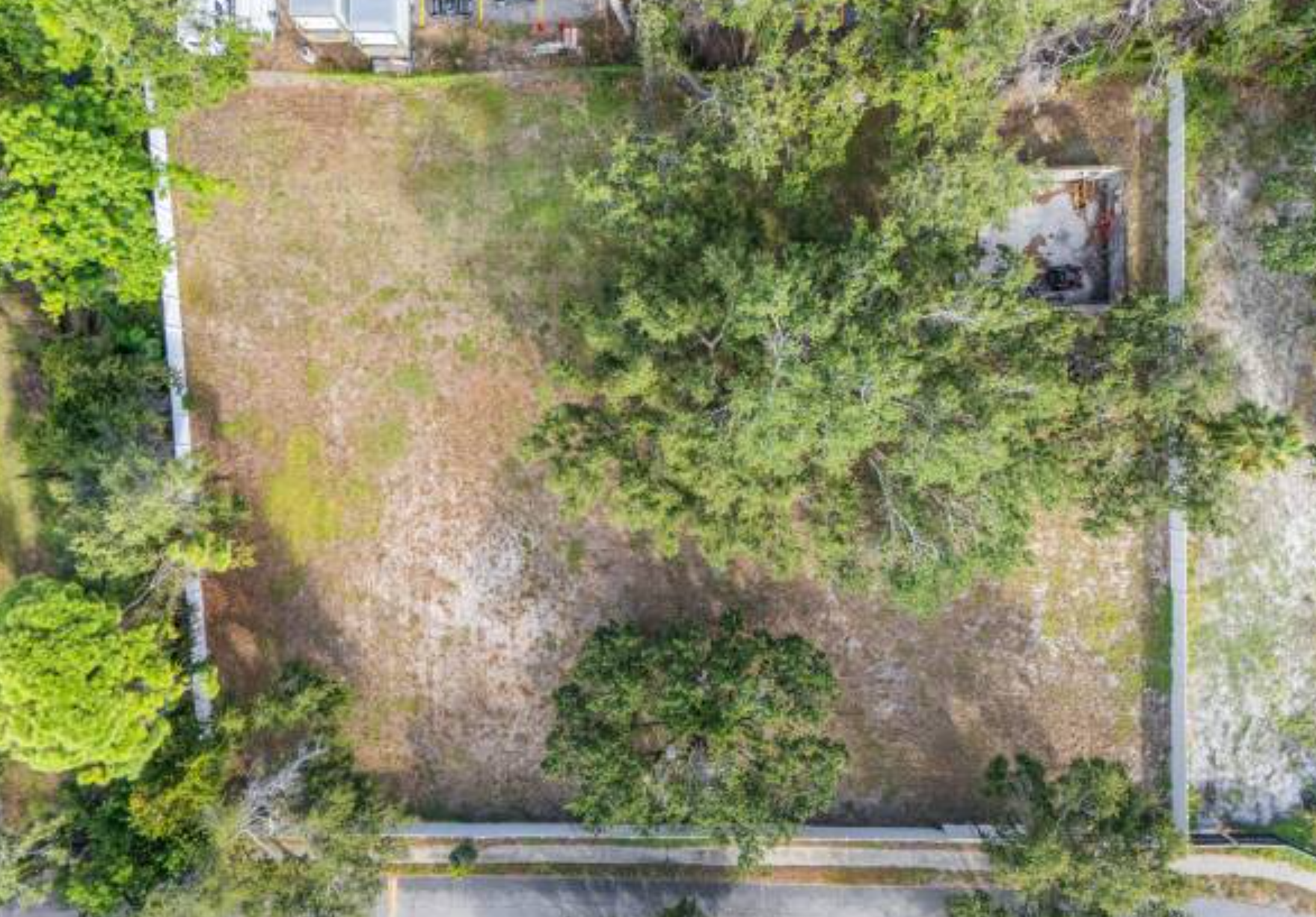
Most of the tight small-bay inventory today is already built. It's just misrouted. A 20,000-square-foot industrial owner has a 600-square-foot fenced corner, an unused yard behind the dock, or a partially vacant bay too small to market. Selling that through a traditional broker is friction the broker doesn't want. So it sits. Meanwhile, the plumber drives past it every morning looking for somewhere to park his van.
Flex operators prove the demand is there. WareSpace leases 200- to 2,000-square-foot units from under $700 a month with six-month terms. ReadySpaces rents 200 to 5,000 square feet with 90-day minimums, month-to-month after. Neighbor, which has raised over $60M from investors including Andreessen Horowitz and Fifth Wall, runs a peer-to-peer storage and parking marketplace across every U.S. city. These businesses are full. They take the polished inventory off the table while leaving the awkward stuff untouched.
Your play is everything they skip.
Industrial Outdoor Storage Is the Reveal
Institutional capital is piling into Industrial Outdoor Storage: the category covering truck yards, trailer parking, container staging, and contractor compounds. By one market forecast, the U.S. IOS market is estimated around $228 billion in 2025 and projected to hit $367 billion by 2033. IOS vacancy averaged about 2.5% in Q4 2025 — tighter than even small-bay.
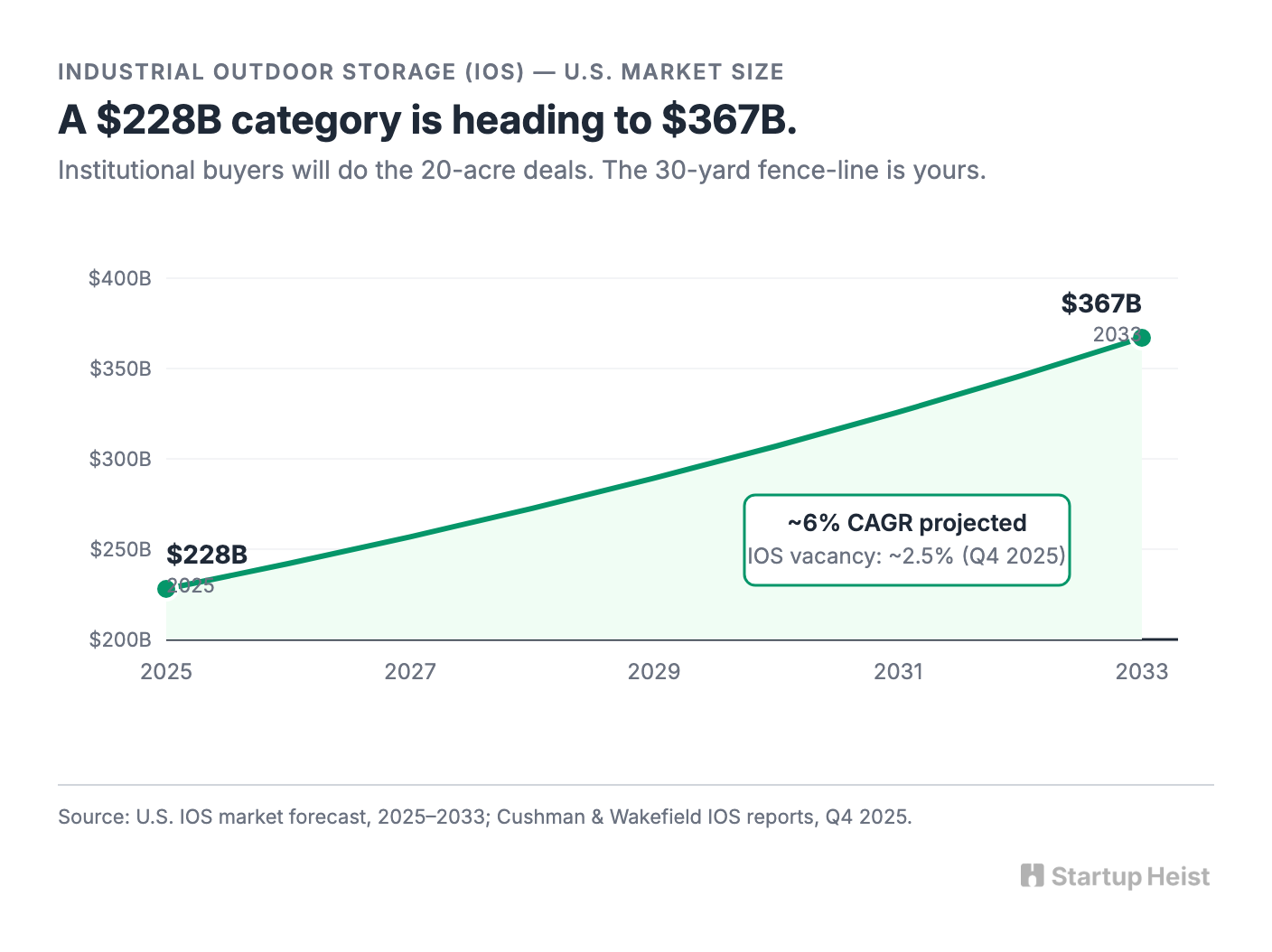
Zoning and community resistance constrain new supply. Electrified outdoor sites, with power already pulled for EV depots and powered equipment, command 20% to 30% rent premiums. Institutional buyers will do the 20-acre yard deals. What they won't do is the 30-yard fence-line sublease for a local HVAC crew.
That deal is yours.
Why This Can Work Now
Three conditions line up:
- Small-bay and outdoor inventory is structurally tight, so rents hold.
- Large-format owners have more slack post-2024 peak and will entertain creative occupancy they would have ignored two years ago.
- Existing flexible-space and storage marketplaces validate demand but leave loose, local inventory unaggregated.
Add one more: tradespeople are already buying. Plumbers, electricians, and small GCs already spend $200 to $1,200 a month on storage units, yard fees, and truck parking. You're not teaching them a new behavior. You're giving them a better shelf.
Where the Wedge Actually Is
Don't try to build "the Airbnb for industrial space." That's how you burn capital.
The wedge is narrower and more defensible: month-to-month micro-leasing for tradespeople in one secondary U.S. city, focused on dead warehouse corners, fenced yards, truck parking, and delivery-friendly overflow space.
WareSpace and ReadySpaces are facility operators. They master-lease buildings, subdivide, add amenities, and run a hospitality-flavored product. That's a capital-heavy model. You're not competing on polish.
You're helping owners and brokers monetize inventory those operators will never touch: weird corners, partially used yards, the 400-square-foot sliver next to the freight elevator, the fence line that could hold three trailers. This inventory already exists inside someone else's footprint. Your job is to find it, translate it, and match it to a tradesperson who can actually use it.
That translation is the moat at the beginning. Not software. Product language.
What the Product Actually Is
Strip the marketplace language. At MVP, this is a brokered lead-gen and matching engine with a thin software wrapper. A two-sided Rolodex with a website.
Customer-facing promise:
- Secure truck parking
- Small indoor storage for tools, inventory, fittings
- Fenced yard space for trailers and materials
- Delivery-friendly access when the supplier drops 20 lengths of pipe
- Month-to-month or short initial term
- No pretending to be a real warehouse tenant
Supply-facing promise:
- Monetize dead corners and non-core space
- Fill awkward inventory without chasing full-building tenants
- Prequalified local operators, not random consumers
- Simple agreements, recurring rent, low foot traffic
List inventory by use case, not CRE jargon. "400 SF industrial flex" means nothing to an electrician. Speak his language:
- "1 van + tools + occasional pallet drop"
- "Fenced yard for one trailer and equipment"
- "Contractor storage with roll-up door and loading access"
- "Overflow warehouse corner for a mobile service business"
Pick One City. Start Ugly.
Don't pick Dallas. Don't pick Los Angeles. Don't pick "nationwide."
Pick one secondary market with three things:
Unlock the Vault.
Join founders who spot opportunities ahead of the crowd. Actionable insights. Zero fluff.
“Intelligent, bold, minus the pretense.”
“Like discovering the cheat codes of the startup world.”
“SH is off-Broadway for founders — weird, sharp, and ahead of the curve.”


