


Austin is trying to turn its backyard into its best housing stock. The city's HOME amendments let property owners build up to three homes on single-family lots, dropped off-street parking requirements, and pushed the minimum lot size for an accessory dwelling unit down to 2,500 square feet. The rules got friendlier. The paperwork did not.
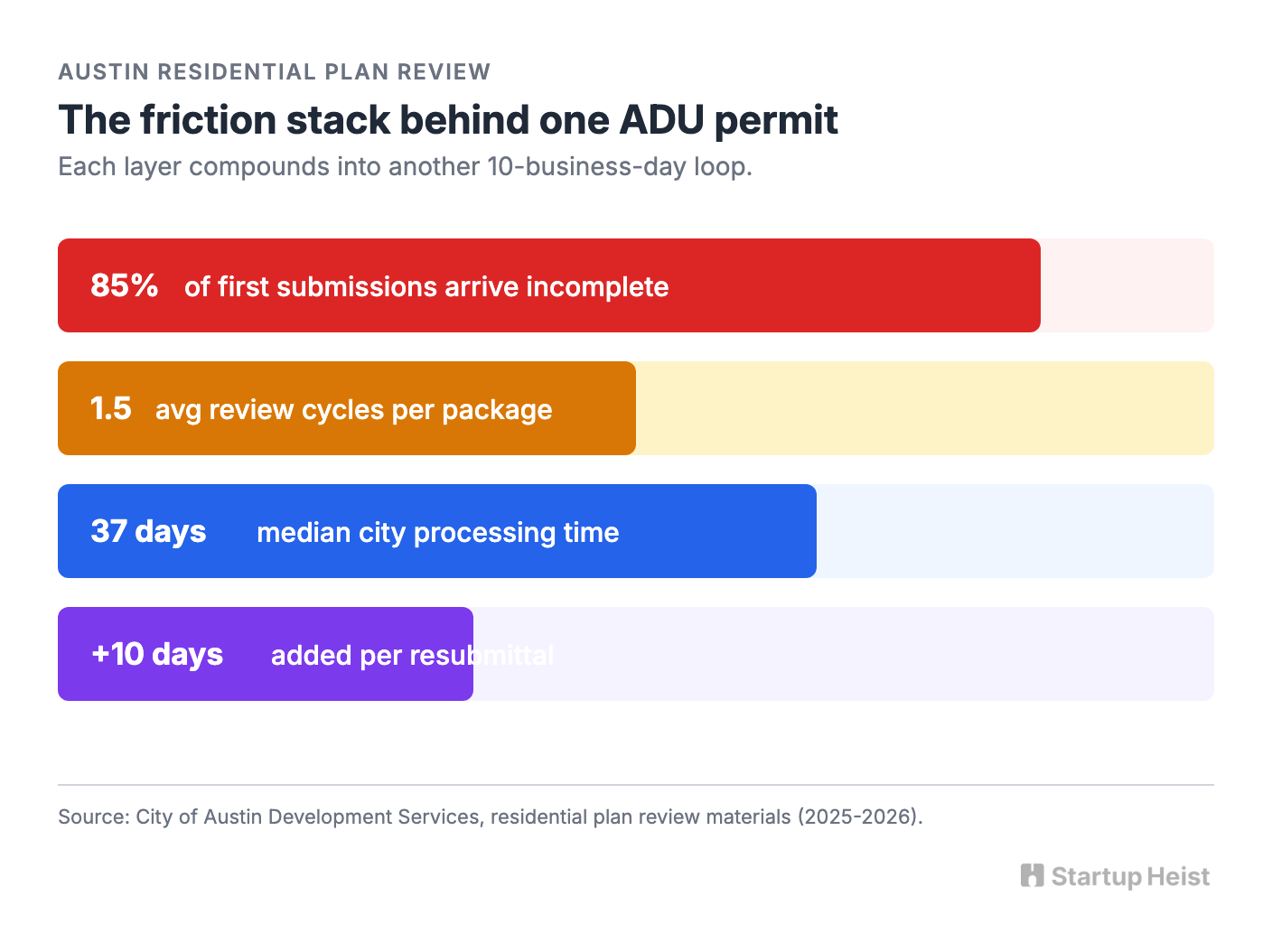
The city's own Development Services materials route Austin ADU permit applicants straight into the hard stuff: zoning districts, setbacks, lot and building coverage, impervious cover, unique addressing, fire separation, and technical-code consultations. Austin's own development-process materials have flagged that a large majority of initial applications, by some accounts roughly 85%, arrive incomplete enough to slow review. Publicly, Austin's residential plan review now runs about 1.5 cycles and a median of 37 days in processing. Most first submissions come back with comments. Every resubmittal adds another ten business days to the clock.
There's the crack in the wall: a city that wants to approve ADUs faster, a permit desk that keeps bouncing packages for fixable reasons, and a queue of designers, expediters, and small builders eating the delay.
Here's the opportunity:
The money: Ten expediter firms at $1,500/month plus 25 solo scans at $199 lands near $20K MRR. Austin ADUs now run $125K–$200K each.
Inside:
• Five-bucket scan spec for ADU plan check
• Pricing ladder from $199 scan to $1,500/mo
• Cold email that converts local expediters
• Three-moat defense against PermitFlow, Archistar
The macro is pushing more owners into the same queue
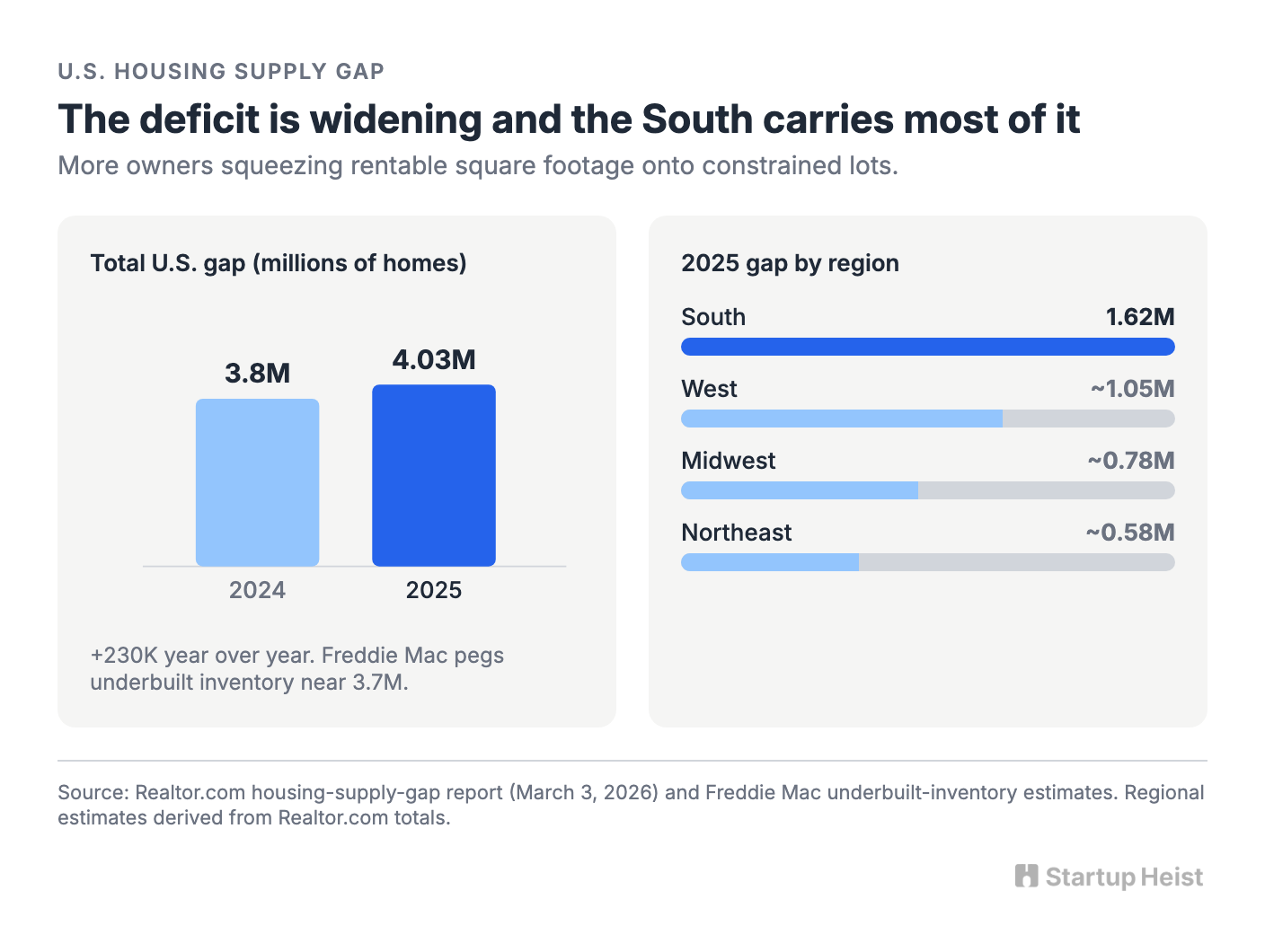
Realtor.com's March 3, 2026 housing-supply-gap report put the U.S. deficit at 4.03 million homes, up from 3.8 million the year before, with the South carrying the largest regional shortfall at 1.62 million. Freddie Mac puts underbuilt inventory at around 3.7 million units.
Financing followed. Fannie Mae published SEL-2025-08 on October 8, 2025, expanded eligibility to let one-unit primary residences carry up to three ADUs, and for the first time allowed projected ADU rental income to count toward mortgage qualification, up to 30% of qualifying income drawn from one ADU even on properties allowed up to three. The Desktop Underwriter 12.1 update lands March 21, 2026, which means automated underwriting can process that ADU rental income without manual override. Friction gone. Demand tailwind locked in.
None of that makes ADUs a trillion-dollar category. It does guarantee one thing: more owners, designers, and small builders will keep trying to squeeze rentable square footage onto constrained lots, and more of them will keep hitting city permitting complexity.
The adjacent market is real, but it is not this
The obvious reaction is "build AI for permitting." Serious capital is already there. PermitFlow closed a $54 million Series B on December 2, 2025 at a reported $500 million valuation, with over $20 billion in construction value running through its platform and customers like Lennar and Amazon. Symbium sells a $50 standard plan-check subscription to roughly 60 California cities. Archistar signed on with the City of Austin itself for an AI Pre-Check that went into expedited residential plan review on February 2, 2026, and claims deployments in 25-plus cities worldwide, with its Los Angeles wildfire recovery tool reportedly cutting staff review time by about 54%.
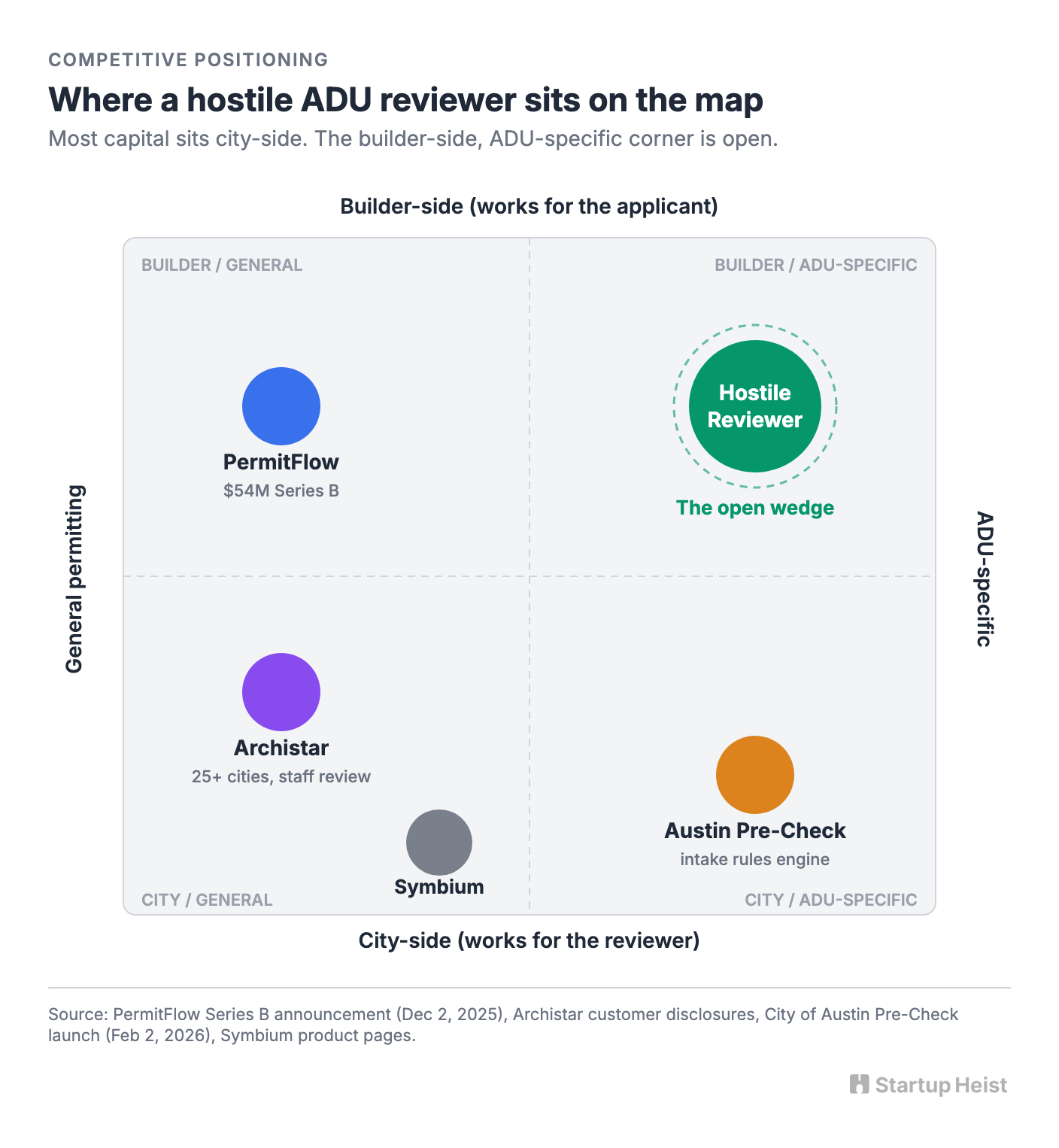
Read the fine print and a lane opens. Most of these products sit on the city side of the counter: eligibility lookups, intake screening, completeness automation, faster staff review. Builder-facing, city-specific, drawing-level QA across the whole submission package, site plan, floor plan, elevations, survey, and supporting forms, is still a thin layer, especially for ADUs. Austin's own Pre-Check tool is explicitly a rules-based engine embedded in intake, not a hostile external reviewer working for the applicant. That's the wedge. Not a permitting operating system. A pre-submission risk scanner that reads the package the way an Austin reviewer would, and flags the 20 mistakes that cause the bounce.
The customer is the professional who already eats this cost
Homeowners don't buy permit software. Builders, designers, permit runners, and prefab ADU operators buy time compression. An Austin ADU now runs $125,000 to $200,000 for a standard 500-square-foot detached unit, with base permit fees of $1,500 to $3,500 that often reach $7,500 or more once utility hookups and tree reviews enter the picture, and a total timeline to move-in of three to twelve months. A permit expediter on an ADU charges $2,000 to $5,000 and bills $75 to $300 an hour for the manual navigation that follows.

The professional running five or twenty of these a year feels every rejection cycle. They pay in staff hours, client confidence, carrying costs, and reputation. They're already spending money to avoid this pain. They're the buyer.
The product: a hostile reviewer in a tab
Picture the simplest version. The user drags a PDF package into a browser. Site plan, floor plan, elevations, survey, supporting forms. A few minutes later they get back two artifacts: a redlined PDF and a reviewer-style issue log with code citations. Every flag carries a confidence score so the user can tell "likely fatal" from "likely reviewer comment" from "manual check recommended."
That confidence score is the whole product philosophy. Austin's rules are nuanced. Some checks are objective and machine-friendly: setbacks, coverage math, sheet presence. Others depend on interpretation, parcel conditions, or documents the scanner doesn't have. A tool that pretends to be a permit approval engine dies the first time it misses an exception. A tool that behaves like a sharp-eyed senior reviewer with citations and hedges becomes indispensable.
Version one should check five buckets, ranked by how often each triggers a comment round:

Unlock the Vault.
Join founders who spot opportunities ahead of the crowd. Actionable insights. Zero fluff.
“Intelligent, bold, minus the pretense.”
“Like discovering the cheat codes of the startup world.”
“SH is off-Broadway for founders — weird, sharp, and ahead of the curve.”


