


Patient Carts Are Not Abandoned Carts
Open any Shopify brand's email program and the script is identical. Someone adds to cart, leaves, and within the hour gets a message that reads like a waiter tapping them on the shoulder mid-conversation: "You forgot something." Two hours later: "Still thinking about it?" Then the discount code. Then the escalation. Then the guilt.
That sequence was designed for a shopper who wandered off by accident. For a growing share of younger buyers, it's the wrong script at the wrong time.

On March 23, 2026, RTB House published its "Before They Buy" U.S. consumer study, surveyed with Cint across 1,000 respondents split evenly among Gen Z, Millennials, Gen X, and Boomers. Fifty percent of Gen Z shoppers sit on what's in their cart for two or more days before checking out. Only 25 percent of Boomers do the same. Only 40 percent of shoppers arrive at an ecommerce site with a specific item in mind. The other 60 percent are browsing.
Call it what it is: a decision-architecture problem dressed up as a Shopify cart abandonment problem. And it's quietly reshaping what "recovery" should mean in 2026.
Here's the opportunity in one block:
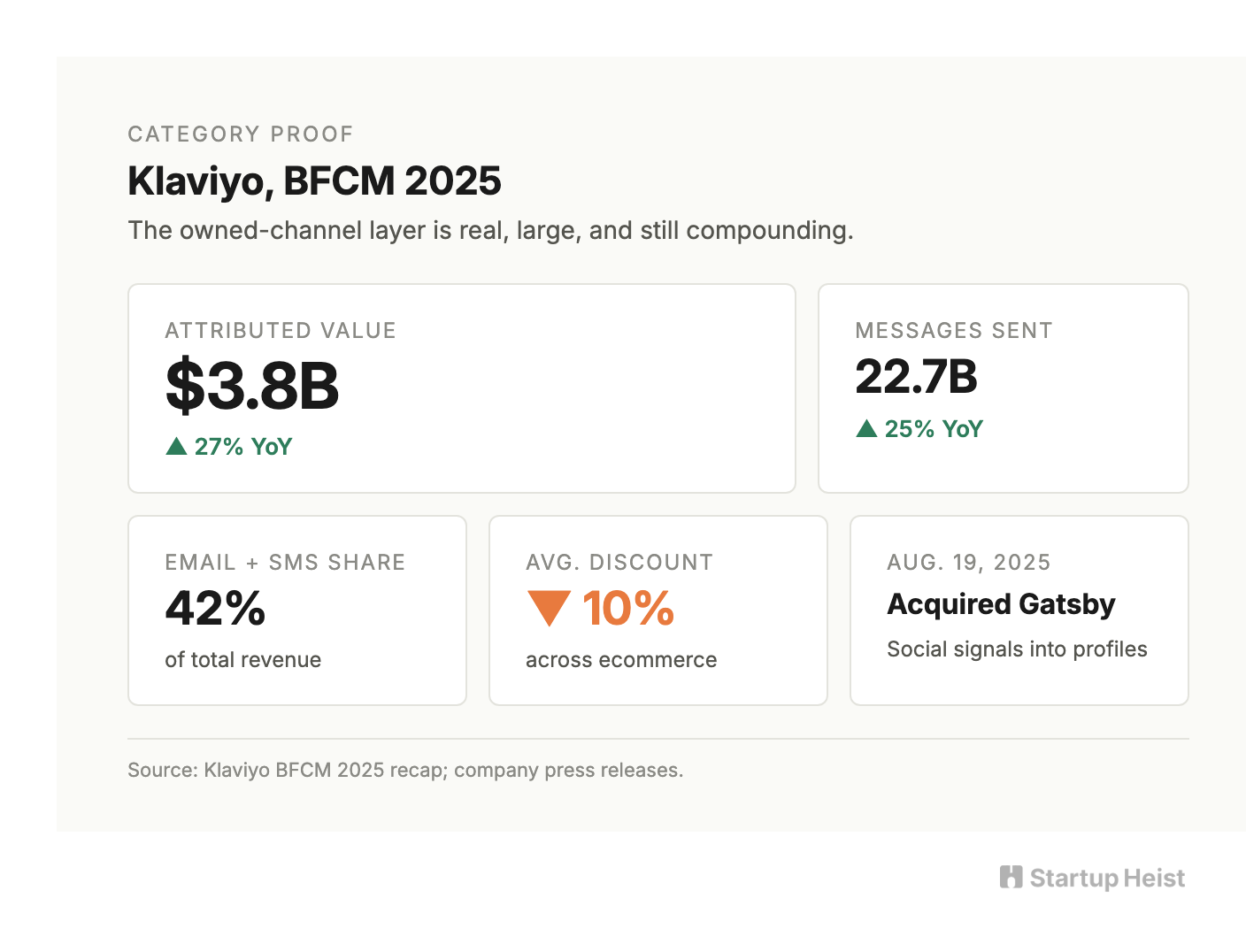
The money: Ten customers at a blended $1,000 per month gets you to $10K MRR. Klaviyo drove $3.8B during BFCM 2025, up 27 percent year over year. The category is real.
Inside:
• Patient-cart segmentation rules that work
• The 48/72/5-day recovery sequence
• Peer-sharing mechanic with attribution
• Three-tier pricing from $499 to $5K setup
What Gen Z is actually doing with your cart
The default model inside Klaviyo accounts, Shopify dashboards, and retention agency decks still assumes hesitation equals distraction. Pull the customer back before the tab closes. Send the reminder, then the nudge, then the offer. That model is optimized for a buyer who's almost there. Nudges work on people whose only obstacle is a ringing phone.
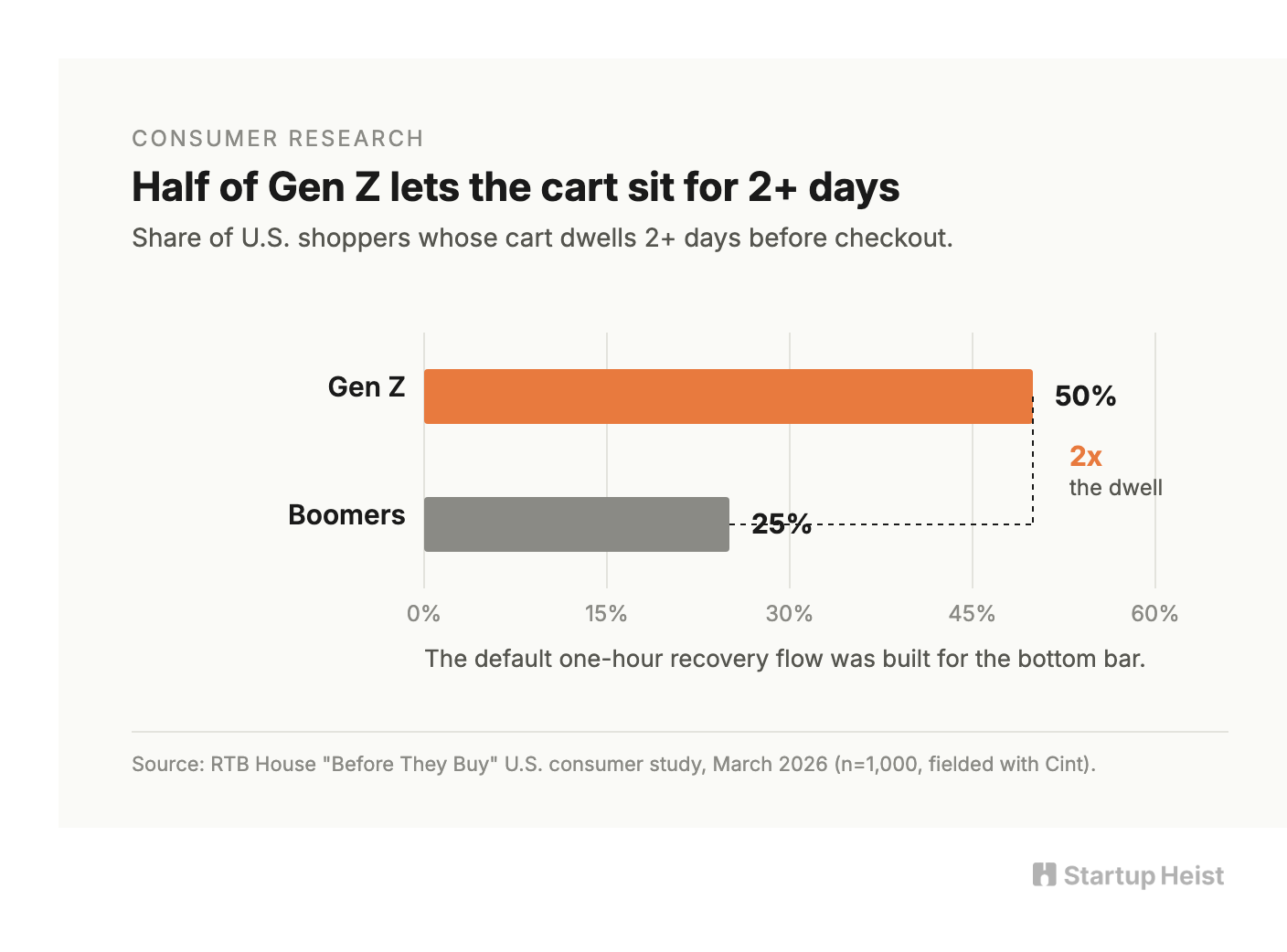
Gen Z doesn't use the cart that way. They use it as a fitting room. They use it as a shared Google Doc with three group chats running in parallel. They save five colors to compare in natural light. They screenshot the checkout page and ask a friend whether the $78 top reads like them or like their aunt. They wait for Friday's paycheck. They revisit the product three times over the weekend while half-watching a show. Only then do they decide.

Researchers now call this cohort "research-heavy." Even for purchases under $100, most buyers visit a site multiple times before buying. The cart is a staging area for a social, comparative decision that unfolds over days. When a brand drops a "you forgot something" abandoned cart email ninety minutes into that process, it doesn't accelerate the sale. It interrupts the deliberation. For a Gen Z-heavy audience, the default Gen Z cart abandonment flow reads like a needy text from someone they met once at a party.
The incumbents are busy, not asleep
The plumbing layer is crowded. Klaviyo, Attentive, Postscript, and Omnisend own almost every owned-channel Klaviyo flow inside serious Shopify brands. Klaviyo reported $3.8 billion in attributed value during Black Friday and Cyber Monday 2025, up 27 percent year over year, with email and text driving 42 percent of total revenue even as discounts fell 10 percent across ecommerce. Klaviyo sent 22.7 billion messages across BFCM 2025, up 25 percent year over year. On August 19, 2025, Klaviyo acquired Gatsby, a social-automation tool that pulls DMs, mentions, and UGC into owned customer profiles. More recently, Klaviyo shipped Customer Hub, which gives shoppers a persistent home for wishlists and saved carts tied to their profile. The direction is clear: Klaviyo is moving toward social signals and cart-as-staging-area behavior, not away from them.
A founder walking into this category with "better cart emails" is walking into a fight the incumbent already wins. Yet the same incumbents still optimize channel mechanics rather than decision tempo. Klaviyo is getting better at when to send email versus SMS versus RCS. It doesn't yet default to the idea that some shoppers should not be messaged for forty-eight hours. Customer Hub is adjacent to the behavior. It isn't a "patient cart" segment.
That gap is small. It's also real. Most of the industry is tuning the radio while almost nobody is asking whether the song should start later.
The wedge: build a behavior, not another app
Another cart abandonment app isn't the play. There are dozens in the Shopify App Store, they all wire into the same event streams, and they all fight for the same margin. A handful of generic "share your cart" utilities also exist — Social Share Cart by DevCloud, CSS: Cart Save and Share, CBB Keep & Share Your Cart, and a few others. They give a shopper a share link. None of them tie that link to deliberation timing, suppress the standard recovery flow, or attribute downstream revenue back to the original shopper.
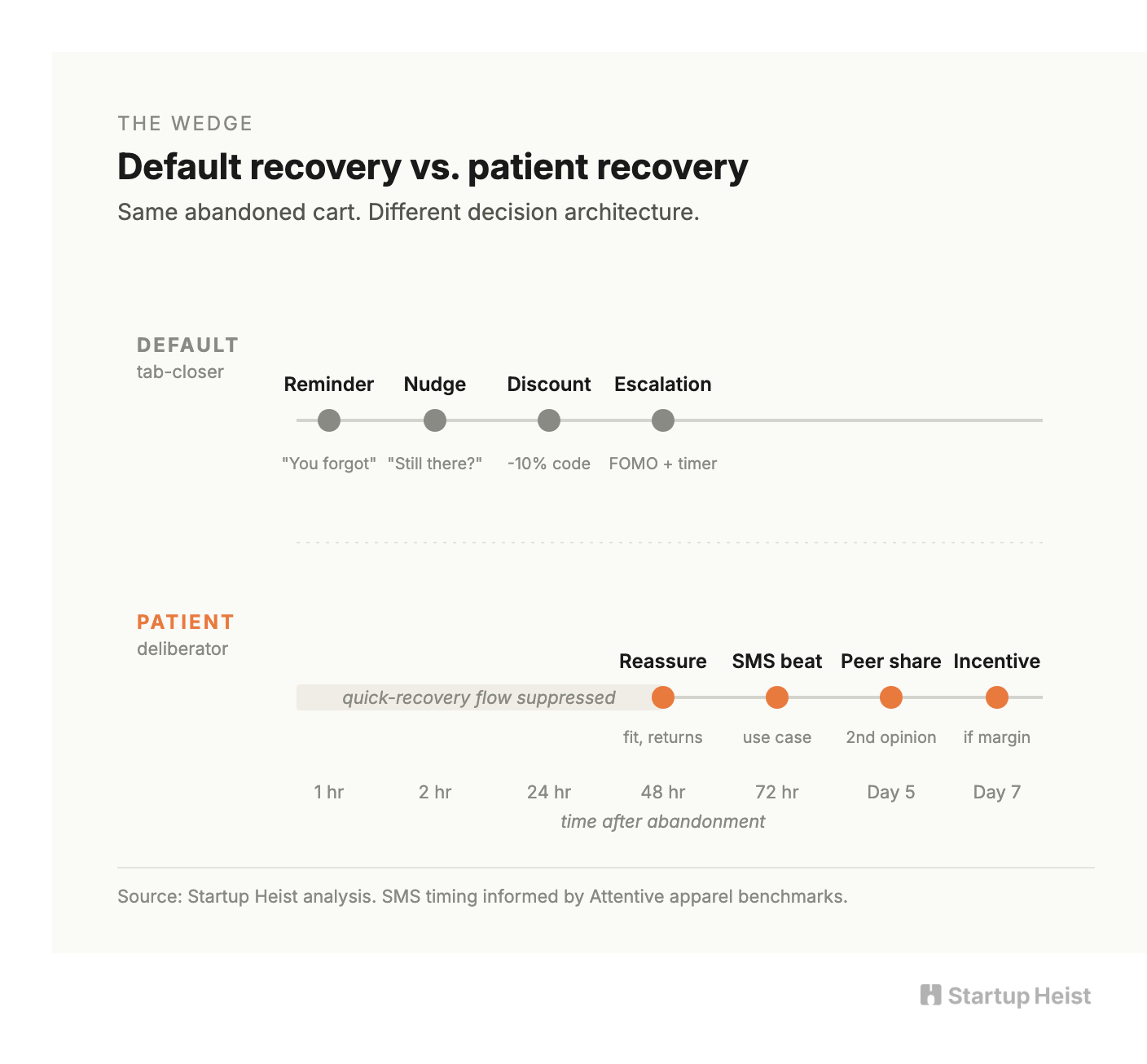
The play is a Gen Z-optimized cart recovery layer that sits on top of Klaviyo and the other tools brands already use. Three mechanics define it:
- Patient timing. Delay the first recovery touch to 48 or 72 hours for qualifying shoppers. Suppress the one-hour panic flow entirely for that segment.
- Reassurance content. The first message answers the actual question in the customer's head: how does it fit, how does it feel, what do other people say, how do returns work. No countdown timer. No discount in the opener.
- Peer-sharing mechanics. A lightweight "send to a friend" or "get a second opinion" flow with tracked links, saved cart state, and attribution back to the original shopper.
The third mechanic is where the business gets interesting. It turns the recovery system from a rescue tool into an acquisition surface — and it's the piece the existing generic share-cart apps don't touch.
The best customers to sell to
This isn't for every store. Targeting matters more than the pitch.
The ideal customer profile:

Unlock the Vault.
Join founders who spot opportunities ahead of the crowd. Actionable insights. Zero fluff.
“Intelligent, bold, minus the pretense.”
“Like discovering the cheat codes of the startup world.”
“SH is off-Broadway for founders — weird, sharp, and ahead of the curve.”


