


Most productivity products are built on a flattering lie: that people are choosing badly.
The category assumes the bottleneck is intention. So it sells better planners, sharper trackers, longer streaks, prettier dashboards, and brand-new "systems." Wake up, see the app, make a better decision, and gradually become the kind of person who drinks water, writes every morning, sleeps eight hours, and stops doomscrolling.

Behavior doesn't actually work that way.
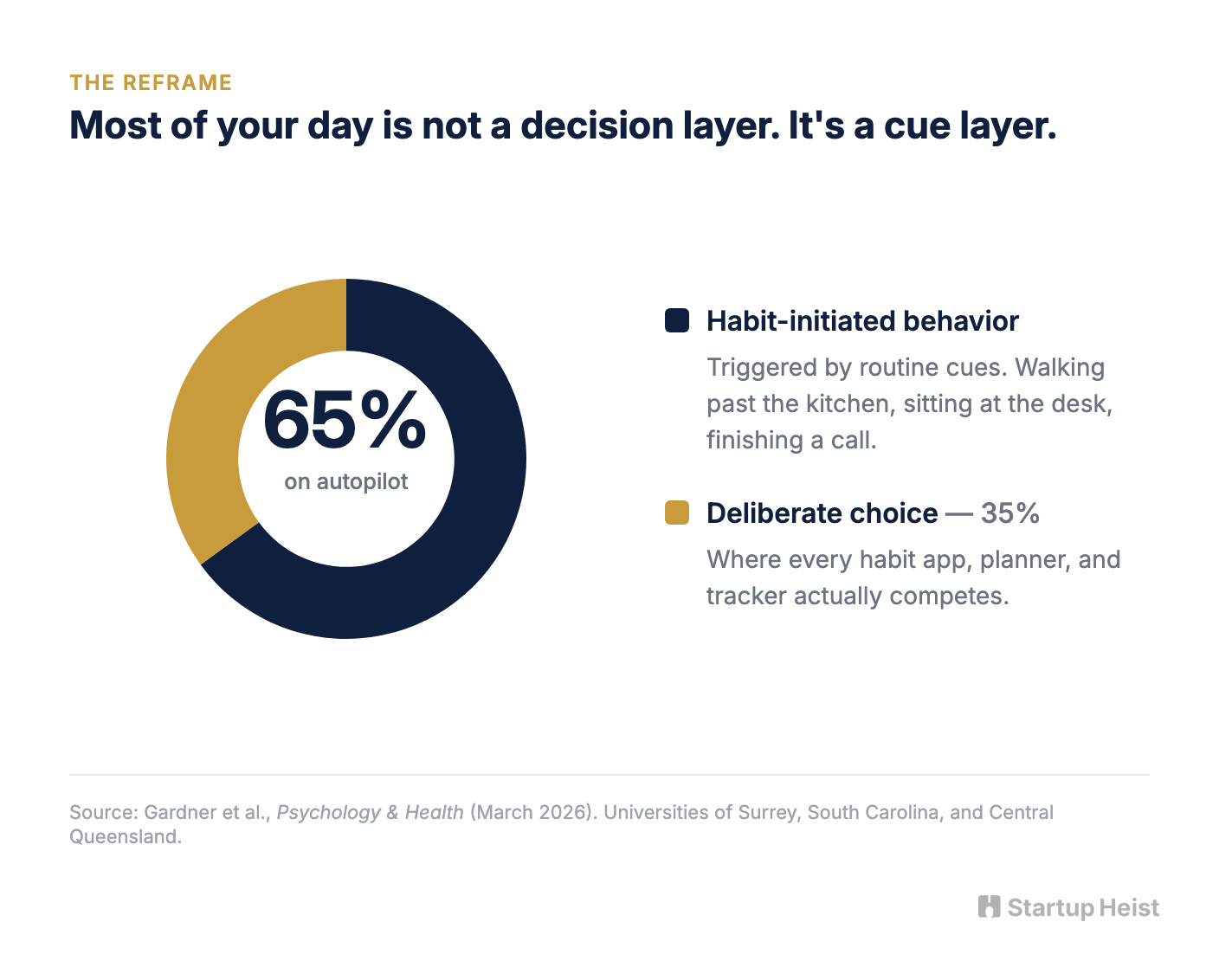
In March 2026, researchers from the University of Surrey, the University of South Carolina, and Central Queensland University published findings in Psychology & Health showing that roughly 65% of everyday behaviors are initiated by habit, not by deliberate choice. Lead author Benjamin Gardner framed the implication directly: most of what you do each day happens on autopilot, prompted by routine cues rather than conscious intent.
The percentage isn't the interesting part. The reframe is. Most of daily life isn't a decision layer. It's a cue layer. A founder walks past the kitchen and opens the fridge. Sits down at the desk and opens Slack. Drops the phone on the nightstand and loses 38 minutes of sleep before bed. Finishes a call, opens email, snacks at 3 p.m., closes the laptop already drained. None of those feel like grand acts of agency. They feel like the day happening.
There's a clean startup opening hiding in that gap. Build a premium Cue Audit for burned-out knowledge workers, founders, and operators who are tired of being told to try harder.
Skip the habit app. Skip the tracker. Skip the Notion template.
Instead, run a 30-day, done-with-you behavior design service where a coach, supported by lightweight data capture and AI-assisted pattern clustering, maps a client's recurring cue → behavior loops and prescribes specific changes to their physical, digital, and calendar environment. Charge $500 to $1,000 per engagement. Start as a boutique service. Build the software later.
Here's the opportunity:
The money: 10 clients/month at $995 = ~$10K MRR solo. Productize to $20-30K MRR within a year, then layer team audits at $5-10K each.
Inside:
• 4-phase audit protocol with intake template
• Three-tier pricing from $495 to $10K team audit
• Cue loop taxonomy and intervention library
• 90-day launch plan and outreach script
The habit market is aimed at the wrong layer
The category is crowded, but most of it sells to the same 35%. Habitica gamifies the streak. Streaks records the streak. Coach.me wraps coaching around the streak. Screen-time tools shame the streak. Focus apps slam a door shut after the urge has already arrived. Useful products. All of them live downstream of intention. They assume the user already knows what they want and just needs help executing. The 65% of life that runs on autopilot is the part nobody is selling against.
A founder doesn't need another dashboard showing he opened X 47 times yesterday. He needs someone to notice that the first open lands the moment a task gets ambiguous, that the phone sits within arm's reach during deep work, that his bookmark bar puts dopamine above revenue, and that his calendar has zero friction between meetings and reactive work. A senior remote worker doesn't need another meditation streak. She needs to see that her worst eating happens after back-to-back Zoom calls, that her kitchen lighting makes 10 p.m. feel like 7, and that Slack has quietly become the place she goes when work gets hard.
The real market isn't habit tracking. It's environment design for people whose work and life have collapsed into the same room.
Why this is a real business
The personal development industry already pays for guided self-improvement. Mordor Intelligence sizes the global market at $53.73 billion in 2026, projected to hit $70.55 billion by 2031. The U.S. life coaching market, the closer comparable, was $1.98 billion in 2024 and is forecasted to reach $3.08 billion by 2033 according to Grand View Research. Consumers will pay for help. They won't pay generously when the service is generic. A $79 habit course feels overpriced. A $900 Founder Environment Audit feels reasonable if the buyer believes the outcome is fewer wasted hours, better sleep, and a workday that stops leaking energy.
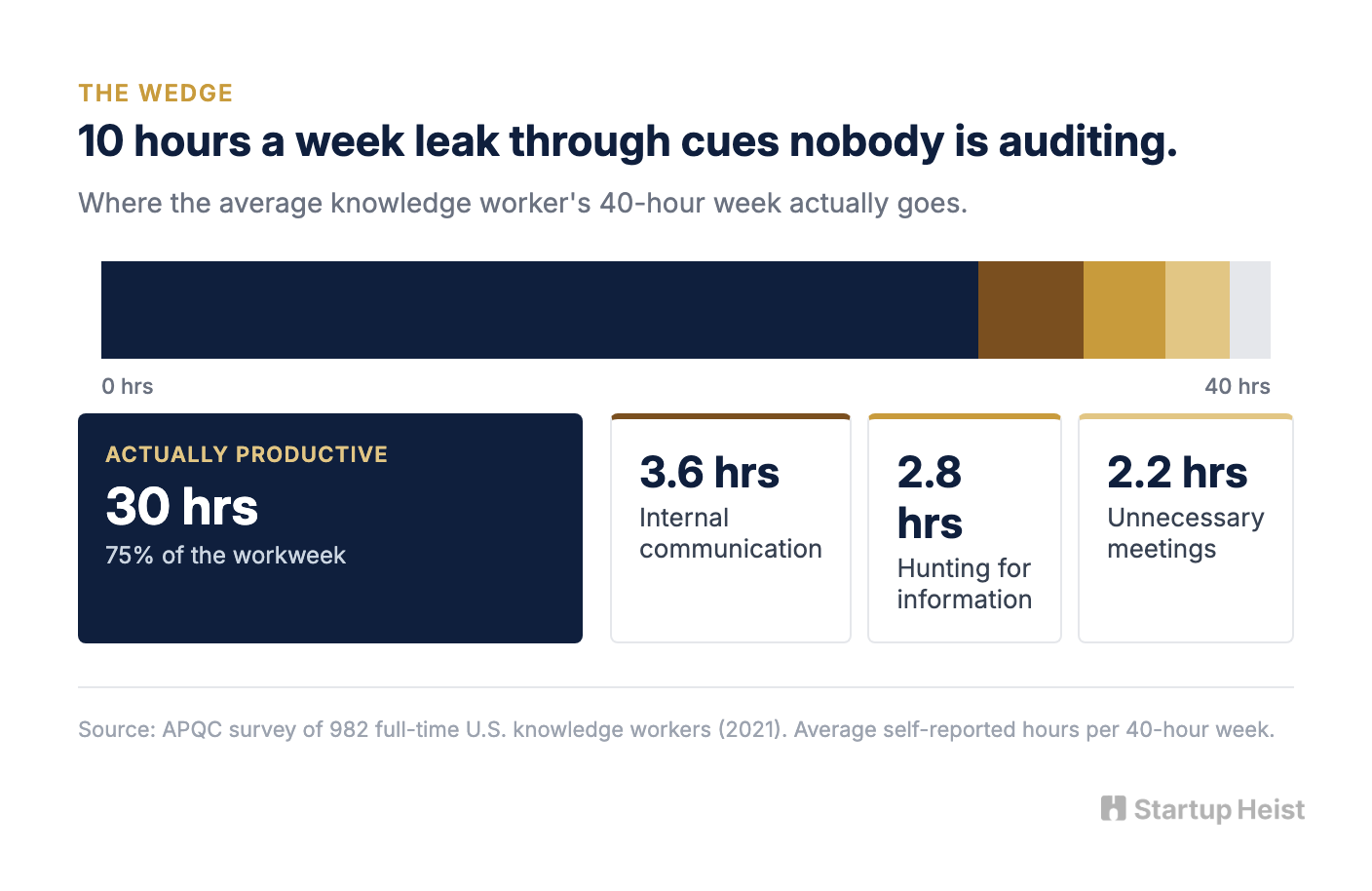
The pain is concrete and measurable. APQC research from 2021 surveyed 982 full-time knowledge workers and found the average one spends only 30 of 40 weekly hours on actually productive work. Internal communication burns 3.6 hours, hunting for information eats 2.8 hours, unnecessary meetings drain another 2.2. The findings have only gotten more relevant since. Eagle Hill Consulting, working with Ipsos in November 2025, surveyed more than 1,400 U.S. employees and found 61% of fully remote workers reporting burnout. Bedtime is no escape. The average American spends 38 minutes scrolling before sleep, losing roughly 231 hours per year. A 2025 study of 45,202 university students published in Frontiers in Psychiatry found that each additional hour of screen use raised insomnia risk by 59%.
Buyers know their week is disappearing. They can't name why. The wedge for a knowledge worker burnout product sits right there.
The product: a 30-day Cue Audit
The first version isn't an app. It's a structured, productized service. A working name set: Default Audit, Cue Audit, Founder Environment Audit, Autopilot Audit, or Executive Environment Design.
The promise: in 30 days, identify the cues quietly driving a client's worst work and life patterns, then redesign their physical, digital, and calendar environment around better defaults.
The protocol breaks into four phases:

Unlock the Vault.
Join founders who spot opportunities ahead of the crowd. Actionable insights. Zero fluff.
“Intelligent, bold, minus the pretense.”
“Like discovering the cheat codes of the startup world.”
“SH is off-Broadway for founders — weird, sharp, and ahead of the curve.”


