


The $19 Contract Scanner: A Freelancer Risk Engine Hiding Inside the Legal-AI Gold Rush
Most freelancers don't lose money because they're bad at their craft. They lose money because they sign documents written by the other side.
That's the whole business in one sentence. The opportunity isn't "AI for legal" or "democratizing contracts." It's narrower and sharper: a pre-signing risk engine for independents who know a contract matters, know a lawyer is expensive, and sign anyway because they have no better option.

The gap is quantifiable. The US independent workforce reached roughly 72.9 million freelancers in 2025 and is projected to hit 90 million by 2028, collectively generating around $1.5 trillion in annual earnings. The global freelance platforms market alone is set to grow from $8.9 billion in 2026 to $21.97 billion by 2031. On the other side of the pricing mismatch, Clio's 2026 Legal Trends data puts average US law firm rates near $311 an hour, with contract attorneys often billing $200 to $500 per hour and flat-fee reviews ranging from $300 to $3,000.
Here's the opportunity:
The money: A disciplined solo founder can build this to $10K-$60K MRR. At $29/mo Solo and $79/mo Pro, 500 paying users clears $20K MRR.
Inside:
• Full MVP scope for freelance contract review
• Five-layer moat built on quantified risk
• Four-tier pricing ladder from free to $79/mo
• Community-led GTM with outreach script
Now layer in the damage. A Freelancers Union survey of roughly 5,000 freelancers found that only 28% use a written contract for any given project. In 2025, 58% of freelancers globally encountered non-payment or delayed payments. About 40% experienced delays of 30 to 60 days. And 18% lost between $500 and $2,000 per project to outright non-payment. The majority of freelancers worldwide wait more than 30 days after completing work to get paid.
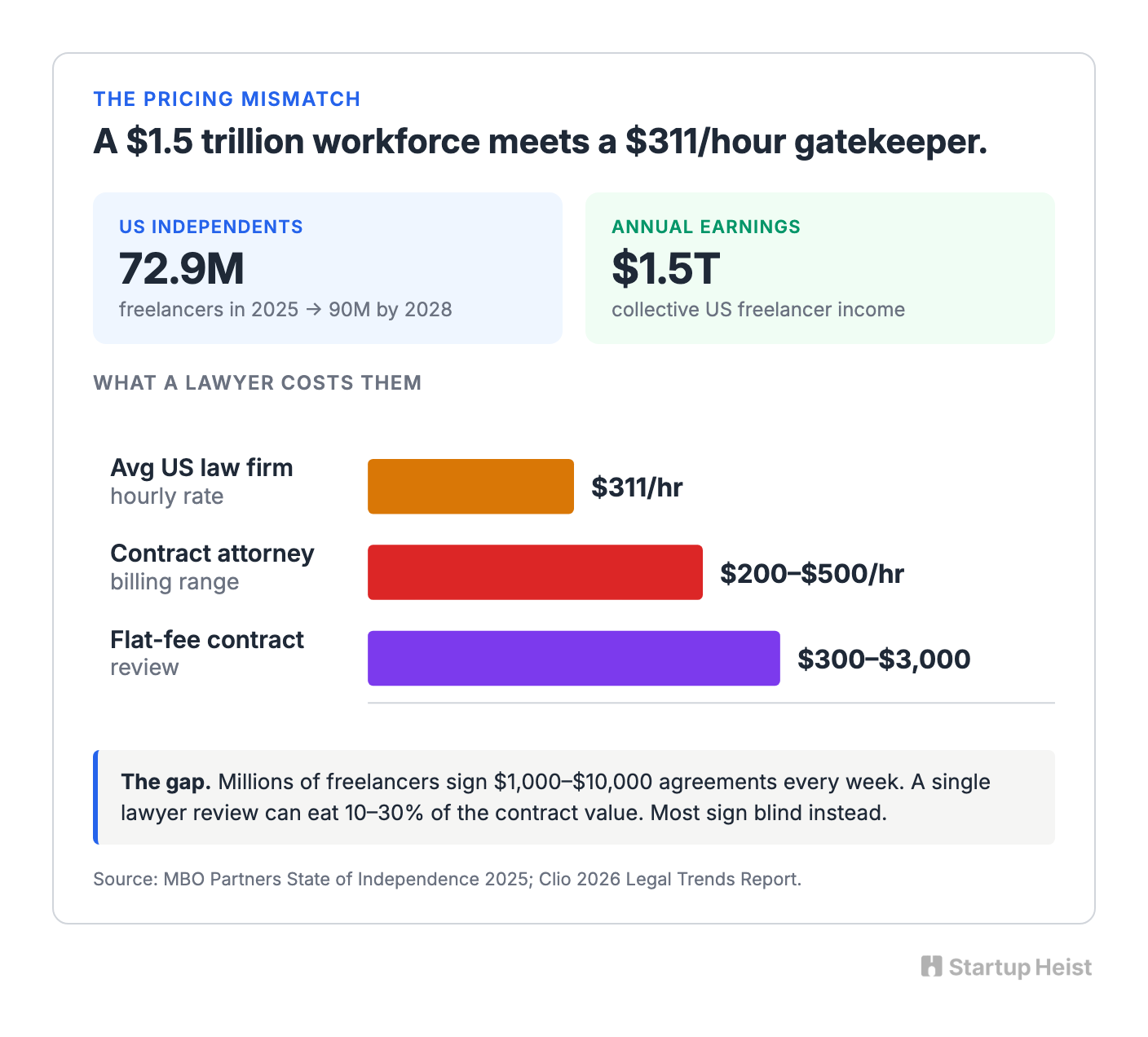
The product isn't a legal replacement. It's a Claude-powered AI contract scanner for freelancers and solopreneurs that does three things well: flag the contract red flags most likely to hurt them, convert those clauses into a dollar-value Hidden Cost Score, and generate exact freelancer negotiation language they can send back before signing. The user isn't buying legal theory. They're buying relief from one concrete question: what can this agreement cost me if I sign it as written?
The Competitive Field Is Crowded, Not Empty
The category already has real competitors, and the lesson they teach is useful. ContractCrab charges $3 per contract or $30 per month for 120 documents and positions itself as a fast AI summarizer. ClauseGuard offers $4 per contract with three free scans monthly, while a sibling variant charges $9 one-time with flagged clauses and rewrite suggestions. BeforeYouSign runs $2.99-$9.99 per contract. Clausely is $12.99 per month. Pact sells at $49.99 per year. Legitt AI gives away ten contracts a month on its free tier. goHeather sits around $99 per month. LinkSquares sells AI-powered risk scoring into enterprise legal ops, priced and designed for a general counsel, not for a solo designer reviewing a $4,000 agreement on a Tuesday night.
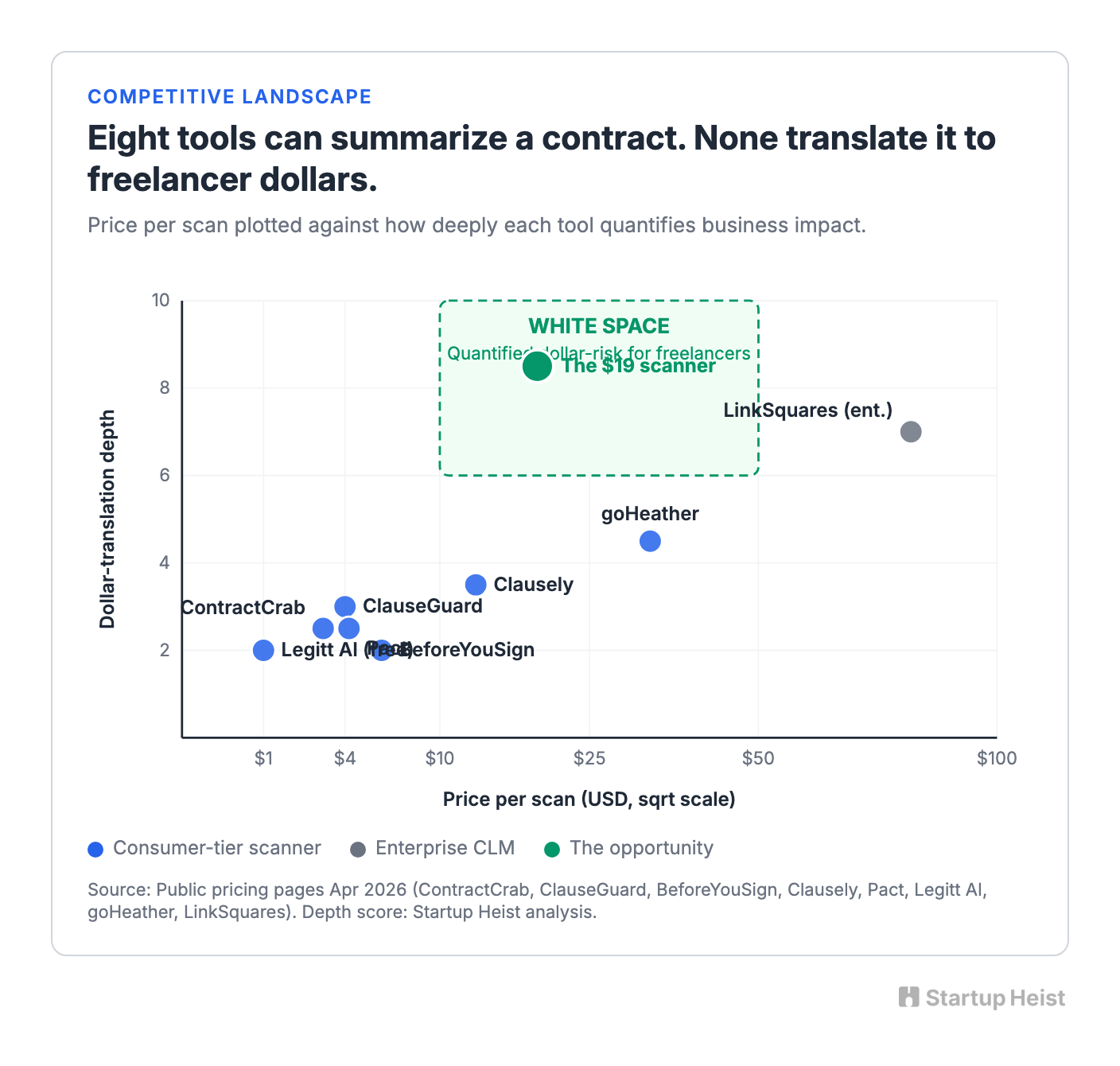
The pattern is clear: six to eight consumer-tier tools have already learned to parse PDFs and flag risks. What remains underserved is the dollar-translation angle. Nobody has fully translated those risks into the language of freelancer economics. A broad IP assignment clause isn't just "risky." It can hand over your side-project templates and core tooling to a single client. Net-60 payment terms aren't just "unfavorable." They force you to finance the client's operations at your cost of capital. Unlimited revision language isn't "vague." It routinely drives 50-100% project overruns because there's no incentive for a client to consolidate feedback when revisions are free. A one-sided indemnity clause creates asymmetric downside that can dwarf the project fee several times over.
Map clauses to business impact reliably, and you stop being a summarizer. You become a decision tool.
The Scale of the Opportunity
This is a focused micro-SaaS, not a venture-scale legal platform. A disciplined solo founder can build it into a $10K to $60K MRR business, and possibly larger once it climbs into agencies and small studios. The first honest read: this is a sharp tool for a painful moment, and that moment happens millions of times a year.
The wedge works because freelancers don't need comprehensive legal operations. They need a first pass before they send back "Looks good to me." The value is strongest when the contract is meaningful enough to create anxiety but not large enough to justify counsel. That sweet spot is enormous, and it gets bigger every time another million people go independent.
The smartest version of this business sells against three alternatives at once: "do nothing and sign," "ask ChatGPT and hope," and "pay a lawyer." You don't need to beat a lawyer on accuracy. You need to beat inertia, beat generic AI on structure, and save the lawyer for the contracts that deserve one. Say that out loud in the product. The American Bar Association has been explicit that AI legal tools need clear boundaries between legal information and legal advice, with explicit disclaimers and user education about limitations. Credibility carries real weight in any legal-adjacent category, and that framing becomes part of the moat.
Where the Moat Actually Lives
The moat isn't the model. Claude Opus 4.7 is $5 per million input tokens and $25 per million output tokens. Sonnet 4.6 is $3 input and $15 output. Prompt caching can cut input costs by up to 90%, and batch processing adds another 50% discount. Model access is commodity-like and getting more so. Anyone can wire up a PDF upload and an LLM call, which means the barrier to launch is gone and the barrier to defensibility has to come from somewhere else.
Five layers make that defensibility real.
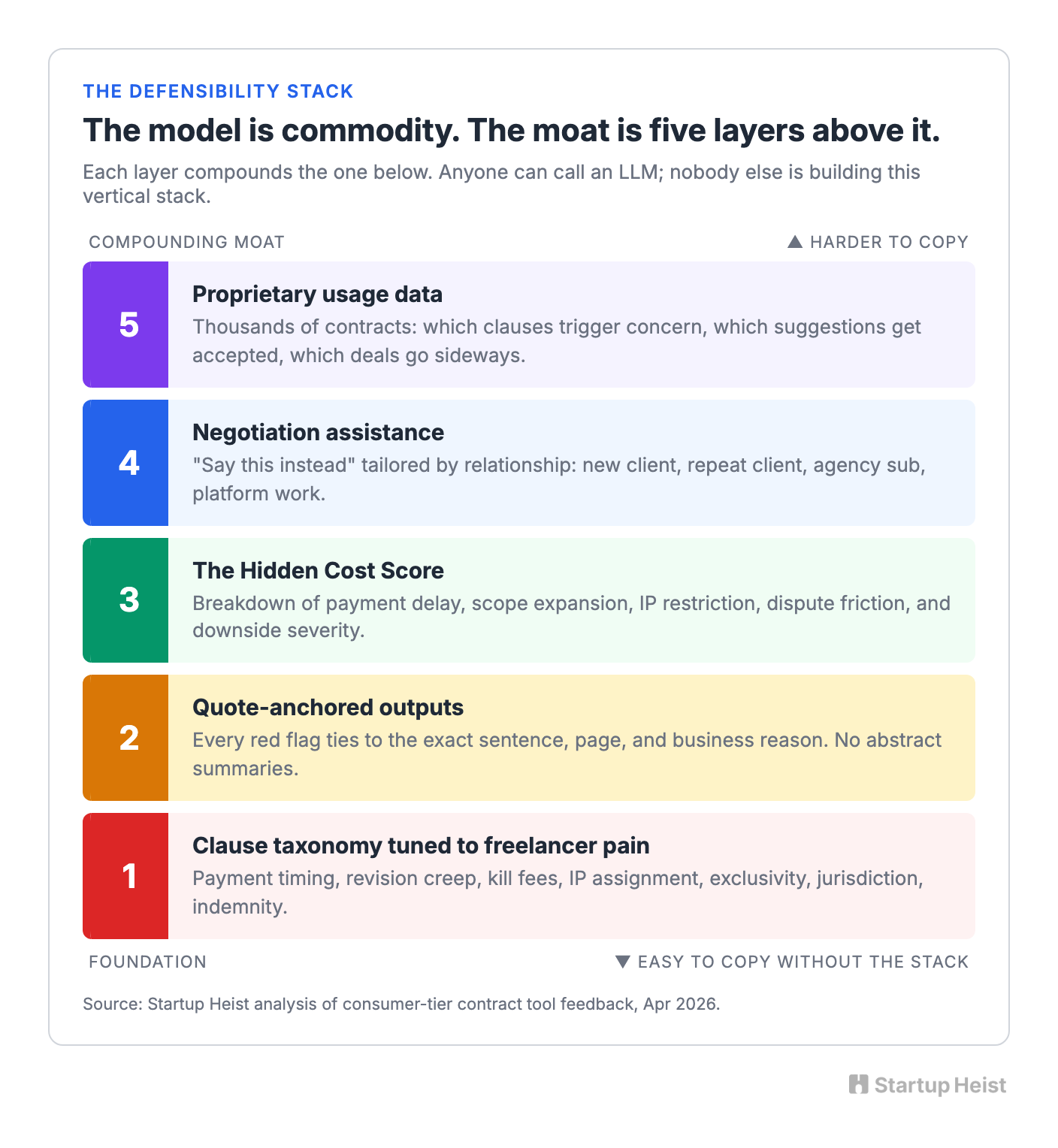
Clause taxonomy tuned to freelancer pain. Enterprise tools obsess over repository search, approval workflows, and renewal dates. Your tool obsesses over payment timing, revision creep, kill fees, IP assignment, exclusivity, non-solicit, non-compete, jurisdiction, indemnity, chargebacks, acceptance criteria, reimbursement rules, and termination asymmetry.
Quote-anchored outputs. The sharpest early feedback on competitor launches has been blunt: risk scores are fine, show me the exact clause. Trust isn't built from abstract summaries. Every red flag must tie to the exact sentence, exact page, and exact business reason.
The Hidden Cost Score. This is the actual product innovation. Not a fake AI score, but a visible breakdown: expected payment delay cost, likely scope expansion cost, future IP restriction cost, dispute friction cost, and downside severity if the worst clause is enforced. Directional numbers, not deterministic. The act of quantifying still turns a fuzzy legal concern into a business decision.
Negotiation assistance. "Say This Instead" blocks are now table stakes. The real edge is tailoring freelancer negotiation language by relationship: new client, repeat client, agency subcontract, platform work, creative services, development contract, retainer, fixed-scope build. Each context calls for different language and a different negotiating posture.
Proprietary usage data. Over time, the moat isn't "our AI is smart." It's "we've seen thousands of freelancer contracts, know which clauses trigger user concern, know which negotiation suggestions get accepted, and know which deal patterns correlate with later disputes." That dataset becomes valuable because no competitor with a generic clause library can replicate it.
The last layer is the bridge from heist play to durable business.
Why This Is Both a Heist and a Business
A solo founder can ship a credible MVP in weeks. The stack is plain: Next.js or React frontend, PDF upload and extraction, structured clause detection prompt chain, Anthropic backend, Stripe, and a secure file lifecycle. The nearest indie competitor reportedly runs on Vercel serverless, Supabase, and Claude. The technology isn't the blocker. Trust, UX, and product boundaries are.
The medium-term story is where the business becomes interesting. The product moves from one-off scans into contract-operating-system behavior for independents. Not full CLM. Something lighter: a vault of past agreements, risk trend tracking, client-by-client clause memory, "compare this contract to my last three," and pre-signing checklists. Once the product knows a given client always sneaks in net-60 or expansive IP language, it stops being a scanner and becomes a counterparty intelligence tool.
That's when the business becomes harder to copy.
The Pricing Ladder
The business model should begin simple and transactional:
- Free: one scan per email, abbreviated results, used to seed the funnel.
- Pay-per-scan: $19 for a full review, freelancer negotiation language, and a downloadable PDF report.
- Solo plan: $29 per month for 5 scans plus basic vault access.
- Pro freelancer / agency plan: $79 per month for 25 scans, full contract vault, and reusable clause preferences.
- Human escalation: attorney partner referral or premium human-reviewed upgrade where legally appropriate.
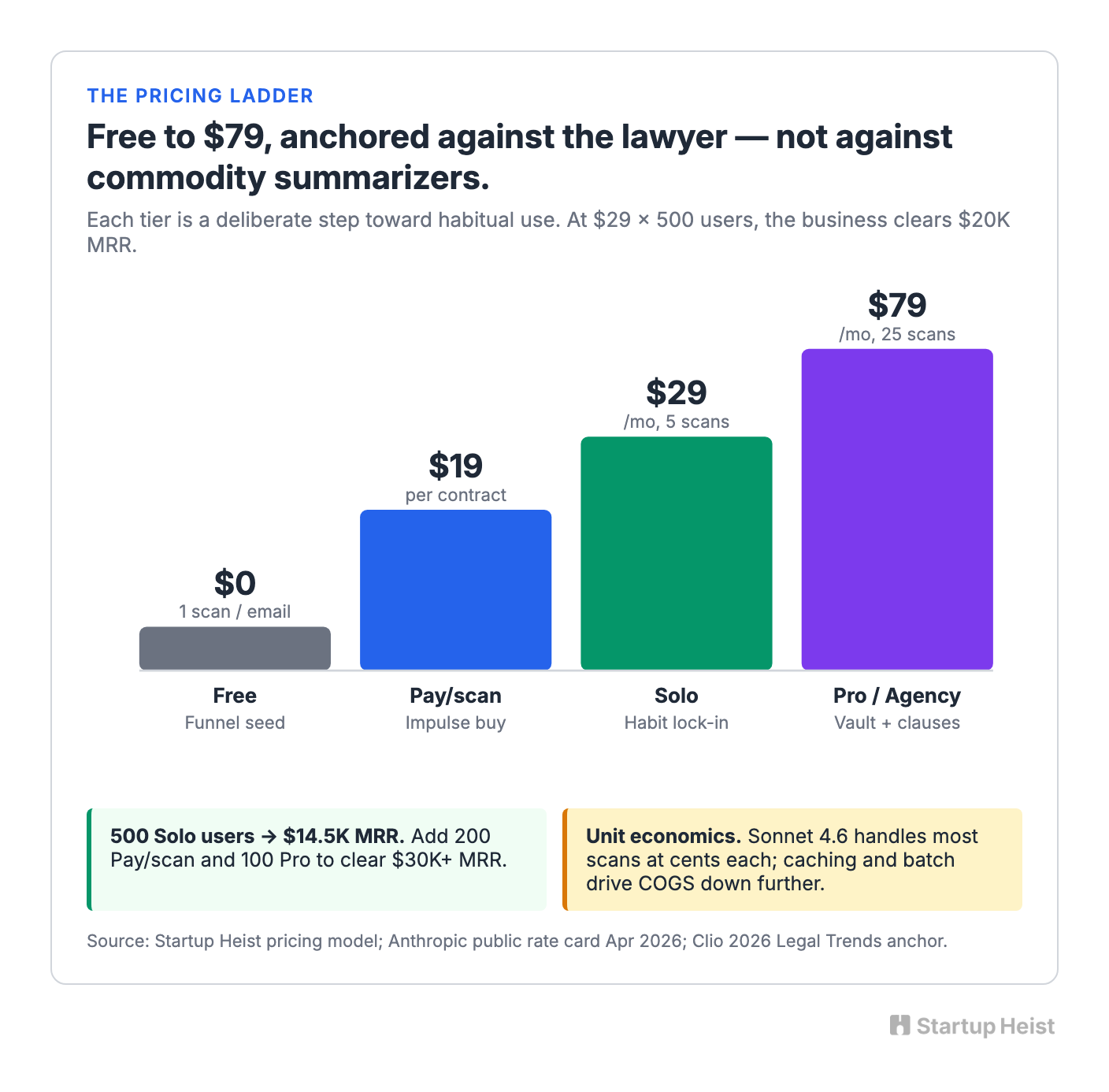
Why push pay-per-scan above the $15 anchor? The user isn't comparing you to a commodity summarizer. They're comparing you to signing blind or paying a lawyer. If the average US law firm rate is $311 an hour, a $19 or even $29 scan is still impulse-priced against the alternative. The price signals seriousness without forcing subscription on day one.
Gross margins should stay strong. Sonnet 4.6 handles the bulk of clause detection cheaply. Opus 4.7 is reserved for edge cases, deep reasoning, or the premium upsell. Batch and caching discounts compress costs further. One caveat worth pricing in: Opus 4.7 ships with a new tokenizer that can raise effective costs up to 35% compared to Opus 4.6 despite unchanged sticker pricing, so budget against tokens actually consumed, not list price. Contract documents are long, but not enterprise-repository long. Careful extraction and clause chunking keep the bill per scan measured in cents.
The MVP Scope
Version one should support freelance service agreements, independent contractor agreements, SOWs, simple MSAs, retainer agreements, and creative services contracts. The output should include:

Unlock the Vault.
Join founders who spot opportunities ahead of the crowd. Actionable insights. Zero fluff.
“Intelligent, bold, minus the pretense.”
“Like discovering the cheat codes of the startup world.”
“SH is off-Broadway for founders — weird, sharp, and ahead of the curve.”


