


Build the TurboTax for SBIR Before the Rules Change
Most software founders treat SBIR the way they treat taxes: something to hand to a consultant and ignore. That reflex was rational in 2024. It just became expensive.
On April 13, 2026, President Trump signed S. 3971, the Small Business Innovation and Economic Security Act, reauthorizing SBIR and STTR through September 30, 2031 after a six-month statutory lapse that had paused new awards across all eleven participating agencies. The Senate passed it by voice vote. The House cleared it 345 to 41. Those aren't partisan numbers. That's consensus.
Two changes inside the bill matter far more than the reauthorization headline. The first is a new Phase II "Strategic Breakthrough" vehicle. Agencies with SBIR budgets above $100 million can now allocate up to half a percent of their extramural research budget to single awards of up to $30 million over 48 months. Winners must already hold a prior Phase II, produce a 100% match from new private capital or qualifying non-SBIR government sources, and show through market research that their technology solves a real problem. DoD layers on additional transition and readiness requirements. The second change: beginning in fiscal year 2027, every participating agency must set its own proposal caps on a per-company, per-solicitation, or per-topic basis. Waivers exist but cover no more than 5% of topics. The explicit target is the pattern Congress has spent two years calling "SBIR mills," firms that win through sheer submission volume rather than technical depth.
Put the two together and a clean asymmetric opening appears. The top of the market just got dramatically bigger. A single program can now write a $30 million check to a small business. The bottom is getting policed. Serious entrants have a better opening today than they did a year ago. Shallow volume players have a shrinking one.
That's the opening for an AI-native product company, and not the "AI writes grants" version that dies in 18 months. The real company is the interface layer between technical founders and a federal funding system most of them find unusable. Founders don't just need words on a page. They need topic matching, compliance scaffolding, deadlines, commercialization framing, and a high-confidence go/no-go decision before burning three weeks on a dead-end solicitation. The raw ingredients are public. They're also fragmented across eleven agencies running eleven different workflows. When a market is big, compliance-heavy, and operationally annoying, the winning product is rarely the smartest model. It's the best workflow.
Here's the opportunity.
The money: 12-18 Phase I engagements at $8-20K each = $15-25K MRR solo. Legacy consultants charge $300/hr and bill multi-million-dollar track records.
Inside:
• Five-job MVP scope for an SBIR Copilot
• Three-tier pricing from $149 SaaS to $20K service
• Law-change cold email that actually converts
• Four moats that beat generic AI grant tools
Why this window is real
SBIR isn't new. It's been running since 1982, invested more than $81 billion into over 34,000 small businesses, and deploys roughly $3 to $4 billion a year in awards across eleven agencies. DoD alone accounts for about $1 billion of that. It's called America's Seed Fund for a reason. What changed is the incentive structure on both sides.
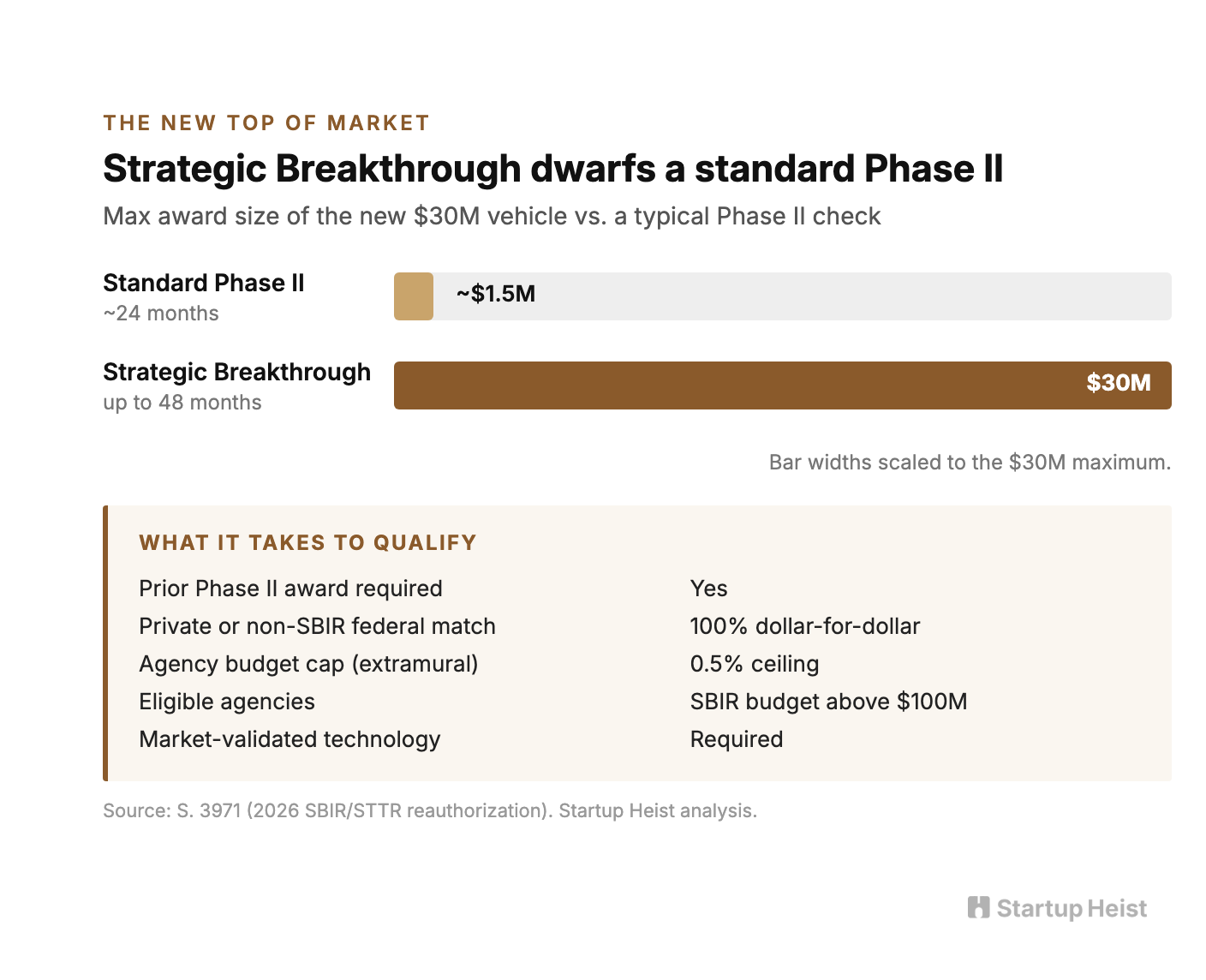
The government is steering toward deployment. Thirty million dollars over four years, with a dollar-for-dollar private match, isn't a polite academic grant. It's a bridge across the valley of death for technologies the government actually wants procured. DoD and NIH are expected to publish the first new solicitations in April or May 2026, with NSF, DOE, and NASA following through mid-year. Q4 FY2026 should bring the first Strategic Breakthrough Award solicitations from DoD.
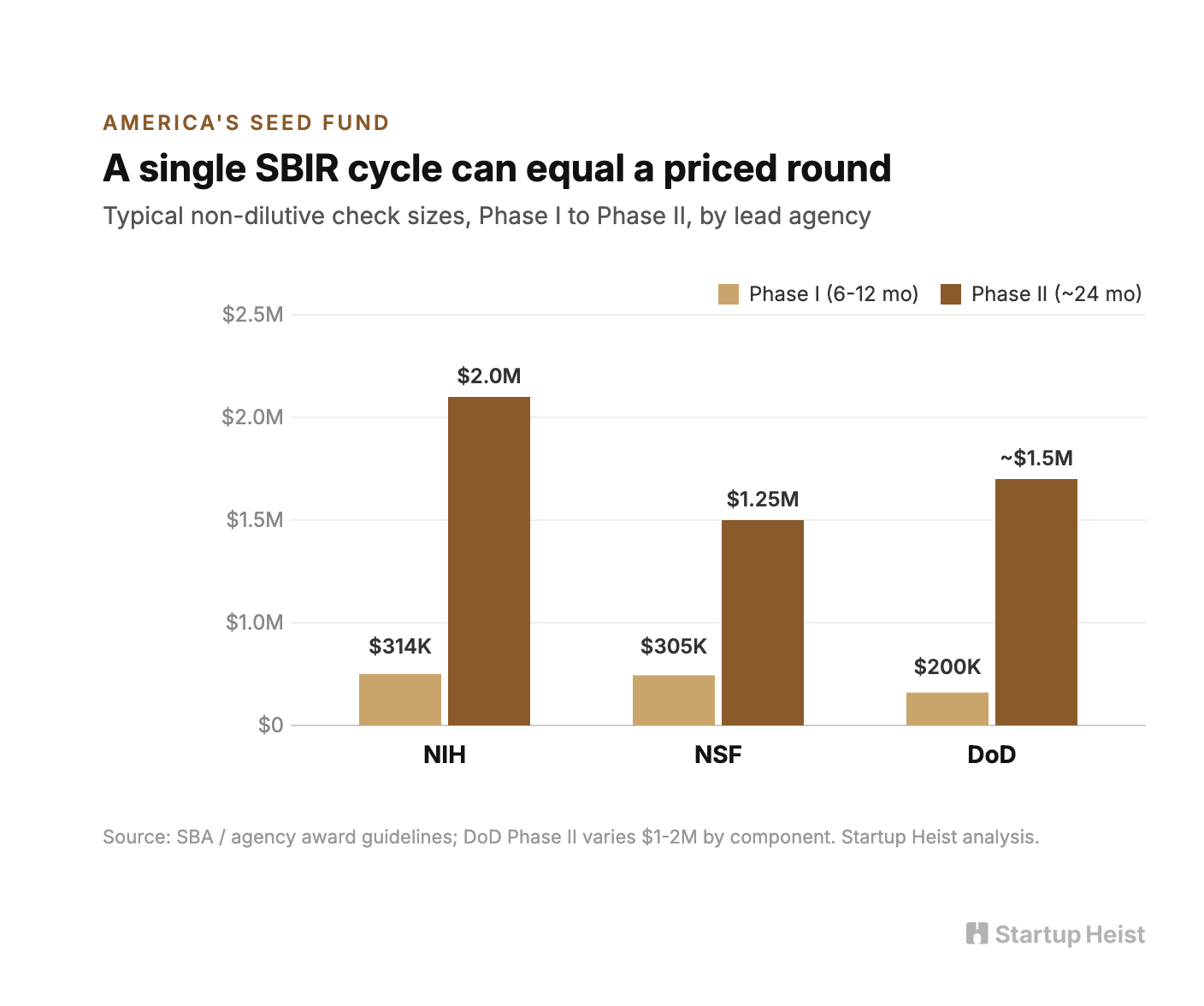
The founder side matters just as much and gets discussed half as often. Standard award sizes are meaningful on their own. Phase I checks run up to roughly $314,000 at NIH, $305,000 at NSF, and $200,000 at DoD over six to twelve months. Phase II tops out around $2 million at NIH, $1.25 million at NSF, and generally $1 to $2 million at DoD depending on component over roughly 24 months. Non-dilutive. No board seats. No liquidation preferences. For a pre-seed or seed-stage deep tech company, one Phase I plus one Phase II can equal an entire priced round without the dilution. And yet most technical founders skip it because the process is opaque and every agency has its own topic structure, scoring rubric, formatting requirements, and unwritten failure modes. Demand already exists. You aren't creating it. You're removing the friction that keeps the best candidates from participating.
One bet, two layered businesses
Think of this as two businesses stacked on each other. The first is SBIR-as-a-service, the cash engine. You use AI internally to compress research, topic matching, compliance checks, and first-draft generation, then sell a founder-facing service for Phase I and selective Phase II applications. Published rates for SBIR consultants run $100 to $300 per hour. Seliger + Associates anchors the high end at $300 per hour. Flat-fee shops price a full NSF Phase I around $6,000. Subscription tools like TurboSBIR sit around $1,500 a month with three-month minimums. Premium consultants market multi-billion-dollar track records but deliver through people, not product.
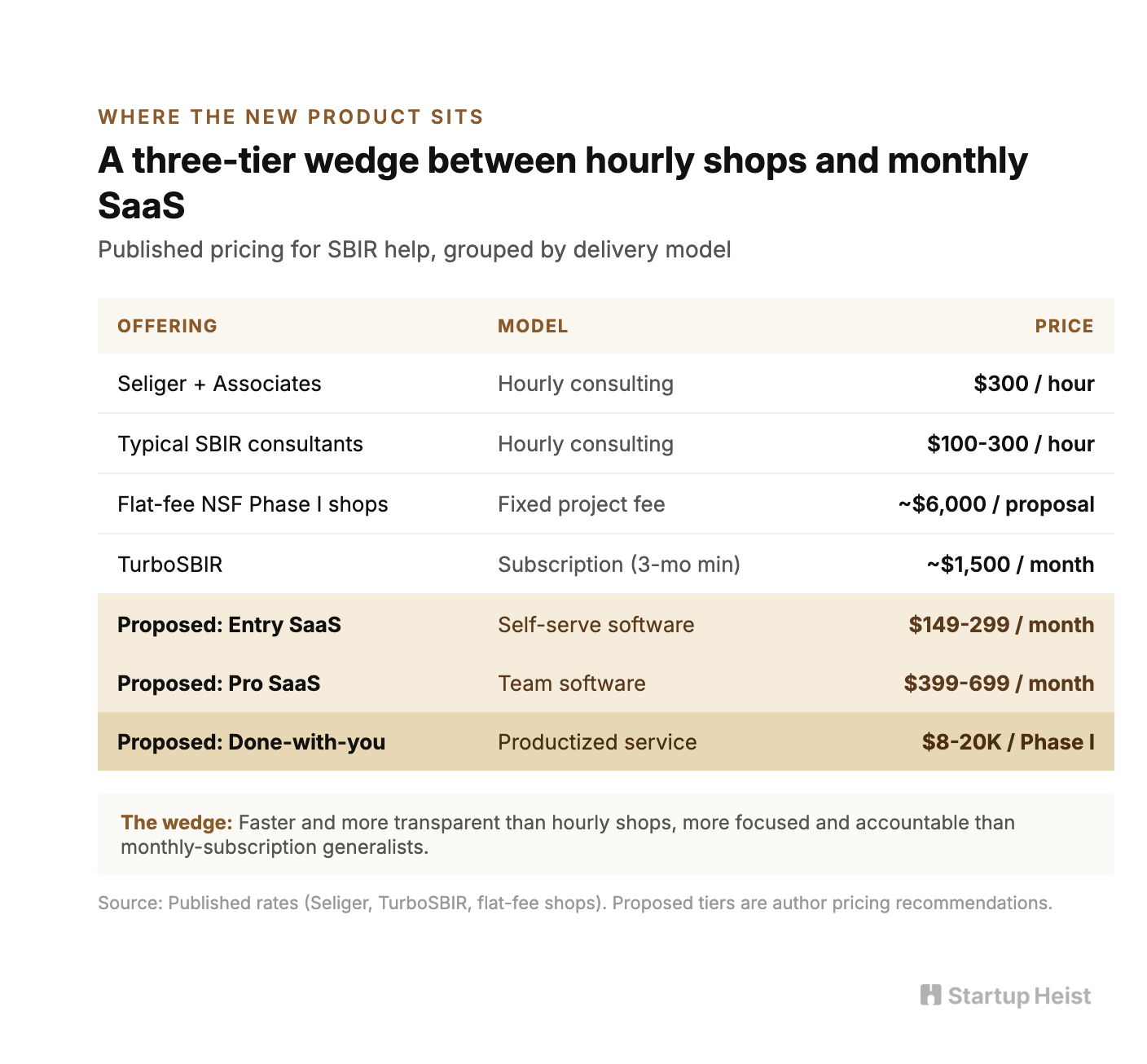
The second business is SBIR Copilot, a subscription software product. Rogue, Granted AI, and a handful of adjacent tools already push AI-assisted grant workflows. That validates willingness to pay for software and reveals a gap: most current products are either generic grant platforms or unfocused generation tools. The wedge is a product that's narrower and more operationally useful: topic matching, agency-specific formatting, technical-document ingestion, commercialization-plan drafting, deadline monitoring, and submission readiness scoring, all tuned specifically to SBIR and STTR.
Start with the service and let the software emerge from repeated use. Service gives you revenue, training data, objections, and proof of value. Software productizes the repeatable 70%. Anyone who tries to ship a fully self-serve vertical AI SaaS before running 20 real engagements will build the wrong product.
What the MVP actually is
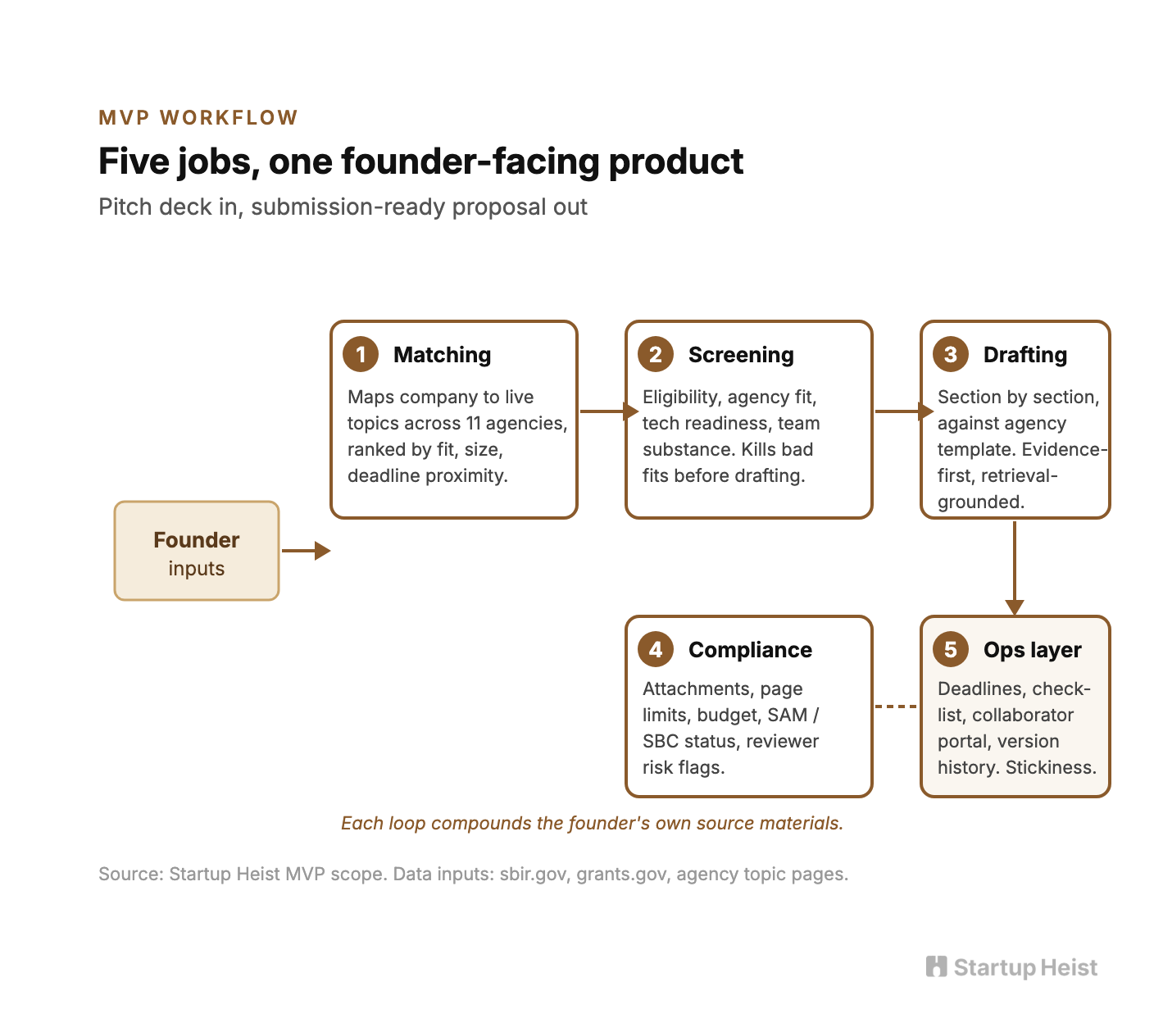
Don't overbuild this. Version one isn't a magical autopilot that promises funded proposals. It's a focused workflow product with five jobs:
Unlock the Vault.
Join founders who spot opportunities ahead of the crowd. Actionable insights. Zero fluff.
“Intelligent, bold, minus the pretense.”
“Like discovering the cheat codes of the startup world.”
“SH is off-Broadway for founders — weird, sharp, and ahead of the curve.”


