


The Last Mile of Paid Intelligence
A commercial real estate broker in Philadelphia subscribes to three permit alert feeds, two trade newsletters, and a zoning digest. Every morning, roughly forty items land in the inbox. Somewhere in that pile is a change-of-use application on a building owned by a developer the firm has been courting for two years.
Nobody catches it. The information wasn't hidden. It arrived at 6:14 a.m. alongside thirty-nine other things, and the person who would have recognized it was on a call.
Salesforce's 2026 State of Sales research puts the average seller at 40% of the workweek actually selling. The other 60% goes to admin, data entry, internal meetings, and hunting for context. That ratio has barely budged, and it explains something important about the information business: the constraint stopped being access a long time ago. The constraint is the distance between an event landing in a feed and a human doing something about it.

That distance is where the money is. Nobody needs another newsletter, another alert product, or another AI summarizer. What's missing is the system that carries a high-value event all the way into an approved business action:
source → structured event → matched account → recommended action → Slack message → CRM task → human approval.
Call it intelligence-to-action infrastructure. It's a vertical micro-SaaS that turns authoritative public records into accountable workflows inside the software customers already live in. There's a specific, unglamorous way to steal it.
The money: Fifty firms at a $499 blended average is $25K MRR. One publisher partnership adds roughly $8,000 more without a single cold email.
Inside:
• Which of three verticals you can actually ship
• The eight-part MVP and 30-day build order
• Pricing from $249 to $1,500 a month
• The publisher channel that kills the legal risk
What the product actually looks like
Same broker, Tuesday morning. Instead of forty emails, one Slack message:
High-priority zoning event — 1234 Market Street Change of use: office → multifamily. Applicant: Example Development LLC. Affected area: 82,000 sq. ft.
Matched account: Example Development · Owner: Sarah Chen · Last touch: 94 days ago Suggested action: Re-engage on acquisition financing and leasing requirements.
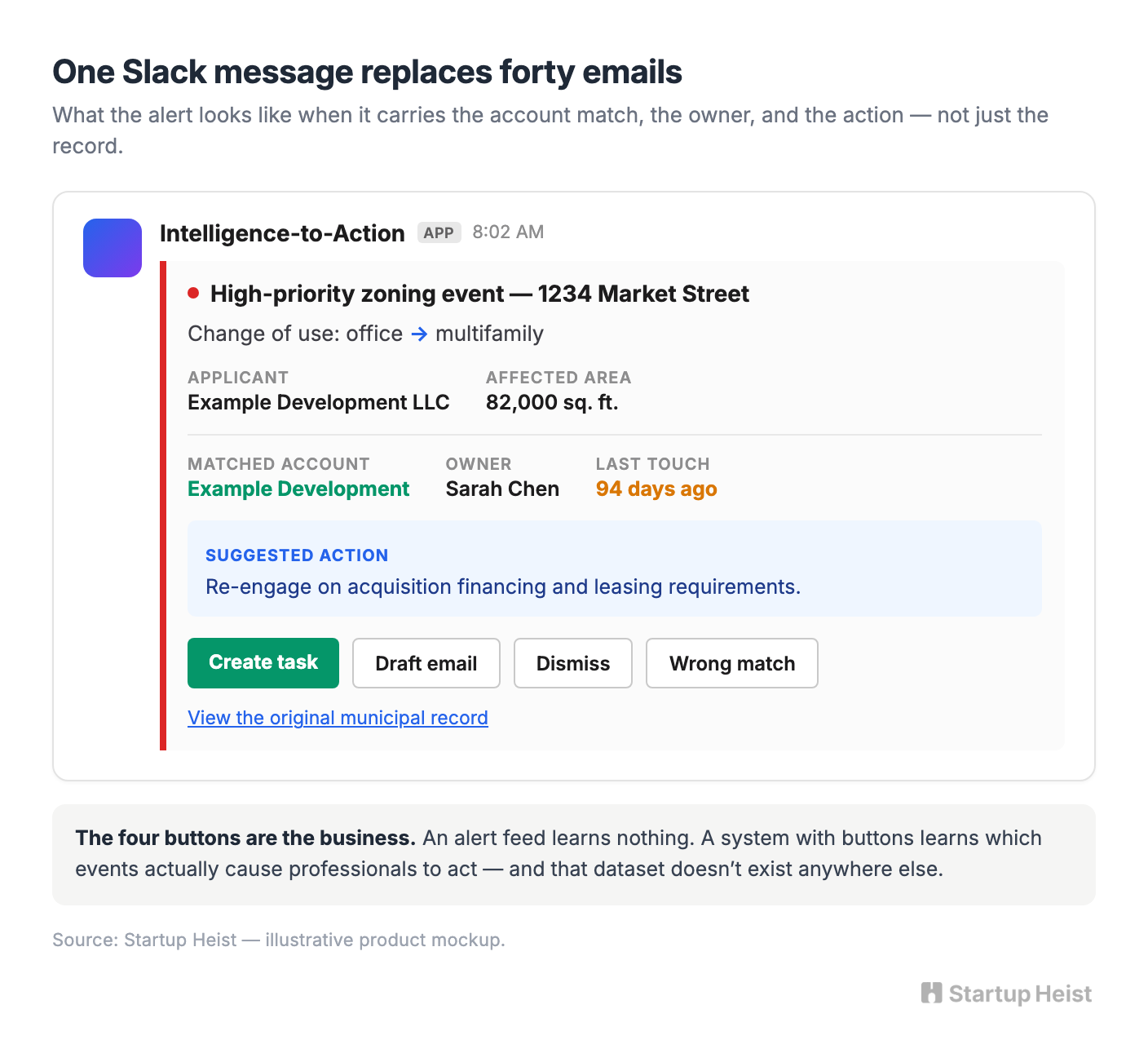
Four buttons underneath: Create task. Draft email. Dismiss. Wrong match. Below that, a link to the original municipal record.
The information is almost the least interesting part. The product knows what happened, which entity it happened to, whether it's material to this specific buyer, which CRM record corresponds to that entity, who internally owns the relationship, what action fits, and, critically, whether the human accepted or rejected the recommendation.
That last item is where the business hides. An alert feed learns nothing. A system with buttons learns which events actually cause professionals to act, and that dataset doesn't exist anywhere else.
Why this works now
Three things changed, and only one of them is AI.
Professional information fragmented. Substack crossed 5 million paid subscriptions in March 2025, up from 4 million four months earlier. Those aren't B2B workflow buyers, but they're evidence of a behavior shift: instead of one Bloomberg terminal or one trade publication, professionals now assemble their own intelligence stack from newsletters, government feeds, niche databases, and alerts. Every added source makes the reading problem worse, because more subscriptions means more human hours converting text into decisions.
The plumbing became a rounding error. Make's Core plan runs about $9 per month billed annually for 10,000 operations. Zapier Professional starts near $19.99 per month billed annually with 750 tasks. Slack posts structured interactive messages through a documented API. HubSpot creates tasks and associates them with records the same way. Postmark parses an inbound email into JSON and POSTs it to your webhook. If your startup idea is connecting an RSS feed to Slack, Zapier already ate it. Used as quiet plumbing underneath a decision engine, though, it's a gift.
Language models got good at the boring transformation. Government notices arrive as PDFs, malformed HTML tables, RSS posts, and narrative prose. The valuable capability has nothing to do with clever summarization. It's turning unstructured input into a constrained structured object: event type, parcel ID, applicant, current use, proposed use, square footage, confidence score. Once an event is in that shape, ordinary software handles everything downstream. AI doesn't make this a product. It makes the product economically possible at solo-founder scale.
The market already proved this thesis in the wrong domain
An entire go-to-market category called signal-based selling already exists, and it's consolidating fast. Clay went from a $3.1 billion valuation in August 2025 to a $5 billion mark in a January 2026 tender offer, and restructured its pricing in March 2026 around $185 and $495 monthly tiers. Zoom acquired Common Room in July 2026. UserGems, Warmly, and Unify all sell some version of the same promise: watch for a signal, match it to an account, route it to a rep.
The category works, and buyers pay real money for it. But every one of those companies watches the same signals: job changes, website visits, GitHub activity, community posts, LinkedIn behavior. Digital exhaust from people being people on the internet.
None of them watch the physical world. A parcel changing permitted use, a demolition permit posting on a building your client leases, a bond issuer on your watchlist filing a material event notice, none of that ever reaches a rep's screen. Resolving those events means tying public records to properties, parcels, LLCs, and CUSIPs, which has nothing in common with matching an email address to a CRM contact.
The horizontal players validated the workflow and left the hardest, least crowded half of the signal universe untouched.
Pick the vertical that lets you ship
Three verticals fit the pattern, and they're not equally survivable.
Municipal securities disclosures carry the highest-value information and the clearest professional buyers. The MSRB's real-time continuing disclosure feed costs $45,000 a year, with the historical data product at $22,500 plus a $2,000 first-time fee. That's your licensing bill before you write a line of code, and drifting from "here's a disclosure" toward "you should buy this security" changes your regulatory exposure entirely.
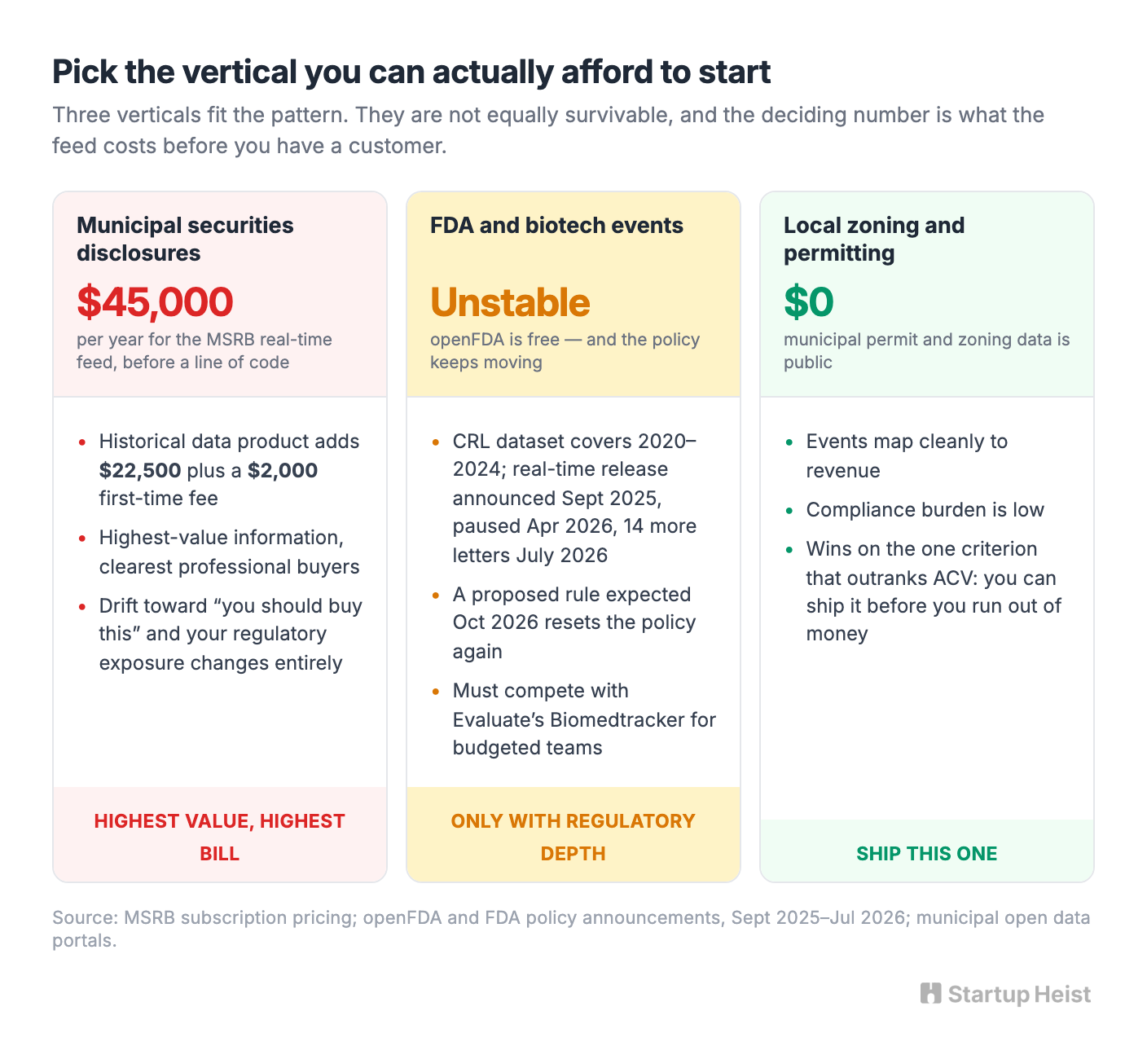
FDA and biotech events look seductive because a single event can be worth millions, and the data supply is unreliable in a way that should give you pause. The openFDA Complete Response Letter dataset covers 2020–2024. FDA announced real-time CRL release in September 2025, paused the program in April 2026 after a citizen petition, then posted fourteen more letters in July 2026, with a proposed rule expected in October 2026 to reset the policy again. Your core feed is a live political question. On top of that, a real biotech product has to fuse FDA decisions, label changes, trial updates, PDUFA dates, SEC filings, and financings, then compete with Evaluate's Biomedtracker for teams that already have budget. A founder with regulatory depth should absolutely take this. Everyone else should learn the workflow problem somewhere less expensive.
Local zoning and permitting wins on one criterion that matters more than ACV: you can ship it before you run out of money. Municipal permit and zoning data is public, the events map cleanly to revenue, and the compliance burden is low.
That's the wedge, and it's more interesting than it looks, because the obvious version of it is already dead.
The data feed is not the moat
Municipal data is embarrassingly abundant.
Chicago's building permit dataset holds about 845,000 records going back to 2006, queryable free through a public API. Philadelphia's permit data runs past 930,000 records with parcel identifiers, scope of work, owner, contractor, and use category, plus an Atlas product exposing ownership, zoning, violations, and appeals.
The aggregators are further along than most founders assume. Shovels has 185 million permits across 2,750-plus jurisdictions with contractor profiles and derived quality metrics, sold through sales rather than self-serve, with a publicly cited entry point around $600 a month. PermitStack publishes 67 million permits with webhooks that fire within about 60 seconds, at $29 to $499 monthly and contractor plans priced per ZIP. Zoneomics claims more than 23,000 digitized cities and 100 million parcels. Reonomy sells ownership intelligence on 53 million commercial properties at $400 per user per month.
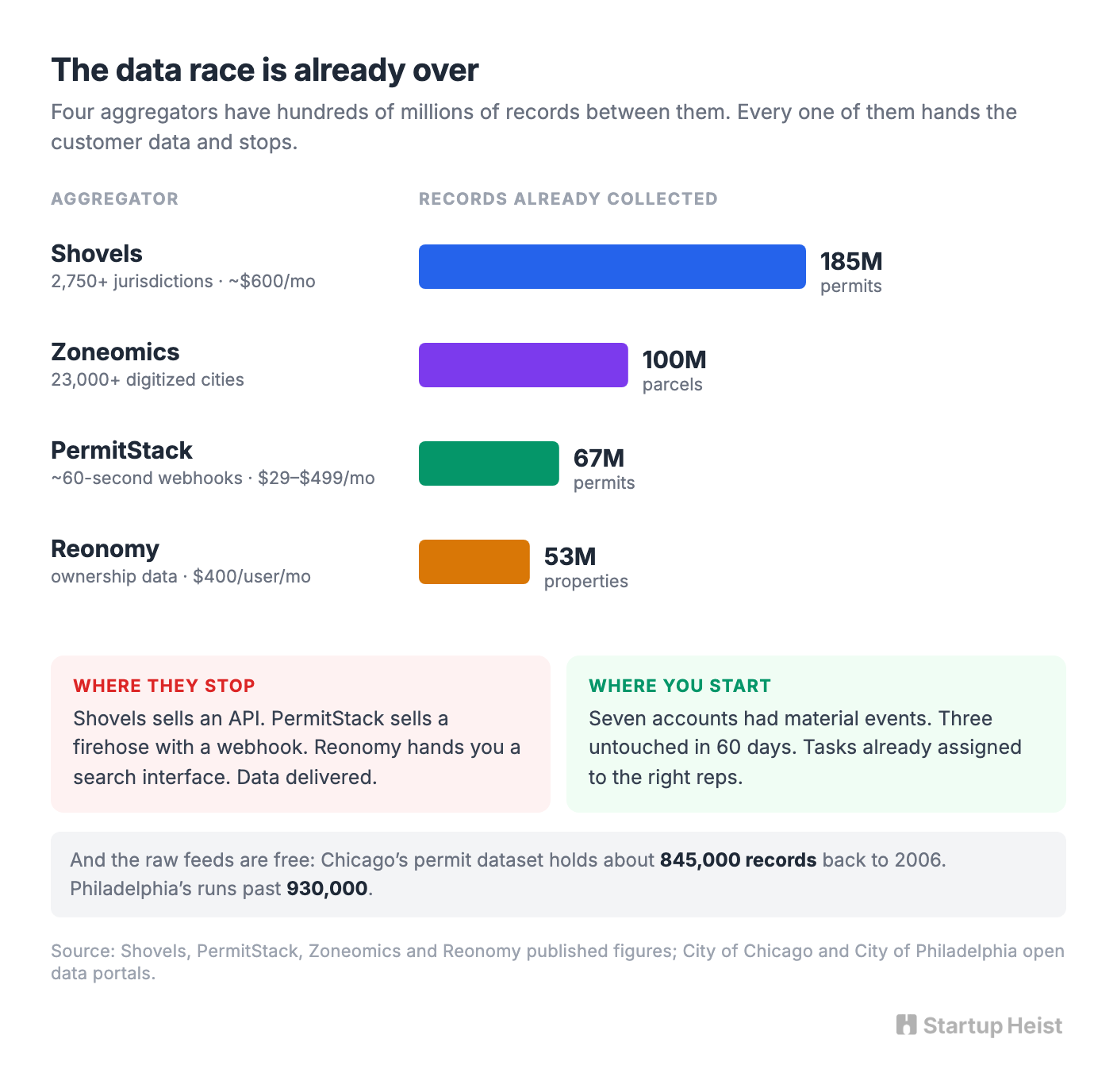
So don't build another permit database. That race is over and you're not in it.
Read those companies again and notice what none of them sell. Shovels sells an API and openly says it isn't built for contractors, which means there's no "email me this week's list" workflow. PermitStack sells a firehose with a webhook on it. Reonomy hands you a search interface. Every one of them gives the customer data and walks away at exactly the moment the work begins.
A generic permit product says: here are 2,817 permits this week.
Your product says: seven accounts in your CRM had material events this week, three haven't been contacted in 60 days, two involve projects above your team's size threshold, and tasks are already assigned to the right reps.
The first is a data subscription. The second is pipeline. They aren't close in value, and the gap between them is entirely execution.
The MVP has eight parts
Keep this painfully narrow. One vertical, one event family, one metro, one CRM, one Slack. As in: zoning and major construction events in Philadelphia for boutique CRE brokerages using HubSpot. Anything broader buys you a bigger TAM slide and a support nightmare to go with it.
Unlock the Vault.
Join founders who spot opportunities ahead of the crowd. Actionable insights. Zero fluff.
“Intelligent, bold, minus the pretense.”
“Like discovering the cheat codes of the startup world.”
“SH is off-Broadway for founders — weird, sharp, and ahead of the curve.”


