


Build the Cloud Architecture Puzzle Gym
A GitHub project called Server Survival has collected more than 6,000 stars. It's a browser tower-defense game where you play a cloud architect. Traffic arrives, you place load balancers, queues, compute fleets and databases, and you watch the system hold or buckle. Twenty-six services across five categories, auto-scaling with cold starts, circuit breaking, multi-region failover, power budgets measured in kilowatts. It's MIT-licensed, free, and needs no build step.
Nobody is charging a dollar for it, and that's the opening. The appetite for turning cloud architecture into a solvable puzzle is proven. The business around that appetite doesn't exist yet.
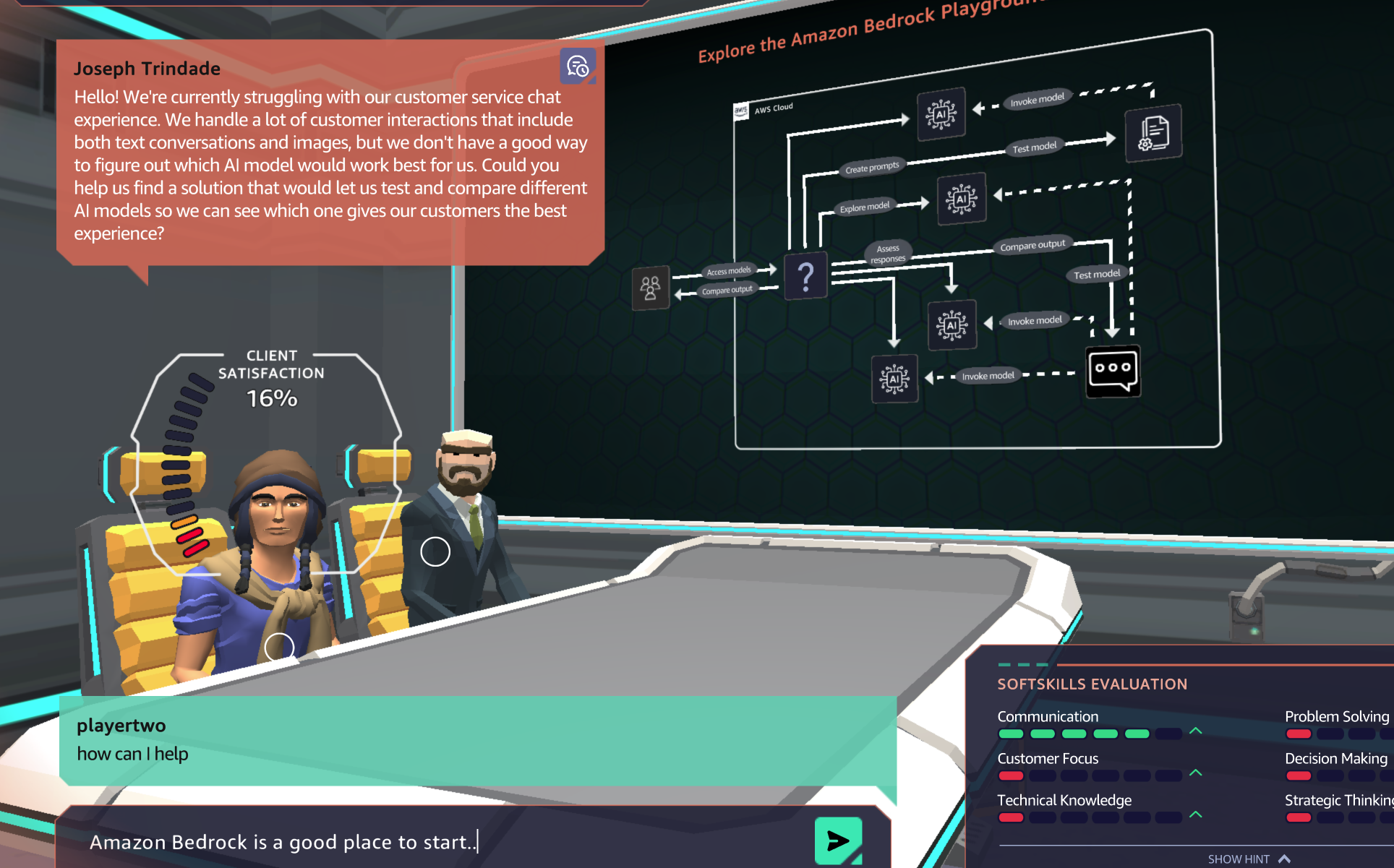
Understand what's already occupied. On August 11, 2026, AWS relaunched Cloud Quest, its role-based 3D learning game, adding AI-powered customer conversations, hands-on builds in live AWS environments, global tournaments, and a path to official AWS badges. More than a million learners have trained in it. AWS Skill Builder gives away 900-plus digital courses and charges $29 a month or $449 a year for a tier that includes 200-plus guided Builder Labs. Pluralsight launched Cloud Ready on May 7, 2026, bundling assessments, certification prep, instructor-led training, labs, and sandboxes into an enterprise program sold on cloud ROI and workforce readiness.
So the obvious framings are dead on arrival. "Duolingo for AWS" walks straight into Skill Builder. "Zachtronics for cloud certifications" walks straight into Cloud Quest.
What's open is narrower and better:
A browser-based architecture gym where cloud engineers repeatedly diagnose, repair, and redesign systems under real constraints — cost, reliability, security, throughput, latency, and operational complexity.
Closer to a flight simulator than a course. Here's the opportunity on one screen:
The money: 2,000 buyers a year at $49 is $98,000; instructor cohort licenses at $299 and $1,500 team pilots push an owner-operated business past $250,000.
Inside:
• The SOA-C03 scope trap that reshapes the wedge
• Full MVP scope and deterministic scoring rules
• Pricing ladder from free puzzle to $1,500 pilot
• Instructor outreach email that gets replies
The scarcity is reps, not information
A cloud engineer preparing for an AWS certification can watch free AWS videos, take a Pluralsight course, buy 330 practice questions from Tutorials Dojo for $14.99, read the documentation, ask an AI assistant, spin up a lab, and burn a hundred hours on YouTube. Nobody is going to out-publish that stack.
None of it forces the reasoning.
Traditional prep asks which AWS service you should use. The gym hands you a situation instead. Your checkout system is missing its latency target. The queue is growing. The monthly bill jumped 38%. Security flagged a publicly reachable component. Fix the architecture and stay under $3,000 a month.
The learner gets a diagram. They move components, swap services, add queues, change retry behavior, tighten permissions, adjust scaling. Then they hit Run and the simulator answers:
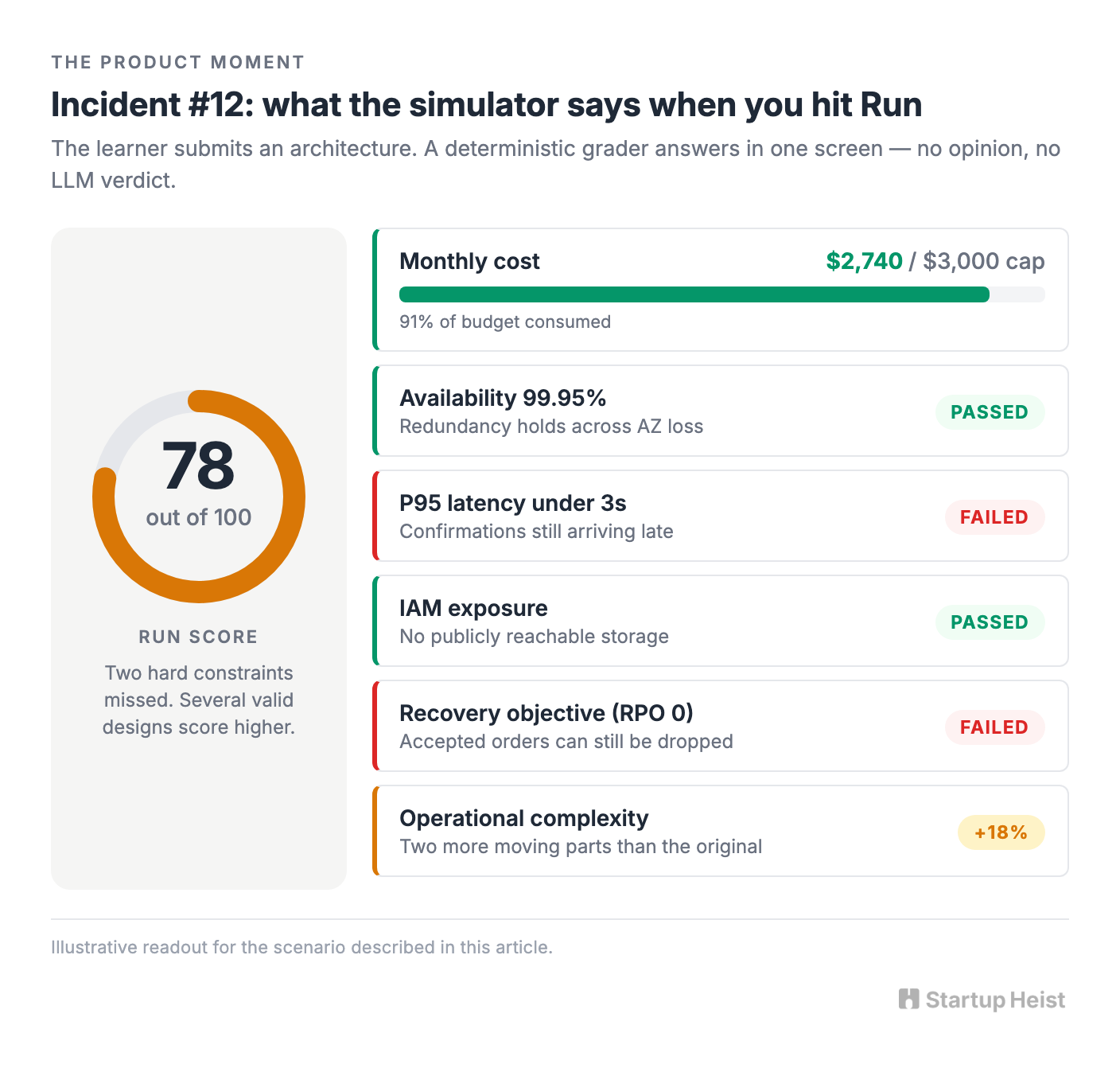
- Monthly cost: $2,740
- P95 latency: failed
- Recovery objective: failed
- IAM exposure: passed
Score: 78 out of 100. Then it tells them why.
AWS itself frames architecture as a set of tradeoffs across six pillars: operational excellence, security, reliability, performance efficiency, cost optimization, and sustainability. Different workloads legitimately weight them differently, which is a scoring system waiting to be written.
The trap hiding inside the obvious wedge
Every version of this idea starts in the same place, and the reasoning is sound. Pick one painfully specific buyer instead of "cloud engineers." The candidate is AWS Certified CloudOps Engineer – Associate, the certification that replaced SysOps Administrator when SOA-C03 went live on September 30, 2025. It costs $150, targets someone with roughly a year of AWS operations experience, and covers monitoring and remediation, reliability, deployment automation, security, and networking. CloudOps content turns into incidents naturally. A queue fills faster than workers drain it. A deploy raises the error rate. An Auto Scaling policy misfires. Logs exist but the alarm doesn't.
Now read the actual exam guide, because this is where founders lose six months.
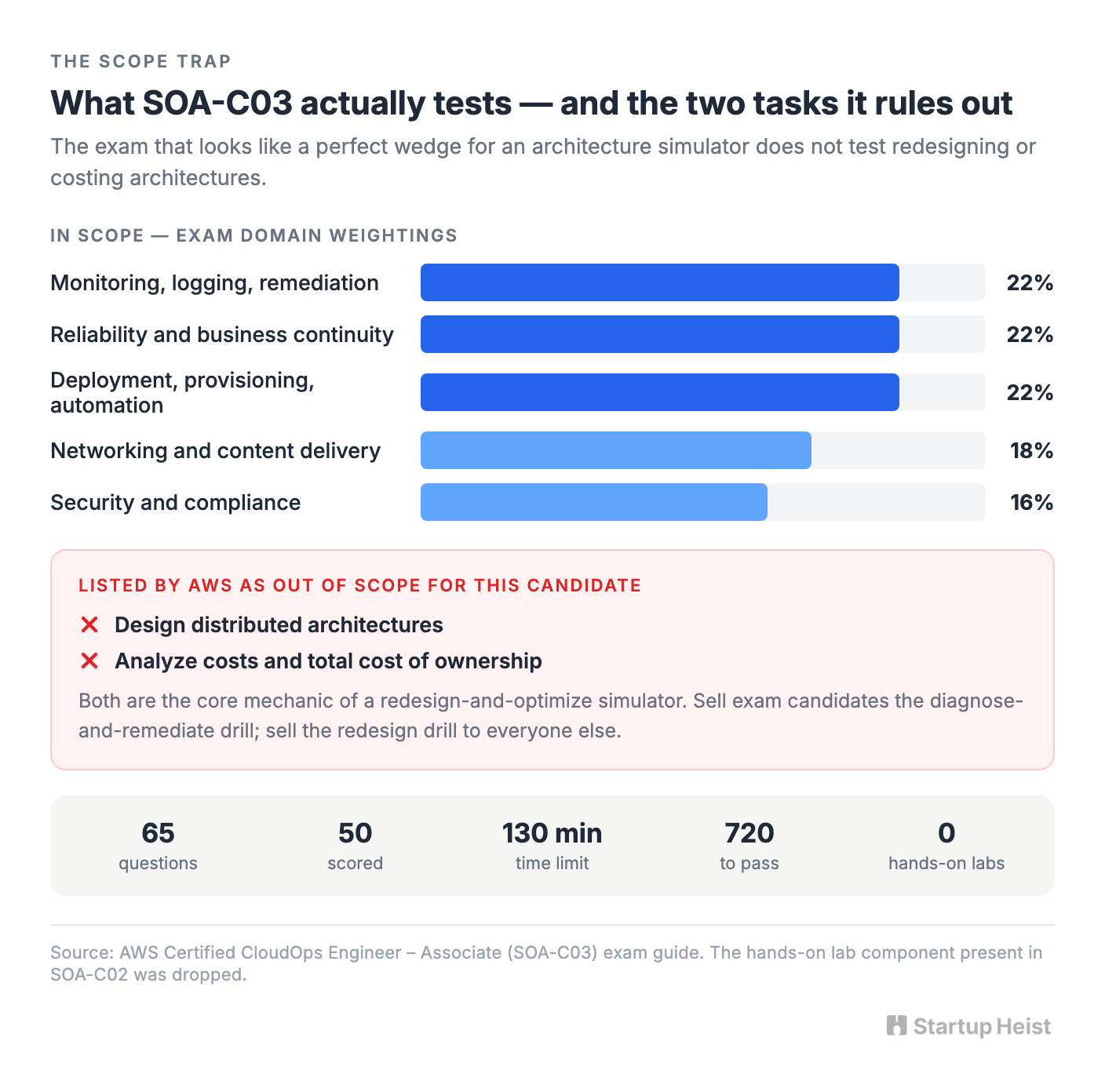
AWS lists "design distributed architectures" and "analyze costs and total cost of ownership" as job tasks explicitly out of scope for the SOA-C03 candidate. The exam also dropped the hands-on lab component that SOA-C02 had. It's 65 questions, 50 of them scored, multiple choice and multiple response, 130 minutes, 720 to pass.
The certification you were about to build a redesign-and-optimize simulator for doesn't test redesigning or costing architectures, and it no longer tests hands-on work at all. That doesn't kill the wedge, it reshapes it, and the reshaping is the difference between a product that converts and one that collects polite feedback.
Split the pitch. The CloudOps pack sells diagnosis and remediation, squarely in scope: "identify, classify, and remediate incidents" is a listed exam task. The scenario reads: something is broken, find it, fix it, don't break anything else. The redesign-and-optimize mechanic, the one with budgets and tradeoff scoring, belongs to Solutions Architect candidates, interview prep, and on-the-job practice. Same engine, two promises.
Sell exam candidates the drill that maps to their exam, and sell everybody else the drill that maps to their job.
What one challenge feels like
Open the product and you see this.
INCIDENT #12: The Friday Traffic Spike
An ecommerce company runs an event-driven order-processing application. Traffic tripled. Customers are getting confirmations 18 seconds late. The backlog is growing. Infrastructure costs $2,420 a month.
Your constraints:
- P95 processing latency under 3 seconds, availability of 99.95%
- Maximum monthly cost of $3,000
- Zero data loss on accepted orders, no publicly accessible storage
- Minimize deployment complexity
The architecture appears on a canvas. You inspect nodes, remove them, add approved services, change capacity, alter queue behavior, adjust autoscaling, tighten permissions. Then you submit.
A deterministic rules engine evaluates the graph. It never asks whether you recreated the official diagram; it asks whether your system satisfies the invariants. There should be several valid answers. One design costs less and adds operational complexity. Another hits latency and costs $250 more. A third clears every performance target while quietly leaving a bucket exposed.
That third design is where the learning happens. The learner walks away knowing what they traded off without noticing, which is the one lesson no diagram teaches.
The MVP is smaller than it looks
You don't simulate AWS. Trying to kills the company by month two.
Unlock the Vault.
Join founders who spot opportunities ahead of the crowd. Actionable insights. Zero fluff.
“Intelligent, bold, minus the pretense.”
“Like discovering the cheat codes of the startup world.”
“SH is off-Broadway for founders — weird, sharp, and ahead of the curve.”


